
Deep Learning · Continual Learning / DEEP LEARNING II
What a Continual Learner Remembers: Replay, Constraints, and the Accounting of Forgetting
A memory budget is an information policy: retention, task identity, and evaluation order decide what a lifelong learner can claim.
English original. Translations of this new review are not yet available.
Abstract
Continual learning is often summarized as preventing catastrophic forgetting, but the phrase hides different information contracts. This technical review separates parameter regularization, function preservation, and replay under explicit supervision, task-identity, storage, and update budgets. Six primary studies motivate an analytical treatment of conflicting tasks, rare-event coverage, and protocol design. Two independently reproducible constructions show how a quadratic stability–plasticity trade-off and finite-memory omission probabilities arise. These constructions are diagnostics rather than trained-network benchmarks. The resulting evaluation framework reports retained competence and new-task acquisition together, counts every retained artifact, and distinguishes a learner that recognizes the current task from one that must infer it.
In this paper
- 1. Define the information contract before the algorithm
- 2. Remembering weights and remembering behavior differ
- 3. A scalar construction isolates unavoidable conflict
- 4. The trade-off can disappear when the problem changes
- 5. Online importance summaries have a temporal meaning
- 6. Distillation needs a domain on which to agree
- 7. Replay changes the retained evidence, not only the loss
- 8. Rare-event coverage is a finite sampling question
- 9. Gradient constraints protect the examples they inspect
- 10. Historical logits are another stored artifact
- 11. Replay weighting and regularization can coincide locally
- 12. Evaluation needs a matrix, not only a final score
- 13. Resources include time, privacy, and deletion
- 14. An informative comparison controls the information supply
- 15. Independent checks establish the scope of the figures
- 16. Retention is a decision about future usefulness
1. Define the information contract before the algorithm
Consider a supervised learner receiving labeled observations in temporal order. It may retain a bounded state and must predict on both recent and previously encountered distributions. The word continual does not specify whether observations can be revisited, whether task boundaries are announced, or whether a test example arrives with a task identifier. Those choices change the problem before any optimizer is selected. A method that chooses among separate heads using a supplied task identifier receives information unavailable to a single-head classifier facing all accumulated classes. A fair report states which signals exist during training and inference, how often each observation is processed, and whether evaluation labels influence subsequent updates. GEM explicitly formulates learning over a continuum and evaluates transfer as well as accuracy. Its framing motivates our central bookkeeping rule: every resource that carries knowledge forward belongs to the learner. That includes parameters, examples, logits, class prototypes, normalization statistics, task descriptors, and the policy that decides when to replace them. Calling only the example buffer memory can conceal a substantial retained state.
Sources: [5]
2. Remembering weights and remembering behavior differ
Parameter protection addresses one route to forgetting: updates useful for the new task may move coordinates needed for previous behavior. Kirkpatrick and colleagues protect parameters judged important to previous tasks. This mechanism does not identify a unique definition of importance for every architecture or data stream. Our analysis distinguishes three objects: a coordinate displacement, the resulting change in predictions, and the resulting change in population loss. They coincide only under special assumptions. A small displacement in a sensitive direction may matter more than a large displacement in a redundant direction. Reparameterization can change coordinate magnitudes without changing the represented function. Conversely, protecting many coordinates may unnecessarily restrict an alternative implementation of the same useful behavior. Therefore an importance penalty should be assessed by the competence it preserves, with its estimation data and update rules recorded. The appropriate claim is conditional: a particular summary discouraged particular changes under the tested distribution. The stronger claim that the system stored the old task intact needs direct behavioral evidence.
Sources: [1]
3. A scalar construction isolates unavoidable conflict
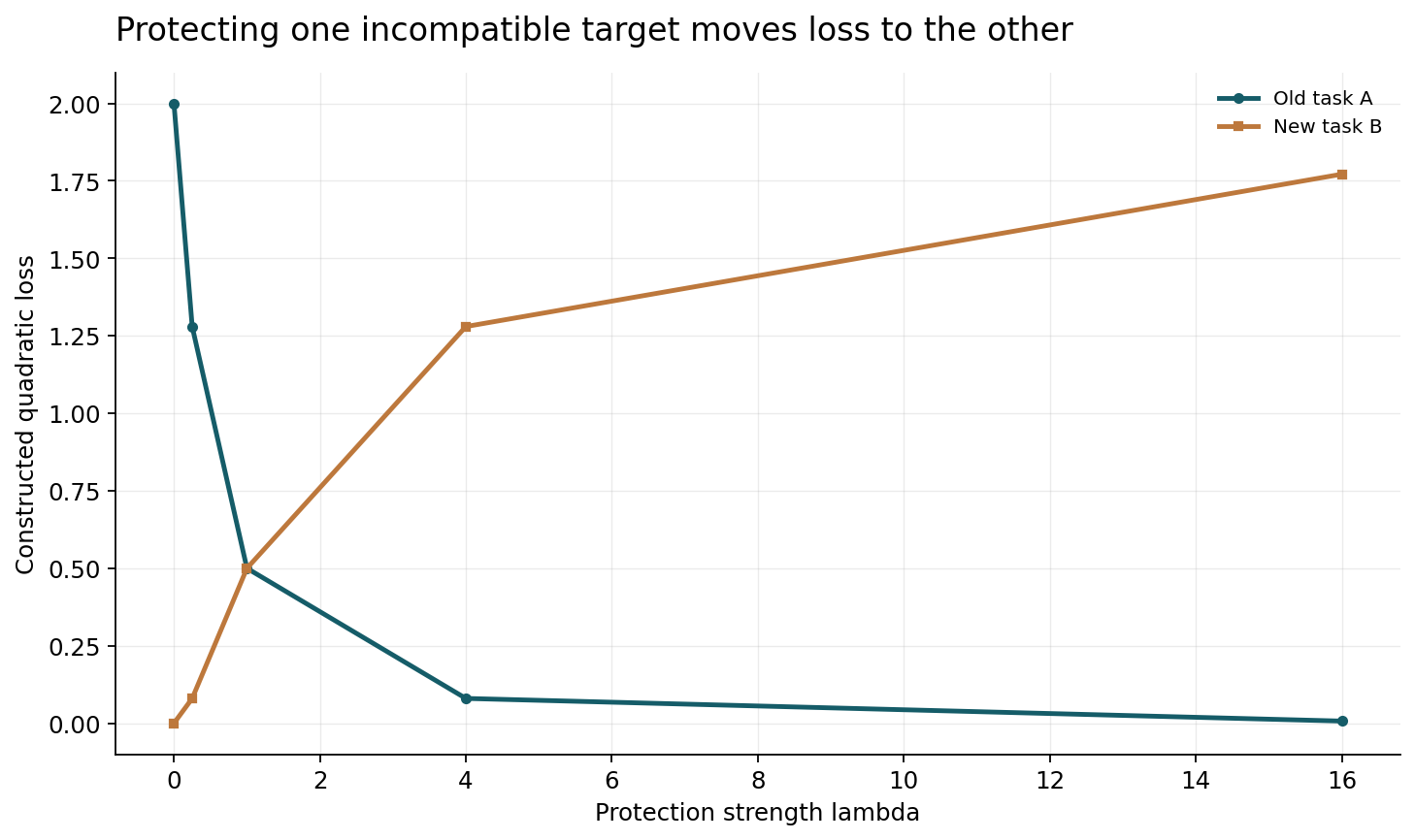
Let one unconditioned real-valued parameter w serve two tasks. Define the old-task loss as one half of (w minus one) squared and the new-task loss as one half of (w plus one) squared. These losses have incompatible unique minimizers. Add a penalty of strength lambda around the old optimum and minimize the combined objective exactly. Its derivative is (w plus one) plus lambda times (w minus one), so the stationary point is (lambda minus one) divided by (lambda plus one). The positive second derivative proves this is the unique minimizer for every nonnegative finite lambda. Stronger protection moves the solution toward the old task and away from the new one. At lambda zero the old loss is two and the new loss is zero; at lambda one both losses are one half. This is an author-constructed quadratic example, not a simulation of EWC or a neural-network benchmark. It establishes a narrower impossibility: incompatible targets cannot both be attained by this same unconditioned scalar output.
4. The trade-off can disappear when the problem changes
The preceding conflict is not an impossibility theorem for continual learning as a field. Give the predictor a valid task bit and let it return plus one for the old task and minus one for the new task. Both losses become zero because the function class and its information have changed. Give an expressive predictor different inputs for the two tasks and a common parameter vector may also represent both solutions. Alternatively, demand both outputs for exactly the same observable input without a task signal, and representation capacity alone cannot resolve the contradiction. This distinction matters when interpreting a dramatic improvement obtained by adding heads, routers, context prompts, or externally supplied task labels. Those changes may be entirely useful; they must be counted as changes to the inference contract. A credible analysis asks whether residual forgetting reflects optimization, insufficient retained evidence, limited capacity, or contradictory supervision. A single average-accuracy number cannot identify which mechanism was improved, even when that number itself is measured correctly.
5. Online importance summaries have a temporal meaning
Synaptic Intelligence accumulates task-relevant information during learning and subsequently uses it to resist destructive changes. Its existence highlights that a memory summary can depend on the learning trajectory, rather than only on the final parameter value. Two runs ending near the same predictor can nevertheless assign different importance to coordinates if their paths, gradients, or data orders differ. This observation suggests a practical test rather than an objection: vary the task order and optimization path while holding the information budget fixed, then inspect retention and acquisition separately. Record when a summary is consolidated, whether it decays, and how summaries from multiple tasks are combined. Repeatedly strengthening protection can gradually consume plasticity even when no explicit example buffer grows. On the other hand, aggressively discarding importance can reopen forgotten directions. Neither behavior is diagnosed by counting stored examples alone. The temporal policy should therefore be versioned with the model, including its reset semantics and the points at which future learning is allowed to override past evidence.
Sources: [2]
6. Distillation needs a domain on which to agree
Learning without Forgetting uses new-task inputs to preserve previous capabilities when the old training set is unavailable. The key analytical question is where the preservation condition is evaluated. Suppose two classifiers agree on every new-task input but differ on a region visited only by the old task. A penalty evaluated exclusively on new inputs cannot distinguish them. This is a support limitation, not a claim that the cited method always fails. Relatedness between old and new input distributions, inductive bias, and the chosen architecture may make preservation useful in practice. A report should therefore expose overlap assumptions and evaluate on held-out old inputs. Stored teacher outputs also encode a historical model's mistakes and confidence scale. Preserving them may stabilize useful boundaries or retain a biased boundary that should change. The objective must say which historical behavior deserves preservation and what evidence authorizes revision. Without that policy, consistency with the past is easy to mistake for continuing correctness.
Sources: [3]
7. Replay changes the retained evidence, not only the loss
Rehearsal restores selected old observations to the update process. It gives the learner direct anchors that parameter summaries and agreement on new inputs may lack. iCaRL studies class-incremental learning while updating both representations and classifiers, illustrating why exemplar storage and changing representations must be considered together. A retained item can mean raw data, a compressed input, a feature vector, or a prototype; these are different information budgets. A feature stored under an old encoder may become stale when the encoder changes. Recomputing it requires access to the original input, while freezing the encoder imposes a different adaptation limit. Selection also matters: a balanced per-class store presupposes labels and a mechanism for allocating class capacity; a stream-uniform sample represents frequency rather than equal class importance. Our recommendation is to publish both a byte budget and a semantic inventory. Saying that two systems store one thousand memories is inadequate if one stores tiny vectors and another stores full-resolution inputs with labels and historical logits.
Sources: [4]
8. Rare-event coverage is a finite sampling question
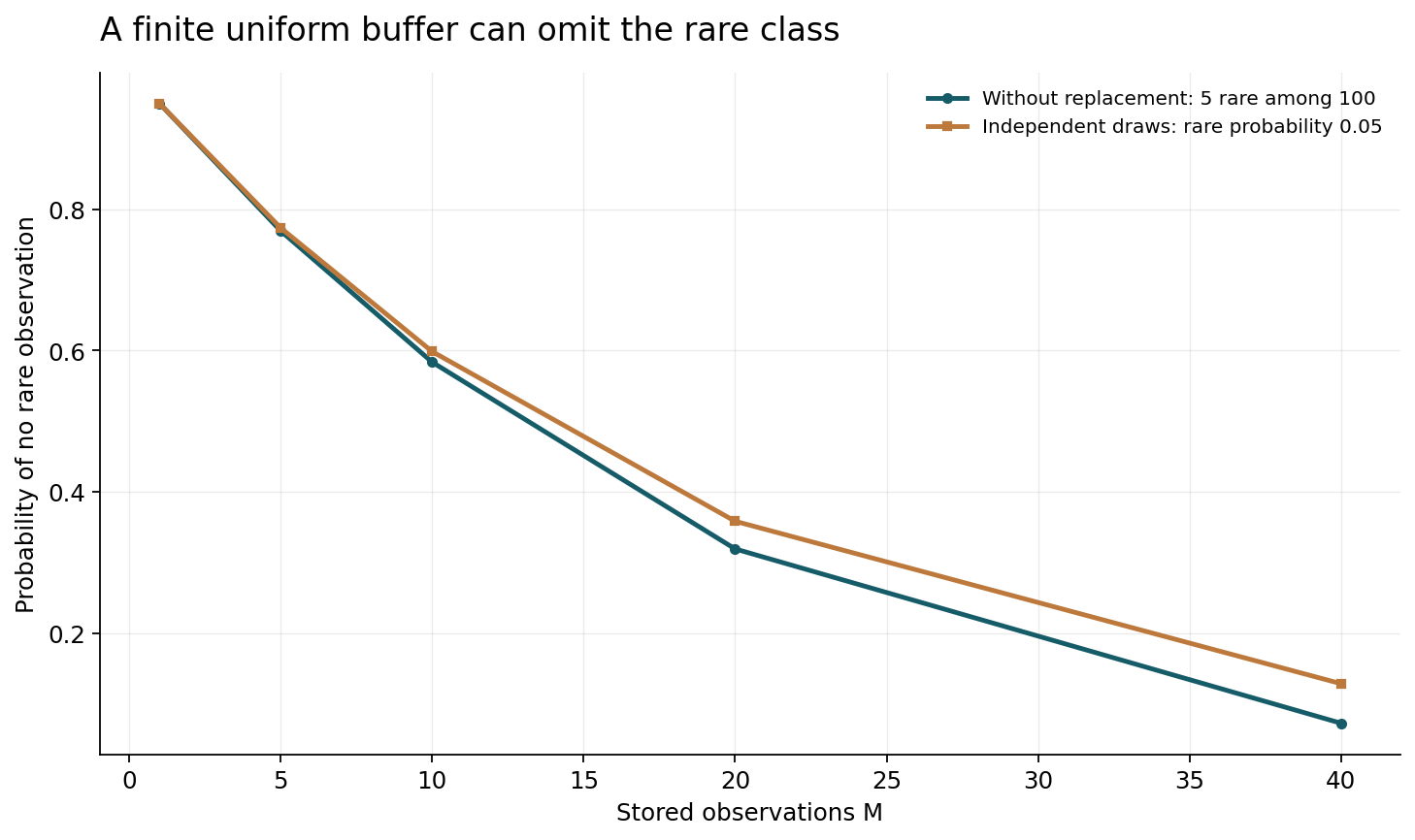
Construct a population of one hundred labeled observations containing exactly five rare-class members. Choose M distinct observations uniformly without replacement. The probability of storing no rare member is the ratio of the binomial coefficient choosing M from ninety-five to the coefficient choosing M from one hundred, with zero probability once the requested sample exceeds the nonrare population. At M equal to ten, the miss probability is approximately 0.58375; at forty it is approximately 0.07254. These are exact finite-population calculations evaluated numerically, not measurements from a continual-learning dataset. Sampling independently with replacement would instead give 0.95 to the power M and is a different model. Increasing a uniform buffer reduces this particular omission risk but does not ensure that its retained examples span every relevant subgroup or decision boundary. A class-aware selection policy can guarantee at least one rare exemplar only if the rare class has been recognized and sufficient capacity is allocated. That guarantee purchases information and policy, not free representativeness.
9. Gradient constraints protect the examples they inspect
GEM uses episodic memory to constrain updates and assesses cross-task transfer. In a local smooth approximation with a Lipschitz-continuous loss gradient, if the update is minus eta times a candidate vector v, an old memory loss changes first order by minus eta times its gradient dotted with v. Requiring the dot product to be nonnegative prevents a positive first-order change for that inspected loss. Finite step sizes add higher-order terms, and a memory loss is still an estimate rather than the full old population. Consequently the useful diagnostic is not whether a projection was performed, but whether its local constraints correspond to retained competence at the chosen update scale. Inspect constraint violations after the actual step, compare memory and held-out losses, and account for the work required to compute and resolve constraints. A strict policy may block new learning in conflicting directions. A relaxed policy may allow controlled forgetting. Both can be rational decisions if their trade-offs are measured and the allowable degradation is explicit.
Sources: [5]
10. Historical logits are another stored artifact
Dark Experience Replay combines rehearsal with matching logits recorded along the optimization trajectory and addresses settings with blurred task boundaries. Historical outputs provide information different from labels alone: they preserve relationships expressed by an earlier model on stored inputs. The storage and meaning of those outputs therefore deserve separate accounting. If a classifier expands its output space, an older logit vector may lack coordinates for new classes. If calibration or temperature changes, matching raw numbers is not identical to preserving decision probabilities. An implementation needs a rule for alignment, masking, precision, and the point in training at which the target was captured. Our analysis does not reproduce the paper's benchmark comparisons. It uses the mechanism to expose an evaluation obligation: compare the benefit of each retained artifact against a baseline given the same total bytes and update budget. Otherwise a method can appear more memory-efficient simply because auxiliary targets, model copies, or metadata were left outside the accounting boundary.
Sources: [6]
11. Replay weighting and regularization can coincide locally
The scalar construction offers a useful equivalence with a sharply limited domain. Mix the old quadratic loss with weight r and the new quadratic loss with weight one minus r. Exact minimization gives w equal to two r minus one. For r strictly below one, divide the objective by one minus r: it becomes the new loss plus lambda times the old loss with lambda equal to r divided by one minus r. Thus weighted replay and a quadratic penalty around the old optimum produce the same solution in this particular setting. This does not imply that replay and parameter regularization are interchangeable in neural networks. The equality relies on exact quadratic losses, a shared scalar, a fixed old optimum, and exact minimization. Real examples can constrain predictions far from the local parameter neighborhood summarized by a quadratic. The narrow equivalence is still useful because it prevents method names from obscuring a shared mechanism and makes the assumptions required for a stronger equivalence visible.
12. Evaluation needs a matrix, not only a final score
Let A indexed by i and j denote accuracy on held-out task j after learning through stage i. A final average summarizes one row, while the full matrix exposes acquisition speed, retention, and beneficial or harmful backward transfer. A learner can improve its final average by excelling at new tasks while abandoning a small but important earlier one. Another can preserve every old task by barely learning the new material. Report both trajectories, task-weighted and sample-weighted summaries, and the denominators defining each. When task boundaries are absent, use declared time windows or independently annotated evaluation slices rather than inventing boundaries from the learner's performance. Evaluation itself must not leak answers: if held-out labels tune replay weights or stopping rules, they are validation data and require a separate final test. Repeated task orders, buffer seeds, and training seeds should be varied independently enough to reveal sensitivity. A fixed favorable ordering is a valid case study, but it is not evidence of order robustness.
13. Resources include time, privacy, and deletion
A practical continual learner consumes more than parameter memory. Count optimizer state, importance summaries, teacher copies, example storage, labels, logits, class metadata, and checkpoint history. Report incoming-observation passes, replay passes, update latency, and the time between observing a distribution change and evaluating its consequences. Equal nominal buffer size does not guarantee equal compute. Retained inputs can also carry usage restrictions; deleting an example from a replay buffer does not by itself establish that its influence disappeared from weights or auxiliary targets. A system requiring deletion should define what its policy promises and what evidence supports the promise. This article does not supply a machine-unlearning method. It points out that a storage policy and a learned-information policy are distinct. Operationally, records should identify when an artifact entered the learner, which transformations produced derivatives, and which checkpoints incorporated it. Such provenance enables a meaningful response when retention requirements change, instead of treating every memory object as interchangeable.
14. An informative comparison controls the information supply
A proposed experiment should begin with a small set of clearly specified regimes: task identity available or unavailable, fixed or growing label space, announced or unannounced boundaries, and bounded replay permitted or forbidden. Within each regime, compare straightforward sequential training, a jointly trained reference where allowed, simple replay, and the proposed preservation mechanism. The joint reference consumes information unavailable to some methods, so it is an informative reference rather than an equal-budget competitor. Sweep replay bytes and update counts, not just one preferred setting. Include conflicting tasks, related tasks with potential transfer, recurring distributions, and rare classes whose frequency changes. These choices separate representational incompatibility from avoidable optimization damage. Keep the test distribution fixed long enough to make forgetting interpretable, and separately report deliberate changes to the target task. All of these are prospective evaluation recommendations. No new training run, accuracy table, or hardware timing is claimed here; the only computed results are the transparent finite constructions supplied with the article.
15. Independent checks establish the scope of the figures
The first figure evaluates the closed-form minimizer for five nonnegative protection strengths and computes both quadratic losses. The accompanying checker verifies stationarity and the special replay-weight equivalence within numerical tolerance. The second figure computes rare-class omission probabilities using exact integer binomial coefficients before floating-point conversion, and contrasts the without-replacement model with its explicitly labeled independent-draw alternative. These scripts require only the standard library and do not train a network or download data. Boundary cases matter: an empty buffer always misses the rare class, a complete population sample cannot miss it, and stronger protection approaches but does not equal the old optimum at finite strength. The checks make those statements reproducible. They do not certify the cited implementations, assess perceptual quality, or estimate uncertainty for trained models. Keeping a modest proof attached to a modest claim is more useful than presenting exact toy arithmetic with the visual authority of an empirical benchmark.
16. Retention is a decision about future usefulness
A useful memory policy balances what the system can retain, what future evaluation values, and what new evidence is allowed to change. Preserving every historical prediction is not automatically desirable when labels are corrected or the task itself changes. Forgetting can be an unwanted optimization failure, an unavoidable response to incompatible requirements, or an intentional policy action; these cases need different remedies. The six studies reviewed here supply distinct mechanisms for retaining information, but their results should not be collapsed into a universal ranking. Our synthesis instead asks three inspectable questions of a continual learner: what evidence survives, what knowledge that evidence constrains, and under which inference signals competence is measured. A strong experimental answer couples a precise protocol with taskwise outcomes and complete resource accounting. A strong deployed answer adds provenance and reset semantics. In both cases, the system should make clear whether it remembers a dataset, a function, a parameter neighborhood, or a selected set of past decisions.
Core equations and definitions
(1) Author-constructed incompatible scalar tasks; each loss is nonnegative.
(2) Exact derivative and positive curvature establish the unique minimizer.
(3) The regularization/replay equivalence holds only for these quadratics and 0≤r<1.
(4) Uniform selection of M distinct population members, not independent draws.
(5) Assumes a locally L-Lipschitz loss gradient along the step: the remainder magnitude is at most L eta² ||v||² / 2. Applies to the inspected old loss, not a population guarantee.
Constructed analytical figures
Comparison and reporting contract
| Retained object | What it constrains | What to count |
|---|---|---|
| Parameter importance | A local parameter neighborhood | Summary tensors, consolidation and decay |
| Teacher function | Predictions on preservation inputs | Teacher copies, inputs, temperature and output mapping |
| Replay examples | Behavior on selected previous observations | Bytes, labels, selection state and replay passes |
| Historical logits | Earlier output relations on selected inputs | Logit arrays, capture time, class-coordinate metadata |
Evaluation protocol
- Declare task identifiers, boundary signals, class growth, supervision and allowed passes before comparison.
- Evaluate taskwise trajectories under several independent orders and buffer seeds.
- Compare bytes and update counts across parameter summaries, teachers, buffers and auxiliary targets.
- Publish raw task-by-stage scores and label the joint-training reference's extra information.
- Run the finite scripts separately from any trained-model evaluation and publish failures as well as successful checks.
Limitations
- Focused six-source technical synthesis, not a systematic survey or independent neural benchmark.
- Quadratic incompatibility and finite-population coverage are constructed diagnostics with stated assumptions.
- No assertion that toy replay and regularization are equivalent outside the exact scalar setting.
- Retention governance and deletion accounting are requirements, not a supplied unlearning guarantee.
Open research questions
- Which retained artifacts most efficiently preserve rare-class competence under a fixed byte and update budget?
- How does uncertainty in task identity change the observed stability–plasticity trade-off?
- Can preservation policies distinguish corrected historical errors from destructive forgetting using independently supplied evidence?
Evidence and its boundaries
- Protects important parameters to reduce forgetting in the evaluated task sequences.
- [1] — Not a proof that incompatible tasks can share one unconditioned output without a trade-off. Inspected: Primary abstract and bibliographic record inspected on 2026-10-28.
- Accumulates task-relevant synaptic information during learning and uses it to protect acquired behavior.
- [2] — Does not make a finite importance summary equivalent to storing all past data. Inspected: Primary abstract and bibliographic record inspected on 2026-10-28.
- Uses new-task inputs to preserve previous capabilities when original task training data are unavailable.
- [3] — Preserving old outputs on new inputs alone does not establish agreement on an arbitrary old distribution. Inspected: Primary abstract and bibliographic record inspected on 2026-10-28.
- Studies class-incremental representation and classifier learning using limited simultaneous class data.
- [4] — Published benchmark results are setting-specific and are not reproduced here. Inspected: Primary abstract and bibliographic record inspected on 2026-10-28.
- Uses episodic memory and measures transfer and forgetting across task sequences.
- [5] — First-order protection on memory examples is not a global population guarantee. Inspected: Primary abstract, framework and method sections inspected in the versioned full HTML on 2026-10-28.
- Combines rehearsal with matching logits collected along the optimization trajectory and analyzes general continual-learning settings.
- [6] — Its experimental comparisons do not establish universal superiority across deployment streams. Inspected: Primary abstract, general-setting requirements and method discussion inspected in full HTML on 2026-10-28.
References
- Overcoming catastrophic forgetting in neural networks
James Kirkpatrick, Razvan Pascanu, Neil Rabinowitz, Joel Veness, Guillaume Desjardins, Andrei A. Rusu, Kieran Milan, John Quan, Tiago Ramalho, Agnieszka Grabska-Barwinska, Demis Hassabis, Claudia Clopath, Dharshan Kumaran, Raia Hadsell. PNAS 2017 (2017). https://arxiv.org/abs/1612.00796v2Source scope
Primary abstract and bibliographic record inspected on 2026-10-28.
- Continual Learning Through Synaptic Intelligence
Friedemann Zenke, Ben Poole, Surya Ganguli. ICML 2017 (2017). https://arxiv.org/abs/1703.04200v3Source scope
Primary abstract and bibliographic record inspected on 2026-10-28.
- Learning without Forgetting
Zhizhong Li, Derek Hoiem. ECCV 2016; updated manuscript (2016). https://arxiv.org/abs/1606.09282v3Source scope
Primary abstract and bibliographic record inspected on 2026-10-28.
- iCaRL: Incremental Classifier and Representation Learning
Sylvestre-Alvise Rebuffi, Alexander Kolesnikov, Georg Sperl, Christoph H. Lampert. CVPR 2017 (2017). https://arxiv.org/abs/1611.07725v2Source scope
Primary abstract and bibliographic record inspected on 2026-10-28.
- Gradient Episodic Memory for Continual Learning
David Lopez-Paz, Marc'Aurelio Ranzato. NeurIPS 2017; manuscript v6 (2017). https://arxiv.org/abs/1706.08840v6Source scope
Primary abstract, framework and method sections inspected in the versioned full HTML on 2026-10-28.
- Dark Experience for General Continual Learning: a Strong, Simple Baseline
Pietro Buzzega, Matteo Boschini, Angelo Porrello, Davide Abati, Simone Calderara. NeurIPS 2020 (2020). https://arxiv.org/abs/2004.07211v2Source scope
Primary abstract, general-setting requirements and method discussion inspected in full HTML on 2026-10-28.