

Abstract: Why the Amount Captured Does Not Equal the Amount Removed
Direct air capture separates carbon dioxide from the dilute atmosphere, involving not only materials but also air handling, regeneration, and ultimate fate. This article places engineering process studies and porous framework materials studies at different levels of evidence, distinguishing adsorption capacity, cycle yield, and net removal. We derive the ideal dilute-separation work and establish a transparent accounting framework for energy carbon intensity to explain how excellent materials can connect to system outcomes, without treating materials experiments or costs from older designs as current commercial guarantees.[1] A Process for Capturing CO2 from the Atmosphere[2] Carbon dioxide capture from open air using covalent org
English abstract
Direct air capture links dilute-gas separation to sorbent kinetics, regeneration and durable storage. We connect process-scale and covalent-organic-framework studies, derive a limiting separation-work estimate and a transparent net-removal balance, and examine how capacity, working capacity and cycle productivity differ. No current commercial cost or removal claim is inferred.
Boundaries Established by Process Studies
Keith and colleagues describe a direct air capture process, discussing material and energy flows through a combination of pilot-unit data, process simulations, and engineering assumptions. Its importance lies in placing absorption and regeneration back within the complete process. This article does not use its 2018 cost range as a current quotation, nor does it equate design scale with a production scale already achieved continuously. Historical engineering studies can provide methods, but every numerical value has its own year and assumptions.[1] A Process for Capturing CO2 from the Atmosphere
Boundaries Established by Materials Studies
Zhou and colleagues investigate carbon dioxide capture from air using COF-999, providing evidence on material structure, adsorption, and cycling. The source page indicates that an author correction has been published; this article cites the update record and does not rely on a single promotional figure extracted in isolation. Good material performance under the original experimental conditions does not mean that fan, regeneration, manufacturing, and storage emissions have been accounted for across the complete installation; these require independent system-level evidence.[2] Carbon dioxide capture from open air using covalent org
Thermodynamic Constraints of Dilute Feeds
For a limiting thought experiment involving an ideal gas mixture, a near-zero recovery fraction, and a pure product, the minimum work required to separate a mole of the target component is approximately RT multiplied by the natural logarithm of the reciprocal of its feed mole fraction. This shows that dilution itself carries a cost, but does not directly give the energy consumption of an actual installation. Finite recovery, product purity, and process irreversibility change the result; this limit cannot be treated as an equipment guarantee or a design compliance threshold.作者分析与复核建议 / Author analysis
Unit Conversions Must Be Complete
Converting joules per mole into a value per tonne of carbon dioxide requires explicit specification of molar mass, the relationship between tonnes and kilograms, and the relationship between joules and kilowatt-hours. This article uses 298 K and an assumed 400 ppm to illustrate the ideal limit, without claiming that this is the current global mean concentration. Comparing heat and electricity also requires consideration of energy quality and temperature conditions; a unit of low-temperature heat cannot simply be treated as equivalent to a unit of electricity in terms of available work.作者分析与复核建议 / Author analysis
Equilibrium Capacity and Working Capacity
A material's saturation uptake at a particular temperature and concentration is not the amount it can release in a single cycle. Working capacity is the usable difference between the adsorption and regeneration states, and the extent to which equilibrium is actually reached must still be considered. Studies should retain complete adsorption and desorption paths, moisture conditions, and cycle times. Showing only the highest capacity may overlook difficult regeneration, slow kinetics, or a very low effective amount cycled.作者分析与复核建议 / Author analysis
Kinetics Determine Equipment Scale
A material with very high capacity but slow adsorption may require more material or a larger contactor to achieve the target throughput. Time response and cycle productivity should be reported together, rather than selecting the best capacity and rate values separately. Gas flow, mass transfer, and particle morphology also affect the transition from laboratory to installation. Minute-scale behavior in a small material sample cannot be extrapolated directly to an entire bed without validation.作者分析与复核建议 / Author analysis
Airflow and Fan Costs
Low target concentrations in air mean that large volumes of gas must be processed, and contactor pressure drop and mass-transfer efficiency affect fan energy consumption. Reducing pressure drop may sacrifice opportunities for contact, while increasing surface area may raise manufacturing and maintenance burdens. System comparisons need to retain the air-handling boundary and actual capture fraction, rather than calculating regeneration heat alone. This article does not design a specific installation; it only explains the constraints linking local adsorption performance and air-handling costs.作者分析与复核建议 / Author analysis
Moisture Can Help or Add Burden
Humidity can affect adsorption sites, kinetics, and competitive adsorption, while also causing more water to be carried through regeneration. The direction and magnitude of the response may differ among materials, so a single dry experiment cannot be extrapolated to all climates. Studies should compare working capacity, energy consumption, and degradation under representative temperature and humidity variations, and include water inputs and outputs in the balance rather than treating moisture effects as secondary background.作者分析与复核建议 / Author analysis
Regeneration Temperature Does Not Equal Total Regeneration Energy Consumption
A lower temperature may improve compatibility with heat sources, but total energy also involves the sensible heat of the material and water, heat of adsorption, heat recovery, and cycle efficiency. Two materials may have different total requirements even when regenerated at the same temperature. Discussions of low-grade heat use should specify available heat sources, their continuity, and alternative uses. Ranking materials by temperature alone cannot determine the energy efficiency of the complete process.作者分析与复核建议 / Author analysis
What Must Be Deducted to Calculate Net Removal
Using each tonne captured as the basis, this article multiplies electricity and heat requirements by their respective carbon intensities, then deducts other emissions such as manufacturing and transport. The resulting net value also requires the captured carbon to enter the specified durable-storage boundary. This accounting framework is merely a clear calculation structure, not a statement that a particular project has achieved negative emissions. Changes in energy sources can change the net outcome of the same equipment, so net removal must be tied to location, time, and system scope.作者分析与复核建议 / Author analysis
A Constructed Energy-Sensitivity Example
Assume that each tonne captured requires 0.5 MWh of electricity and 1 MWh of heat, that heat has a carbon intensity of 0.1 tonnes per MWh, and that other emissions are 0.05 tonnes; when electricity carbon intensity is 0.4 tonnes per MWh, the net value is 0.65 tonnes. The figure varies only electricity carbon intensity to illustrate linear sensitivity. All inputs are hypothetical, come from neither the cited installations nor the cited materials, and include no actual storage or leakage data; they cannot be used for project certification.作者分析与复核建议 / Author analysis
The Difference Between Utilization and Durable Storage
After capture, carbon dioxide can enter products or different forms of storage. If a product releases it again soon afterward, the amount captured does not automatically become an amount durably removed. Studies should define the observation period, rerelease, and counterfactual fate, rather than stopping the accounting at the capture-unit outlet. Storage chains involving losses or delays also require separate tracking of transport, processing, and final retention.作者分析与复核建议 / Author analysis
Cyclic Stability and Material Replacement
Good capacity retention over tens or hundreds of cycles still cannot directly establish a multiyear operating lifetime. Oxidation, impurities, mechanical wear, and climate cycles may operate on different timescales. All failures should be tracked from the initial material batch, recording working capacity, pressure changes, and regeneration energy consumption rather than following equilibrium capacity alone. Material replacement frequency also affects life-cycle emissions and resource requirements.作者分析与复核建议 / Author analysis
Heat and Mass Transfer During Scale-Up
Uniform temperature and gas contact in a small sample may become gradients in a larger bed. The cycle bottleneck may shift from molecular adsorption to heat transfer or flow distribution, potentially reversing material rankings. Reliable scale-up requires model validation at different scales while retaining boundary conditions. Simply multiplying a parameter from a single small sample by the loaded mass misses portions of the installation that cannot attain the same conditions simultaneously.作者分析与复核建议 / Author analysis
Energy Counterfactuals and Opportunity Costs
If a low-carbon energy source is used for capture, it might otherwise have displaced other emission sources in the absence of capture. Different system boundaries for the net effect lead to different conclusions. This article does not select a particular energy policy; it emphasizes that attribution should specify the counterfactual and avoid treating “using renewable electricity” as a zero-emissions premise requiring no accounting. Life-cycle studies should include these choices in sensitivity analyses rather than hide them in a single coefficient.作者分析与复核建议 / Author analysis
Useful Tasks for AI Materials Discovery
AI can help screen candidates for adsorption and stability, but if training labels include only capacity, a model may neglect working capacity, kinetics, and regeneration. More valuable tasks include multiobjective prediction, abstention, and uncertainty estimation, validated on independent material families and actual cycling conditions. Model outputs cannot replace adsorption measurements, much less extend to net-removal claims for a complete installation; different levels require different data and error models.作者分析与复核建议 / Author analysis
Connecting Analytical Limits to Actual Measurements
The minimum-work curve in this article tests the mathematical effect of dilution, while the net accounting framework tests the dimensions and sensitivity of energy and other emissions. Independent recalculation can verify these using chemical-potential differences and direct material enumeration, but cannot prove that any material reaches the limit. A genuine connection requires material and installation measurements to close balances within the same boundary, with predictions tested on cycles or scales not used for parameter calibration.作者分析与复核建议 / Author analysis
Falsifiable Targets and Research Packages
A system advantage should persist under the same capture, purity, storage-duration, and energy boundaries, rather than appearing only in the most favorable dry small-sample conditions. If higher capacity brings lower cycle yield or a greater water burden, the evaluation should be updated. Shareable research materials should include source versions, adsorption and desorption paths, cycle times, flow rates, energy and replacement assumptions, and a clear list of unmeasured items.作者分析与复核建议 / Author analysis
Conclusion: Completing the Evidence Chain for Materials Breakthroughs
Scientific progress in direct air capture requires joint support from material mechanisms, process design, and net carbon accounting. Treating an ideal limit as equipment performance, or adsorption uptake as durable removal, skips critical levels of evidence. Transparent operating conditions, cycles, and life-cycle boundaries allow the potential of excellent materials to be evaluated fairly, while turning shortcomings into testable research questions for the next step.作者分析与复核建议 / Author analysis
Core Equations and Derivations
(1) Dilute-limit approximation for an ideal gas, a pure product, and a near-zero recovery fraction.
LaTeX
w_{\min}\simeq RT\ln(1/y)(2) Working capacity differs from maximum equilibrium capacity.
LaTeX
q_{\rm working}=q_{\rm adsorption}-q_{\rm regeneration}(3) Simplified net accounting per tonne captured; E is in MWh/t and I in t/MWh, and the storage boundary must also be satisfied.
LaTeX
R_{\rm net}=1-E_eI_e-E_hI_h-E_{\rm other}(4) Ideal cycle productivity; the state actually reached and equipment availability must still be considered.
LaTeX
P_{\rm cycle}=m_s q_{\rm working}/t_{\rm cycle}Methods and Evidence Workflow
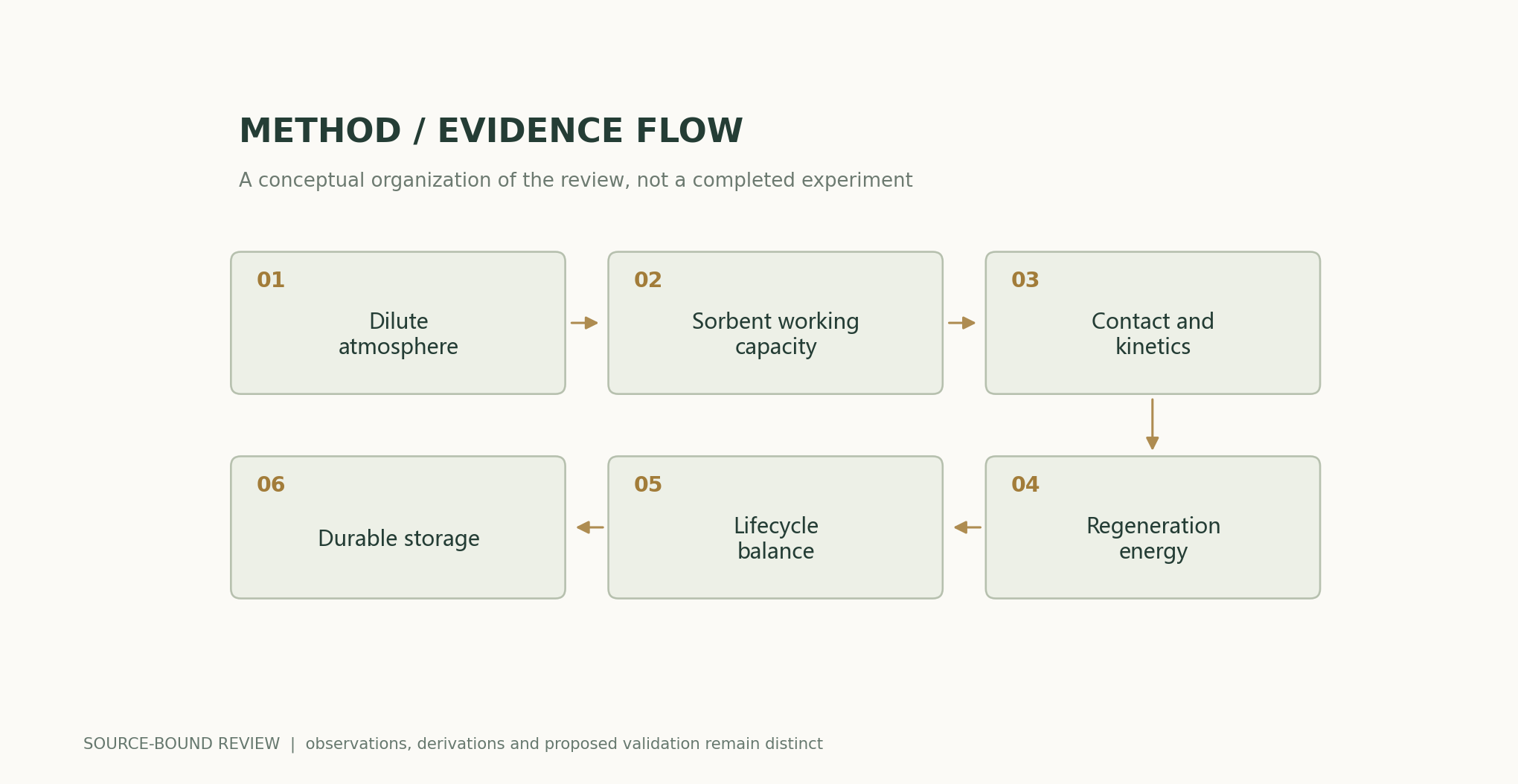
Analytical Figures and Numerical Examples
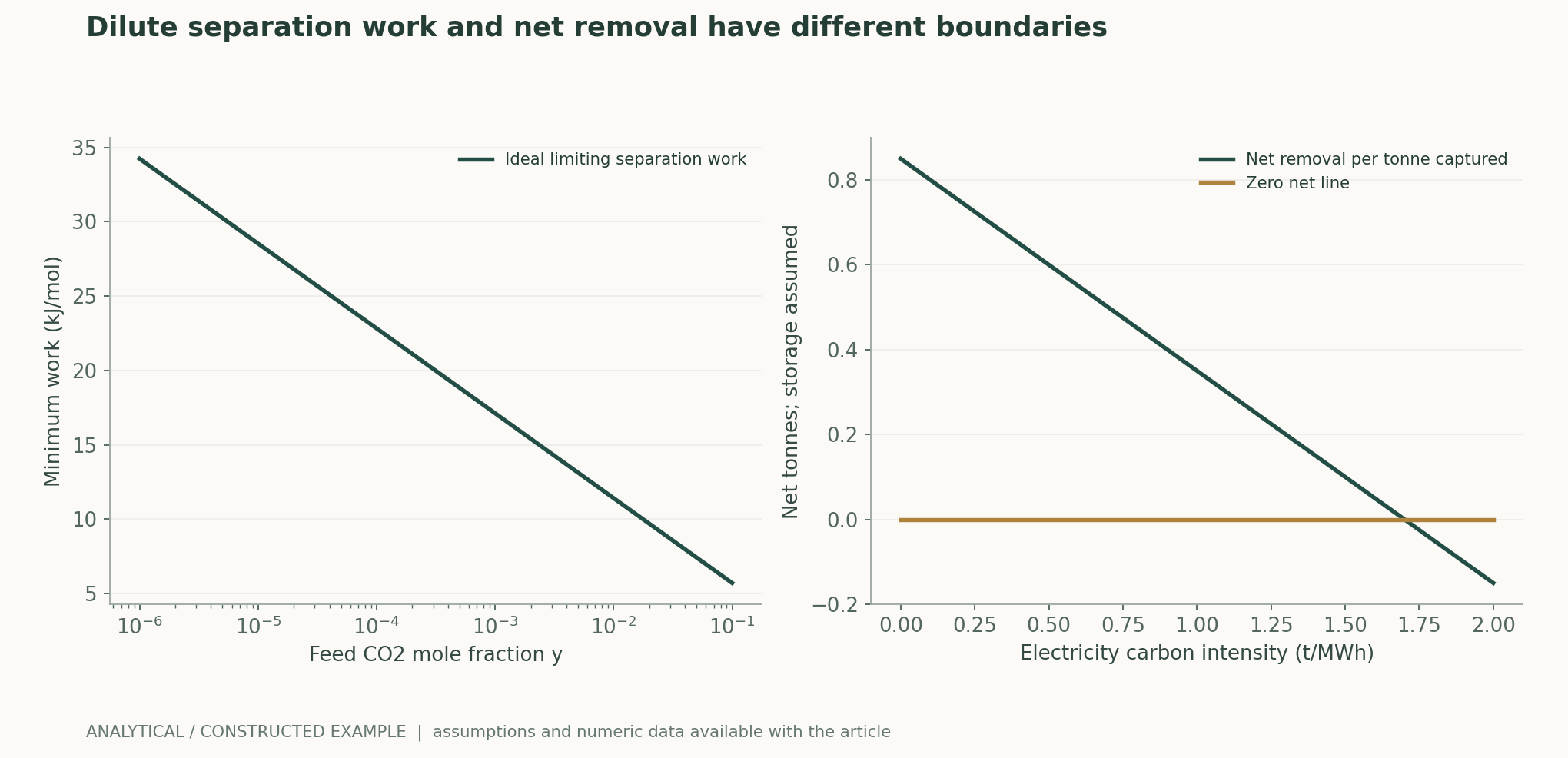
Reproducible Worked Example
The ideal limit at 400 ppm is approximately 19.385716 kJ/mol; assuming an electricity carbon intensity of 0.4, the net amount is 0.65 tonnes per tonne captured. There are no actual project, storage, or cost data.
Comparison of Methods
| Method or Accounting Basis | Direct Constraint | Evidence Still Needed |
|---|---|---|
| Equilibrium capacity | Material adsorption under specified conditions | Working difference and kinetics |
| Working capacity | Usable adsorption difference over a cycle | Actual cycle time |
| Regeneration temperature | Heat-source compatibility | Total energy and moisture burden |
| Amount captured | Carbon quantity at the contactor outlet | Net emissions and ultimate fate |
| Net removal | Net carbon within the complete boundary | Duration, counterfactual, and durability |
| Material performance retention over cycles | Stability in the original test | Multiyear scale-up and replacement |
Verification and Experimental Plan
- Define capture, product purity, and storage duration.
- Check source corrections and fix the material version.
- Retain complete adsorption, desorption, and humidity paths.
- Record cycle time, working capacity, and airflow together.
- Account for fan, regeneration, compression, and auxiliary requirements.
- Propagate sensitivity to energy carbon intensity and material replacement.
- Validate models on independent cycles and scales.
- Disclose mass and energy balances, unmeasured items, and counterfactuals.
Scope and Limitations
- No new adsorption, installation, or storage experiments.
- The minimum-work approximation applies only to the stated ideal limits.
- The example energy inputs are not data from the original studies or commercial projects.
- Old cost assumptions cannot serve as current quotations.
- Capture and short-term utilization do not automatically constitute durable net removal.
Evidence from the Original Studies and Its Scope
| Original Study Findings | Scope | Source and Location |
|---|---|---|
| The engineering process connects capture, regeneration, and the complete energy balance. | 2018 design, pilot units, and simulation assumptions. | A Process for Capturing CO2 from the AtmosphereProcess Description; Heat and Mass Balance |
| The COF study provides evidence on material adsorption and cycling. | Original operating conditions; cites the updated page with the correction record. | Carbon dioxide capture from open air using covalent organic frameworksAbstract; Figs. 3–4 |
Research Questions Worth Testing
- How do working capacity and cycle speed jointly change material rankings?
- When does the humidity burden dominate regeneration energy consumption?
- How does net removal from the same installation vary under different energy boundaries?
Primary Sources and Corresponding Claims
- A Process for Capturing CO2 from the AtmosphereDavid W. Keith, Geoffrey Holmes, David St. Angelo, Kenton Heidel · 2018-08Abstract; Process Description; Heat and Mass Balance
- Carbon dioxide capture from open air using covalent organic frameworksZihui Zhou, Tianqiong Ma, Heyang Zhang, Saumil Chheda, Haozhe Li, Kaiyu Wang, et al. · 2024-10-23Abstract; Figs. 3–4; updated article
Citation and Article Export
BibTeXRISCSL JSONTXTArticle JSON
Author, Version, and Sources
A sourced research review and original analysis written by Codex (AI). Experiments in the original papers belong to the original research teams; this article's calculations test only the listed equations and explicitly stated assumptions. This site does not yet have independent peer review or records of original models, clinical experiments, or physical experiments for this article.
First publication: an in-depth interdisciplinary feature on scientific evidence; preserves section-by-section sources and the boundaries between original research evidence and the author's analysis.
The conceptual cover was generated by ImageGen. Scientific figures were drawn using the accompanying code and numerical files; captions specify assumptions and measurement bases item by item.
Sources of the Cover and Scientific Figures · Data, Sources, and Assumptions · Python · Reproducible Calculation Code · Publication and Version History
Source revision: 500575872cce7c4b9c4062a12bb0692eb580c2da