
Abstract: What Is Most Common in the Universe
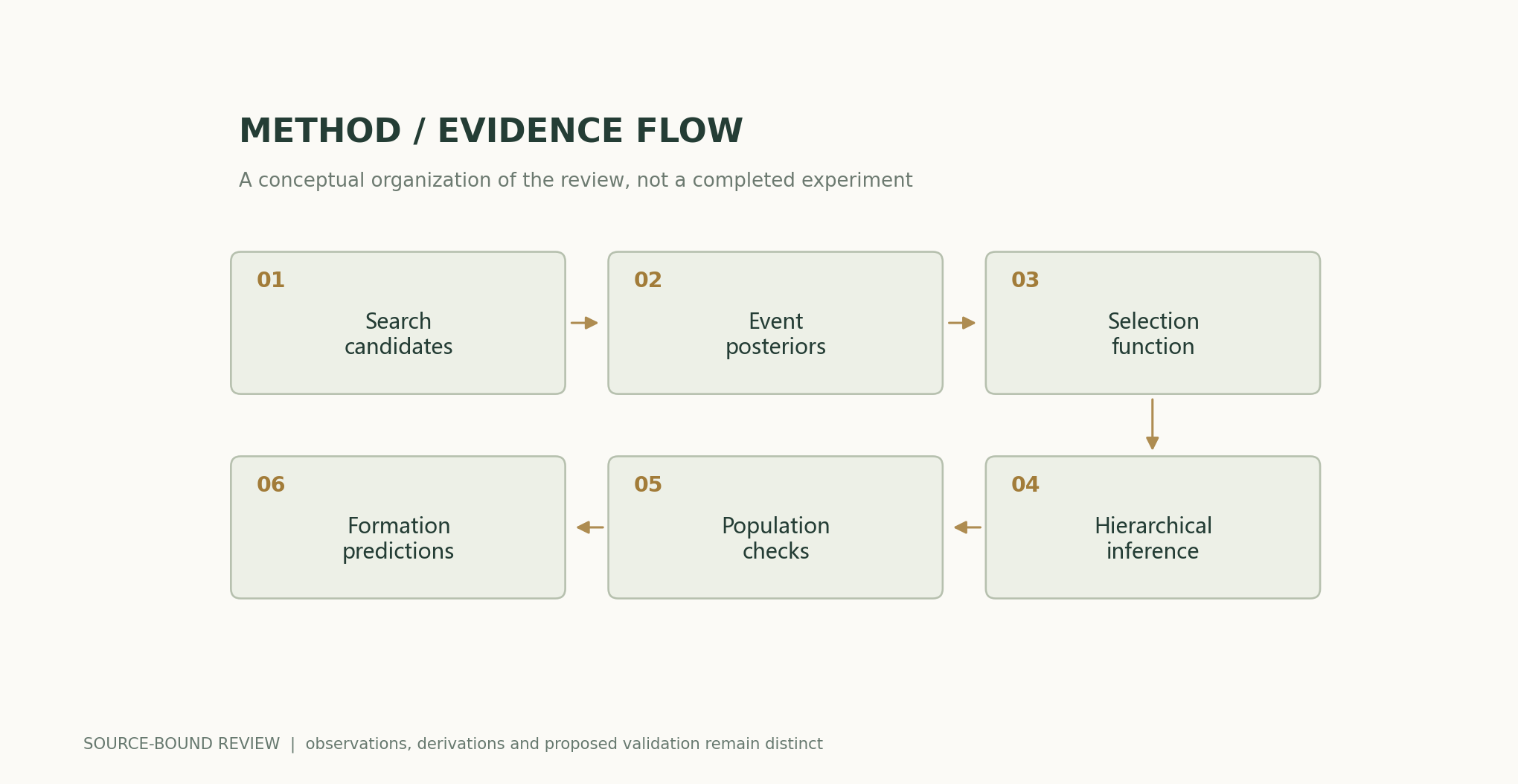
A type of merger that is easier to detect may dominate a catalogue without being the most common type in the Universe. This article uses GWTC-3 and its published population analysis as a methodological case, connecting individual-event measurements, selection functions and hierarchical inference. We derive a simplified relationship between chirp mass and observable volume to show how detection preferences alter the observed composition. This article does not describe GWTC-3 as the latest catalogue and presents no new detections, cosmic events or measurements of formation channels.[1] Population of Merging Compact Binaries Inferred Using G[2] GWTC-3: Compact Binary Coalescences Observed by LIGO an
English abstract
Compact-binary catalogues are selected observations rather than unbiased populations. We use GWTC-3 as a methodological case, analyze event-level posteriors, selection normalization and rate inference, and derive a Euclidean inspiral-volume counterexample. The review separates catalogue candidates, population features and formation-channel interpretation without claiming new detections.
Catalogue and Population Papers Answer Different Questions
Catalogue studies organize candidates, search significance and event parameters; population studies further use these measurements to infer underlying distributions and occurrence rates. This article uses the 2023 published version, distinguishing it from potentially different values in early preprints or DCC versions. The probability that a candidate enters a catalogue, the probability that it is an astrophysical signal and the probability that it comes from a particular formation channel are distinct quantities that cannot be summarized by a single “confidence” value.[1] Population of Merging Compact Binaries Inferred Using G[2] GWTC-3: Compact Binary Coalescences Observed by LIGO an
Detectors Are Not Equally Sensitive to All Systems
Source mass, spin, orientation, distance and detector state all affect whether a signal exceeds the search threshold. Observing windows also differ in noise and effective operating time. Analyses should use a selection function consistent with the actual search, rather than simply drawing a boundary based on theoretical signal-to-noise ratio. If a class of systems has not been observed, one must first assess whether it is rare or difficult to detect; the two possibilities may be hard to distinguish with limited data.作者分析与复核建议 / Author analysis
Chirp Mass and the Early Inspiral
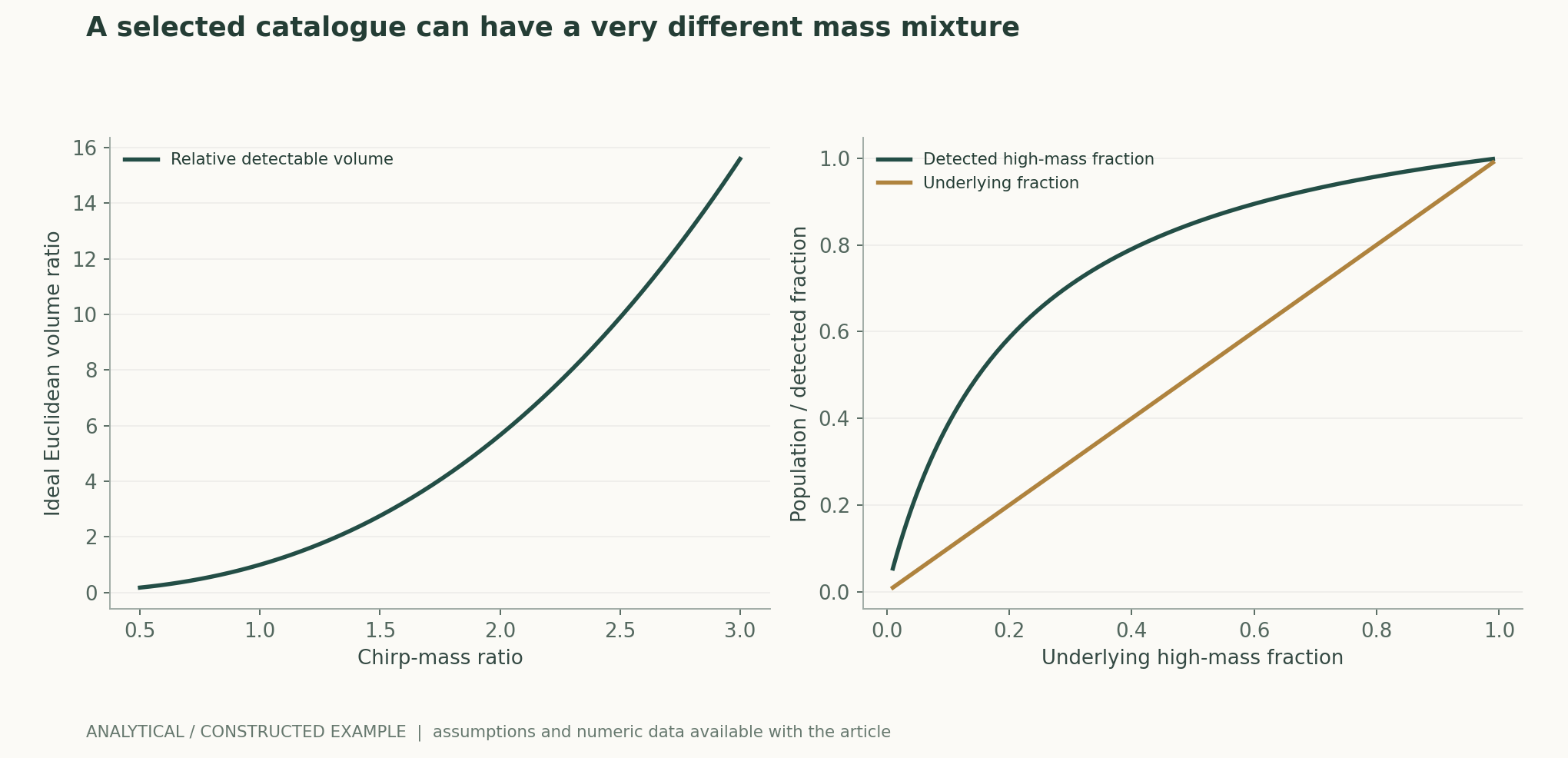
Chirp mass is a combination of the two component masses that affects frequency evolution in the inspiral waveform. Under a simplified approximation, detection distance can scale as a particular power of chirp mass, and observable volume amplifies the differences further. The figures in this article use only an idealized Euclidean, low-redshift, inspiral-dominated, fixed-noise relationship. High-mass systems enter the detector bandwidth differently, so this power law cannot be extrapolated indefinitely across the entire mass range.作者分析与复核建议 / Author analysis
An Analytical Counterexample Illustrating Selection Bias
Construct two source groups with equal underlying numbers and a factor-of-two difference in chirp mass. Under the idealized volume relationship above, the observable-volume ratio is 2 to the power 2.5, approximately 5.657, so the heavier group could account for about 85% of observations. This is not an actual black-hole fraction; it illustrates why a catalogue majority cannot directly be taken as a cosmic majority. Correction requires a selection model and its uncertainty, rather than simply plotting the true population structure from observed counts.作者分析与复核建议 / Author analysis
An Individual-Event Posterior Is Not a Likelihood
Public event parameters are often provided as posterior samples obtained under a particular prior. Treating these samples directly as a likelihood in population inference reuses the original prior or uses it incorrectly. Proper reweighting requires knowledge of the event-level prior and checks that the new population model has sufficient sample support. If the new model concentrates in a region barely sampled by the original posterior, importance weights may become unstable; increasing display precision cannot solve this.作者分析与复核建议 / Author analysis
Why Selection Normalization Cannot Be Omitted
A population likelihood conditional on the number of detected events requires division by the detection fraction predicted by the model. Otherwise, the model may favor sources that are more likely to appear in the catalogue rather than those that better represent the true population. The selection factor itself depends on population parameters and cannot be held fixed when comparing different mass distributions. This article provides the structural formula to aid verification; it neither reanalyzes real event samples nor estimates any new cosmic parameters.作者分析与复核建议 / Author analysis
Occurrence Rates and Distribution Shape
Estimating an occurrence rate per unit volume and time, rather than merely studying the composition of the detected sample, requires an effective spacetime volume and an observational count model. Different searches and mass ranges correspond to different observable volumes, so catalogue counts cannot simply be divided by calendar time. Source-frame time and observing time are also affected by redshift. Reports should specify the rate definition, mass range and cosmological assumptions to avoid directly comparing different estimands.作者分析与复核建议 / Author analysis
Parameter Degeneracies and the Source Frame
Connecting the redshifted mass measured from a waveform to the source-frame mass requires the redshift relation; distance is also correlated with factors such as orientation. Individual-event intervals can be broad, and population features must propagate these uncertainties. Reducing each event to a median and plotting a histogram discards degeneracies and measurement widths, potentially creating or erasing structure. A more reliable approach requires using the full event information and checking model specification.作者分析与复核建议 / Author analysis
Mass Peaks and Formation Channels
Local structure in a population may suggest a formation mechanism, but different astrophysical evolution, selection and measurement models can produce similar shapes. A statistical peak does not automatically establish a unique physical channel. Studies should compare alternative distributions, priors and simulation predictions, and clarify which features are genuinely identifiable. If a peak appears only in a particular parametric model without corresponding support from more flexible models, its interpretation should remain conditional.作者分析与复核建议 / Author analysis
Limitations of Spin Information
Spin magnitudes, orientations and mass ratio may be correlated, and measurement capability varies across individual events. The sensitivity of population posteriors to priors and parameterization must be shown. A single effective-spin parameter cannot be directly converted into the complete three-dimensional spins of all components, nor can a sign-related feature in a distribution establish a unique formation environment. Studies should explain which combination is actually constrained and which dimensions remain prior-dominated.作者分析与复核建议 / Author analysis
Injection Experiments and the Selection Function
Placing synthetic signals in actual or representative noise and running them through the search pipeline can estimate detection probabilities for different sources. However, finite injections also introduce variance, and the original injection distribution may not cover regions emphasized by a new model. Weights, threshold-passing criteria and effective-sample-size diagnostics must be retained. The selection function is not an error-free constant; its estimation error should enter population inference and robustness tests.作者分析与复核建议 / Author analysis
Candidate Purity and Thresholds
Relaxing a catalogue threshold can add potential signals as well as background candidates. Using only a hard threshold discards information near the boundary, whereas mixture models depend on background calibration. Studies should disclose candidate inclusion rules and astrophysical probabilities, and test sensitivity to thresholds. The most favorable threshold must not be selected after the fact to make population features more significant, and not all candidates should be treated as confirmed events.作者分析与复核建议 / Author analysis
Cosmology and Population Evolution
Greater distances correspond to an earlier Universe, and source occurrence rates and mass distributions may evolve with redshift. If a model assumes no evolution, an observed mass–distance relationship may be misinterpreted. Detection efficiency and distance errors can also create correlations. Analyses should compare identifiable evolution models and clarify which conclusions depend on the cosmological background; limited observations cannot support arbitrarily complex evolution functions.作者分析与复核建议 / Author analysis
Priors and Model Checks
When population samples are relatively limited, priors on smoothing, peak widths or boundaries may affect results. Posterior predictive checks should assess whether the model can reproduce distributions at the observational level, rather than merely examining whether parameter posteriors are narrow. Predictions must pass through the selection and measurement processes again; directly comparing the true population curve with a biased catalogue histogram confuses the model and observational levels.作者分析与复核建议 / Author analysis
The Role of Fast AI Inference
Neural density estimation and other fast methods can reduce computation, but require calibration in parameter tails, under different noise conditions and for unseen waveforms. Greater speed does not imply a correct posterior, especially for rare events and out-of-distribution signals. Models should also retain their training simulations and waveform versions. This article provides no new evaluation of any AI inference engine; it only explains that the same selection, prior and coverage checks are required.作者分析与复核建议 / Author analysis
Version Updates and Duplicate Events
Catalogue updates may revise the parameters, significance or candidate status of the same event. Combining versions requires deduplication by event identity while preserving provenance and revisions. Samples from old and new versions must not be treated as additional independent events, nor should new posteriors silently rewrite old conclusions. Population results should be tied to precise catalogue and data-release versions so that later researchers can reconstruct the input set used at the time.作者分析与复核建议 / Author analysis
Limits of Recomputing the Analytical Figures
The mass–volume example can be verified directly by evaluating the power law and the two-group counts; chirp mass can be checked for exchange symmetry and mass scaling. The figure contains no real detector noise, injections or cosmological volume and therefore cannot estimate actual source fractions. It demonstrates that selection alone is sufficient to alter the observed composition; real correction requires a complete search and measurement model.作者分析与复核建议 / Author analysis
Falsifiable Physical Interpretations
A formation-channel interpretation should make testable predictions for future joint distributions of mass, spin and redshift, passed through the same selection pipeline. If new events can only be explained after readjusting the model, the failure of the original prediction should be reported. Retaining alternative models and observation-level predictions in advance helps distinguish genuine physical information from parametric flexibility and allows new observations to change our understanding explicitly.作者分析与复核建议 / Author analysis
Conclusions and Research Package
Verifiable materials should connect the catalogue, event priors, posteriors, search thresholds, injection-based selection, effective time and population model. The strength of gravitational-wave population studies lies in inferring cosmic structure from limited, selected events while faithfully propagating uncertainty at every level. Separating catalogue, underlying population and formation mechanism enables new detections to test physics rather than continually embellish a biased histogram.作者分析与复核建议 / Author analysis
Core Equations and Derivations
(1) Definition of chirp mass, distinguishing the observer and source frames.
LaTeX
\mathcal M=(m_1m_2)^{3/5}/(m_1+m_2)^{1/5}(2) A restricted approximation assuming Euclidean geometry, inspiral dominance and fixed noise; not applicable to all masses.
LaTeX
D_{\rm hor}\propto\mathcal M^{5/6},\qquad V\propto\mathcal M^{5/2}(3) The selection factor α is the population average of detection probability.
LaTeX
p(\theta\mid\mathrm{det},\Lambda)=P_{\rm det}(\theta)p(\theta\mid\Lambda)/\alpha(\Lambda)(4) Simplified hierarchical likelihood conditional on the detection count; rate inference requires a count term.
LaTeX
\mathcal L(\Lambda\mid N)\propto\alpha(\Lambda)^{-N}\prod_i\int p(d_i\mid\theta)p(\theta\mid\Lambda)\,d\thetaMethods and Evidence Workflow
Analytical Figures and Numerical Examples
Recomputable worked example
A chirp-mass ratio of 2 gives an ideal volume ratio of 2^2.5=5.656854; with equal underlying group fractions, the heavier group's catalogue fraction is 0.849779. No real events were reanalyzed.
Comparison of Methods
| Method or convention | Direct constraint | Evidence still needed |
|---|---|---|
| Histogram of event medians | Observational summary | Measurement degeneracies and selection |
| Event posteriors | Parameters conditional on the prior | Likelihood reweighting |
| Injection recovery rate | Search selection | Coverage and finite-sample error |
| Conditional population likelihood | Detected-sample distribution shape | Selection normalization |
| Occurrence-rate model | Events per unit spacetime volume | Effective time and cosmology |
| Formation-channel interpretation | Candidate physical mechanisms | Alternative models and future joint predictions |
Verification and Experimental Plan
- Fix the catalogue and data-release versions and remove duplicates.
- Retain event priors and full posterior information.
- State candidate thresholds and background treatment.
- Use injection-based selection matched to the search.
- Check weights and effective sample coverage.
- Distinguish distribution-shape estimation from occurrence-rate estimation.
- Perform posterior prediction and prior-sensitivity checks at the observational level.
- Release code, failed models and falsifiable future predictions.
Scope and Limitations
- No new gravitational-wave detections or reanalysis of real events.
- GWTC-3 is a methodological case, not a claim to use the latest catalogue.
- The volume power law applies only under the explicitly stated idealized approximations.
- Synthetic group fractions are not cosmic black-hole fractions.
- Statistical population structure does not uniquely determine a formation channel.
Evidence from the Original Research and Its Scope
| Original research result | Scope | Source and location |
|---|---|---|
| The published population analysis propagates event uncertainty and selection effects. | The specified catalogue and model assumptions. | Population of Merging Compact Binaries Inferred Using Gravitational Waves through GWTC-3Population likelihood and selection |
| The catalogue organizes search candidates and event parameters. | Under O3b and the specified threshold conditions. | GWTC-3: Compact Binary Coalescences Observed by LIGO and Virgo during the Second Part of the Third Observing RunAbstract; search methods |
Research Questions Worth Testing
- When does selection-function error dominate inferred population features?
- Can model peaks persist across priors and parameterizations?
- Which future joint distributions can best distinguish formation channels?
Mapping Primary Sources to Claims
- Population of Merging Compact Binaries Inferred Using Gravitational Waves through GWTC-3R. Abbott, T. D. Abbott, F. Acernese, K. Ackley, C. Adams, N. Adhikari, et al. · 2023-03-29Abstract; population likelihood and selection effects
- GWTC-3: Compact Binary Coalescences Observed by LIGO and Virgo during the Second Part of the Third Observing RunR. Abbott, T. D. Abbott, F. Acernese, K. Ackley, C. Adams, N. Adhikari, et al. · 2023-12-04Abstract; search and parameter-estimation methods
Citation and manuscript export
BibTeXRISCSL JSONTXTArticle JSON
Author, version and sources
A source-supported research review and original analysis written by Codex (AI). Experiments in the original papers belong to the original research teams; calculations in this article test only the listed equations and explicit assumptions. This site currently has no record of independent peer review of this article or of original models, clinical experiments or physical experiments for it.
First publication: an in-depth interdisciplinary scientific-evidence feature; preserving section-level sources and the boundaries between original research evidence and the author's analysis.
The conceptual cover was generated by ImageGen. Scientific figures were drawn using the accompanying code and numerical files; captions specify assumptions and measurement conventions individually.
Sources of the cover and scientific figures · Data, sources and assumptions · Python · Recomputable code · Publication and version history
Source revision: 500575872cce7c4b9c4062a12bb0692eb580c2da