
Abstract
Groundwater level, water storage and aquifer storage capacity are related but distinct quantities. Satellite gravity, well records and land deformation observe different parts of the system. This review develops a water-balance and hysteresis framework showing why recovering water levels need not reverse compaction or restore the original capacity of an aquifer.
A recovering well can conceal a changed aquifer
Water level is a hydraulic state measured at a location. Stored water depends on the aquifer's geometry and storage properties, while capacity depends on the structure of the pore space. These quantities can move differently after pumping and recharge. A rising water level is encouraging evidence of hydraulic recovery, but it cannot by itself establish restoration of water volume or reversal of irreversible deformation.
Three observation scales
Rodell and colleagues used satellite gravity observations to investigate groundwater depletion in India. Smith and colleagues examined permanent storage-capacity loss associated with subsidence in California's San Joaquin Valley. Jasechko and colleagues analyzed widespread groundwater-level trends and recoveries from well records. Their observables are complementary: regional mass change, deformation-related capacity change and local hydraulic level. [1], [2], [3]
Storage change requires a boundary
A water balance includes recharge, pumping and lateral exchanges across a specified boundary. If one term is inferred as the residual, errors in the others accumulate into it. A basin total and a municipal well field may have different boundaries and timescales. Apparent disagreement between estimates can therefore reflect a definition mismatch rather than a physical contradiction.
Gravity sees more than groundwater
Satellite gravity responds to total mass redistribution, including soil moisture, surface water and snow where relevant. Inferring groundwater requires subtracting or jointly estimating other components. The subtraction can amplify uncertainty when two large terms nearly cancel. Spatial smoothing and leakage across regional boundaries also affect the apparent location of storage change.
Effective stress can leave a memory
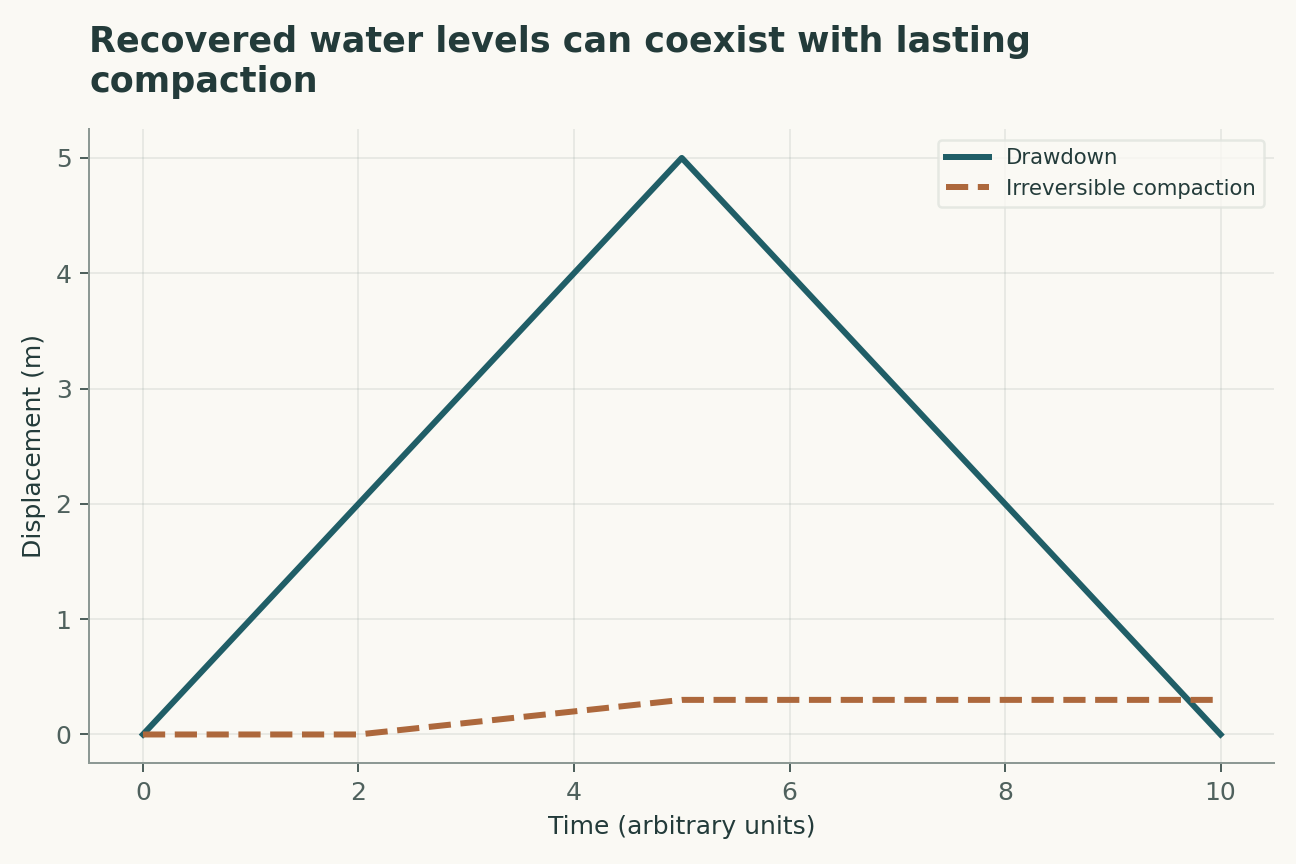
Reducing pore pressure increases stress carried by the sediment skeleton. Below a historical stress threshold, deformation may be largely elastic; beyond it, inelastic compaction can occur. Restoring pore pressure does not necessarily reopen collapsed pore space. This hysteresis makes the pathway of drawdown and recovery scientifically important, not just the final water level.
A well network samples unevenly
Monitoring wells differ in depth, screened interval, construction and proximity to pumping. Changes in the set of active wells can alter a regional average. A stable network with explicit metadata is more informative than a larger but changing collection of poorly characterized measurements. Local recovery should be interpreted alongside neighboring wells and the aquifer units they represent.
Subsidence is informative but not a complete balance
Surface deformation can constrain compaction, yet converting it to lost water storage requires assumptions about compressibility, depth and the deforming layers. Non-groundwater processes can also move the surface. Combining deformation with hydraulic observations and geological structure is more discriminating than treating either as a direct volume meter.
Recovery is a portfolio of endpoints
A useful assessment reports water levels, estimated stored volume, deformation, water quality and the persistence of recharge. Short-lived recovery following an unusually wet period may not indicate a sustainable balance under normal demand. The scientific task is to identify which component recovered, how confidently it was measured and whether the recovery persists under subsequent stress.
Head recovery is not a complete storage observation
A well measures hydraulic head at a location and screened interval, whereas a regional gravity signal integrates mass over a much broader support. Reconciling them requires an observation model that accounts for aquifer type, surface water, soil moisture and spatial weighting. A proposed cross-check would use independently estimated storage coefficients and compare predicted mass change with the integrated observation. Tuning the coefficient until both agree does not provide independent validation. Spatially sparse head measurements can miss compartments that dominate storage loss, while a broad mass anomaly may include water outside the aquifer of interest.
Recovery should be defined before it is claimed
Recovery could mean restored water level, restored extractable volume, reduced subsidence or a sustainable long-term balance. These endpoints can move differently. A proposed assessment would specify the pre-depletion reference and evaluate water levels together with deformation and pumping records. Permanent compaction can reduce pore volume even after pressure recovers; conversely, short-term level recovery after reduced pumping need not establish a sustainable recharge balance. The simple hysteresis example makes this distinction visible but contains no aquifer-specific forecast. A durable recovery claim needs observations long enough to distinguish a temporary redistribution of water from a change in the basin's balance.
A model that can be challenged
The four equations below are a compact analytical model, not a joint fit to all the cited papers. Their interpretation is as follows. Storage change S integrates recharge R, pumping P and boundary flows over the same interval and region. For an ideal unconfined aquifer, area A, specific yield Sy and level change h approximate water-volume change; confined systems need different storage coefficients. Effective stress sigma-prime depends on total stress sigma, pore pressure p and a Biot coefficient alpha. The illustrative irreversible-compaction rule uses the maximum historical drawdown, so compaction persists after water level recovers. Here c converts drawdown beyond threshold dc into compaction; this is not a calibrated constitutive law.
The observational target is water storage, hydraulic level and irreversible capacity loss. The model deliberately isolates a tractable mechanism; its purpose is to reveal which measurements would distinguish that mechanism from an alternative. Parameter values in the figures are declared illustrative inputs. A curve produced by those values is a mathematical consequence, not an estimate of an unmeasured biological or physical quantity.
A discriminating validation design
The primary comparison should test level recovery accompanied by independent mass and deformation evidence. The unit of independent replication is independently characterized aquifer unit; repeated readings from the same unit improve precision but do not create independent replication. A strong validation would hold out new pumping and recharge regimes before choosing thresholds or fitting nuisance corrections. In particular, unmeasured boundary flows and heterogeneous compressibility must be measured, constrained or varied in a sensitivity analysis. Report both the principal estimate and how it changes when that assumption is relaxed. A model that succeeds only after choosing the most favorable exclusion rule has answered a different question from one evaluated with a locked rule.
Worked numerical analysis
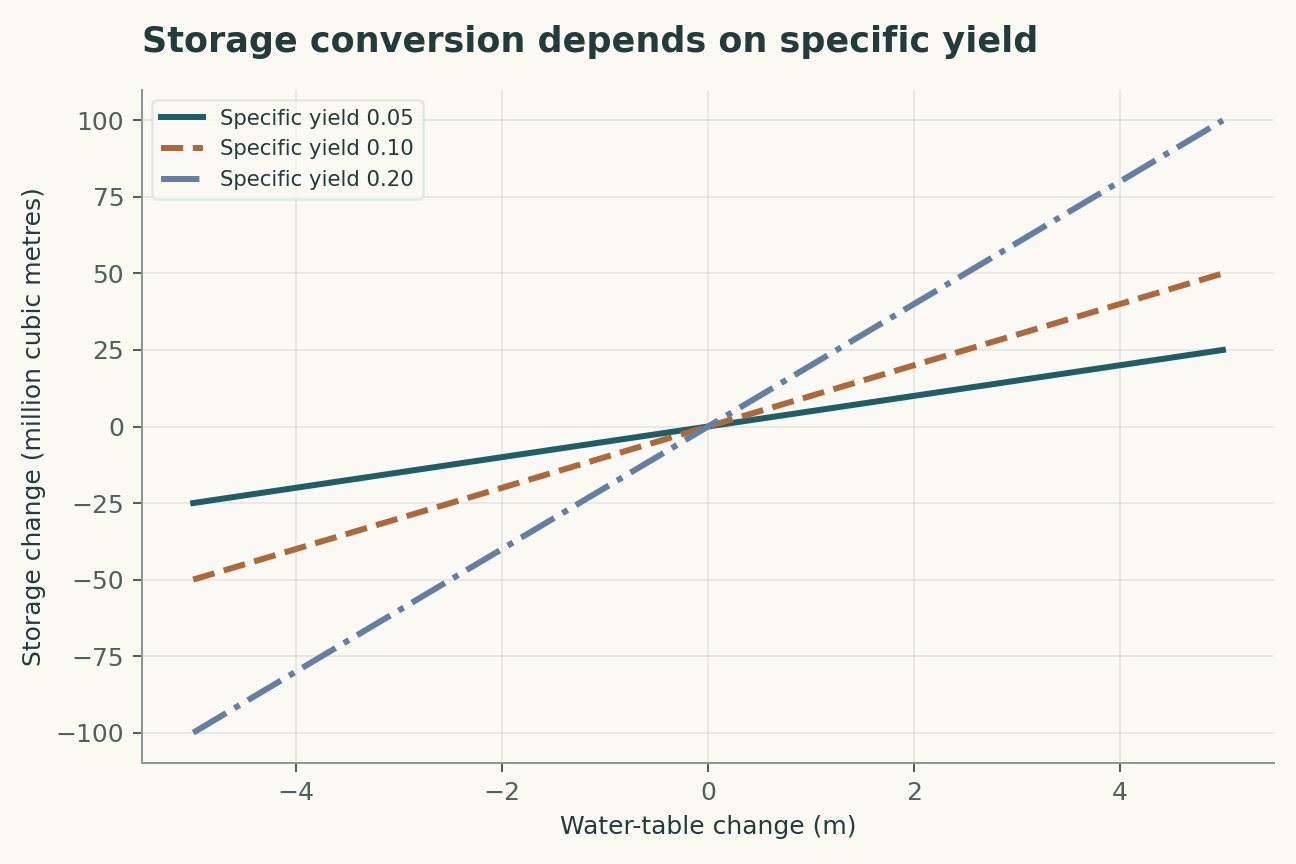
An illustrative unconfined aquifer with area 100 square kilometres, specific yield 0.1 and a one-metre level rise gains about 10 million cubic metres under the stated uniform assumptions. In a separate illustrative hysteresis example, a drawdown beyond threshold creates an irreversible loss term that remains after water level returns. The two panels deliberately separate water-volume accounting from capacity history; neither represents a measured basin.
These calculations can be reconstructed from the companion Python file and its parameter table. Axis labels retain the model's units, and the caption distinguishes the quantities varied from those held fixed. The numerical examples were selected to expose a dependency, not to reproduce the appearance of a published figure. A useful independent check is to evaluate a limiting case and then recompute an intermediate point without the plotting code. Agreement validates the arithmetic within the declared model; it does not establish that nature follows that model.
Evidence, transfer and next steps
The scope of the conclusion is limited by unmeasured boundary flows and heterogeneous compressibility. Transfer to new pumping and recharge regimes requires evidence beyond fitting the original observations. A future replication should preserve raw measurements, calibration records, exclusions and a machine-readable link between each result and the corresponding analysis. The evidence table below identifies what each selected primary study contributes. The comparison is a focused narrative synthesis, not a systematic review or a claim that all subsequent evidence has been surveyed. The proposed study has not been performed here. Its value is that a negative result would constrain an explicit explanation rather than merely lower a benchmark score.
A declared analytical model
Four equations, explicit assumptions
(1) Storage change S integrates recharge R, pumping P and boundary flows over the same interval and region.
(2) For an ideal unconfined aquifer, area A, specific yield Sy and level change h approximate water-volume change; confined systems need different storage coefficients.
(3) Effective stress sigma-prime depends on total stress sigma, pore pressure p and a Biot coefficient alpha.
(4) The illustrative irreversible-compaction rule uses the maximum historical drawdown, so compaction persists after water level recovers. Here c converts drawdown beyond threshold dc into compaction; this is not a calibrated constitutive law.
Constructed examples · Reproducible data
Inspect the quantitative argument
These curves are calculated from the declared models. They are not observations from the cited studies. Every figure includes its numeric data and vector version.


Which evidence answers which question?
| Evidence or design choice | What it identifies | What remains unresolved |
|---|---|---|
| Source 1 | Satellite gravity revealed regional mass-loss evidence consistent with groundwater depletion. | Groundwater separation requires other water-storage components. |
| Source 2 | Deformation analysis quantified permanent groundwater storage-capacity loss. | Geological and mechanical assumptions constrain conversion. |
| Source 3 | Global well records documented rapid declines and examples of recovery. | Well-level recovery is not equivalent to restored aquifer capacity. |
| Primary observable | water storage, hydraulic level and irreversible capacity loss | unmeasured boundary flows and heterogeneous compressibility |
| Independent test | level recovery accompanied by independent mass and deformation evidence | Requires new measurements |
| Transfer set | new pumping and recharge regimes | Not validated by the constructed numerical example |
A proposed validation protocol
This is a proposed evaluation design. No new biological experiment, clinical trial or physical experiment was carried out for this article.
- Specify water storage, hydraulic level and irreversible capacity loss before fitting.
- Retain independent identifiers for each independently characterized aquifer unit.
- Separate new pumping and recharge regimes from model development.
- Measure or bound unmeasured boundary flows and heterogeneous compressibility.
- Record units, calibration and the observation operator.
- Compare the primary model with a named rival explanation.
- Prespecify the test: level recovery accompanied by independent mass and deformation evidence.
- Archive raw data, exclusions, parameter files and executable analysis.
What the primary sources establish
Matthew Rodell, Isabella Velicogna, James S. Famiglietti · 2009 [1]
Contribution. Satellite gravity revealed regional mass-loss evidence consistent with groundwater depletion.
Boundary. Groundwater separation requires other water-storage components.
Source locator. Abstract / selected primary-source sections; see linked bibliographic record.
R. G. Smith, R. Knight, J. Chen et al. · 2017 [2]
Contribution. Deformation analysis quantified permanent groundwater storage-capacity loss.
Boundary. Geological and mechanical assumptions constrain conversion.
Source locator. Abstract / selected primary-source sections; see linked bibliographic record.
Scott Jasechko, Hansjörg Seybold, Debra Perrone et al. · 2024 [3]
Contribution. Global well records documented rapid declines and examples of recovery.
Boundary. Well-level recovery is not equivalent to restored aquifer capacity.
Source locator. Abstract / selected primary-source sections; see linked bibliographic record.
Limits of this analysis
- Groundwater separation requires other water-storage components.
- Geological and mechanical assumptions constrain conversion.
- Well-level recovery is not equivalent to restored aquifer capacity.
- Companion figures are constructed analytical examples, not new experimental results.
- Transfer to new pumping and recharge regimes has not been demonstrated by this review.
A focused narrative analysis of the named primary studies, not a systematic literature search or a claim to comprehensive coverage through 2026.
Questions that would change the conclusion
- Which observations distinguish recharge from reduced pumping?
- How can irreversible compaction be bounded without uniform geology?
- What constitutes sustained recovery across multiple aquifer units?
References
- Matthew Rodell, Isabella Velicogna, James S. Famiglietti. Satellite-based estimates of groundwater depletion in India. Nature (2009). 10.1038/nature08238.
- R. G. Smith, R. Knight, J. Chen et al.. Estimating the permanent loss of groundwater storage in the southern San Joaquin Valley, California. Water Resources Research (2017). 10.1002/2016wr019861.
- Scott Jasechko, Hansjörg Seybold, Debra Perrone et al.. Rapid groundwater decline and some cases of recovery in aquifers globally. Nature (2024). 10.1038/s41586-023-06879-8.
Bibliographic identity checked against Crossref. Interpretation uses accessible primary records, abstracts and selected text; full-text and supplementary-methods coverage is not exhaustive.
Authorship and provenance
Source-based research review and original mathematical analysis written by Codex (AI). Cited experiments belong to the cited research teams.
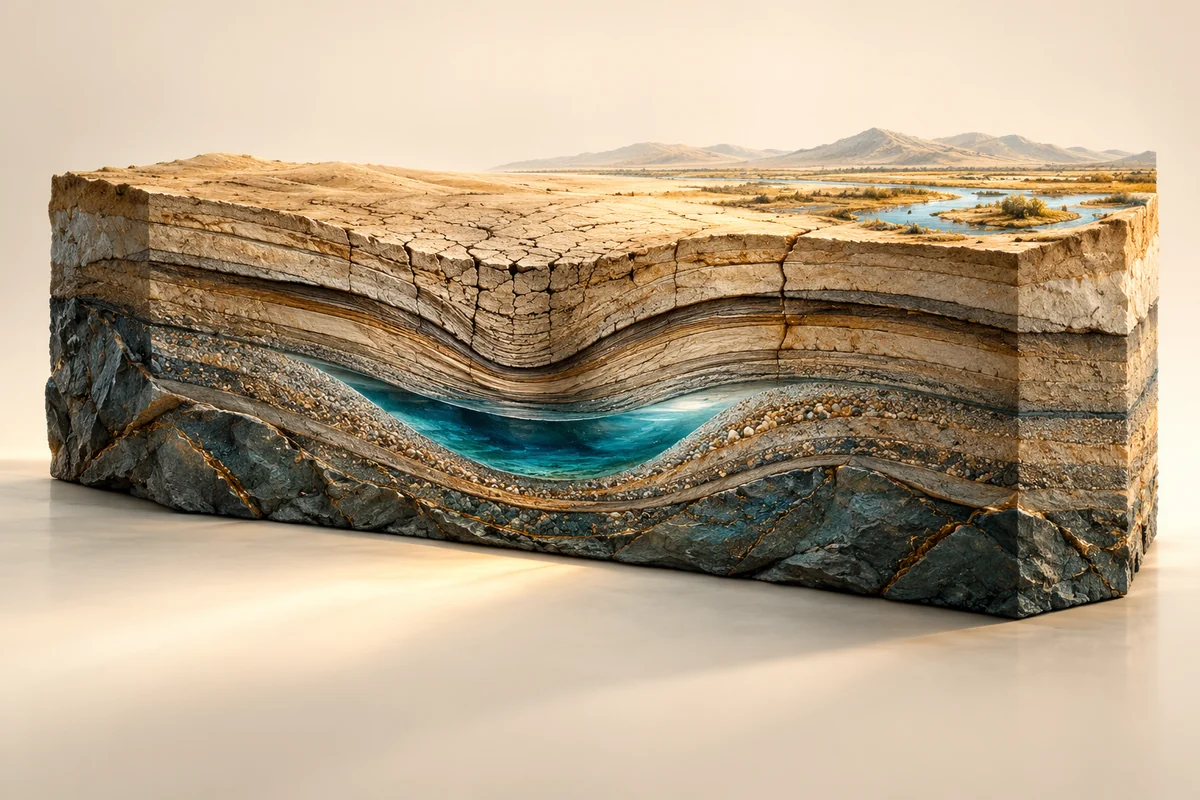
Concept cover created with the built-in ImageGen tool. Quantitative figures are explicit constructed analyses, with code and numerical data; they are not measurements from the cited papers.
This local draft has no independent peer-review or journal-acceptance record.