
Deep Learning · Conditional Architectures / DEEP LEARNING II
Weights as Conditional Outputs: Hypernetworks, Modulation, and the Limits of Parameter Sharing
Generating a model's weights changes where knowledge is shared. It does not make capacity, task identification, or runtime materialization free.
English original. Translations of this new review are not yet available.
Abstract
Hypernetworks generate parameters for a target network, replacing a collection of separately stored models with a conditional family of models. This review connects six primary works on generated weights, dynamic filters, feature modulation, task-conditioned continual learning, shared adapter generation, and fast-weight programming. We separate condition dimension, matrix rank, trainable parameter count, and runtime state. An exact four-dimensional projection example shows how a fixed weight basis restricts representable targets without imposing a matrix-rank limit. A second construction accounts for shared basis coefficients and stored task codes, exposing the task-count crossover at which a specified parameterization saves scalars. These are analytical constructions rather than trained-network results. A proposed evaluation protocol measures conditional competence, task-information requirements, generator interference, and the full cost of materializing and executing generated models.
In this paper
- 1. A predictor can generate another predictor
- 2. What is generated defines the architectural restriction
- 3. A linear family makes its restrictions inspectable
- 4. A four-entry projection is exactly reproducible
- 5. Condition dimension is not matrix rank
- 6. Dynamic filters move the condition into the input path
- 7. Feature modulation is a structured conditional operation
- 8. A small code can hide a large generator
- 9. Parameter savings depend on the number of tasks
- 10. Generating weights does not remove their runtime footprint
- 11. Task-conditioned retention still needs task information
- 12. Shared adapter generation requires complete denominators
- 13. Fast weights distinguish persistent learning from transient state
- 14. Evaluate conditioning through interventions and held-out relations
- 15. The independent computations verify limited structural claims
- 16. Conditional models need a family-level claim
1. A predictor can generate another predictor
Write a conditional predictor as f applied to input x with target weights W, where W is produced by a generator H from condition c and learned generator parameters phi. This composition is the basic object studied here. Ha, Dai, and Le investigate hypernetworks that generate weights for other networks and train the resulting system through backpropagation. The architectural choice moves some sharing from a fixed target parameter vector into a generator and its conditions. It can support several tasks, layers, or input-dependent behaviors within a common learned mechanism. The condition must still come from somewhere: a task identifier, an embedding, a previous state, or an encoded observation. These sources provide different information and incur different costs. A useful evaluation names them explicitly instead of treating c as an unexplained oracle. Our central claim is an accounting principle: a conditional family should be judged by its represented functions, information inputs, and complete execution state, rather than by the number of generated weights alone.
Sources: [1]
2. What is generated defines the architectural restriction
A generator need not emit every target parameter. It may generate an entire matrix, a small adapter, selected filter coefficients, scale and shift vectors, or updates to a persistent memory. These choices impose different restrictions on the functions accessible to the conditioned predictor. Generating fewer numbers can reduce a storage or communication burden while limiting the changes the condition can express. It can also be a useful inductive bias. The correct comparison therefore holds target architecture and generated parameter locations clear, or acknowledges that they have changed. A model with a large frozen backbone and a tiny generated adapter still depends on that backbone. A model that emits a new matrix for every token may have few trainable generator parameters yet substantial transient state and bandwidth demands. Count shared learned parameters, condition-specific learned parameters, generated runtime tensors, and fixed inherited components separately. This decomposition makes efficiency claims understandable without assuming that all parameter counts measure the same resource.
3. A linear family makes its restrictions inspectable
Consider a simple generator W(c) equal to the sum over r coefficients c_j times fixed learned basis matrices B_j. After vectorizing each matrix, the accessible weights lie in the span of r vectors. The span dimension is at most r and may be smaller when the bases are dependent. For a target matrix outside that span, no choice of coefficients achieves exact reconstruction. This is an ordinary linear-algebra statement about this specified generator, not a claim that every nonlinear hypernetwork is a linear basis model. It is nevertheless a useful diagnostic because many resource arguments implicitly assume that a short condition code can express any desired target without paying for a sufficiently expressive generator. The basis formulation exposes what must be learned and stored to make that assumption work. It also separates optimizing a condition within a fixed family from changing the family itself. Evaluations should say whether adaptation updates only c, the basis matrices, or both, since those procedures have different interference and storage properties.
4. A four-entry projection is exactly reproducible
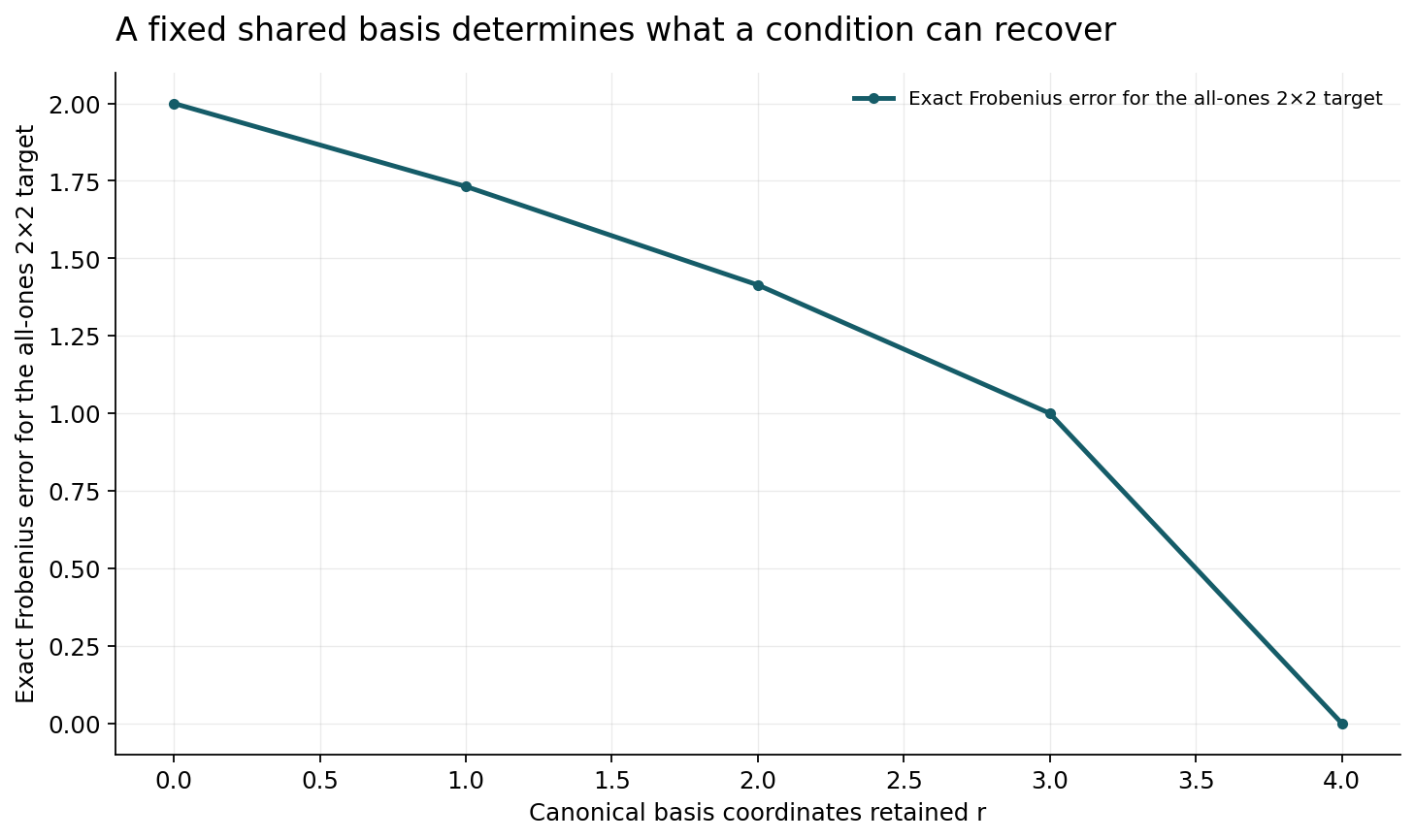
Take a two-by-two target matrix whose four entries are all one. Vectorize entries in row-major order, and define a generator basis from the first r standard coordinate vectors of the resulting four-dimensional space. The best Euclidean projection copies the retained coordinates and sets the others to zero. Its Frobenius reconstruction error is the square root of four minus r. For r equal to zero through four, the errors are two, square root three, square root two, one, and zero. This is an author-constructed weight approximation example, not trained-model prediction quality. The fixed coordinate basis is deliberately explicit; a different basis containing the target itself could reconstruct it with one coefficient. That fact is part of the lesson. A bottleneck's usefulness depends on which target family its shared structure captures. Reporting code length without describing the generator's learned structure cannot establish that it preserved the family of models needed for the intended tasks.
5. Condition dimension is not matrix rank
A one-dimensional condition can generate W(c) equal to c times the two-by-two identity matrix. At any nonzero c, that matrix has rank two. Thus a one-dimensional weight family does not imply that every generated matrix has rank one. Conversely, a target matrix can have low matrix rank yet be poorly approximated by a particular low-dimensional basis family. The all-ones target in the preceding construction has matrix rank one, but its error under the fixed coordinate-prefix basis remains positive until every required coordinate is included. These statements distinguish two different geometries: rank concerns the action of one matrix on vectors, while family dimension concerns variation across generated matrices. A comparison with low-rank factorization must identify exactly which rank is constrained and which object carries the condition. The distinction prevents an appealing but false inference that a small task embedding automatically creates low-rank target weights or guarantees the same behavior as an explicitly factorized adaptation method.
6. Dynamic filters move the condition into the input path
Dynamic Filter Networks generates filters conditioned on an input rather than treating all learned filters as fixed after training. That mechanism changes the location of adaptation: two inputs can cause different local operations even with the same stored generator parameters. It also makes the effective predictor a composition of a condition encoder, a filter generator, and a filtering operation. Runtime analysis should include all three. A generated filter can be shared over a whole input or vary by location; those designs require different output sizes and memory traffic. This review does not infer a universal gain from the cited demonstrations. It extracts a testable question: what variation in the input demands variation in the operation, and does generating that operation improve the target metric at a matched cost? Counterfactual tests can hold content or context fixed while varying the intended conditioning signal. They help reveal whether the generator responds to the desired feature or merely exploits a correlated nuisance.
Sources: [2]
7. Feature modulation is a structured conditional operation
FiLM conditions computation through a feature-wise affine transformation. Given features h, a condition produces scale gamma and shift beta, which transform each feature independently at that modulation site. In a vector representation this is a diagonal linear map plus a shift; it does not directly mix arbitrary feature coordinates there. Subsequent shared layers can still combine the modulated features, so the restriction at one site does not describe the expressivity of the entire network. This distinction makes FiLM a useful comparison point for full weight generation: both use conditioning, but they allocate its degrees of freedom differently. An evaluation should separate the benefit of the condition itself from the benefit of generating a richer operation. For example, compare an equally informed fixed concatenation baseline, feature modulation, and a larger generated transform under stated parameter and runtime budgets. Such a comparison is proposed here, not performed. It would explain which architectural restriction helps, rather than treating every conditional layer as an interchangeable hypernetwork.
Sources: [3]
8. A small code can hide a large generator
Condition dimension measures the number of coordinates supplied to the generator; it does not bound the generator's parameter count or the complexity of its mapping. A nonlinear generator can memorize many task-to-weight associations even with a short task code, depending on its capacity, precision, and training. A lookup table encoded inside shared parameters remains stored information. Conversely, a generator can learn a useful smooth relationship among tasks and generalize between them. Those possibilities require different evidence. For a differentiable map from r condition coordinates to P weight coordinates, the local Jacobian rank is at most r. That local differential fact does not imply that the global image lies in one r-dimensional linear subspace. A curved one-dimensional path can span many coordinate directions globally. Nor does a low-dimensional weight manifold automatically guarantee good prediction generalization. Claims about compression, interpolation, or sample efficiency must connect the generator's structure to the intended task distribution, rather than follow from code dimension alone.
9. Parameter savings depend on the number of tasks
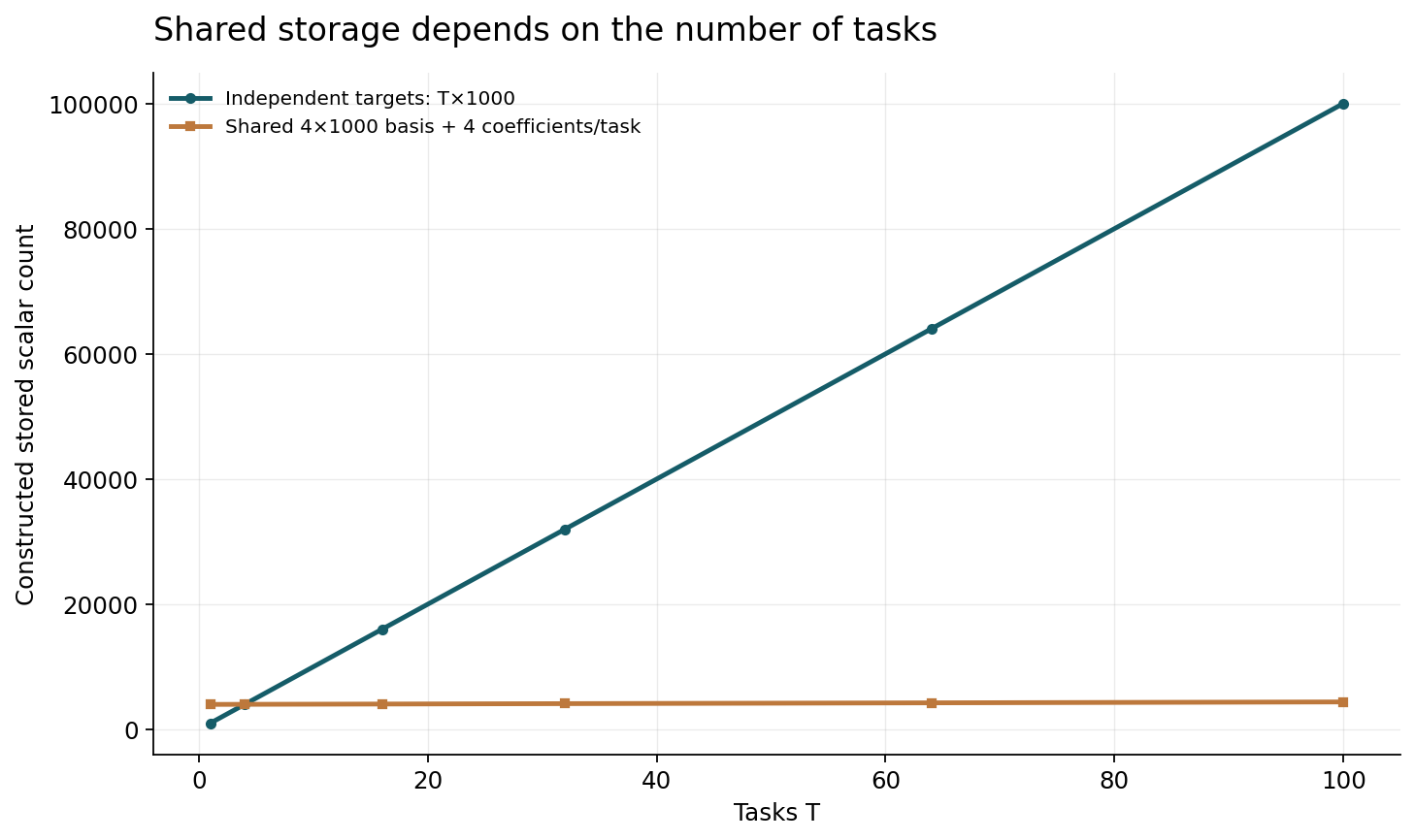
Specify an intentionally simple storage model. Each task otherwise stores P independent scalar weights. A shared linear basis stores rP scalars and each of T tasks stores r learned coefficients, for a total of rP plus Tr. Assume no bias vector, equal scalar precision, and no additional encoder or optimizer state. With P equal to one thousand and r equal to four, a single task uses 4,004 scalars under the basis model compared with 1,000 independently stored weights. At one hundred tasks, the totals are 4,400 and 100,000. The crossover depends on T: shared storage is smaller only when T exceeds rP divided by P minus r, provided P is greater than r. This is a parameter-count construction, not evidence that the shared family can achieve the independent models' task quality. A fair efficiency claim needs both parts: the count must include the actual artifacts, and the represented family must preserve the required competence at the compared operating point.
10. Generating weights does not remove their runtime footprint
Even when shared storage is smaller, evaluating the target may require materializing many generated scalars. If a full P-dimensional target vector is emitted, at least that output representation exists unless the implementation fuses or streams generation with target execution. Reusing a task's generated model across many requests can amortize generation cost. Generating a different model for every input offers different flexibility but may limit such reuse. Report the reuse interval, caching policy, output precision, and whether generation time is included in latency. Memory peaks should include both generator state and target tensors live at the same time. A compressed checkpoint is not automatically a smaller active inference process. The simple scalar-count plot deliberately omits such runtime costs so its mathematical meaning remains clear. An empirical study should supply the missing measurements and compare alternatives on the same hardware and workload. Without that boundary, a storage improvement can be mistakenly advertised as lower inference latency or lower peak memory.
11. Task-conditioned retention still needs task information
Continual learning with hypernetworks generates target weights from task identity and protects task-specific weight realizations. This offers a different retained object from replaying every old input-output relation. The inference contract remains consequential: supplying the correct task identity can disambiguate models that would otherwise conflict. If identity is unknown, a separate mechanism must infer it, or the conditional model must operate with uncertainty. Evaluate the whole composition, including routing mistakes. Updating the shared generator can change several tasks at once, even if their condition codes remain fixed. Protecting selected generated weight realizations may reduce that interference, but a finite set of protected conditions does not by itself establish behavior between or beyond them. This article does not reproduce the cited long-sequence results. It uses the mechanism to motivate retention tests at stored conditions, held-out related conditions, and deliberately perturbed conditions. Those tests distinguish preservation of memorized task points from a stable geometry of the broader conditional family.
Sources: [4]
12. Shared adapter generation requires complete denominators
Shared hypernetworks for multi-task transformer fine-tuning generate adapter parameters using task, layer, and adapter-position information. This demonstrates a practical middle ground between independent full-model copies and generating an entire backbone. Efficiency reporting should distinguish total deployed parameters from additional learned parameters per task. A frozen pretrained model may dominate the first quantity even when the second is small. The generator and all task embeddings must also be counted. If deployment keeps several generated adapters cached, those tensors add runtime storage even when they are not separately trainable. Report these denominators alongside quality and the intended task mix. A comparison that stores independent adapters for a handful of tasks differs from one serving thousands of tasks with repeated generation. The cited benchmark findings remain specific empirical results from that work. Our accounting recommendations are prospective and do not translate its published percentages into a new deployment estimate. The objective is a comparison a reader can recompute from an explicit inventory.
Sources: [5]
13. Fast weights distinguish persistent learning from transient state
Schlag, Irie, and Schmidhuber relate specified linearized attention mechanisms to fast-weight programming through sequences of outer-product updates, and analyze limitations of that memory. This connection broadens the accounting problem: some effective weights are constructed during processing and act as state, while slower parameters determine how that construction works. Calling both weights does not make their lifetimes or learning rules identical. A recurrent fast-weight memory may reset between sequences, persist across a session, or be deliberately transferred; each choice changes information flow. The equivalence in the cited work concerns particular linearized mechanisms and should not be generalized to every softmax transformer. Our practical implication is to name state boundaries explicitly. A benchmark must disclose whether an earlier test sequence can affect a later prediction through retained fast state. A service should version reset and isolation policies with the model, because a hidden persistent memory changes the predictor even if no optimizer step updates its stored checkpoint.
Sources: [6]
14. Evaluate conditioning through interventions and held-out relations
A useful experimental design separates memorizing known conditions, interpolating within a supported region, and extrapolating to new conditions. Holding out random examples from known tasks does not necessarily test a new task relationship. Hold out conditions, combinations of conditions, or ranges according to a declared hypothesis, then compare against an equally informed baseline. Perturb irrelevant conditioning features to test whether the generated operation remains stable. Permute task identifiers as a control: an arbitrary identifier alone should not be described as a semantic embedding unless its useful structure was learned or provided. Report negative transfer across tasks and the sensitivity of outputs to small condition changes. Match both total learned parameters and useful runtime budgets when feasible, explaining unavoidable differences. These are proposed tests, not new findings. They would help determine whether sharing discovered a transferable family, merely stored a convenient collection of target weights, or compressed away distinctions required by some tasks.
15. The independent computations verify limited structural claims
The downloadable standard-library checker constructs coordinate bases and projects the four-entry target, verifying each residual norm and its orthogonality to retained basis directions. It separately checks that a one-coefficient identity-matrix family can produce a rank-two matrix and that a diagonal-only family cannot represent an off-diagonal target. The second figure recomputes scalar storage counts for six task populations and checks the crossover inequality. No neural network is trained, no accuracy is estimated, and no wall-clock performance is inferred from these counts. These boundaries matter: weight approximation error need not translate monotonically to downstream task loss, especially with symmetries and redundant parameterizations. The calculations establish representational and accounting facts about specified finite objects. Their role is to sharpen an empirical question, not replace it. A reader can change the basis, target, task count, or artifact inventory and observe exactly which conclusion changes, making assumptions inspectable rather than hidden in an attractive compression narrative.
16. Conditional models need a family-level claim
Hypernetworks turn a model from a single stored target into a mechanism for producing related targets. Their strength depends on whether the shared mechanism captures useful regularities across the conditions that matter. A rigorous claim therefore names the family, the supplied condition information, the degrees of freedom generated, and the resources required to generate and execute them. It distinguishes condition dimension from matrix rank, trainable state from transient state, and per-task additions from total deployed storage. The six primary studies supply concrete ways to organize conditional computation, but they do not establish that every model collection admits lossless compact generation. Our finite constructions show both an exact restriction and a conditional accounting advantage. The proposed evaluations then ask the missing empirical questions about competence and transfer. This framework supports ambitious conditional architectures while keeping their promise precise: structured sharing demonstrated on a declared family, with the information and costs needed to make that sharing work visible to the reader.
Core equations and definitions
(1) The condition source and lifetime are part of the composed predictor.
(2) Specified linear generator, not a representation theorem for all hypernetworks.
(3) All-ones 2×2 target under a fixed canonical-coordinate prefix projection.
(4) Equal-precision scalar counts, P>r, no extra bias/encoder/optimizer; representational quality is not established.
(5) Feature-wise affine modulation at one site; later layers can mix features.
Constructed analytical figures
Comparison and reporting contract
| Quantity | What it measures | What it does not establish |
|---|---|---|
| Condition dimension r | Coordinates supplied to the generator | Matrix rank, total generator capacity or generalization |
| Trainable generator parameters | Persistent shared learned state | Generated-tensor footprint and runtime latency |
| Generated target size P | Output parameter representation | Number of independently learned scalars |
| Per-task coefficients | Task-specific learned state | Cost or correctness of identifying the task |
| Fixed backbone weights | Inherited target computation | Free storage or zero execution expense |
Evaluation protocol
- Specify the condition source, generated parameter locations and state reset boundaries.
- Compare known-condition fit, held-out condition combinations and explicit extrapolation separately.
- Inventory backbone, generator, task codes, caches and live generated tensors with equal precision assumptions.
- Measure generator and target latency together under a declared reuse policy.
- Test task-routing errors, condition perturbations, generator interference and negative transfer.
Limitations
- Focused six-source synthesis, not a systematic review or independent trained-model evaluation.
- Fixed linear-basis projection examples do not limit arbitrary nonlinear hypernetworks.
- Parameter-count savings do not prove equal predictive quality, lower latency or smaller peak runtime memory.
- Local Jacobian dimension, global linear span and individual matrix rank are intentionally distinguished.
Open research questions
- Which task relations support shared generation without hiding unacceptable negative transfer?
- How much generation cost can realistic reuse and fusion remove under input-dependent conditions?
- Can uncertainty in task identity be represented without losing the efficiency that motivates conditional target generation?
Evidence and its boundaries
- Uses one network to generate weights for another and trains the composition with backpropagation.
- [1] — Fewer learned parameters in selected experiments is not a universal compression or runtime theorem. Inspected: Primary abstract and versioned bibliographic record inspected on 2026-10-28.
- Generates filters dynamically conditioned on an input, rather than using only fixed post-training filters.
- [2] — Input-dependent filters do not imply arbitrary conditional operations at fixed resource cost. Inspected: Primary abstract and versioned bibliographic record inspected on 2026-10-28.
- Conditions computation through feature-wise affine modulation.
- [3] — Feature-wise modulation is a structured operation rather than unrestricted full-matrix generation. Inspected: Primary abstract and versioned bibliographic record inspected on 2026-10-28.
- Generates target weights from task identity and protects task-specific weight realizations in continual learning.
- [4] — Availability of task identity is part of the evaluated information contract; retention results are not universal. Inspected: Primary abstract and versioned bibliographic record inspected on 2026-10-28.
- Generates adapter parameters using shared hypernetworks conditioned on task, adapter position and transformer layer.
- [5] — Added adapter parameters, frozen backbone storage, generator state and serving memory are distinct budgets. Inspected: Primary abstract and versioned bibliographic record inspected on 2026-10-28.
- Relates linearized attention to fast-weight programming through additive outer-product updates and analyzes memory limitations.
- [6] — The equivalence concerns specified linearized mechanisms, not all softmax transformers or arbitrary hypernetworks. Inspected: Primary abstract and versioned bibliographic record inspected on 2026-10-28.
References
- HyperNetworks
David Ha, Andrew Dai, Quoc V. Le. arXiv manuscript; ICLR 2017 work (2016). https://arxiv.org/abs/1609.09106v4Source scope
Primary abstract and versioned bibliographic record inspected on 2026-10-28.
- Dynamic Filter Networks
Bert De Brabandere, Xu Jia, Tinne Tuytelaars, Luc Van Gool. arXiv manuscript (2016). https://arxiv.org/abs/1605.09673v2Source scope
Primary abstract and versioned bibliographic record inspected on 2026-10-28.
- FiLM: Visual Reasoning with a General Conditioning Layer
Ethan Perez, Florian Strub, Harm de Vries, Vincent Dumoulin, Aaron Courville. AAAI 2018 (2018). https://arxiv.org/abs/1709.07871v2Source scope
Primary abstract and versioned bibliographic record inspected on 2026-10-28.
- Continual learning with hypernetworks
Johannes von Oswald, Christian Henning, Benjamin F. Grewe, João Sacramento. ICLR 2020; manuscript v4 (2020). https://arxiv.org/abs/1906.00695v4Source scope
Primary abstract and versioned bibliographic record inspected on 2026-10-28.
- Parameter-efficient Multi-task Fine-tuning for Transformers via Shared Hypernetworks
Rabeeh Karimi Mahabadi, Sebastian Ruder, Mostafa Dehghani, James Henderson. ACL 2021 (2021). https://arxiv.org/abs/2106.04489v1Source scope
Primary abstract and versioned bibliographic record inspected on 2026-10-28.
- Linear Transformers Are Secretly Fast Weight Programmers
Imanol Schlag, Kazuki Irie, Jürgen Schmidhuber. ICML 2021 (2021). https://arxiv.org/abs/2102.11174v3Source scope
Primary abstract and versioned bibliographic record inspected on 2026-10-28.