
Multimodal Models & Audio / DEEP LEARNING II
What the Audio Tokens Carry: Neural Codecs, Generative Interfaces, and Latency Budgets
A compact audio token stream has distinct reconstruction, semantic, timing and compatibility obligations.
English original. Translations of this new review are not yet available.
Abstract
Neural audio codecs convert waveforms into quantized representations used both for compression and for generative modeling. Their usefulness depends on more than nominal bitrate: the representation must preserve task-relevant sound, support a compatible decoder and meet an explicit timing contract. This review connects six primary sources on residual-quantized audio codecs, high-fidelity compression, hybrid audio tokens, multistream music generation and codec-based speech synthesis. A constructed frame-rate calculation separates codebook count, alphabet size and raw index rate. A second serial timing model shows how packet buffering and lookahead can dominate latency independently of nominal bitrate or real-time factor. These arithmetic examples are not codec benchmarks. We distinguish waveform reconstruction, intelligibility, speaker and musical attributes, long-range structure, packet behavior and generation quality. The proposed evaluation measures codec-only reconstruction before evaluating a token prior, preserves domain-specific failures and records token layout and decoder versions. The main conclusion is that audio tokens form a maintained interface whose information and timing constraints must be tested independently.
In this paper
- 1. An audio token stream serves more than one task
- 2. Residual quantization exposes a rate-control axis
- 3. Nominal index rate can be calculated exactly
- 4. Equal bitrate need not mean equal representation
- 5. Training losses define competing reconstruction goals
- 6. Quantizer improvements need component-level evidence
- 7. Semantic and acoustic tokens preserve different distinctions
- 8. Multiple code streams need an ordering policy
- 9. Conditional speech generation has separate correctness axes
- 10. Real-time factor is not first-output latency
- 11. A constructed packet budget exposes buffering
- 12. Packet loss and chunk boundaries alter the task
- 13. Codec reconstruction and prior generation must be split
- 14. Decoder compatibility is a semantic requirement
- 15. The arithmetic checks have explicit limits
- 16. Audio tokens are a timed information interface
1. An audio token stream serves more than one task
A neural audio codec can be evaluated as a compression system or used as the representation for a generative model. These uses share machinery but have different targets. A codec reconstructs a particular input waveform under a quality and bitrate contract. A generative prior produces new token sequences whose decoded sound should satisfy a distributional or conditional objective. Success at one task does not establish success at the other.
The interface includes sample rate, channels, frame rate, quantizer layout, token ordering, decoder version and timing assumptions. It also includes the information that the representation is allowed to discard. A perceptually pleasing reconstruction may still alter a quiet consonant, a transient or a spatial cue. A coherent generated sequence may preserve long-range structure while changing the content of a specified prompt. This review separates these obligations and uses transparent counting and timing models to make their resource implications visible. It does not introduce a new codec or reproduce a published listening study.
2. Residual quantization exposes a rate-control axis
SoundStream combines convolutional encoding and decoding with residual vector quantization and studies variable-rate operation through structured dropout. This provides a concrete architecture for converting high-rate waveforms into several discrete code components. The source's reported quality and latency are tied to its evaluated settings, rather than guarantees for every signal or device.
A residual stack can represent successive refinements of an encoded feature, but the number of retained components must be part of the decoder contract. Dropping components without compatible training or decoding rules can change behavior unpredictably. A comparison should report the frame rate, number of codebooks and size of each alphabet rather than only naming a bitrate. It should also identify whether the rate counts fixed-width indices or an entropy-coded stream. A variable-rate interface is useful only when every advertised operating point has been tested for decoding correctness, reconstruction quality and timing under the intended audio domains.
Sources: [1]
3. Nominal index rate can be calculated exactly
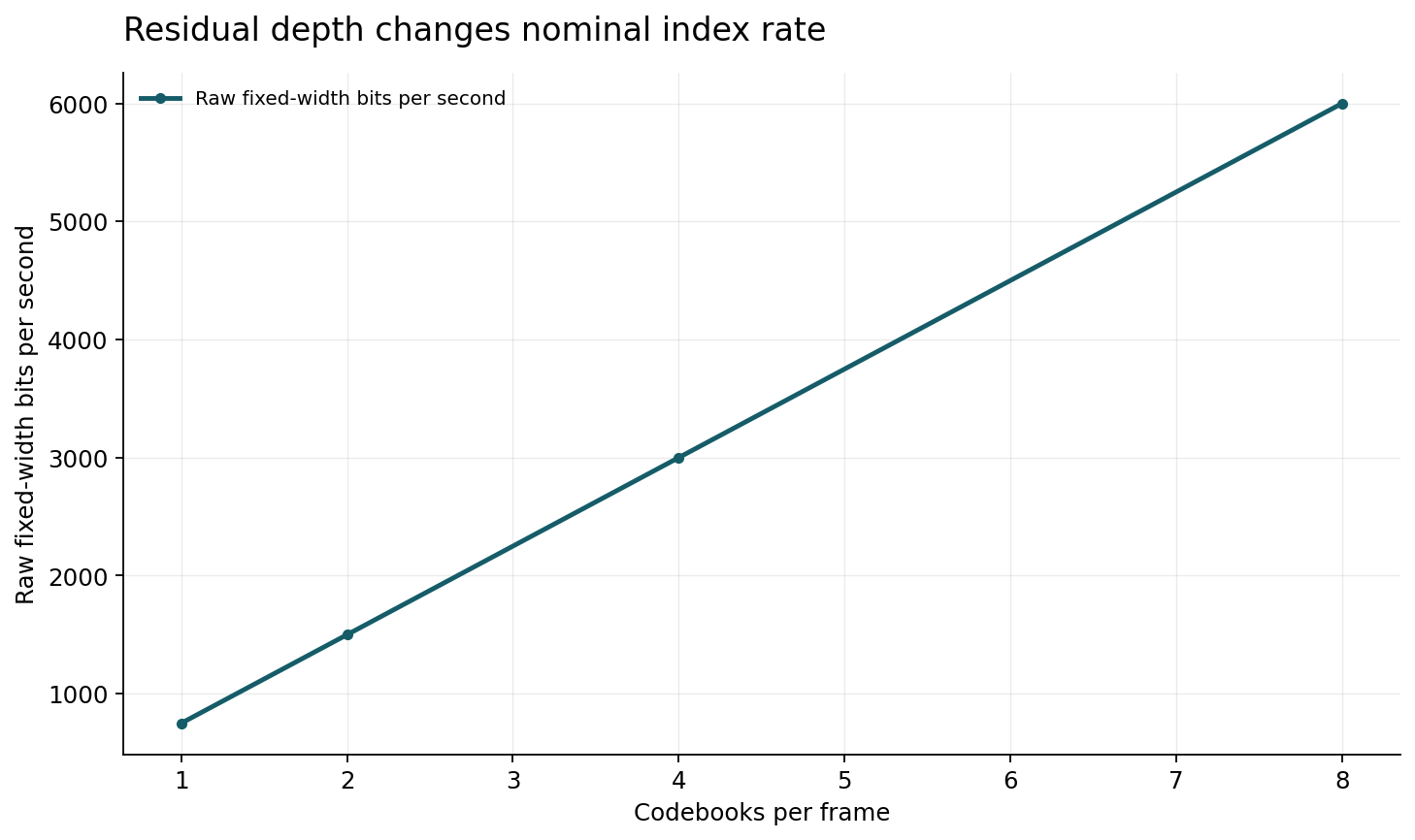
Consider a constructed encoder receiving 24,000 samples per second and emitting one frame per 320 input samples. Its frame rate is seventy-five per second. If each frame has Q code indices from alphabets of size 1024, a fixed-width index representation uses ten bits per index. The nominal raw rate is therefore 750 times Q bits per second.
With one, two, four or eight codebooks, the rates are 750, 1500, 3000 and 6000 bits per second. A two-second clip at four codebooks contains 150 frames and 600 indices, giving 6000 raw index bits. These are stipulated architectural counts, not measured bitstreams from SoundStream, EnCodec or another model. They exclude headers, timestamps, error protection, entropy-model metadata and decoder weights. They also say nothing about reconstruction quality. The calculation is useful because it catches unit errors and distinguishes temporal resolution from residual depth, two choices that can produce the same nominal rate while preserving different information.
4. Equal bitrate need not mean equal representation
A system can reduce raw index rate by emitting fewer frames, using fewer residual components or using smaller alphabets. These changes are not semantically equivalent. Lower temporal resolution can remove rapid variation before quantization. Fewer residual components can reduce refinement precision. A smaller alphabet changes the set of feature values available at each decision. The decoder and training objective determine how the resulting constraints affect sound.
An experiment should therefore report the factorization of the rate and compare reconstruction on carefully chosen signal classes. A steady vowel, a sharp percussion transient, overlapping speakers and a high-frequency texture can stress different aspects of the representation. A single average quality score can conceal those differences. The goal is not to demand that every codec be best on every signal, but to connect its operating points with the information its users care about. The nominal-rate equation provides a bookkeeping identity, while actual quality requires waveform and listening evidence.
5. Training losses define competing reconstruction goals
The EnCodec work studies a streaming quantized representation with perceptual objectives and a loss-balancing mechanism. This supports the importance of how training signals are combined, rather than treating an encoder-decoder architecture as sufficient to determine audio fidelity. The source's subjective evaluations are evidence for its tested domains and protocol; they are not rerun in this article.
Waveform error, spectral reconstruction and adversarial plausibility can prioritize different attributes. A small phase shift can affect a samplewise error strongly while preserving much of the perceived sound. A synthesized texture can sound natural while differing from the source. A speech-oriented score can overlook musical timing or stereo changes. A useful evaluation should state which attributes are primary and which are protected constraints. It should also report failure examples rather than only selected audio demonstrations. Training-loss weights are not themselves an evaluation: the decoded signal must be assessed under an independently specified quality protocol.
Sources: [2]
6. Quantizer improvements need component-level evidence
The improved RVQGAN work studies quantization and synthesis design for high-fidelity audio tokenization. Its relevance is that a codec's representation quality depends on several interacting choices, including code usage and reconstruction objectives. The inspected source does not justify extrapolating its reported compression factors or benchmark advantages to arbitrary signals.
A controlled ablation should distinguish changing the quantizer from changing the encoder, decoder, loss or training data. It should report which codebooks are active, how often symbols occur and whether rare signal classes occupy poorly supported regions of the latent space. A code-usage histogram is informative but incomplete because it does not capture dependencies across time and residual levels. A tokenizer can use many codes while still discarding a particular acoustic distinction. Conversely, uneven code frequencies may be appropriate for the source. Component-level diagnostics should therefore be paired with reconstruction and downstream-generation tests instead of being promoted into a stand-alone certificate of representation quality.
Sources: [3]
7. Semantic and acoustic tokens preserve different distinctions
AudioLM combines representations intended to support long-range structure and high-quality synthesis. This provides a useful design contrast: one token stream need not be optimal simultaneously for semantic organization and local waveform detail. The source motivates a hybrid interface, not an exact theorem that all audio information separates cleanly into semantic and acoustic factors.
A representation optimized for intelligible content may discard speaker, room or musical texture information. A high-fidelity codec can preserve local sound while leaving a prior with a long and difficult sequence to model. Combining streams introduces an alignment contract between their temporal resolutions and meanings. The evaluation should test content preservation, temporal coherence and local fidelity separately. It should also identify what conditioning information is available to each stage. Otherwise, an improvement caused by a richer upstream representation can be attributed incorrectly to the generative prior, or a failure caused by lost information can be blamed on a decoder that never received that information.
Sources: [4]
8. Multiple code streams need an ordering policy
MusicGen models several streams of compressed audio tokens with an interleaving pattern. This makes token layout an explicit architectural choice. A codec frame can contain several codebook decisions, and a prior must decide which of them are predicted sequentially, jointly or with delayed dependencies. Counting frames alone can therefore understate the number of predictive decisions.
The ordering affects which earlier predictions can condition later ones and how generation work is parallelized. A flattened sequence, a depth-first residual order and a delayed multistream pattern can have different compute and dependence structures even when they represent the same number of raw indices. A fair comparison should report both the logical code layout and measured inference behavior. It should include the cost of conditioning encoders and waveform decoding, not only transformer calls. The resulting musical quality also depends on long-range organization, which cannot be inferred from reconstruction fidelity or a short token-level likelihood measurement alone.
Sources: [5]
9. Conditional speech generation has separate correctness axes
VALL-E treats speech synthesis as conditional language modeling over codec codes. This is a meaningful use of the codec interface: the prior predicts a discrete acoustic representation rather than directly regressing a continuous waveform. The source's naturalness and similarity findings do not establish that every generated utterance preserves its intended transcript or every property of an acoustic prompt.
An evaluation should distinguish content accuracy, pronunciation, timing, speaker-related attributes, background conditions and audible artifacts. A model can score well on one axis while failing on another. Prompt duration and selection procedures belong in the test definition, as do any retries or output filtering. When evaluating a research system, demonstrations should be based on appropriate source material and should not be used as evidence of identity verification. The technical point is that an acoustic representation can carry more than words, and a conditional prior must be assessed against the specific attributes that its interface promises to preserve or generate.
Sources: [6]
10. Real-time factor is not first-output latency
Real-time factor compares processing time with audio duration under a specified measurement protocol. A system with a factor below one can keep up on average, yet still delay its first usable output because it buffers a large chunk or requires future context. Conversely, a low-latency streaming system can have less throughput headroom. These are distinct service properties.
A timing contract should identify algorithmic lookahead, input buffering, computation, packetization and output buffering. Some stages can overlap, so summing them without a stated scheduling model can overestimate or underestimate latency. Our illustration deliberately assumes serial non-overlapping stages to make the arithmetic inspectable. It is not a prediction for a real codec. An empirical study should measure time to first decoded sample, steady-state latency and behavior under load, with the same definitions across systems. Reporting only average real-time factor leaves unanswered whether an interactive user receives sound quickly enough.
11. A constructed packet budget exposes buffering
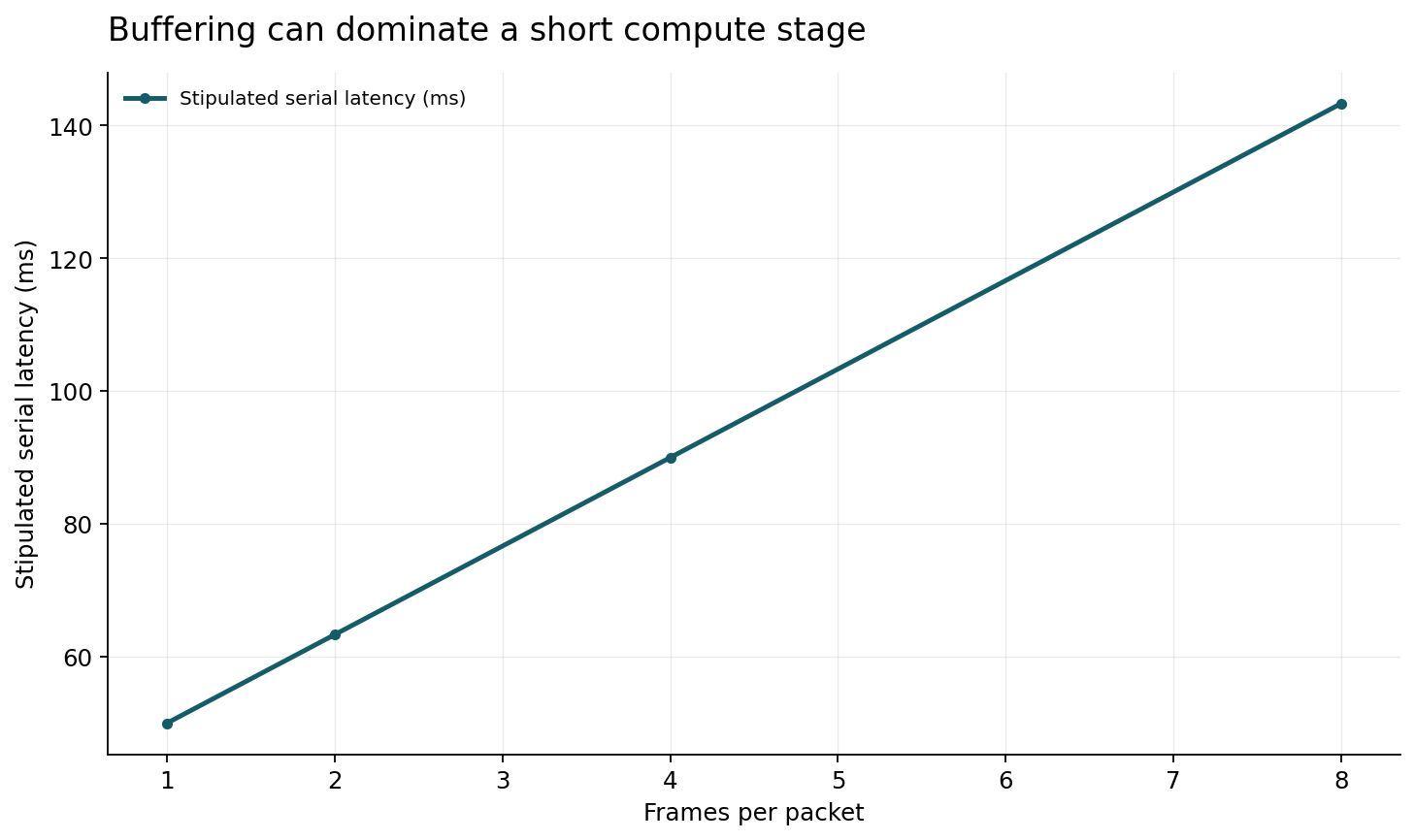
Use the seventy-five-frame-per-second toy representation, whose frame spacing is approximately 13.333 milliseconds. Assume a serial design requiring two frames of future context, a packet containing m frames and ten milliseconds of computation. With no network delay, the stipulated latency is two frame intervals plus m frame intervals plus ten milliseconds. For packets of one, two, four and eight frames, the totals are fifty, approximately 63.333, ninety and approximately 143.333 milliseconds.
These values depend entirely on the declared serial model. A real implementation can overlap work, use causal encoding, emit partial packets or introduce additional buffering. The example shows why a rate setting and a latency setting need separate parameters. Increasing residual codebook count changes the nominal bit count without changing the toy frame spacing; increasing packet duration changes latency even if nominal bits per second stay constant. A benchmark should measure those interventions separately and should not describe a smaller packet or faster processor as an intrinsic improvement in the codec's representation quality.
12. Packet loss and chunk boundaries alter the task
A continuous latent stream evaluated without interruptions is not the same as a deployed packetized audio service. Missing packets, reordered frames, a truncated final chunk or a decoder reset can change reconstruction. The consequences depend on the codec's temporal state, entropy coding and concealment policy; there is no universal behavior implied by the use of neural networks.
A test suite should state whether it evaluates pristine compression, streaming robustness or both. It should include boundaries between chunks and verify that state is carried or reset as specified. If a recovery mechanism synthesizes plausible missing audio, that output should not be mistaken for preserved source content. A generative prior can make concealment sound natural while changing words or musical events. The evaluation should therefore inspect content and timing after simulated transport failures, not only overall perceptual smoothness. All added redundancy, recovery computation and buffering belong in the resource ledger for the resulting service.
Multichannel material adds another timing boundary. A left and right channel can each reconstruct plausibly while a relative delay changes the spatial impression. If streams are packetized independently, their timestamps and reset behavior must preserve the intended alignment. The same issue appears when semantic and acoustic streams have different frame rates: an offset or dropped frame can attach otherwise valid tokens to the wrong interval. A useful boundary test inserts a short event at a known time in each channel and checks relative timing after encode, transport and decode. This tests alignment directly rather than assuming that a high average audio score proves synchronization.
13. Codec reconstruction and prior generation must be split
A poor generated waveform can originate in the codec, the prior or an interface mismatch between them. Codec-only reconstruction tests whether the representation can preserve the relevant source information. Prior tests examine whether generated token sequences follow the desired conditional or unconditional law. Decoder tests examine the behavior of token sequences outside common training regions.
These experiments should use versioned artifacts and separate datasets where appropriate. A codec trained on broad audio does not automatically make a speech or music prior equally broad. A prior can also exploit a small subset of available codes and generate repetitive but locally clean sound. Metrics should therefore include content, diversity and long-range behavior in addition to local fidelity. The claim that a tokenizer is useful for language modeling should be supported by the complete pipeline under a stated task, while keeping enough component evidence to explain which boundary failed when a new domain or conditioning regime is introduced.
14. Decoder compatibility is a semantic requirement
A token identifier has meaning only relative to the codebook, decoder and layout used to interpret it. Updating a codec while preserving the integer-array shape can still change every decoded waveform. A generative prior trained on one codec cannot be assumed compatible with a new codec simply because the number of codebooks and alphabet sizes match.
An artifact should bind sample rate, channel mode, hop size, quantizer order, decoder weights and any entropy-coding rules. Compatibility tests should include reference token sequences and expected decoded behavior, with a stated numerical tolerance when exact waveform equality is not promised. A streaming implementation should also bind its state initialization and chunking policy. These records do not freeze research progress; they make updates assessable. A successful file load or tensor-shape check establishes format compatibility, while audible and semantic compatibility requires additional tests tied to the intended reconstruction or generation contract.
15. The arithmetic checks have explicit limits
The first check divides the sample rate by the hop size, multiplies the resulting frame rate by the number of codebooks and fixed-width index bits, and verifies counts over a two-second interval. It should reject inconsistent units and a nonintegral frame count unless the padding rule is specified. The second check evaluates the serial packet-latency expression for several packet sizes and confirms that bitrate and latency are not treated as the same variable.
Negative tests should omit residual depth, confuse kilobits with kilobytes or interpret real-time factor as first-sample delay. The checker should fail those labeled calculations. Neither script trains a codec, listens to audio or measures a device. The figures are exact architectural counts and a stipulated scheduling model. Their narrowness is useful: every plotted value has a clear origin, while subjective quality, transport robustness and actual timing remain separate empirical obligations rather than being inferred from an index-rate equation.
16. Audio tokens are a timed information interface
The selected sources show how quantized audio representations can support compression, coherent generation, music control and conditional speech synthesis. Their shared token interface does not make their objectives interchangeable. A system must state which acoustic distinctions survive, how a prior uses them and when a decoder can produce usable output.
Our constructed rate and latency examples separate frame spacing, residual depth, index capacity, buffering and compute. They do not rank codecs or predict listening quality. Future evaluations should combine codec-only reconstruction with versioned prior tests, domain-specific failure cases and explicit streaming timing. This would make compact audio representations easier to compare and maintain. A reader could see which savings are counts, which are measured engineering results and which content or timing assumptions must hold when a research model becomes an interactive application.
Core equations and definitions
(1) Constructed sample rate and hop size; not a particular published codec configuration.
(2) Raw fixed-width code-index count, excluding headers, entropy coding and decoder weights.
(3) Stipulated non-overlapping lookahead, packet buffering and compute model; actual pipelines can overlap stages.
(4) Throughput-style ratio under a measurement protocol; it does not determine first-output latency.
Constructed analytical figures
Comparison and reporting contract
| Codebooks Q | Raw index bits/s | Indices for 2 seconds | Nominal index bits for 2 seconds |
|---|---|---|---|
| 1 | 750 | 150 | 1500 |
| 2 | 1500 | 300 | 3000 |
| 4 | 3000 | 600 | 6000 |
| 8 | 6000 | 1200 | 12000 |
Evaluation protocol
- Freeze sample rate, channels, hop size, codebooks and decoder.
- Count complete bitstreams separately from raw index rates.
- Evaluate codec-only reconstruction before prior generation.
- State content, perceptual, speaker and musical quality axes separately.
- Record multistream ordering and conditioning availability.
- Measure first-output, steady-state latency and real-time factor independently.
- Test chunk boundaries, resets and declared packet-loss behavior.
- Include buffering, recovery and decoder work in the service budget.
- Use fixed domain-specific test sets with failures retained.
- Revalidate token/decoder compatibility after model updates.
Limitations
- Index rates are constructed counts, not actual bitstream measurements.
- The latency model assumes serial stages and omits network delay.
- No audio model is trained, timed or subjectively evaluated here.
- Perceptual naturalness does not establish transcript or source-detail correctness.
- The cited systems have different tasks and cannot be universally ranked by these examples.
- The six-source selection is focused rather than exhaustive.
Open research questions
- Which codec-only tests best predict downstream semantic failures of an audio token prior?
- How should a codec artifact specify stable streaming behavior across chunk sizes and device implementations?
- Can token layouts jointly reduce generation dependencies and latency without hiding reconstruction losses?
Evidence and its boundaries
- SoundStream jointly trains an audio encoder/decoder and residual vector quantizer, with structured dropout for variable rates.
- [1] — Reported bitrate, quality and device timing results apply to the tested model and conditions. Inspected: Primary abstract on convolutional encoding/decoding, residual vector quantization and variable-rate training.
- EnCodec studies end-to-end quantized audio compression with perceptual objectives and optional further compression.
- [2] — Perceptual quality, bitrate and latency require their actual configuration and evaluation protocol. Inspected: Primary abstract on streaming quantized representations, loss balancing and subjective evaluation.
- Improved residual quantization and synthesis objectives are studied as components of a high-fidelity audio tokenizer.
- [3] — The review does not reproduce compression factors, subjective scores or universality over arbitrary audio. Inspected: Primary abstract on audio tokenization, quantization design and adversarial/reconstruction losses.
- AudioLM combines token representations aimed at long-range structure and high-quality synthesis.
- [4] — A semantic/acoustic decomposition is a modeling choice, not an exact separation of all information factors. Inspected: Primary abstract on hybrid semantic/acoustic tokens and long-term audio generation.
- MusicGen models multiple codec-token streams using a specified interleaving pattern.
- [5] — Interleaving, token count and actual sequential generation cost must be reported together. Inspected: Primary abstract on MusicGen's multistream compressed representation and token interleaving.
- VALL-E frames speech synthesis as conditional generation over neural codec codes.
- [6] — The source's naturalness and speaker-similarity results are not a guarantee of transcript correctness or broad deployment safety. Inspected: Primary abstract on codec-token language modeling for conditional speech synthesis.
References
- SoundStream: An End-to-End Neural Audio Codec
Neil Zeghidour, Alejandro Luebs, Ahmed Omran, Jan Skoglund, Marco Tagliasacchi. arXiv preprint; IEEE/ACM TASLP article (2021). https://arxiv.org/abs/2107.03312Source scope
Primary abstract on convolutional encoding/decoding, residual vector quantization and variable-rate training.
- High Fidelity Neural Audio Compression
Alexandre Défossez, Jade Copet, Gabriel Synnaeve, Yossi Adi. arXiv preprint (2022). https://arxiv.org/abs/2210.13438Source scope
Primary abstract on streaming quantized representations, loss balancing and subjective evaluation.
- High-Fidelity Audio Compression with Improved RVQGAN
Rithesh Kumar, Prem Seetharaman, Alejandro Luebs, Ishaan Kumar, Kundan Kumar. NeurIPS 2023 (2023). https://arxiv.org/abs/2306.06546v2Source scope
Primary abstract on audio tokenization, quantization design and adversarial/reconstruction losses.
- AudioLM: A Language Modeling Approach to Audio Generation
Zalán Borsos, Raphaël Marinier, Damien Vincent, Eugene Kharitonov, Olivier Pietquin, Matt Sharifi, Dominik Roblek, Olivier Teboul, David Grangier, Marco Tagliasacchi, Neil Zeghidour. IEEE/ACM TASLP (2023). https://arxiv.org/abs/2209.03143v2Source scope
Primary abstract on hybrid semantic/acoustic tokens and long-term audio generation.
- Simple and Controllable Music Generation
Jade Copet, Felix Kreuk, Itai Gat, Tal Remez, David Kant, Gabriel Synnaeve, Yossi Adi, Alexandre Défossez. NeurIPS 2023 (2023). https://arxiv.org/abs/2306.05284v3Source scope
Primary abstract on MusicGen's multistream compressed representation and token interleaving.
- Neural Codec Language Models are Zero-Shot Text to Speech Synthesizers
Chengyi Wang, Sanyuan Chen, Yu Wu, Ziqiang Zhang, Long Zhou, Shujie Liu, Zhuo Chen, Yanqing Liu, Huaming Wang, Jinyu Li, Lei He, Sheng Zhao, Furu Wei. arXiv preprint (2023). https://arxiv.org/abs/2301.02111Source scope
Primary abstract on codec-token language modeling for conditional speech synthesis.