
Deep Learning Representations / DEEP LEARNING II
When Class Means Form a Simplex: Neural Collapse, Geometric Diagnostics, and Their Limits
An exact three-class construction separates within-class compression, simplex geometry, classifier alignment and generalization.
English original. Translations of this new review are not yet available.
Abstract
Neural collapse describes a collection of last-layer geometric regularities, rather than a single scalar measure of representation quality. This source-based analytical review distinguishes empirical observations from simplified optimization models and derives a reproducible three-class simplex example. Exact scatter calculations, a nearest-center identity, translation controls, and a degenerate-collapse counterexample show why diagnostics need centering, denominators, and explicit classifier assumptions. A proposed evaluation protocol tests each component separately and treats training geometry as evidence about observed representations rather than an automatic guarantee of unseen-data performance.
In this paper
- 1. A collection of phenomena deserves separate tests
- 2. The original observation and its scope
- 3. Define means and scatter before normalizing
- 4. Constructing an exact three-class simplex
- 5. Exact scatter and a denominator guard
- 6. The simplex Gram matrix identifies another component
- 7. Simplified feature models explain conditional optima
- 8. Nearest-center decisions need equal norms and alignment
- 9. Translation and scaling are diagnostic controls
- 10. MSE dynamics are not cross-entropy dynamics
- 11. Imbalance changes the reference question
- 12. Training geometry does not determine an unseen map
- 13. A verification and evaluation protocol
- 14. A useful theory keeps its counterexamples visible
1. A collection of phenomena deserves separate tests
A representation can become more compact within each training class while its class means remain irregular. Class means can form an elegant symmetric configuration while a classifier points in different directions. A classifier can agree with nearest-center decisions on observed examples without having that property throughout feature space. These distinctions make neural collapse interesting and make a single attractive scatter plot an incomplete diagnosis.
This article studies the geometry of a last-layer representation in a finite balanced classification setting. Its purpose is to explain what several measurements establish and where inference can fail. Selected primary papers provide empirical and theoretical context. An author-constructed three-class example supplies exact quantities that another reader can reproduce without a GPU or a training dataset. The example is not a new benchmark and does not claim that all deep networks follow its trajectory. By separating within-class scatter, centered simplex geometry, classifier alignment and decision equivalence, the analysis turns a broad descriptive phrase into a set of falsifiable claims. The resulting audit is useful even when the network displays only some components, or when an apparently favorable statistic arises from an uninformative degenerate representation.
2. The original observation and its scope
Papyan, Han and Donoho describe four related patterns during the terminal phase of training in selected classification experiments. Within-class last-layer activations approach their class means; centered means acquire simplex equiangular tight-frame geometry; classifier directions align with those means up to scaling; and classifier decisions approach a nearest-class-center rule. These are linked observations, but a measurement of one is not a direct measurement of all four.
The terminal phase matters because the description concerns continued training after classification error has effectively vanished while the training loss is further reduced. It does not assert that the same pattern must hold at initialization, at an arbitrary early-stopped checkpoint, or under every data imbalance and architectural restriction. In this review, the source supports the terminology and the reported phenomenon within its experimental scope. We do not import its empirical accuracy or robustness conclusions as results of the finite construction. A useful replication should record the checkpoint regime, the loss and regularization, the class balance, and whether the geometry is measured on training observations or held-out observations. These choices determine what the plotted representation can reasonably be said to describe.
Sources: [1]
3. Define means and scatter before normalizing
Let h_ci be a d-dimensional feature vector for observation i in class c, with the same number m of observations in each of C classes. Define the class mean mu_c as the average within that class and the global mean mu as the average of class means. The centered class means are v_c=mu_c minus mu. Equal class weighting is an explicit convention here, and is distinct from observation-weighted centering when classes are imbalanced.
Define within-class scatter W as the average outer product of h_ci minus mu_c. Define between-class scatter B as the average outer product of v_c. Both are positive semidefinite matrices. For the finite example we use the simple scalar ratio r=trace(W)/trace(B), provided the denominator is positive. This is a declared scatter diagnostic, not an assertion that every paper uses the same canonical NC1 normalization. Keeping the matrices available is valuable: one scalar can hide direction-specific variation and rank deficiencies. A reproducible report should state normalization factors, centering convention, pseudoinverse thresholds if used, and how absent classes or zero denominators are handled. Otherwise even implementations with identical input features can produce incomparable geometry scores.
4. Constructing an exact three-class simplex
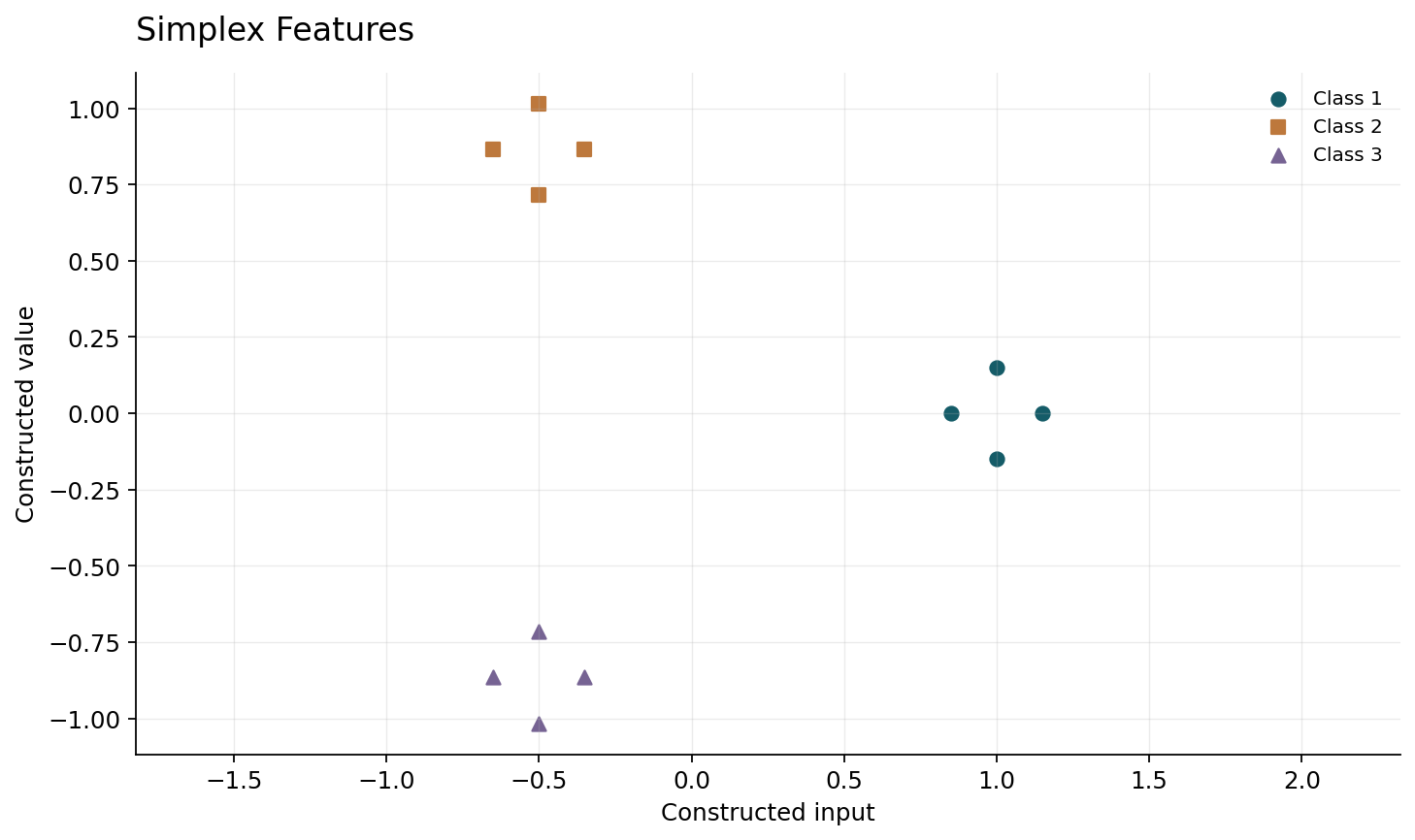
Choose three unit means in two dimensions: mu1=(1,0), mu2=(-one half, square root three divided by two), and mu3=(-one half, minus square root three divided by two). Their sum is zero. Each pair of different means has inner product minus one half. Their equal norms and equal pairwise angles give the centered regular simplex for three classes, and their span has the required dimension two.
For each class create four features: the mean plus and minus epsilon times the first coordinate vector, and the mean plus and minus epsilon times the second coordinate vector. The symmetric offsets sum to zero, so the empirical class means remain exactly the declared simplex vertices for every epsilon. No learning algorithm is being simulated. Epsilon is an explicit construction parameter controlling within-class spread while holding the class means fixed. This separation lets us test independent diagnostics without confusing them with a training trajectory. The example also makes the distinction between an empirical collection and an underlying distribution visible: the twelve listed feature vectors are all the data used in the arithmetic. Generalization would require an additional model for unseen observations.
5. Exact scatter and a denominator guard
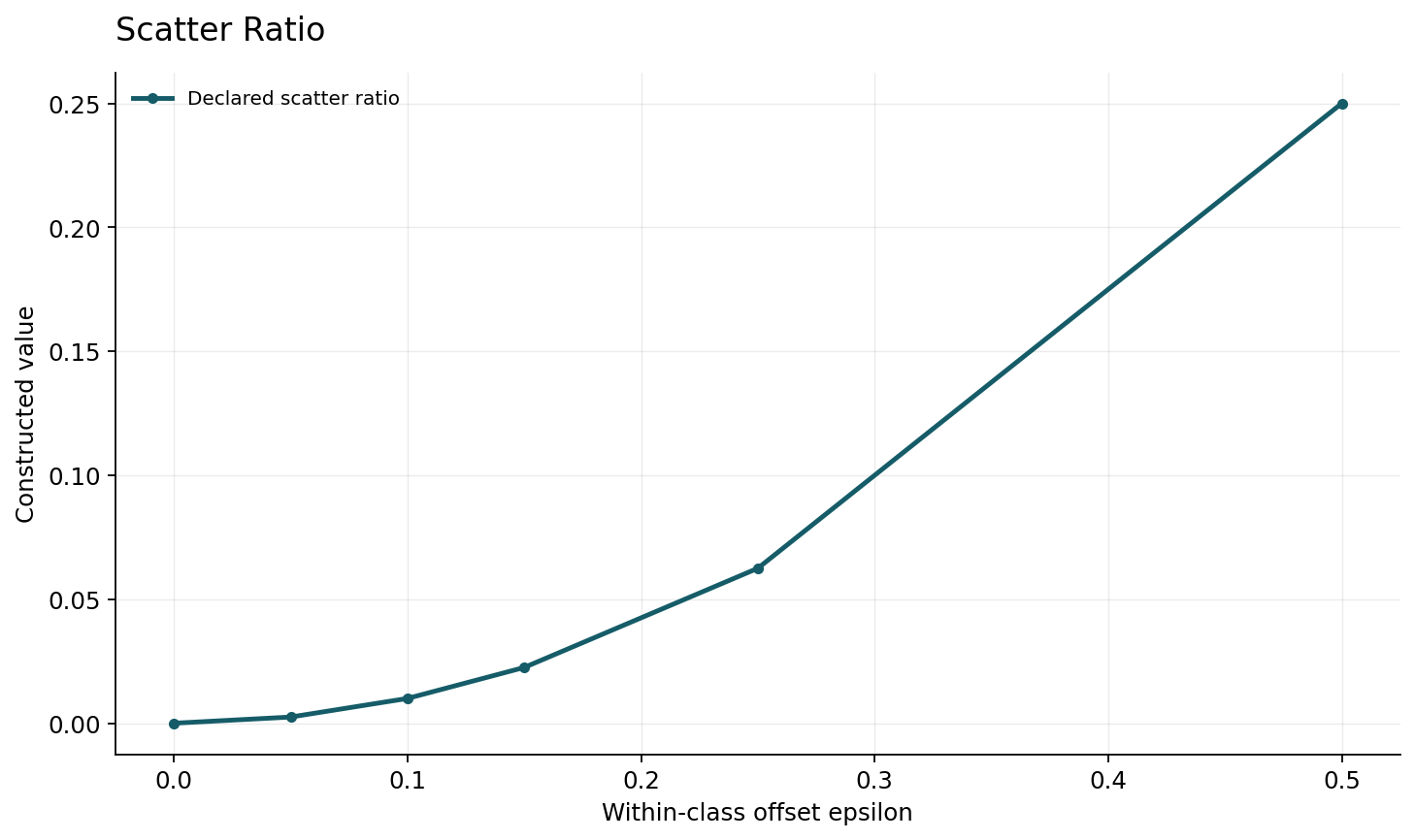
For the four offsets within one class, the average outer product is epsilon squared divided by two times the two-dimensional identity matrix. The same holds across the balanced classes, so W has that value. Averaging the three mean outer products gives B equal to one half times the identity. Therefore trace(W)=epsilon squared, trace(B)=one, and the declared ratio r equals epsilon squared. Shrinking epsilon reduces within-class variation without changing simplex geometry.
The computation immediately exposes a negative control. If all features of all classes are set to the zero vector, within-class scatter is zero, but between-class scatter is also zero. Reporting r as zero by replacing the denominator with an arbitrary constant would label a completely uninformative representation as perfect compression. The correct result under the declared definition is undefined. A numerical implementation should return an explicit degenerate status, not silently score it as favorable. Similar care is needed when classes have tiny mean separation: a denominator stabilized with a numerical epsilon changes the statistic and must be disclosed. Stability of the computation and scientific interpretability are related, but neither is achieved by hiding singular cases.
6. The simplex Gram matrix identifies another component
Normalize each nonzero centered class mean to unit length and form the C by C Gram matrix G of pairwise inner products. A unit simplex has diagonal entries one and off-diagonal entries minus one divided by C minus one. For C=3 the target is therefore minus one half. The construction matches this target exactly at every epsilon, even when within-class scatter is large. That observation demonstrates why within-class compression and between-class geometry should be reported separately.
Dimension is a real constraint. A nondegenerate C-class simplex requires a span of dimension at least C minus one. If the representation dimension is smaller, demanding the exact target would be geometrically impossible. Conversely, having a sufficiently large feature dimension does not force the observed means to form a simplex. One should report the effective rank of centered means and the residual from the target Gram matrix, rather than assume the target from the class count. Unequal mean norms also deserve a separate diagnostic: normalizing them before computing angles can conceal substantial norm imbalance. The geometry report should preserve both raw norm variation and angular residuals.
7. Simplified feature models explain conditional optima
Mixon, Parshall and Pi introduce an unconstrained-features model that isolates an analytically manageable part of the learning problem. Zhu and colleagues analyze a particular unconstrained-feature cross-entropy formulation with weight decay and characterize its global landscape. Such results explain what solutions of their stated optimization problems look like. They do not remove the constraints imposed by an actual network's feature map or guarantee that every training run reaches the corresponding global solution.
This distinction is productive rather than dismissive. A simplified model identifies a candidate mechanism and predicts measurable geometry. The full-network experiment then tests whether its features and optimization regime approximate the conditions that make the mechanism relevant. If they do not, the discrepancy can reveal missing constraints, finite-width effects, class imbalance, or optimization behavior. The current construction has freely specified features, so it is appropriate for checking geometric identities. It is insufficient for validating an optimization-landscape theorem about a different objective. No convergence curve in this article is presented as a reproduction of these primary papers, and no idealized optimum is substituted for a measured representation from a deployed classifier.
8. Nearest-center decisions need equal norms and alignment
Set the classifier weight for class c equal to mu_c and set all class biases to zero. Its score on feature h is the inner product mu_c with h. The squared distance from h to mu_c equals the squared norm of h plus the squared norm of mu_c minus twice that score. Because all class-mean norms equal one, the first two terms are common across classes. Maximizing the score is therefore exactly equivalent to minimizing squared distance to the mean, with a shared tie-breaking convention.
This identity holds for every feature h, not only the twelve constructed observations. It depends on the declared classifier. If weights are rotated independently, biases differ, or mean norms vary without a compensating bias, the same nearest-center statement need not hold. Classifier alignment should therefore be measured explicitly rather than inferred from a simplex plot alone. A finite dataset can exhibit accidental agreement even when decision boundaries differ elsewhere. Checking boundary cases and arbitrary feature probes helps distinguish an algebraic equivalence from limited observed agreement. For a real model, report both alignment residuals and the fraction of prediction disagreements with the specified nearest-center rule.
9. Translation and scaling are diagnostic controls
Translate every feature by the same vector t. Class means translate by t, but centered means and within-class offsets remain unchanged. Consequently W, B and the centered Gram matrix are invariant. A computation based on uncentered mean angles generally changes. This provides a simple negative control for an implementation that claims to measure centered simplex geometry. The expected invariance follows from the definition and can be tested without any learning assumptions.
To preserve the original classifier scores after translating features, retain weight mu_c and add bias minus the inner product mu_c with t. Then each translated feature has exactly its original score. This explicit bias adjustment matters: translating features while keeping every classifier component fixed changes the predictor. Uniformly scaling all features also changes some raw quantities while leaving ratios and normalized angles invariant, depending on the metric. A report should state which invariances it intends to preserve and test them independently. Invariance does not make a diagnostic universally predictive, but failed declared invariance can expose an implementation error before more expensive experiments are interpreted.
10. MSE dynamics are not cross-entropy dynamics
Han, Papyan and Donoho investigate neural collapse under mean squared error, including a decomposition that separates classifier optimality from feature-related terms and an analysis along a central path. Lu and Steinerberger study a sphere-constrained variational cross-entropy problem with a dimension condition for simplex minimizers. These analyses concern different objectives and constraints. Their conclusions cannot be merged into a claim that one unrestricted dynamical theorem covers every loss and network.
The geometric target can be shared while the route to it differs. For example, a fixed norm constraint, explicit weight decay, and an unregularized loss approaching an infimum can produce different notions of a finite optimizer or asymptotic limit. A careful theoretical comparison lists those differences before comparing predicted configurations. The construction here deliberately avoids a dynamical claim: changing epsilon is not gradient descent, and the plotted epsilon-squared scatter ratio is not a training curve. Researchers can use it to verify diagnostic code, then separately test whether a specified training process exhibits analogous geometry. That separation prevents an analytically convenient parameter sweep from being mistaken for evidence about optimizer convergence.
11. Imbalance changes the reference question
Fang and colleagues' layer-peeled analysis distinguishes class-balanced simplex behavior from a minority-collapse phenomenon in an imbalanced setting. The source provides a reason to treat class proportions as part of the problem definition rather than a harmless dataset detail. It does not license predicting a universal imbalance threshold from the balanced three-class construction. A real analysis should retain class counts and per-class outcomes.
Under imbalance, observation-weighted and class-weighted global means differ. The same raw features can therefore have different centered Gram matrices under the two conventions. Both may answer useful questions, but the chosen convention must be reported. Macro-averaged geometry gives equal importance to rare classes, whereas observation-weighted geometry reflects the observed frequency distribution. Neither substitutes for per-class predictive performance. A representation can look compact on majority classes while leaving minority classes poorly separated. An audit should show class-mean norms, within-class scatter and pairwise confusion by class, and should examine whether rare classes disappear from a normalized average. Aggregate symmetry is not a sufficient account of a classifier's behavior when the data distribution assigns unequal importance or unequal support to different labels.
Sources: [5]
12. Training geometry does not determine an unseen map
Two feature maps can agree on every training observation and differ arbitrarily on unobserved inputs. Both maps then have exactly the same training class means, scatter matrices and classifier alignment, while producing different held-out predictions. A finite lookup construction makes this explicit: preserve all twelve training feature vectors, and assign a new probe either to its correct mean or to a different class mean. Training geometry remains unchanged. The probe decision changes.
This logical example does not show that learned neural features behave arbitrarily in practice. It shows that training geometry alone does not identify the extension of the feature map beyond observed inputs. To connect collapse to generalization one needs further assumptions, evidence, or a mechanism constraining that extension. Held-out geometry can add information, but it also depends on the evaluation distribution and labels. A useful study compares training and held-out diagnostics without using the final test labels to choose the preferred statistic. It should also investigate subgroup variation, shifts and failure cases rather than equating a smaller training scatter ratio with universal representational quality. An elegant symmetric configuration is an observed property, not a complete theory of prediction.
13. A verification and evaluation protocol
The supplied finite analysis computes means, W, B, their traces and the Gram residual directly from the twelve constructed features. It checks the epsilon-squared ratio over a declared grid, verifies centered-geometry translation invariance, and compares classifier and nearest-center decisions on feature probes. It also tests the all-zero degeneracy and the unchanged-training/different-probe extension counterexample. The scientific figures show the constructed feature positions and the exact scatter-ratio curve, with no invented training epochs or measured accuracies.
For a network study, preregister the representation layer, centering, class weighting, numerical rank tolerance and checkpoint schedule. Preserve classifier weights and biases, and state evaluation mode for normalization or stochastic layers. Record the training loss regime and achieved fit so comparisons do not mix early and terminal phases. Use multiple runs and retain failed or noncollapsed runs. Report each component separately before offering a combined interpretation. If an intended ratio is undefined, publish the undefined status and its cause. That outcome is evidence about the representation and should not be converted into a convenient zero. These steps make the geometry inspectable and keep a descriptive result distinct from a causal or generalization claim.
14. A useful theory keeps its counterexamples visible
Neural collapse offers a striking way to examine the relation between labels, representations and last-layer classifiers. The literature's empirical observations and simplified models become more informative when their assumptions remain visible. The finite construction demonstrates that compression, simplex geometry and nearest-center decisions can be checked independently, and that an apparently perfect scalar can arise from a degenerate representation if denominators are mishandled.
Open questions concern which parts of the geometry transfer across imbalance, architectural constraints, training objectives and distribution shift, and what additional structure connects training geometry to the behavior of an unseen feature map. Answering them requires both mathematically stated models and experiments designed to expose failures. A favorable visualization should survive centering and translation controls, preserve per-class information, and agree with the claimed classifier relationship. It should also be accompanied by an honest statement of what it cannot determine. That combination makes the phenomenon a productive research instrument: a set of concrete geometric claims that can be reproduced, challenged and extended, rather than a single aesthetic signature treated as proof that a representation is universally good.
Core equations and definitions
(1) Balanced class weighting is declared; imbalanced alternatives differ.
(2) Explicit within- and between-class scatters.
(3) Author-constructed exact three-class unit simplex.
(4) For four symmetric offsets ±epsilon e1,±epsilon e2 per class; r is the article's declared scatter ratio, not every paper's NC1 normalization.
(5) Equal norms and aligned zero-bias classifier imply exact nearest-center decisions.
Constructed analytical figures
Comparison and reporting contract
| Component | Separate evidence | Important failure control |
|---|---|---|
| Within-class compression | W and a declared nondegenerate ratio | All-zero features give 0/0 |
| Centered simplex geometry | Mean norms and centered Gram residual | Translation leaves centered geometry fixed |
| Classifier alignment | Weights, means, biases, alignment residual | Simplex means alone do not fix classifier |
| Nearest-center rule | Declared rule and decision disagreement | Finite observed agreement may be accidental |
| Generalization | Independent evaluation or additional theory | Training map can have different unseen extensions |
Evaluation protocol
- Compute declared finite features and exact scatter identities.
- Verify translation controls, nearest-center equivalence and degeneracy handling.
- Separate observed training geometry from proposed held-out evaluation.
- Do not treat epsilon sweep as an optimizer trajectory.
Limitations
- No neural network was trained for these constructed figures.
- Simplified feature-model theorems require their own loss, balance and constraint assumptions.
- Training geometry alone does not determine unseen feature-map behavior.
Open research questions
- Which geometric components persist under realistic imbalance and constraints?
- What conditions connect training collapse to unseen-data representations?
- Which diagnostics retain per-class information while remaining numerically stable?
Evidence and its boundaries
- Reports four related terminal-training phenomena involving within-class variation, centered class-mean simplex geometry, classifier alignment and nearest-center decisions.
- [1] — Only the inspected source scope is used; no source benchmark or proof is claimed as independently reproduced. Inspected: Primary title, authors, version record and abstract inspected on 2026-10-28; attributed claims restricted to this scope.
- Introduces a simplified unconstrained-features model to study empirical-risk landscape explanations; it is not a theorem about arbitrary full-network training.
- [2] — Only the inspected source scope is used; no source benchmark or proof is claimed as independently reproduced. Inspected: Primary title, authors, version record and abstract inspected on 2026-10-28; attributed claims restricted to this scope.
- Studies a specified unconstrained-feature cross-entropy model with weight decay and simplex global minimizers; assumptions are model-specific.
- [3] — Only the inspected source scope is used; no source benchmark or proof is claimed as independently reproduced. Inspected: Primary title, authors, version record and abstract inspected on 2026-10-28; attributed claims restricted to this scope.
- Analyzes MSE decomposition and renormalized flow on a central path, motivated by experiments; this article does not reproduce those training dynamics.
- [4] — Only the inspected source scope is used; no source benchmark or proof is claimed as independently reproduced. Inspected: Primary title, authors, version record and abstract inspected on 2026-10-28; attributed claims restricted to this scope.
- Separates balanced simplex results from minority-collapse behavior in an imbalanced layer-peeled model.
- [5] — Only the inspected source scope is used; no source benchmark or proof is claimed as independently reproduced. Inspected: Primary title, authors, version record and abstract inspected on 2026-10-28; attributed claims restricted to this scope.
- Analyzes a sphere-constrained variational cross-entropy problem, including a dimension condition for simplex minimizers.
- [6] — Only the inspected source scope is used; no source benchmark or proof is claimed as independently reproduced. Inspected: Primary title, authors, version record and abstract inspected on 2026-10-28; attributed claims restricted to this scope.
References
- Prevalence of Neural Collapse during the terminal phase of deep learning training
Vardan Papyan, X.Y. Han, David L. Donoho. Primary arXiv paper record (2020). https://arxiv.org/abs/2008.08186Source scope
Primary title, authors, version record and abstract inspected on 2026-10-28; attributed claims restricted to this scope.
- Neural collapse with unconstrained features
Dustin G. Mixon, Hans Parshall, Jianzong Pi. Primary arXiv paper record (2020). https://arxiv.org/abs/2011.11619Source scope
Primary title, authors, version record and abstract inspected on 2026-10-28; attributed claims restricted to this scope.
- A Geometric Analysis of Neural Collapse with Unconstrained Features
Zhihui Zhu, Tianyu Ding, Jinxin Zhou, Xiao Li, Chong You, Jeremias Sulam, Qing Qu. Primary arXiv paper record (2021). https://arxiv.org/abs/2105.02375Source scope
Primary title, authors, version record and abstract inspected on 2026-10-28; attributed claims restricted to this scope.
- Neural Collapse Under MSE Loss: Proximity to and Dynamics on the Central Path
X.Y. Han, Vardan Papyan, David L. Donoho. Primary arXiv paper record (2022). https://arxiv.org/abs/2106.02073Source scope
Primary title, authors, version record and abstract inspected on 2026-10-28; attributed claims restricted to this scope.
- Exploring Deep Neural Networks via Layer-Peeled Model: Minority Collapse in Imbalanced Training
Cong Fang, Hangfeng He, Qi Long, Weijie J. Su. Primary arXiv paper record (2021). https://arxiv.org/abs/2101.12699Source scope
Primary title, authors, version record and abstract inspected on 2026-10-28; attributed claims restricted to this scope.
- Neural Collapse with Cross-Entropy Loss
Jianfeng Lu, Stefan Steinerberger. Primary arXiv paper record (2021). https://arxiv.org/abs/2012.08465Source scope
Primary title, authors, version record and abstract inspected on 2026-10-28; attributed claims restricted to this scope.