
Deep Reinforcement Learning / DEEP LEARNING II
The Action Missing from the Dataset: Support, Pessimism, and Identification in Offline Deep Reinforcement Learning
Two observationally identical worlds and a solvable backup recurrence expose what fixed data can and cannot justify.
English original. Translations of this new review are not yet available.
Abstract
Offline reinforcement learning must improve decisions using fixed data while controlling extrapolation beyond the behavior that produced it. This analytical review separates support, identification, bootstrapping, conservative objectives, policy extraction and evaluation. A one-state two-action construction proves that missing action outcomes cannot be recovered from identical logs without extra assumptions. Exact scalar backup-error and importance-weight calculations then illustrate how horizon and weak coverage magnify uncertainty. The resulting protocol tests algorithmic claims and dataset provenance while distinguishing constructed arithmetic from reproduced deep-RL benchmarks or deployment guarantees.
In this paper
- 1. More optimization cannot create an unobserved outcome
- 2. Define the data source and target policy
- 3. Two worlds that no logged sample can distinguish
- 4. Support is more specific than dataset size
- 5. Why a maximum can select an unsupported error
- 6. An exact scalar error-accumulation example
- 7. Pessimism changes a decision criterion
- 8. Avoiding unseen queries is a design choice
- 9. Weak support can make an unbiased estimator noisy
- 10. Dataset provenance is part of the benchmark
- 11. Policy selection can reuse evaluation information
- 12. Finite checks that expose the boundary
- 13. A support-aware evaluation protocol
- 14. Pessimism is useful when uncertainty stays visible
1. More optimization cannot create an unobserved outcome
Offline reinforcement learning starts from data collected before the current learning procedure and does not freely gather new online experience during training. This creates a distinctive tension: a policy should improve on the behavior represented in the data, yet its preferred actions may lead to outcomes that the data do not identify. A sufficiently expressive value network can assign numbers to those actions. The existence of those numbers does not mean they are supported estimates.
This article examines the boundary using an exact two-action decision problem. Two worlds generate identical logs under the behavior policy but have different optimal actions. A second construction shows how repeated backups can amplify a persistent local error, and a third quantifies the variance caused by weak action coverage in a one-step importance estimator. Selected primary offline deep-RL papers provide algorithmic context. None of their benchmark results is claimed as reproduced here. The purpose is to distinguish a useful computational method from the additional assumptions and evidence needed to interpret its output. The analysis is about statistical identification and evaluation, not advice to deploy a learned policy in an untested consequential environment.
2. Define the data source and target policy
Consider a discounted Markov decision process with states, actions, rewards, transition probabilities and discount gamma below one. A behavior policy generates a fixed collection of transitions or trajectories. A target policy is learned or evaluated using that collection. The target return depends on the state-action distribution induced by following the target, which can differ from the data distribution even if both policies operate in the same nominal environment.
The offline-RL tutorial by Levine and colleagues frames this fixed-data setting and its central challenges. For a concrete study, the dataset description should include behavior policies, collection periods, reset rules, reward construction, terminal conditions and any filtering. A mixture of policies need not be summarized accurately by one undocumented propensity. Trajectory dependence also matters: treating correlated time steps as independent observations can understate evaluation uncertainty. The learner may generalize across related states or actions, but that generalization is an assumption or learned inductive bias, not direct observation. A clear report identifies which target quantities are supported by logged outcomes and which depend on extrapolation. It also distinguishes access to a simulator for final evaluation from access to online data during training.
Sources: [6]
3. Two worlds that no logged sample can distinguish
Construct one initial state with two available actions, a0 and a1, each followed immediately by termination. In both worlds, a0 gives reward one. In world L, a1 gives reward minus one hundred; in world H, it gives reward one hundred. The behavior policy always chooses a0. Therefore every logged transition is the same state, action a0, reward one, and terminal outcome in either world, regardless of how many transitions are collected.
The optimal action is a0 in world L and a1 in world H. Any learner receiving only these logs sees the same input distribution in both worlds. It cannot determine which world generated them without additional information or assumptions. A randomized learner may choose different actions across its own random seeds, but its output distribution is still identical across the two indistinguishable worlds. No amount of repeating the same supported observation resolves the missing action outcome. This is an identification argument, not a claim that offline learning is always impossible. Structural assumptions, prior information, broader data coverage or new interaction can connect observed and unobserved outcomes. The report must state which of those bridges it actually uses.
4. Support is more specific than dataset size
The construction has arbitrarily many observations but zero support for a1. Dataset size alone therefore does not measure coverage relevant to a target policy. In longer-horizon problems, support concerns states and histories reached by the target as well as individual action labels. An action observed in one state does not directly identify its outcome in another. Continuous actions introduce another distinction: approximate similarity may permit generalization, but an exactly repeated action is not required for every reasonable model and similarity is not a theorem by itself.
A practical audit should characterize coverage at the granularity justified by the problem's structural assumptions. It should state what distance or representation defines similar observations, how rare regions are treated, and how the learned policy departs from the dataset. Visual overlap in an embedding can be a useful diagnostic without proving that reward and transition functions are smooth in that embedding. Likewise, a density estimate may be unreliable precisely where coverage is poor. The right conclusion is a conditional one: the target value is estimable under declared coverage and generalization conditions, with uncertainty reflecting the data and model. Replacing that statement with a large transition count hides the problem rather than solves it.
5. Why a maximum can select an unsupported error
A Q-learning backup uses a reward plus a discounted estimate of future value, often involving a maximum or a policy-selected action. If the function approximator assigns an overly large value to an unsupported action, the backup can propagate that value into estimates for otherwise observed transitions. The maximization operator preferentially selects optimistic errors. A small loss on logged state-action pairs does not by itself constrain all actions queried by this process.
Fujimoto and colleagues introduce batch-constrained reinforcement learning to address extrapolation in fixed-data settings by restricting action selection toward the data. Kumar and colleagues' BEAR work identifies unsupported-action bootstrapping error and studies constraints that mitigate its accumulation. These sources motivate examining the actual backup queries, not only the training residual. They do not imply that a particular distance constraint universally identifies the best action in an unknown environment. In the two-world construction, restricting the policy to a0 avoids the unseen catastrophic action in world L but also forgoes the large reward available in world H. This tradeoff is a consequence of missing information. An algorithm can choose a justified conservative behavior without claiming that the unseen alternative has been accurately valued.
6. An exact scalar error-accumulation example
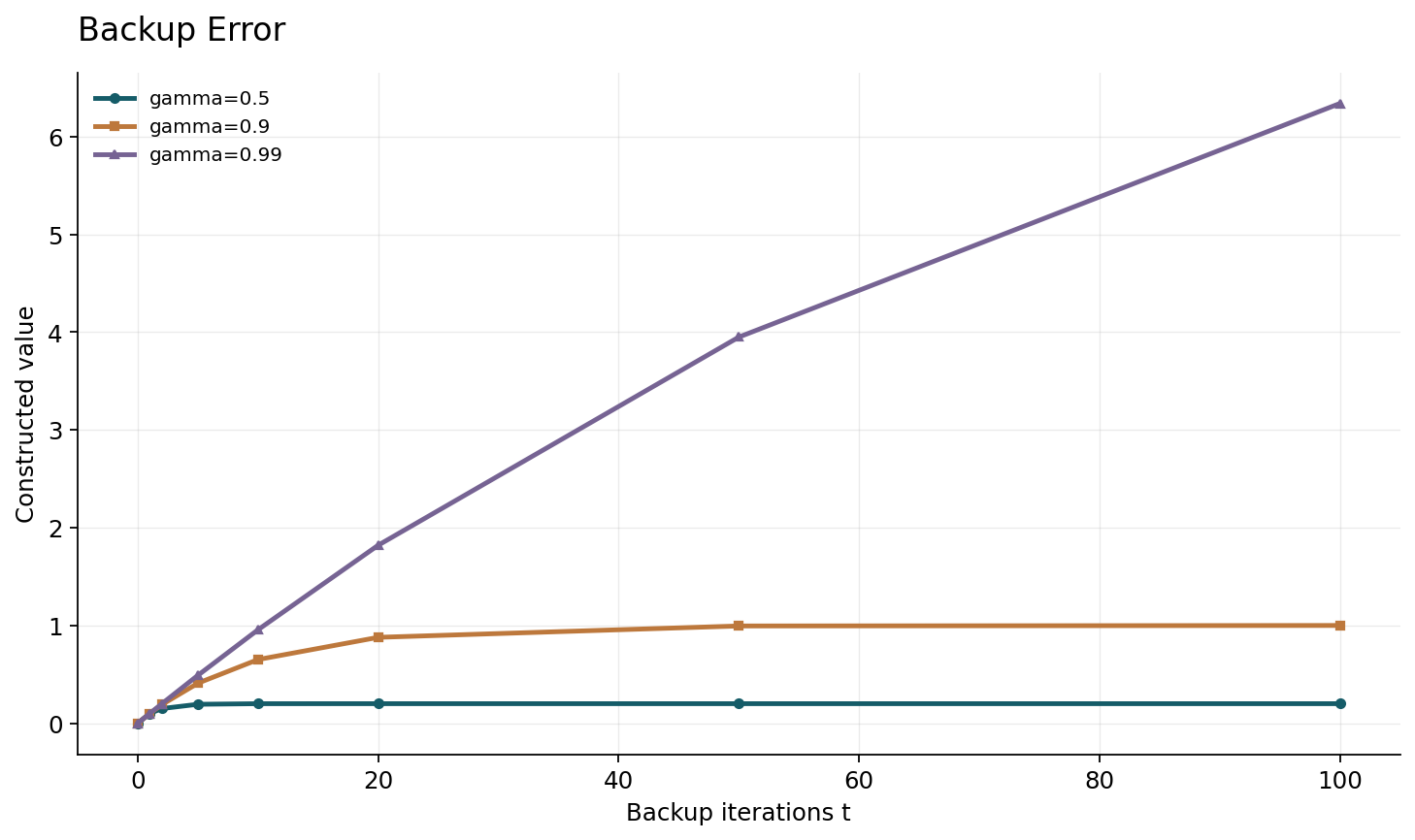
Let a scalar backup-error sequence obey e_(t plus one)=delta plus gamma times e_t, with e_0=0 and nonnegative delta. Repeated substitution gives e_t=delta times one minus gamma to the t, divided by one minus gamma. The limiting error is delta divided by one minus gamma. This is an exact recurrence with a persistent additive perturbation, not a measured learning curve from a neural agent.
The formula exposes a horizon effect. Holding delta fixed, a discount closer to one permits more accumulation. With delta .1, the limits are .2 for gamma .5, one for gamma .9, and ten for gamma .99. These values do not establish the actual error of an offline-RL algorithm. In a finite discounted setting, a related sup-norm argument can use the Bellman operator's contraction when the perturbation is uniformly bounded over the relevant domain. An average residual on logged data is a different object and need not provide that uniform bound, especially for unsupported actions. Every application of the geometric factor should therefore state the norm, domain and error premise. Otherwise an exact algebraic amplification formula can create unwarranted confidence about an unmeasured local error.
7. Pessimism changes a decision criterion
Conservative Q-learning studies a regularized value objective intended to avoid overestimation and provides lower-bound and improvement statements under its specified assumptions. This is a substantive algorithmic approach to the support problem. A practitioner must still check whether the conditions and estimation controls required by the claimed result apply to the implementation and dataset. Adding a penalty with a familiar name is not an independent proof that every fitted value is a valid lower confidence bound.
An illustrative one-step objective can fit the observed q0 to reward one while penalizing log of one plus exp(q1 minus q0). Reducing q1 lowers that penalty, even though the data contain no observation of a1. The regularizer expresses a preference against optimistic unseen values. It does not discover whether world L or world H is true. In this simple unbounded parameterization, q1 can decrease without a finite minimizer for that component, further showing why the complete objective and constraints matter. This example is not the full CQL algorithm. It isolates the distinction between a conservative inductive choice, an identified outcome, and a mathematically justified statistical bound.
Sources: [3]
8. Avoiding unseen queries is a design choice
Kostrikov, Nair and Levine's implicit Q-learning uses expectile value fitting and advantage-weighted behavioral cloning while avoiding explicit unseen-action Q queries during its training procedure. The source provides one way to reconcile policy improvement with fixed data. Its generalization results and empirical performance remain tied to the method and evaluated settings, rather than resolving arbitrary zero-support identification problems.
The two-world example still applies: if no logged observation or structural assumption distinguishes the worlds, changing the optimization formulation cannot reveal which reward a1 would produce. A method may improve by selecting better supported actions across a rich dataset, combining information across related states, or exploiting valid function approximation. Those mechanisms are valuable and should be described precisely. A comparative study can inspect which state-action values each method queries, how policy extraction changes support, and what assumptions permit generalization between records. It should also separate the quality of a fitted value model from the quality of the extracted policy. An apparently conservative value estimate can still be paired with a policy-extraction implementation that changes action probabilities in poorly covered regions.
Sources: [4]
9. Weak support can make an unbiased estimator noisy
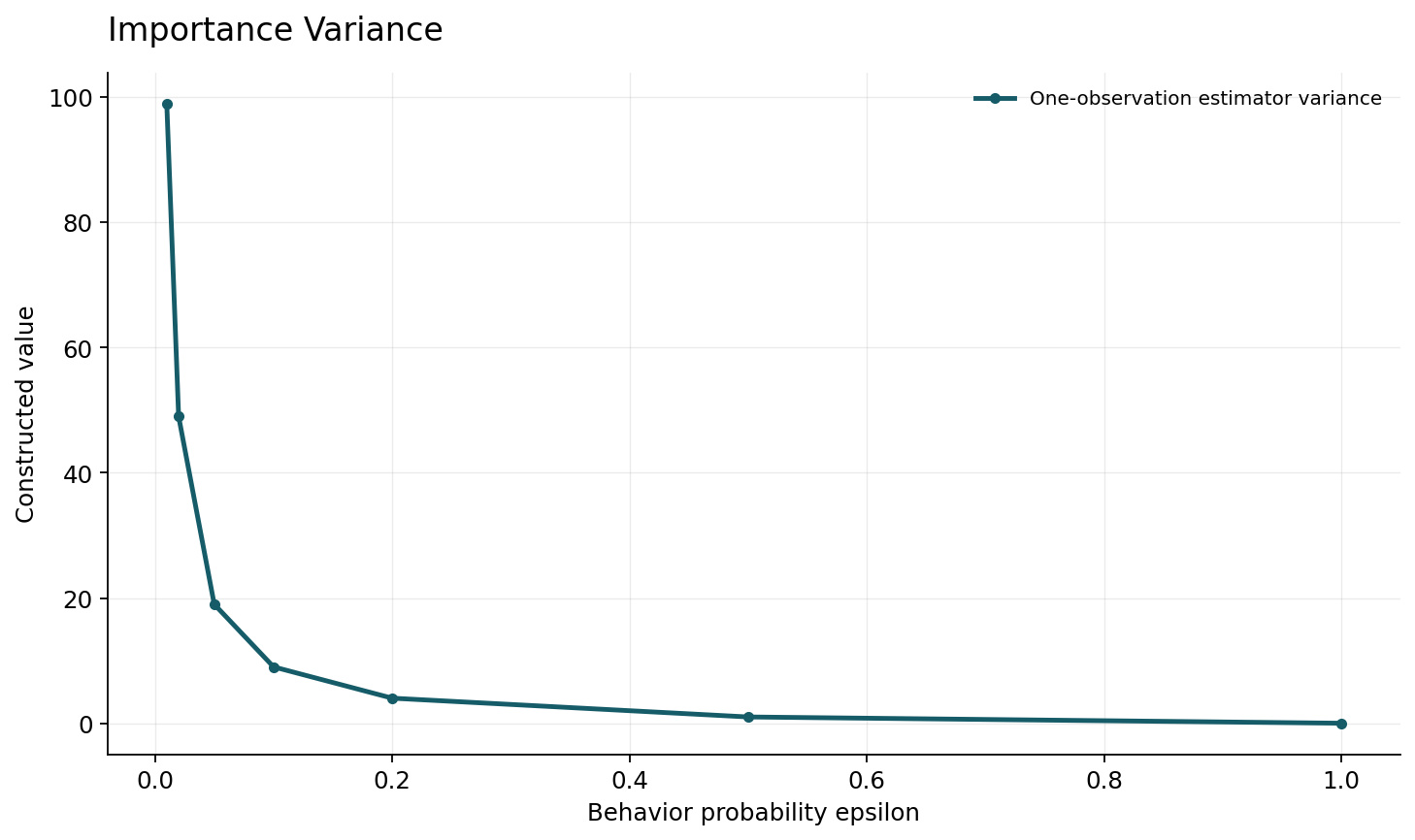
Consider a one-step problem where the target always chooses a1, the behavior chooses a1 with probability epsilon greater than zero, and the reward for a1 is the fixed value r. An ordinary importance-weighted observation is r divided by epsilon when a1 is selected and zero otherwise. Its expectation is r, while its variance is r squared times one divided by epsilon minus one. For n independent observations, the sample-average variance divides by n.
This exact calculation separates nonidentification at epsilon zero from unstable estimation at small positive epsilon. At zero support the importance ratio is not a usable route to the target outcome. At weak support, an unbiased estimate can still have enormous uncertainty. Clipping weights may reduce variance but introduces bias unless a separate argument accounts for it. Self-normalization changes the estimator and its finite-sample properties. The article does not rank these estimators or claim that the one-step formula describes a full trajectory problem. It provides a transparent baseline. In sequential settings, products of ratios, state-distribution mismatch and dependence can create additional difficulties that require their own analysis.
10. Dataset provenance is part of the benchmark
Fu and colleagues' D4RL work emphasizes collection mechanisms beyond a single partially trained agent, including controllers, demonstrations and mixtures. Such diversity matters because offline algorithms can respond differently to coverage, suboptimal behavior and mixed objectives. A benchmark score without the dataset version and evaluation convention is therefore incomplete. The current figures do not reproduce D4RL returns or attach invented normalized scores to the constructed policies.
For a new experiment, retain the exact dataset checksum, reward preprocessing, terminal handling, action scaling and evaluation environment. A time-limit truncation and a true terminal state can require different backup semantics. Changing this detail can alter the learned values without any change in the named algorithm. If a simulator supplies evaluation episodes, state how many episodes and seeds were used and whether those outcomes influenced tuning. Keep online fine-tuning results separate from strictly offline results. The distinction is especially important when a method improves after gathering new interaction: that may be a successful hybrid procedure, but it does not have the same information boundary as learning entirely from the fixed dataset.
Sources: [5]
11. Policy selection can reuse evaluation information
An offline learning campaign may produce many policies through different seeds, regularizers, architectures and checkpoints. Selecting one using a small set of online evaluation episodes consumes information from those episodes. Reporting the selected policy as if its evaluation were independent of selection can create optimistic conclusions. The same issue arises when an off-policy estimator is repeatedly consulted while tuning and then reported without accounting for that adaptivity.
Define the selection rule as part of the algorithm. If only logged data may be used, state the permitted validation data and the assumptions of the policy-value estimator. If online evaluation is permitted for selection, include its interaction budget and reserve an independent final evaluation. Report failure distributions rather than only the best seed, especially when low-probability bad outcomes materially affect return. A point estimate of expected return also does not summarize every operational requirement; variability, constraint violations and domain-specific outcomes may need separate evaluation. These are experimental-design questions, not automatic consequences of a conservative training objective. The two-world construction reminds us that an estimator cannot validate a policy's unobserved action outcomes solely by repeatedly processing the same indistinguishable logs.
12. Finite checks that expose the boundary
The analysis script constructs the two terminal-action reward tables and verifies that behavior-generated observations coincide while optimal actions differ. It checks the scalar backup recurrence against its closed form over a declared gamma and iteration grid. It also enumerates the two outcomes of the one-step importance estimator and verifies its expectation and variance for positive epsilon. No environment interaction or deep neural training is performed.
The first scientific figure plots the exact accumulated scalar error for several discounts and a fixed additive perturbation. The second plots the exact one-observation importance-estimator variance as epsilon varies, with reward r=1. Captions identify the finite models and the absence of empirical benchmark measurements. A negative control replaces the persistent perturbation by zero and checks that the recurrence remains zero. Another marks epsilon zero as undefined for the importance estimator rather than assigning an arbitrary finite value. These checks are deliberately modest. They establish the arithmetic and eligibility of the construction, while keeping distinct the stronger tasks of reproducing a cited algorithm, validating coverage assumptions, or certifying a learned policy's return.
13. A support-aware evaluation protocol
Start with the intended target-policy class and the data-generating behavior. Identify coverage assumptions at both action and state levels, documenting where function approximation bridges missing observations. Audit preprocessing and terminal semantics before comparing algorithms. Inspect backup queries and extracted actions, and retain diagnostics for regions with weak support rather than replacing them with a global average distance.
Use matched dataset access, compute and selection budgets. Compare conservative methods with supported baselines, including the behavior represented in the dataset when it can be evaluated. Report how gains differ across dataset quality, mixture and coverage conditions. If a theorem is invoked, map every assumption to a derivation, measurement or explicit unverified premise. If no valid return certificate is available, report empirical evaluation honestly rather than presenting a regularized Q estimate as one. Finally, retain the distinction between a simulator, real online interaction and a logged-data estimator. Each supplies different evidence. A credible result explains how those sources were used and which uncertainties remain, allowing another researcher to reconstruct both the learning procedure and the basis for the performance claim.
14. Pessimism is useful when uncertainty stays visible
Offline deep RL offers methods for extracting decision rules from rich fixed datasets, but its most important limitation is informational. The absent action in the two-world construction cannot be valued from identical logs without extra structure. The backup and importance-weight examples show how persistent error and weak support can further complicate inference even when a formula is easy to compute. These limits do not make algorithm design futile; they define what the design must control.
Open questions concern practical coverage diagnostics, reliable policy selection, conservative objectives with checkable assumptions, and evaluation procedures that remain informative under realistic data collection. Progress should be expressed as a conditional improvement with transparent evidence. A method can choose a prudent supported policy without claiming to identify every unseen alternative, and can achieve strong benchmark returns without proving deployment safety. The scientific standard is to keep those statements separate. Explicit support, provenance and evaluation accounting make an offline-RL result more useful to a scholar who wants to reproduce it and to an engineer who needs to understand exactly where its evidence ends.
Core equations and definitions
(1) Target discounted return; its occupancy can differ from the logged-data distribution.
(2) Terminal two-action construction gives identical logs but different optimal actions.
(3) Exact persistent-additive-error recurrence; not an empirical deep-RL learning curve.
(4) A related sup-norm Bellman argument requires a uniform perturbation premise, not just average logged residual.
(5) One-step target always a1, behavior probability epsilon>0; zero support is excluded.
(6) Illustrative conservative preference only, not the full CQL objective or a verified lower confidence bound.
Constructed analytical figures
Comparison and reporting contract
| Issue | Construction or diagnostic | What remains necessary |
|---|---|---|
| Zero support | Identical two-world logs | Extra structure, coverage or interaction |
| Weak support | Importance variance rises as epsilon shrinks | Estimator uncertainty and selection accounting |
| Bootstrapping | Persistent error geometric accumulation | Relevant uniform error premise |
| Pessimistic values | Regularizer discourages unseen optimism | Theorem assumptions for any bound claim |
| Benchmark performance | Declared dataset and evaluation | Independent policy selection and application evidence |
Evaluation protocol
- Verify identical logged observations and differing optimal actions.
- Check recurrence and importance-estimator moments exactly.
- Audit support, terminal handling and dataset versions.
- Separate offline selection, simulator evaluation and online fine-tuning.
Limitations
- Constructed finite models do not reproduce any cited deep-RL benchmark.
- Zero-support outcomes require additional assumptions; regularization alone does not identify them.
- No return certificate or real-world deployment guarantee is claimed.
Open research questions
- Which coverage diagnostics predict policy-evaluation failure under realistic function approximation?
- How can policy selection remain reliable with limited logged-data support?
- Which conservative assumptions can be checked rather than only asserted?
Evidence and its boundaries
- Introduces batch-constrained action selection to address extrapolation in fixed-data deep RL; experiments and guarantees retain their stated conditions.
- [1] — Only the inspected source scope is used; no source benchmark or proof is claimed as independently reproduced. Inspected: Primary metadata, abstract and version record inspected on 2026-10-28; source benchmark experiments not reproduced.
- Identifies unsupported-action bootstrapping error and studies constrained action selection in the BEAR procedure.
- [2] — Only the inspected source scope is used; no source benchmark or proof is claimed as independently reproduced. Inspected: Primary metadata, abstract and version record inspected on 2026-10-28; source benchmark experiments not reproduced.
- Studies conservative value regularization and lower-bound/improvement results under its assumptions; not every penalized neural fit is automatically a valid lower bound.
- [3] — Only the inspected source scope is used; no source benchmark or proof is claimed as independently reproduced. Inspected: Primary metadata, abstract and version record inspected on 2026-10-28; source benchmark experiments not reproduced.
- Uses expectile value fitting and advantage-weighted behavioral cloning while avoiding explicit unseen-action Q queries during training.
- [4] — Only the inspected source scope is used; no source benchmark or proof is claimed as independently reproduced. Inspected: Primary metadata, abstract and version record inspected on 2026-10-28; source benchmark experiments not reproduced.
- Provides fixed-data RL tasks with varied collection mechanisms and evaluation protocols; paper results are not reproduced here.
- [5] — Only the inspected source scope is used; no source benchmark or proof is claimed as independently reproduced. Inspected: Primary metadata, abstract and version record inspected on 2026-10-28; source benchmark experiments not reproduced.
- Primary tutorial defines offline learning from precollected data and surveys its challenges; used as conceptual context.
- [6] — Only the inspected source scope is used; no source benchmark or proof is claimed as independently reproduced. Inspected: Primary metadata, abstract and version record inspected on 2026-10-28; source benchmark experiments not reproduced.
References
- Off-Policy Deep Reinforcement Learning without Exploration
Scott Fujimoto, David Meger, Doina Precup. Primary arXiv paper record (2019). https://arxiv.org/abs/1812.02900Source scope
Primary metadata, abstract and version record inspected on 2026-10-28; source benchmark experiments not reproduced.
- Stabilizing Off-Policy Q-Learning via Bootstrapping Error Reduction
Aviral Kumar, Justin Fu, George Tucker, Sergey Levine. Primary arXiv paper record (2019). https://arxiv.org/abs/1906.00949Source scope
Primary metadata, abstract and version record inspected on 2026-10-28; source benchmark experiments not reproduced.
- Conservative Q-Learning for Offline Reinforcement Learning
Aviral Kumar, Aurick Zhou, George Tucker, Sergey Levine. Primary arXiv paper record (2020). https://arxiv.org/abs/2006.04779Source scope
Primary metadata, abstract and version record inspected on 2026-10-28; source benchmark experiments not reproduced.
- Offline Reinforcement Learning with Implicit Q-Learning
Ilya Kostrikov, Ashvin Nair, Sergey Levine. Primary arXiv paper record (2021). https://arxiv.org/abs/2110.06169Source scope
Primary metadata, abstract and version record inspected on 2026-10-28; source benchmark experiments not reproduced.
- D4RL: Datasets for Deep Data-Driven Reinforcement Learning
Justin Fu, Aviral Kumar, Ofir Nachum, George Tucker, Sergey Levine. Primary arXiv paper record (2021). https://arxiv.org/abs/2004.07219Source scope
Primary metadata, abstract and version record inspected on 2026-10-28; source benchmark experiments not reproduced.
- Offline Reinforcement Learning: Tutorial, Review, and Perspectives on Open Problems
Sergey Levine, Aviral Kumar, George Tucker, Justin Fu. Primary arXiv paper record (2020). https://arxiv.org/abs/2005.01643Source scope
Primary metadata, abstract and version record inspected on 2026-10-28; source benchmark experiments not reproduced.