
Data and Training Reliability / DEEP LEARNING III
Clipping Changes the Gradient Before Privacy Noise Arrives
A private optimizer usually modifies each contribution before adding random noise.
English original. Translations of this new review are not yet available.

Abstract
A private optimizer usually modifies each contribution before adding random noise. Clipping limits how much one protected unit can influence an update, but it also changes the direction and magnitude of the learning signal. Consequently, a utility difference between private and ordinary training cannot automatically be attributed to noise alone. This analytical review supplies exact constructed controls, explicit assumptions, and a proposed empirical evaluation; no neural benchmark is claimed.
In this paper
- 1. Privacy noise is not the first modification
- 2. The primary records address different layers
- 3. The protected unit determines the contribution
- 4. Clipping and expectation do not commute
- 5. A zero-mean perturbation cannot remove deterministic bias
- 6. Threshold selection creates a bias-variance tradeoff
- 7. Privacy accounting cannot be inferred from the plot
- 8. Adaptive thresholds use information too
- 9. Per-layer clipping changes the admissible shape
- 10. Minority utility requires conditional diagnostics
- 11. Optimizer state changes how distortion accumulates
- 12. A useful experiment isolates the sources of error
- 13. Exact controls bound the present claims
- 14. Implications for reliable private learning
- 15. Loss normalization changes the apparent threshold
1. Privacy noise is not the first modification
A private optimizer usually modifies each contribution before adding random noise. Clipping limits how much one protected unit can influence an update, but it also changes the direction and magnitude of the learning signal. Consequently, a utility difference between private and ordinary training cannot automatically be attributed to noise alone.
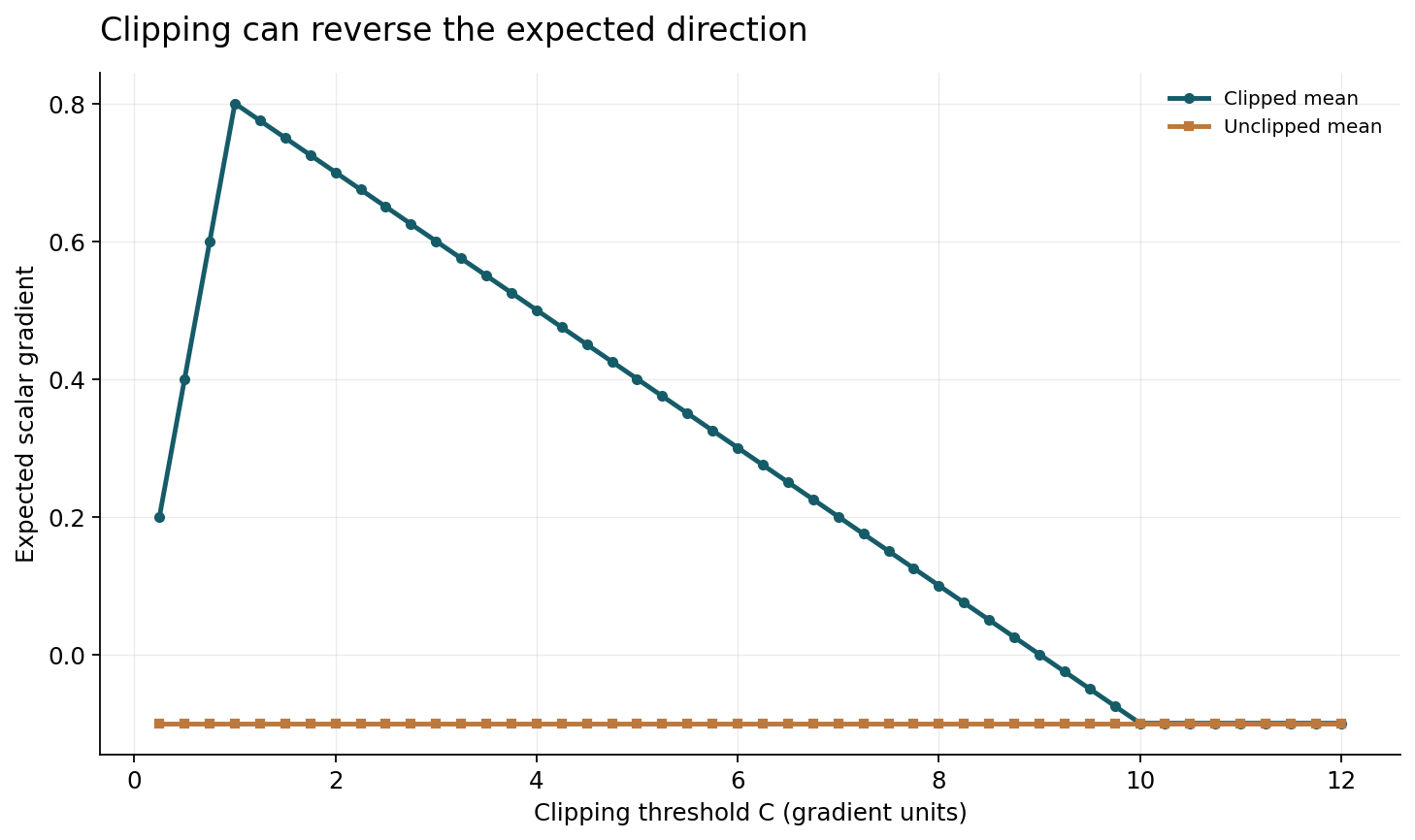
This review studies that distinction through a finite scalar gradient distribution. With probability 0.9 the gradient is positive one; with probability 0.1 it is negative ten. Its mean is negative 0.1, yet clipping at magnitude one makes the mean positive 0.8. The expected direction reverses before any Gaussian perturbation arrives. This deliberately constructed counterexample does not assert that a particular neural dataset has this distribution. It demonstrates why an optimization analysis needs the entire contribution distribution rather than only its average. We then separate clipping bias, noise variance, protected-unit choice, sampling, and privacy accounting, and propose controls that can distinguish their effects in an actual training experiment.
2. The primary records address different layers
Abadi and colleagues develop private deep learning with bounded per-example contributions and privacy accounting. Chen, Wu, and Hong analyze clipping geometry and bias. Andrew and colleagues study adaptive clipping, including the privacy implications of adapting a threshold from updates.
Mironov introduces Rényi differential privacy as a framework for reasoning about privacy loss. Wang, Balle, and Kasiviswanathan analyze subsampling and accounting. Bagdasaryan, Poursaeed, and Shmatikov investigate uneven accuracy effects across groups. Together these records motivate separate statements about optimization, formal privacy, and distributional utility. They do not make those statements interchangeable. The present review relies on their inspected primary abstracts for these scopes; it does not independently audit their proofs or reproduce their neural results. Our exact scalar calculations are author-constructed controls, not a new differential-privacy accountant or a claim that one threshold universally improves a deployed model.
3. The protected unit determines the contribution
Example-level privacy treats neighboring datasets as differing in an example under a specified add-remove or replacement relation. User-level privacy treats a person's entire allowed contribution as the unit. If one user supplies many examples, clipping each example separately does not by itself bound the combined user contribution by the same threshold.
A correct implementation must make this unit concrete before noise calibration. Grouping, per-user aggregation, maximum contribution limits, and sampling all affect sensitivity. The distinction also affects utility: a prolific user's examples may be averaged or summed before clipping, producing different directions and weights. A release should state both the formal adjacency relation and the computational object to which clipping is applied. An apparently small implementation change from per-example to per-batch clipping can invalidate a previously used sensitivity argument. The finite construction below concerns individual scalar contributions and a fixed public batch denominator. It deliberately avoids claiming any user-level guarantee or subsampling amplification.
4. Clipping and expectation do not commute
For a vector g and threshold C>0, norm clipping returns g times min(1,C/||g||). This map is nonlinear. In general, the expectation of clipped gradients differs from clipping their expectation, and neither equals the ordinary mean gradient. Symmetry, tail behavior, and alignment can matter even when the unclipped mean is small.
Our scalar distribution makes the effect explicit. Its unclipped expectation is 0.9 minus one, or negative 0.1. When C is at most one, the clipped expectation is 0.8C. When C is between one and ten, it is 0.9 minus 0.1C. It becomes zero at C=9 and recovers the unclipped mean at C=10. A gradient-descent step subtracts this quantity, so reversal changes the expected movement of the parameter. The example is a statement at a fixed parameter value, not a complete convergent learning trajectory. It nevertheless disproves any blanket assertion that clipping merely scales the average gradient without changing its direction.
5. A zero-mean perturbation cannot remove deterministic bias
Adding independent zero-mean Gaussian noise leaves the expected clipped update unchanged. It increases variability but does not restore the missing negative contribution in our example. Increasing batch size reduces variance of the empirical clipped mean under independent sampling, yet the mean remains the same clipped expectation.
This gives two different large-batch limits. Sampling variability can vanish while clipping bias persists. Noise calibrated to a fixed threshold and a fixed average denominator may also shrink per-coordinate update variance as the denominator grows, but the privacy analysis must still reflect how the batch was formed and how many updates occur. One should therefore avoid treating a smooth-looking large-batch trajectory as evidence that clipping no longer matters. The first figure plots the expected clipped gradient over thresholds, with the unclipped mean shown separately. It is a deterministic reference curve derived from the declared two-point distribution, useful for detecting mistaken claims about expectation but not for selecting a real training threshold.
6. Threshold selection creates a bias-variance tradeoff
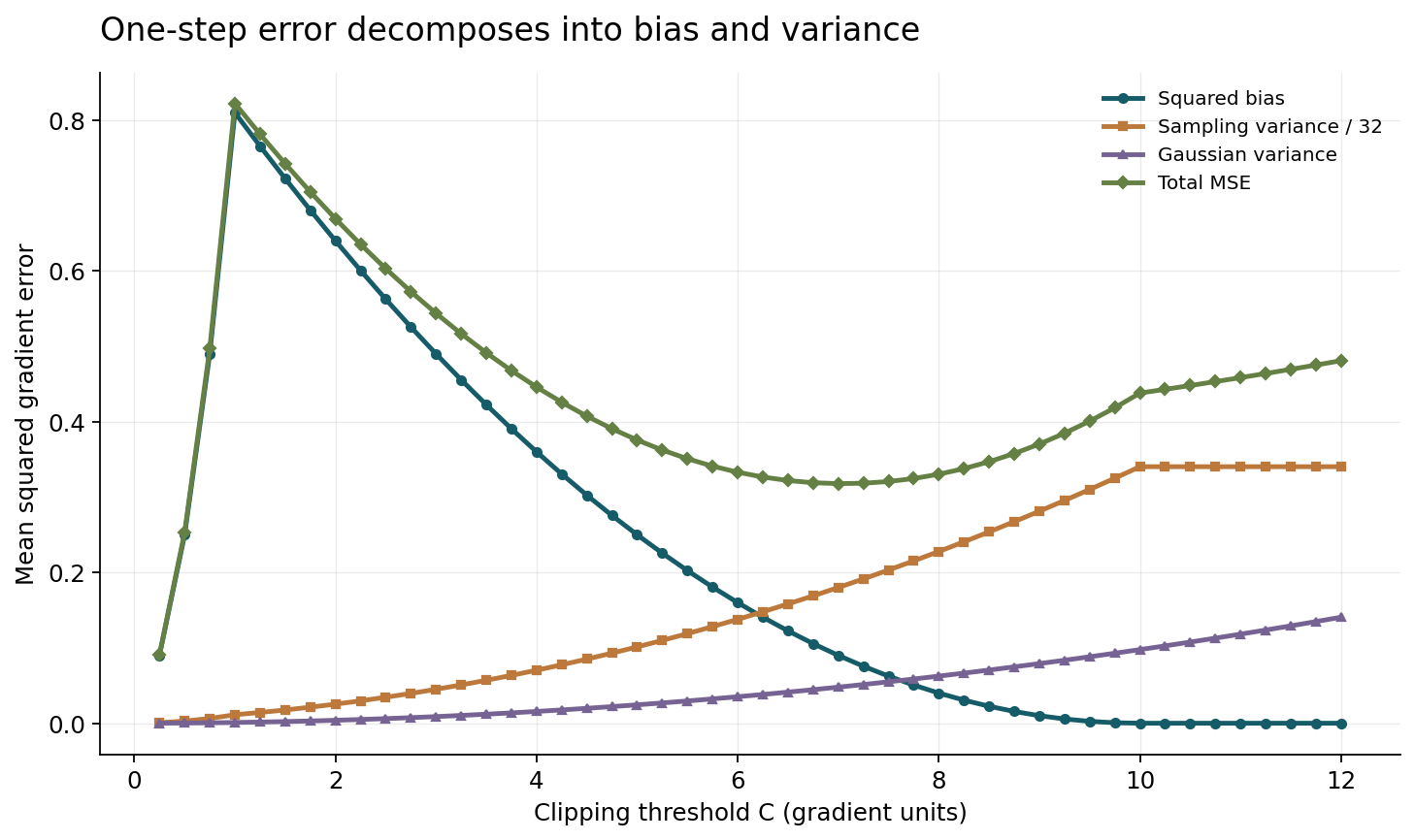
For the constructed batch mean with n independent contributions, clipping variance is Var(clip_C(g))/n. If Gaussian noise with standard deviation sigma C is added to the sum before division by n, its contribution to mean squared error is (sigma C/n)^2. Relative to the unclipped mean, total mean squared error is squared clipping bias plus these two variance terms.
This expression is exact for the stated one-step model. It does not compute privacy epsilon and does not imply that a threshold minimizing one-step gradient error optimizes final predictive performance. We plot its components for n=32 and sigma=1 to show why threshold comparisons can be nonmonotonic. Small C reduces absolute noise but may badly distort the mean; large C retains rare contributions but increases noise. Different distributions, dimensions, correlations, and optimizer states change the tradeoff. The valuable result is the decomposition itself: it makes clear which mechanism a proposed improvement is meant to address and which quantities must be measured independently.
7. Privacy accounting cannot be inferred from the plot
The Gaussian-noise multiplier alone is not a complete privacy guarantee. One needs the neighboring-dataset definition, sensitivity, sampling mechanism, number of compositions, delta, and accountant assumptions. The same apparent noise scale can correspond to different guarantees when these ingredients change.
For a fixed public denominator n, replacing one bounded contribution of norm at most C changes the average by at most 2C/n. An add-remove convention with appropriate fixed representation can have a different bound. Random batch size, data-dependent normalization, or user aggregation requires its own analysis. These details should not be hidden behind a generic label such as private SGD. Our numerical figure is explicitly an optimization-error construction and supplies no epsilon. A production privacy statement needs a validated mechanism and accountant, along with implementation tests that ensure the assumptions match actual sampling and release behavior. Empirical resistance to one attack is useful evidence about that attack, but it cannot substitute for the quantifiers of the formal guarantee.
8. Adaptive thresholds use information too
A threshold chosen from private gradient norms depends on the data. Releasing the threshold or using it in later released model updates can require accounting for that dependence. Treating an adaptive statistic as a free public constant may omit a privacy channel.
The engineering design should identify whether the threshold is fixed from public data, selected through a private mechanism, or tuned on a separate permitted dataset. Hyperparameter search also consumes resources and can consume privacy when its outputs depend on protected data. A utility comparison should include that selection procedure instead of comparing an oracle best threshold with a realistically tuned baseline. The exact two-point distribution is known in our construction, so its optimal one-step threshold can be computed without estimation. In a real model the gradient distribution changes across layers and training time. Learning its geometry is itself an intervention whose cost and privacy consequences should be stated.
9. Per-layer clipping changes the admissible shape
Global clipping places a bound on the norm of the entire contribution vector. Per-layer clipping places separate bounds on blocks, defining a different feasible region and generally a different update direction. If each of L blocks is clipped at C, the full vector norm can reach sqrt(L) times C. One cannot reuse a global-C sensitivity claim without adjusting the mechanism.
Per-layer policies can be useful because layers have different scales and functions. Their comparison should nevertheless include the total sensitivity convention and noise allocation. Rescaling a parameterization may also change measured gradient norms while leaving the represented function similar. This means that a threshold is tied to coordinates, optimizer conventions, and loss normalization. Reporting C without those details makes reproduction difficult. A meaningful ablation can compare policies under a common privacy budget and a documented total-noise allocation, while separately measuring clipping fractions and update alignment. Better utility under one policy does not demonstrate that clipping has become mathematically unbiased.
10. Minority utility requires conditional diagnostics
In the scalar example, the rare negative contribution is the larger one and is preferentially suppressed. That design illustrates a possible mechanism for unequal effects; it is not evidence that real minority groups always have larger gradients or that all utility disparity is caused by clipping. Group labels, data quality, model mismatch, and sample scarcity can interact.
A real evaluation should report group-conditioned loss, clipping frequency, gradient norm distributions, and uncertainty where collecting those statistics is permitted. If the groups or diagnostics are private, releasing them requires appropriate protection. Comparing only mean accuracy can hide a large deterioration for a small group. Conversely, observing a disparity does not identify its cause without interventions. Useful controls include clipping without noise, noise with an independently justified bounded-gradient setup, and changes in contribution grouping. The objective is to locate mechanisms rather than attach a moral interpretation to one scalar gradient norm. Privacy and equitable utility are distinct requirements that need joint evaluation.
11. Optimizer state changes how distortion accumulates
Momentum and adaptive preconditioning transform a sequence of clipped noisy gradients, not merely the current step. A rare large contribution removed early may affect all subsequent moment estimates. Dividing gradients by a running scale can also interact with loss normalization and threshold choice.
Thus a one-step bias-variance calculation is informative but incomplete for final-model behavior. A study should record where clipping occurs relative to aggregation, momentum, weight decay, gradient scaling, and numerical unscaling. Clipping a mixed-precision scaled gradient before undoing the scale changes the effective threshold. Accumulating microbatches and clipping each aggregate can differ from clipping every protected example. These implementation details can alter both utility and privacy assumptions. Tests should use small analytically tractable batches whose expected clipped sums are known, including a rare large contribution, zero vectors, and boundary norms. Such controls can catch a pipeline mistake before expensive training obscures it behind apparently plausible learning curves.
12. A useful experiment isolates the sources of error
Freeze architecture, preprocessing, protected-unit definition, and evaluation splits. Compare ordinary training, clipping-only training, and the full private mechanism with matched optimization budgets. Tune thresholds using a declared permitted procedure. Record clipping rates and directional alignment on a controlled diagnostic dataset, and keep privacy-sensitive diagnostics out of public logs unless separately protected.
Report final utility at matched privacy parameters, including delta and composition assumptions, rather than comparing arbitrary noise multipliers. Include subgroup uncertainty and failed runs. Verify the sampling implementation and accountant against independently known cases. For performance, include the cost of per-example gradients, grouping, and threshold adaptation. If an improvement comes from better representations or public pretraining, identify that source of information and its data assumptions. This design makes it possible to say whether a method reduces clipping bias, noise sensitivity, or computational overhead. A single aggregate accuracy number cannot resolve those mechanisms.
13. Exact controls bound the present claims
The accompanying standard-library program enumerates the two-point distribution over a threshold grid and checks its piecewise mean against direct clipping. It verifies direction reversal, recovery of the unclipped gradient at C=10, and invariance under a positive common scaling of gradients and threshold. It computes the variance directly from weighted squared deviations.
The mean squared error decomposition is checked against an independent expansion of the second moment, rather than only restating the implementation. Endpoint and zero-noise controls ensure that removing noise leaves clipping bias and that sufficiently large thresholds remove clipping bias in this bounded example. These are finite arithmetic checks, not a privacy audit or neural training experiment. They establish that the displayed curves match their assumptions and that the example truly separates bias from variance. Their value is strongest as a falsification tool for overbroad interpretations of clipping, not as a numerical recipe to deploy without a separate privacy and utility evaluation.
14. Implications for reliable private learning
A private training report should identify which contribution is bounded, how the threshold is selected, where randomness enters, and which formal guarantee applies to released outputs. It should then evaluate whether the resulting learning signal remains useful for the intended task and its important subpopulations. These are connected but distinct scientific questions.
Open problems include estimating harmful clipping bias without leaking sensitive diagnostics, adapting bounds across changing representations, and understanding how one-step distortion propagates through long nonconvex optimization. The scalar construction supplies no universal solution. It does establish that privacy noise is not the only mechanism capable of changing learning behavior, and that increasing batch size cannot by itself remove a fixed clipping bias. Preserving these distinctions makes it easier to interpret empirical gains honestly and to design tests that challenge a proposed explanation. A reassuring privacy label and a smooth training curve are both insufficient without the assumptions that make each meaningful.
15. Loss normalization changes the apparent threshold
Suppose every per-example loss is multiplied by a positive constant k. Every gradient is then multiplied by k. If the clipping threshold is also multiplied by k, clipping commutes with that common scaling: clip_(kC)(kg)=k clip_C(g). If C is left unchanged, the operation generally produces a different relative distortion. Thus thresholds from two implementations are not comparable unless their loss reduction and normalization conventions match.
This issue appears with sequence models that average over tokens in one implementation and sum token losses in another. Long examples can contribute larger norms under a summed objective, while a per-token mean gives each example a different effective weight. Choosing which quantity to protect and which population to optimize is a modeling decision. It should not be hidden as a convenience of a tensor reduction call. The same caution applies to gradient accumulation across variable-length microbatches and to distributed averaging across workers with unequal sample counts.
The common-scaling identity gives a useful unit test. Feed a fixed synthetic batch through the implementation, rescale both loss and threshold, and check the correspondingly scaled clipped aggregate before noise. Then hold the threshold fixed and verify that a deliberately large contribution changes as expected. These tests can expose an incorrect clipping location or denominator without requiring access to private training examples.
For a privacy claim, scaling the mechanism must also preserve the intended noise-to-sensitivity relationship and account for the actual released output. The unit test alone supplies no formal guarantee. Its role is narrower: it ensures that the optimizer's numerical conventions match the mathematical description. A paper that reports only a threshold and a noise multiplier leaves this information incomplete, making both utility comparisons and reproducibility harder to assess.
A second normalization test should vary batch partitioning while keeping the protected examples fixed. Correct per-example clipping followed by summation gives the same aggregate whether those examples are processed together or in smaller computational microbatches, up to numerical tolerance. Clipping each microbatch sum generally does not share that property. The difference is particularly visible when large opposing contributions cancel inside one partition but appear in separate partitions in another. This diagnostic identifies a computational grouping error; it does not assume that all legitimate private algorithms must use the same grouping. Algorithms with intentionally grouped protected units need their own declared contract and sensitivity analysis.
Core equations and definitions
(1) For nonzero g; define clip of zero as zero.
(2) Declared two-point scalar distribution.
(3) Exact clipped mean for the declared positive threshold.
(4) Independent batch and zero-mean Gaussian noise on sum, fixed denominator n.
(5) Bound for replacing one norm-bounded contribution with a fixed public denominator; not a full accountant.
Constructed analytical figures
Comparison and reporting contract
| Choice | What changes | What must be checked |
|---|---|---|
| Clipping | Mean and contribution bound | Distributional bias |
| Noise | Random variance | Full accounting assumptions |
| Adaptive threshold | Data-dependent policy | Selection privacy and tuning cost |
Evaluation protocol
- Declare protected units and adjacency.
- Compare ordinary, clipping-only and private arms.
- Validate sampler and accountant assumptions.
- Report subgroup utility with justified diagnostics.
Limitations
- No privacy epsilon is computed.
- One-step scalar error is not final neural utility.
- No protected data or private diagnostics are used.
Open research questions
- How can clipping bias be diagnosed privately?
- How should bounds adapt across changing representations?
- When does one-step distortion dominate final utility?
Evidence and its boundaries
- Private deep learning combines bounded contributions with noise and accounting.
- [1] — Only the inspected abstract scope is asserted; no reproduction of source results. Inspected: Primary publisher or author arXiv abstract and metadata inspected via web on 2026-10-28; no independent proof or benchmark replication.
- Clipping geometry and asymmetry affect optimization bias.
- [2] — Only the inspected abstract scope is asserted; no reproduction of source results. Inspected: Primary publisher or author arXiv abstract and metadata inspected via web on 2026-10-28; no independent proof or benchmark replication.
- Adaptive clipping requires a mechanism for choosing bounds from updates.
- [3] — Only the inspected abstract scope is asserted; no reproduction of source results. Inspected: Primary publisher or author arXiv abstract and metadata inspected via web on 2026-10-28; no independent proof or benchmark replication.
- Rényi divergence supports a formal privacy-loss framework.
- [4] — Only the inspected abstract scope is asserted; no reproduction of source results. Inspected: Primary publisher or author arXiv abstract and metadata inspected via web on 2026-10-28; no independent proof or benchmark replication.
- Subsampling assumptions affect privacy accounting.
- [5] — Only the inspected abstract scope is asserted; no reproduction of source results. Inspected: Primary publisher or author arXiv abstract and metadata inspected via web on 2026-10-28; no independent proof or benchmark replication.
- Accuracy effects can differ across underrepresented groups in studied tasks.
- [6] — Only the inspected abstract scope is asserted; no reproduction of source results. Inspected: Primary publisher or author arXiv abstract and metadata inspected via web on 2026-10-28; no independent proof or benchmark replication.
References
- Deep Learning with Differential Privacy
Martín Abadi, Andy Chu, Ian Goodfellow, H. Brendan McMahan, Ilya Mironov, Kunal Talwar, Li Zhang. arXiv preprint (2016). https://arxiv.org/abs/1607.00133Source scope
Primary publisher or author arXiv abstract and metadata inspected via web on 2026-10-28; no independent proof or benchmark replication.
- Understanding Gradient Clipping in Private SGD: A Geometric Perspective
Xiangyi Chen, Zhiwei Steven Wu, Mingyi Hong. arXiv preprint (2020). https://arxiv.org/abs/2006.15429Source scope
Primary publisher or author arXiv abstract and metadata inspected via web on 2026-10-28; no independent proof or benchmark replication.
- Differentially Private Learning with Adaptive Clipping
Galen Andrew, Om Thakkar, H. Brendan McMahan, Swaroop Ramaswamy. arXiv preprint (2019). https://arxiv.org/abs/1905.03871Source scope
Primary publisher or author arXiv abstract and metadata inspected via web on 2026-10-28; no independent proof or benchmark replication.
- Renyi Differential Privacy
Ilya Mironov. arXiv preprint (2017). https://arxiv.org/abs/1702.07476Source scope
Primary publisher or author arXiv abstract and metadata inspected via web on 2026-10-28; no independent proof or benchmark replication.
- Subsampled Renyi Differential Privacy and Analytical Moments Accountant
Yu-Xiang Wang, Borja Balle, Shiva Prasad Kasiviswanathan. Proceedings of the Twenty-Second International Conference on Artificial Intelligence and Statistics (2019). https://proceedings.mlr.press/v89/wang19b.htmlSource scope
Primary publisher or author arXiv abstract and metadata inspected via web on 2026-10-28; no independent proof or benchmark replication.
- Differential Privacy Has Disparate Impact on Model Accuracy
Eugene Bagdasaryan, Omid Poursaeed, Vitaly Shmatikov. Advances in Neural Information Processing Systems (2019). https://papers.nips.cc/paper/2019/hash/fc0de4e0396fff257ea362983c2dda5a-Abstract.htmlSource scope
Primary publisher or author arXiv abstract and metadata inspected via web on 2026-10-28; no independent proof or benchmark replication.