
Deep Learning Reliability / DEEP LEARNING II
Auditing the Shortcut: Feature Interventions, Hidden Groups, and the Limits of Robustness Claims
Exact binary examples show how high average accuracy and imperfect group labels can conceal a brittle decision rule.
English original. Translations of this new review are not yet available.
Abstract
Shortcut-learning claims are strongest when they specify which input property is suspected, which intervention preserves the task, and which evidence would falsify the claim. This analytical review relates primary work on shortcuts, group robustness, invariant prediction and domain-generalization evaluation. A finite binary model separates a stable signal from a changing correlate, while a second derivation quantifies dilution from noisy group metadata. Reproducible probability calculations motivate an audit protocol that distinguishes diagnostic interventions, group reweighting, causal interpretation and model selection without treating synthetic outcomes as real-world benchmark results.
In this paper
- 1. Name the suspected rule before measuring it
- 2. What shortcut learning contributes to the question
- 3. A binary data-generating construction
- 4. Average risk is a mixture of group risks
- 5. Finite groups make some shifts identifiable
- 6. Group-robust training does not finish the audit
- 7. Noisy metadata can dilute an extreme failure
- 8. An intervention must preserve the intended target
- 9. Invariance is a hypothesis with failure cases
- 10. Benchmark transfer and application transfer differ
- 11. Selection can turn the audit into another benchmark
- 12. An exact verification artifact
- 13. Remediation needs a second, independent audit
- 14. A shortcut claim should survive its own controls
1. Name the suspected rule before measuring it
A model can obtain high accuracy by using a property that is predictive in its evaluation sample but unreliable in its intended environment. Calling this behavior a shortcut is informative only when the suspected rule and the relevant transfer condition are specified. A background, annotation artifact, acquisition device or formatting pattern can be useful evidence in one task and an invalid substitute for the intended signal in another. The label does not by itself distinguish those cases.
This article asks how to audit a particular suspected dependency. The unit of analysis is a decision rule under declared interventions and group definitions. We combine selected primary research with two exact probability constructions. One shows a change in the ranking of two fixed classifiers when a correlation changes. The other shows how imperfect group metadata can hide an extreme group error. Neither construction trains a neural network, estimates a new benchmark result, or proves that a visually salient feature is causally responsible in an application. The objective is a reproducible diagnostic procedure whose assumptions remain visible from the initial hypothesis to the final claim. That procedure should be able to find evidence against the shortcut explanation as well as evidence supporting it.
2. What shortcut learning contributes to the question
Geirhos and colleagues frame shortcuts as rules that perform well on standard benchmarks but fail under more challenging transfer conditions. The perspective encourages examining the relationship between benchmark success and the intended task, rather than assuming that one aggregate score reveals what was learned. It does not provide a universally valid shortcut detector or declare every simple decision rule undesirable.
For an audit, the useful consequence is to separate the target capability from the collection process that makes a feature predictive. If a classifier is supposed to recognize an object, a watermark correlated with its label can be a suspected substitute. But proving that the model uses the watermark requires an intervention or other evidence with a clear interpretation. A saliency map alone may suggest a hypothesis without establishing necessity or sufficiency. Likewise, poor performance under a large distribution shift does not identify which feature caused the failure. The source motivates the research question; the present finite constructions specify what can actually be concluded from a controlled example. A practical audit should retain that distinction when moving from a narrative about shortcuts to a claim about one deployed model.
Sources: [1]
3. A binary data-generating construction
Let Y be equally likely to be minus one or plus one. Define a content feature C that equals Y with probability .8 and equals minus Y otherwise. Define another feature S that equals Y with probability p and equals minus Y otherwise. Conditional on Y, the two feature-noise variables are independent. The parameter p describes a correlation that may differ across environments. Calling C stable here means that its conditional relationship is held fixed by construction; it is not a claim that C has been identified as a real-world cause.
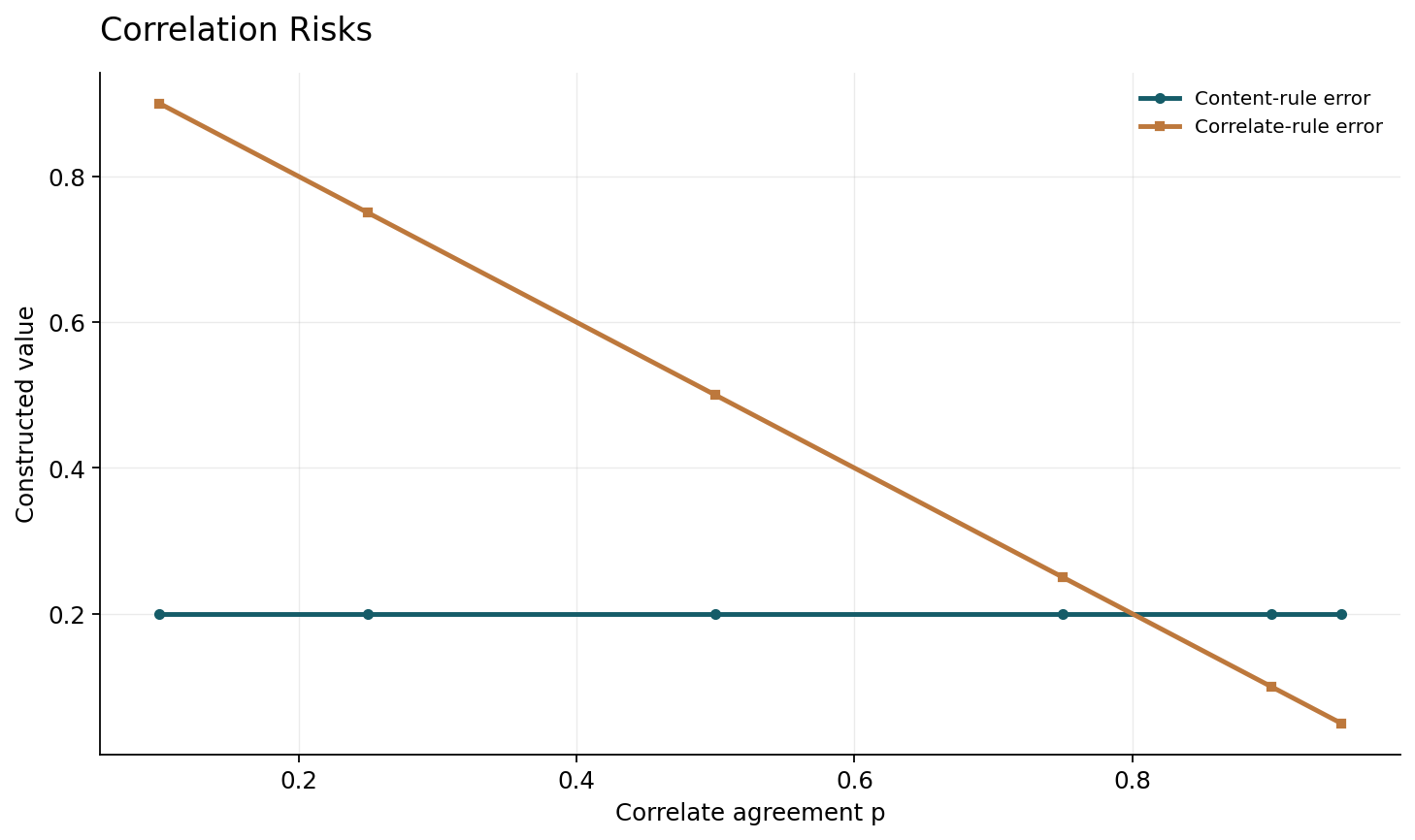
Consider two fixed classifiers: one predicts C, and the other predicts S. Their population errors are exactly .2 and one minus p. At p=.95 the S rule has error .05 and looks better on the corresponding sample distribution. At p=.1 it has error .9, while the C rule remains at .2 under the declared model. These are exact expectations over eight possible triples, not measured accuracies from a learned system. The construction isolates one mechanism: a change in a correlate's reliability. It does not model every possible input shift, a deep optimizer's preference between rules, or the feasibility of identifying the stable feature from observational training data alone.
4. Average risk is a mixture of group risks
Define the group G by whether S agrees with Y. In the agreeing group, the S classifier makes no mistakes; in the disagreeing group, it always makes a mistake. Its average risk equals the probability of the disagreeing group, namely one minus p. The worst-group risk is one whenever both groups have nonzero probability. The C classifier has error .2 within either group because its noise is independent of the S-noise conditional on Y in the declared construction.
This decomposition explains how an impressive average can coexist with a severe group failure. It also shows that changing group proportions alone can change average risk without changing either within-group error. A report should therefore distinguish a reweighting shift from a change in conditional behavior within groups. The distinction is testable when group definitions and enough labeled observations are available. A different grouping can yield different worst-group values, so the group list must be justified by the scientific question rather than chosen solely to make a model appear favorable or unfavorable. Worst-group risk is a property of a model, a distribution, a loss and a declared set of groups, not a universal scalar attached to a network.
5. Finite groups make some shifts identifiable
If group conditional risks R_g remain fixed and only group weights pi_g vary, average risk is the sum of pi_g times R_g. With an uncertainty set containing every probability mixture over a fixed finite group list, the largest possible average risk equals the largest group risk. This identity follows because every weighted average is bounded above by its largest term, and a mixture concentrated on a maximizing group attains that term.
The identity is useful but its premises are narrow. It does not cover a new subgroup absent from the group list, changed label semantics, or a within-group feature shift that changes R_g. Nor does estimating the training group risks establish the corresponding population values. The finite example deliberately gives exact conditional errors, avoiding estimation uncertainty. In an application, a small or unobserved group can make worst-group evaluation unstable or impossible. A responsible audit records sample sizes and uncertainty along with risks, states whether groups overlap or form a partition, and explains which shifts the chosen uncertainty set represents. Otherwise a mathematically correct worst-case calculation can be applied to the wrong collection of possible environments.
6. Group-robust training does not finish the audit
Sagawa and colleagues investigate group distributionally robust training and show why overparameterized training fit alone can leave poor worst-group generalization. Their work distinguishes minimizing a training objective from obtaining low population error for each declared group. The distinction directly matters to an audit: zero observed training loss on every group is not evidence that every future subgroup will be handled well.
The source supports investigating regularization and held-out group behavior in its tested settings. It does not imply that increasing one regularization parameter universally fixes shortcut use. For a new model, compare the full training and selection procedures under matched conditions, report achieved fit and per-group validation outcomes, and preserve the final test set for evaluation. If group labels are required during training, document their availability and quality. A method trained with privileged metadata should not be compared to another without acknowledging that difference. The current binary example contains no optimizer and cannot choose among robust-training algorithms. Its role is to verify the risk decomposition and to make explicit the failure an empirical training intervention would need to address.
Sources: [2]
7. Noisy metadata can dilute an extreme failure
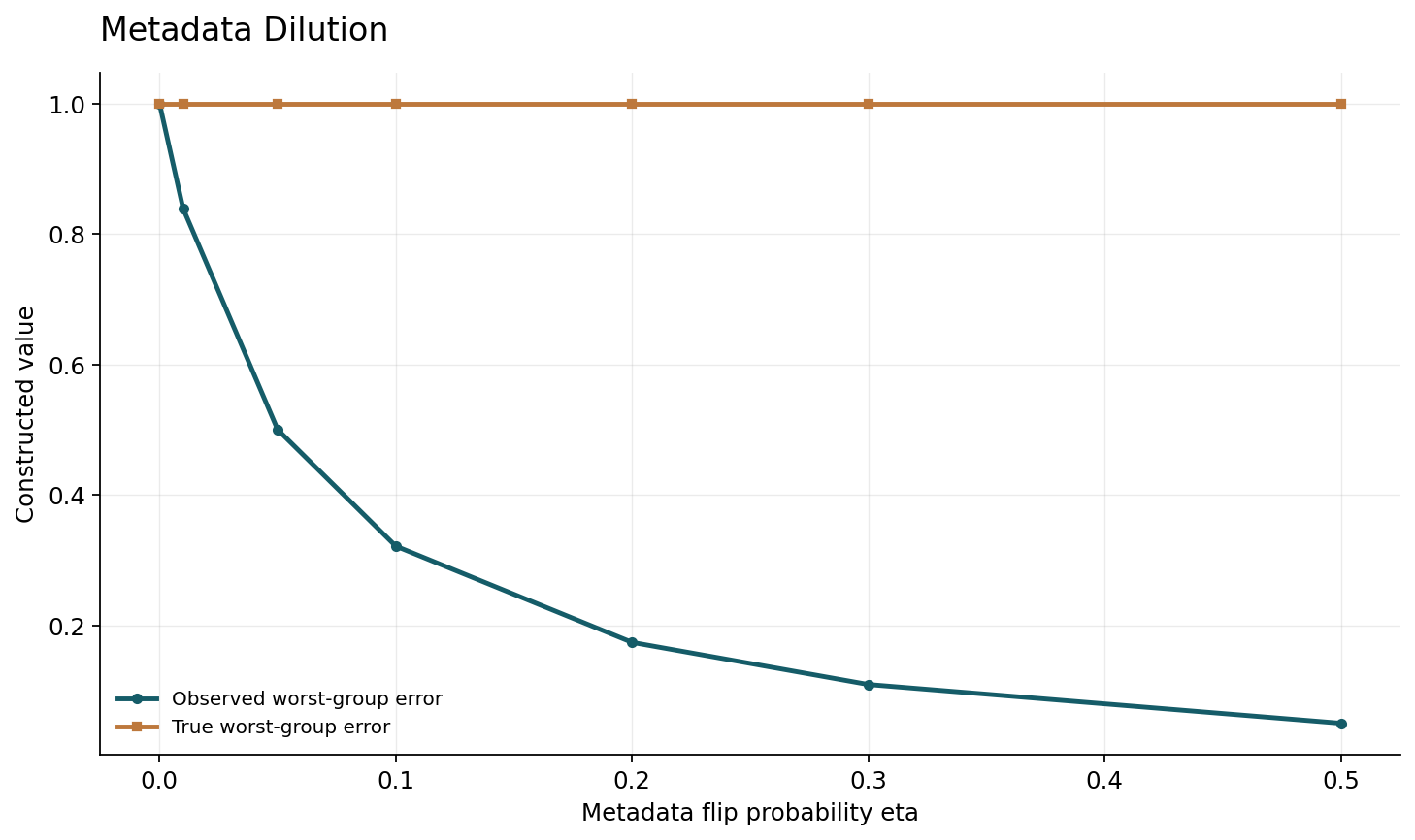
Suppose the true disagreeing group has prevalence q=.05. The S classifier has true error one in that group and zero in the other. Now observe a group label Z obtained by flipping the true binary group label independently with probability eta. Conditional on observed Z indicating disagreement, the fraction truly belonging to the disagreeing group is q(1 minus eta) divided by q(1 minus eta) plus (1 minus q)eta. That fraction is also the observed conditional error of the S classifier.
At eta=.1 this value is .045 divided by .14, approximately .3214. Thus a group with true error one can appear to have error around .32 under the noisy label. The other observed group also contains some errors, but they are diluted by its larger size. This is not a claim about any particular demographic attribute or dataset. It is an exact metadata-corruption example. Its implication is methodological: a worst-group evaluation is only as interpretable as the relationship between observed metadata and the scientifically relevant groups. More data can reduce sampling noise while leaving this systematic misclassification bias intact.
8. An intervention must preserve the intended target
To test whether a model relies on a suspected nuisance feature, alter that feature while preserving the task label and other relevant information as far as the hypothesis requires. This sounds simple but is often the hardest part of the audit. Removing a background can remove part of the object; rewriting text formatting can alter meaning; changing an acquisition artifact can introduce a new distributional anomaly. A performance drop after such an edit need not isolate the suspected dependency.
Use matched controls that quantify editing damage. Include changes to an irrelevant region of similar size or processing intensity, check human or expert label validity when appropriate, and record examples where the intervention is ambiguous. A successful intervention may establish a dependence for the tested inputs without proving that the feature is the sole decision rule. Necessity and sufficiency require different manipulations. Removing a feature tests a different claim from inserting it into otherwise negative examples. In the binary construction, setting the S-noise distribution is a valid model intervention because the generative assumptions are explicit. Transferring that interpretation to real images, text or scientific data requires evidence that the editing operation implements the intended intervention.
9. Invariance is a hypothesis with failure cases
Arjovsky and colleagues propose invariant risk minimization to learn representations whose optimal classifier matches across training environments. Rosenfeld and colleagues analyze conditions and failures of this approach in stated models. Together these sources motivate examining both the invariance objective and the diversity of environments used to identify a reliable predictor. Agreement across observed environments does not by itself prove that a rule will remain useful under every unseen change.
In the construction, if all training environments have p=.95, the S rule appears equally good everywhere. The environment labels provide no variation in the correlation we want to diagnose. More labels naming the same underlying mechanism do not create identification. Varying p can expose the brittle rule, but even that does not establish a unique real-world causal explanation. A manuscript should state which family of shifts its invariance premise covers and how its environments differ. It should also include deliberately uninformative environment partitions as controls. This framing avoids treating an invariance penalty as a magic substitute for scientific knowledge about which relationships may change and which relationships define the intended task.
10. Benchmark transfer and application transfer differ
WILDS supplies curated datasets and standardized evaluations for several naturally occurring distribution shifts. Its contribution is concrete: defined tasks, splits and evaluation conventions allow methods to be compared on specified transfer problems. A favorable result there is evidence about those settings. It does not cover every future deployment environment or identify the shortcut mechanism behind every error.
An application audit can borrow the discipline of explicit environments while defining its own operational target. Record acquisition sites, time periods, devices, annotators and other provenance that can plausibly affect the relationship between inputs and labels. Keep those variables distinct from labels that are unavailable or inappropriate at inference time. Evaluate enough natural variation to test the suspected mechanism, and explain which potentially important shifts remain unobserved. Synthetic interventions and natural held-out environments answer complementary questions: one may isolate a feature more cleanly, while the other better reflects realistic joint changes. They should be reported separately. Combining them into one aggregate score can obscure whether an apparent improvement comes from genuine transfer or merely from better handling of a particular editing artifact.
Sources: [3]
11. Selection can turn the audit into another benchmark
Gulrajani and Lopez-Paz emphasize model selection as part of domain-generalization evaluation. The same principle applies to shortcut audits. If an author repeatedly changes the suspected feature, edit intensity, subgroup definition, threshold or checkpoint after seeing final evaluation outcomes, the reported success has been selected using that evaluation. A nominally held-out shift can become a development environment through repeated inspection.
Separate hypothesis generation from confirmation. Use exploratory examples to design the intervention and controls, then freeze the procedure before applying it to a reserved set. If multiple mechanisms are investigated, report the search and uncertainty rather than presenting only the most striking failure. For remediation, compare the complete pipeline including validation and checkpoint selection, not only the final training objective. Record compute and access to metadata, because those resources can affect outcomes. The binary construction avoids adaptive search by defining its classifiers and probabilities in advance. Real audits rarely have that luxury, so their records should make the adaptive stages visible. A well-designed audit does not eliminate exploration; it prevents exploratory findings from silently acquiring the evidential status of prespecified confirmation.
Sources: [5]
12. An exact verification artifact
The finite script enumerates every Y, content-noise and correlate-noise combination to calculate both classifiers' risks for each declared p. It checks that probabilities sum to one, average risks match .2 and one minus p, and conditional group risks match the stated values. It then adds the independent metadata-flip variable and verifies the Bayes-rule dilution calculation by direct enumeration. These checks validate the finite model's arithmetic, not the presence of shortcuts in a real network.
The first scientific figure plots exact risks across p while holding the content-noise rate fixed. The second plots the observed worst-group error under increasing metadata noise with true rare-group prevalence .05, alongside the fixed true worst-group error one. At eta=.5 the observed groups become uninformative about the true grouping, and the observed errors approach the overall error. Captions identify the construction, parameters and absence of empirical measurements. A negative control changes the content-noise rate instead of p and confirms that the supposedly stable rule is only stable under its declared assumption. This prevents the article's own model labels from being mistaken for facts that survive arbitrary interventions.
13. Remediation needs a second, independent audit
After detecting a dependency, choose a remediation that addresses a specific mechanism: collect counterexamples, improve group coverage, change preprocessing, constrain training or revise the task. Then repeat the frozen audit on fresh or independently reserved observations. A model can learn to defeat one diagnostic edit while retaining the underlying brittle correlation. Improvement on the exact examples that motivated the change is therefore a development result, not a complete validation.
Report both gains and tradeoffs. Reducing reliance on S in the construction improves the shifted error when p is small but can worsen error in the original p=.95 environment if the alternative rule has error .2. An application may accept that tradeoff or seek a model using additional reliable information. The decision depends on the intended environment and consequences, not a universal preference for lower complexity or higher worst-group accuracy. Preserve results for small groups, failed edits and ambiguous labels. If a group has too little data, describe the limitation directly. The audit should support a precise claim about the examined dependency and tested conditions, while leaving untested mechanisms open for future investigation.
14. A shortcut claim should survive its own controls
The most defensible shortcut claim identifies a rule, shows evidence of dependence, defines a relevant transfer failure, and distinguishes that evidence from causal assumptions. The binary model demonstrates why average success can hide an extreme group error. The metadata model demonstrates why an apparently thorough group audit can still understate the problem. Neither result depends on a new neural architecture or an invented experimental campaign.
Open research questions include how to design valid feature interventions at scale, how to detect failures when useful group metadata is incomplete, and how to evaluate remediation without adapting repeatedly to the same held-out shifts. Progress requires more than a larger dashboard of robustness metrics. It requires a clear link between a metric and the mechanism it is intended to test. A good audit keeps the uninformative controls, the invalid interventions and the unsupported causal interpretations visible. That record helps another scholar reproduce the finding, decide whether it applies to a different setting, and challenge the explanation when the model's behavior does not match the proposed rule.
Core equations and definitions
(1) Declared finite generative construction; stability of C is assumed, not causally identified.
(2) Exact population 0–1 errors for the two fixed rules.
(3) All-mixture identity applies only to fixed conditional risks and the declared finite groups.
(4) Independent symmetric metadata flips; for the constructed S rule this equals observed group error.
(5) A true group error of one is diluted by noisy group membership, not by finite-sample uncertainty.
Constructed analytical figures
Comparison and reporting contract
| Evidence | Can support | Does not establish alone |
|---|---|---|
| Aggregate held-out accuracy | Risk on its sampled distribution | Feature mechanism or every subgroup |
| Matched valid feature intervention | Dependency under that edit | Unique causal explanation |
| Worst-group evaluation | Risk for declared observed groups | Coverage of unobserved or mislabeled groups |
| Invariant observed environments | Consistency under those variations | Every unseen intervention |
| Fresh remediation audit | Change on independent tested conditions | Universal robustness |
Evaluation protocol
- Preregister suspected feature, valid edit and damage controls.
- Enumerate finite probabilities and metadata corruption exactly.
- Separate natural shifts, synthetic interventions and model-selection data.
- Reaudit remediation on independent observations and retain subgroup uncertainty.
Limitations
- Binary probability models are analytical constructions, not neural training experiments.
- Real intervention validity and true group labels require application-specific evidence.
- No causal identification or universal transfer guarantee is claimed.
Open research questions
- How can valid interventions be scaled without changing the label?
- How should rare hidden groups be audited with imperfect metadata?
- Which evaluation designs prevent remediation from overfitting the audit itself?
Evidence and its boundaries
- Frames shortcuts as rules that work on standard benchmarks but fail under more demanding transfer conditions; a perspective, not a universal detector.
- [1] — Only the inspected source scope is used; no source benchmark or proof is claimed as independently reproduced. Inspected: Primary metadata, version record and abstract inspected on 2026-10-28; only attributed high-level claims used.
- Studies worst-group training and generalization with specified groups; overparameterized training fit alone does not guarantee worst-group test performance.
- [2] — Only the inspected source scope is used; no source benchmark or proof is claimed as independently reproduced. Inspected: Primary metadata, version record and abstract inspected on 2026-10-28; only attributed high-level claims used.
- Provides curated real-world distribution-shift datasets and standardized evaluation; benchmark scope is not universal deployment coverage.
- [3] — Only the inspected source scope is used; no source benchmark or proof is claimed as independently reproduced. Inspected: Primary metadata, version record and abstract inspected on 2026-10-28; only attributed high-level claims used.
- Analyzes conditions and failure cases for IRM in stated models; does not justify assuming invariant observed performance identifies every causal rule.
- [4] — Only the inspected source scope is used; no source benchmark or proof is claimed as independently reproduced. Inspected: Primary metadata, version record and abstract inspected on 2026-10-28; only attributed high-level claims used.
- Emphasizes experimental conditions and model selection in domain generalization, providing DomainBed comparisons.
- [5] — Only the inspected source scope is used; no source benchmark or proof is claimed as independently reproduced. Inspected: Primary metadata, version record and abstract inspected on 2026-10-28; only attributed high-level claims used.
- Proposes learning representations whose optimal classifier matches across training environments; claims are tied to its theory and experimental setup.
- [6] — Only the inspected source scope is used; no source benchmark or proof is claimed as independently reproduced. Inspected: Primary metadata, version record and abstract inspected on 2026-10-28; only attributed high-level claims used.
References
- Shortcut Learning in Deep Neural Networks
Robert Geirhos, Jörn-Henrik Jacobsen, Claudio Michaelis, Richard Zemel, Wieland Brendel, Matthias Bethge, Felix A. Wichmann. Primary arXiv paper record (2020). https://arxiv.org/abs/2004.07780Source scope
Primary metadata, version record and abstract inspected on 2026-10-28; only attributed high-level claims used.
- Distributionally Robust Neural Networks for Group Shifts: On the Importance of Regularization for Worst-Case Generalization
Shiori Sagawa, Pang Wei Koh, Tatsunori B. Hashimoto, Percy Liang. Primary arXiv paper record (2020). https://arxiv.org/abs/1911.08731Source scope
Primary metadata, version record and abstract inspected on 2026-10-28; only attributed high-level claims used.
- WILDS: A Benchmark of in-the-Wild Distribution Shifts
Pang Wei Koh, Shiori Sagawa, Henrik Marklund, Sang Michael Xie, Marvin Zhang, Akshay Balsubramani, Weihua Hu, Michihiro Yasunaga, Richard Lanas Phillips, Irena Gao, Tony Lee, Etienne David, Ian Stavness, Wei Guo, Berton A. Earnshaw, Imran S. Haque, Sara Beery, Jure Leskovec, Anshul Kundaje, Emma Pierson, Sergey Levine, Chelsea Finn, Percy Liang. Primary arXiv paper record (2021). https://arxiv.org/abs/2012.07421Source scope
Primary metadata, version record and abstract inspected on 2026-10-28; only attributed high-level claims used.
- The Risks of Invariant Risk Minimization
Elan Rosenfeld, Pradeep Ravikumar, Andrej Risteski. Primary arXiv paper record (2021). https://arxiv.org/abs/2010.05761Source scope
Primary metadata, version record and abstract inspected on 2026-10-28; only attributed high-level claims used.
- In Search of Lost Domain Generalization
Ishaan Gulrajani, David Lopez-Paz. Primary arXiv paper record (2020). https://arxiv.org/abs/2007.01434Source scope
Primary metadata, version record and abstract inspected on 2026-10-28; only attributed high-level claims used.
- Invariant Risk Minimization
Martin Arjovsky, Léon Bottou, Ishaan Gulrajani, David Lopez-Paz. Primary arXiv paper record (2019). https://arxiv.org/abs/1907.02893Source scope
Primary metadata, version record and abstract inspected on 2026-10-28; only attributed high-level claims used.