

Abstract
Materials discovery requires connecting structural candidates, energy approximations, first-principles verification, and experimental observations. Using GNoME, CHGNet, and M3GNet as reference points, this article analyzes the roles of active learning and potential energy gradients, and uses fictional composition–energy points to demonstrate how a convex hull changes as competing phases are added. The figures contain no real compounds or energy measurements; computational stability is not presented as evidence of completed synthesis, mass producibility, or application performance.[1] Scaling deep learning for materials discovery[2] CHGNet: Pretrained universal neural network potential f[3] A Universal Graph Deep Learning Interatomic Potential f
English abstract
AI-assisted materials discovery combines candidate search, learned potentials, electronic-structure calculations and experiments. We derive conservative forces and a toy composition-energy hull, showing how new competing phases can change a candidate classification. The energies are fictional and no compound is proposed or synthesized. Computational stability, dynamical behavior and synthesizability remain distinct claims.
1. Discovery counts must correspond to clearly defined evidence levels
Candidate generation, computationally verified low-energy structures, structures that remain on the convex hull after the competing-phase set is updated, and experimentally synthesized materials constitute different records. The GNoME paper discusses these levels separately; counts based on different statistical definitions must not be added together, nor may all candidates be called discovered usable materials. Reports should preserve structures, computational settings, the competing-phase database, and dated versions, with separate records created for subsequent experiments. An attractive crystal image cannot replace evidence concerning energy, dynamics, or synthesis.[1] Scaling deep learning for materials discovery
2. Learned potential energy models connect structure and dynamics
Graph models can estimate energy from atomic species and their neighborhoods, then obtain forces as the negative gradient of energy with respect to coordinates. CHGNet and M3GNet provide specific methods for learning material potentials, but their scope depends on the training elements, structures, and computational references. Differentiating a scalar energy helps maintain the conservative-force relationship, but energy, force, and stress errors still require testing. Low average error may conceal severe extrapolation in regions involving bond breaking, defects, or high temperatures.[2] CHGNet: Pretrained universal neural network potential f[3] A Universal Graph Deep Learning Interatomic Potential f
3. Convex-hull stability depends on the set of competing phases
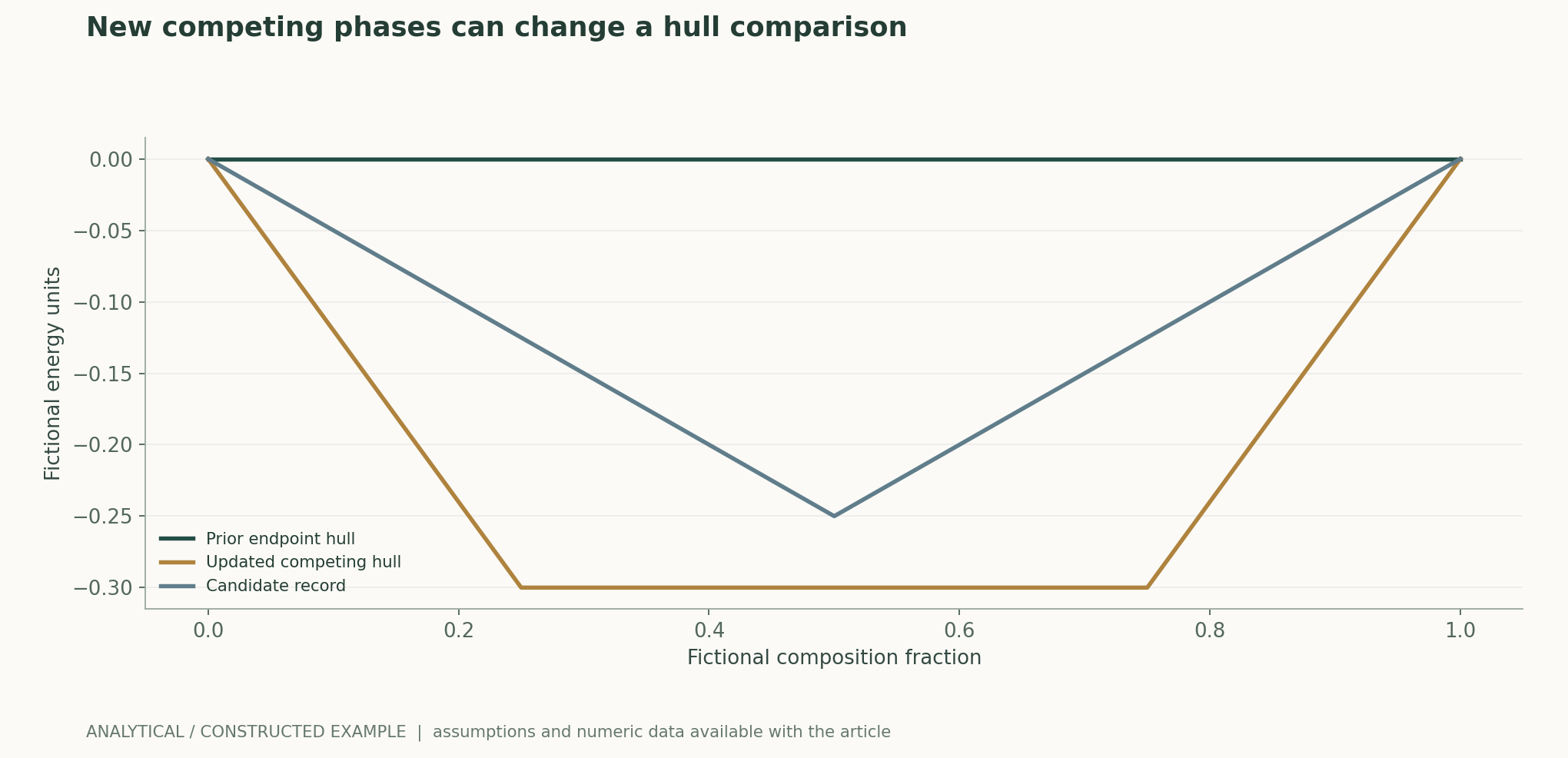
At a fixed composition, comparing the candidate energy with the lowest energy of all allowed phase mixtures yields the distance relative to the convex hull. Adding lower-energy competing phases lowers the convex hull and can render a previously apparently stable candidate unstable. In the figure, the endpoint energies are 0, and the candidate is at composition 0.5 with energy −0.25; after competing phases with energy −0.30 are added at 0.25 and 0.75, the candidate lies 0.05 above the new envelope. All values are fictional calculations and do not represent materials predictions.[1] Scaling deep learning for materials discovery
4. Static thermodynamics does not encompass synthesizability
Energy comparisons at zero temperature or under specific computational conditions do not directly address finite-temperature free energy, kinetic barriers, defects, pressure, lifetime, or preparation pathways. Metastable materials may be synthesizable, while computationally stable materials may be difficult to prepare. Functional performance, such as electrical conduction, catalysis, or mechanical properties, also requires separate measurements. Computational and experimental conditions should be connected item by item, without recasting a low-energy database record as proof of an established application.[1] Scaling deep learning for materials discovery[3] A Universal Graph Deep Learning Interatomic Potential f
5. Active learning requires an external computational feedback loop
Having a model select structures worth additional calculations and then update training with higher-fidelity results can improve search efficiency; however, uncertainty estimation, candidate diversity, and repeated screening affect coverage. Test splits should account for chemical systems and structural similarity; random structure splits may overestimate generalization to new combinations of elements. Failed calculations, nonconvergence, and anomalous structures should be recorded, rather than retaining only successful low-energy samples.[1] Scaling deep learning for materials discovery[2] CHGNet: Pretrained universal neural network potential f
6. Trustworthy publication should allow conclusions to be traced back to structures and settings
Preserve structure files, units, pseudopotentials or computational methods, convergence tolerances, magnetic states, the competing-phase library, and model hashes; experimental records should additionally include samples, preparation, characterization, and failed outcomes. Those reproducing the work need to explain differences in settings and the error budget. This article only analyzes published methods and a fictional convex hull; it has not performed DFT, molecular dynamics, or synthesis, and offers no materials conclusions that can be directly used in engineering.[1] Scaling deep learning for materials discovery[2] CHGNet: Pretrained universal neural network potential f[3] A Universal Graph Deep Learning Interatomic Potential f
Core equations and derivations
(1) Conservative forces are obtained from a differentiable scalar potential energy; training coverage and numerical errors still require validation.
LaTeX
F_i=-\nabla_{r_i}E(R,Z)(2) Composition-constrained mixture-energy comparison for a given competing-phase set; the set and reference energies must be versioned.
LaTeX
E_{\mathrm{hull}}(x)=E(x)-\min_{\lambda_j\ge0}\left\{\sum_j\lambda_jE_j:\sum_j\lambda_jx_j=x,\ \sum_j\lambda_j=1\right\}(3) A calculation in fictional energy units, not real-compound stability or a DFT result.
LaTeX
\Delta E_{\mathrm{toy}}=-0.25-(-0.30)=0.05Method and evidence workflow
Analytical figures and numerical examples
Recomputable worked example
The candidate at x=0.5 has energy −0.25, below the old endpoint envelope of 0; after competing phases are added, the envelope is −0.30, and the candidate lies 0.05 above it. The stability assessment depends on the competing-phase version and still does not constitute evidence of synthesizability or function.
Method comparison
| Method or assessment | Controlled variables and measurements | Failure conditions and interpretation |
|---|---|---|
| Structural candidates | Retain structures and generation versions | A candidate is not a synthesized material |
| Learned potential energy | Evaluate energy, forces, stress, and extrapolation separately | Average error does not cover rare configurations |
| Convex-hull stability | Freeze competing phases and computational references | New competing phases can change the classification |
| Experiments and applications | Preserve preparation, characterization, and performance records independently | A low-energy structure does not prove preparability or usefulness |
Verification and experimental plan
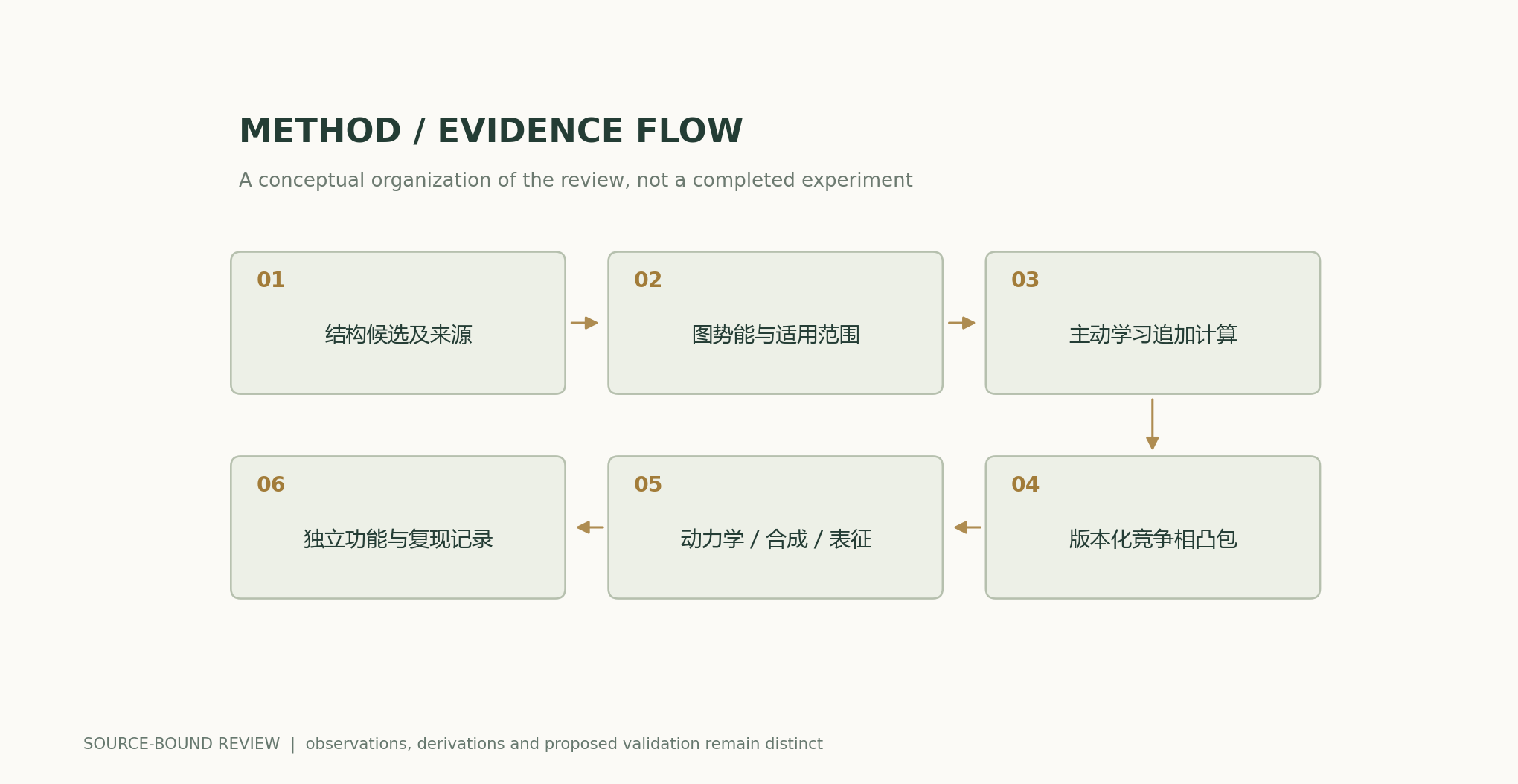
- Freeze structures, the element scope, reference calculations, and the competing-phase database version.
- Separate training and testing by chemical system and structural family to prevent leakage between near neighbors.
- Evaluate energy, forces, stress, anomalous configurations, and numerical stability separately.
- Record active-learning selections, failed calculations, convergence, and additional labeling costs.
- Define evidence and conditions separately for thermodynamics, dynamics, synthesis, and function.
- Publish traceable structures and settings, explicitly identify DFT, dynamics, or experiments that were not performed, and do not conflate discovery counts.
Scope and limitations
- Fictional energies do not correspond to real materials.
- No DFT or materials experiments were performed.
- Convex-hull results depend on competing phases and references.
- Static stability does not imply synthesizability or usability.
Primary sources and corresponding claims
- Scaling deep learning for materials discoveryAmil Merchant, Simon Batzner, Samuel S. Schoenholz, Muratahan Aykol, Gowoon Cheon, Ekin Dogus Cubuk · 2023-11-29Abstract; Active learning; Discovered stable crystals; Methods
- CHGNet: Pretrained universal neural network potential for charge-informed atomistic modeling, , , , , , · 2023-02-28Abstract; 原文方法、理论和实验章节见作者原始论文链接
- A Universal Graph Deep Learning Interatomic Potential for the Periodic Table, · 2022-02-05Abstract; 原文方法、理论和实验章节见作者原始论文链接
Citation and manuscript export
BibTeXRISCSL JSONTXTArticle JSON
Author, version, and sources
AI-assisted research review; written with analytical derivations by Codex (AI), based on the listed primary literature. This site has no record of independent peer review or original model experiments for this article.
Reader performance revision: previously read pages are also reused when a recent HEAD request returns 200 and the ETag matches. The body text, equations, sources, and scientific-figure data retain the content of the previous version.
The conceptual cover is separate from the scientific diagrams; scientific figures are calculated from published equations and explicit assumptions, and all results from original papers are attributed.
Author, version, and correction history · /guides/ai4science-materials/v1/
Sources for the cover and scientific figures · Data, sources, and assumptions · Publication and version history
Source revision: 6251a250b27bb8b449f59b392f81abd355383770