
What an Attestation Establishes: Confidential Computing and the Remaining Trust Boundary
A premise-by-premise account of remote evidence, key release, freshness, and persistent authority.
قد تتضمن ترجمة الذكاء الاصطناعي أخطاء. يُرجى التحقق بالرجوع إلى النص الأصلي.
النص الأصلي باللغة الإنجليزية. ترجمات هذه المراجعة الجديدة غير متاحة بعد.
Abstract
Remote attestation supports an inference about a computing environment; it does not provide an unconditional guarantee about every action performed there. This analytical review decomposes that inference into evidence authenticity, approved workload identity, freshness, channel binding, policy currency, and supporting collateral. Selected official RATS and EAT specifications, platform documentation, and original architectural research anchor the discussion while preserving their distinct evidentiary scopes. A constructed key-release protocol exposes a relay error in which authentic evidence is accepted without binding the secret recipient. Two reproducible models then examine omitted acceptance predicates and the delay imposed by periodic policy reappraisal. Their outputs are logical counts and analytical time windows, not estimated attack probabilities or hardware benchmarks. Additional counterexamples separate fresh attestation from persistent-state continuity and distinguish memory isolation from the leakage of application interfaces. We propose a validation procedure that exercises correctly signed but unacceptable evidence, recipient substitution, state rollback, collateral outages, and policy changes. The resulting framework treats attestation as a bounded, attributable justification for a particular action. It does not independently verify platform implementations or establish that a measured program is semantically safe.
In this paper
- 1. Evidence is not an unconditional verdict
- 2. Separating the roles in an attestation system
- 3. Measurement identifies an artifact, not its meaning
- 4. Platform evidence and appraisal dependencies
- 5. Freshness is a relation to a challenge
- 6. Channel binding and the relay counterexample
- 7. An explicit acceptance predicate
- 8. What the predicate model can and cannot prove
- 9. Fresh appraisal does not freeze the future
- 10. Rollback is different from replay
- 11. Isolation leaves observable interfaces
- 12. Failure modes belong to the release protocol
- 13. A falsifiable validation plan
- 14. Attestation as a bounded justification
1. Evidence is not an unconditional verdict
Remote attestation provides evidence about a computing environment under a chain of cryptographic and platform assumptions. It does not turn arbitrary application code into correct code, nor does a valid signature alone establish that releasing a secret is appropriate. This manuscript's central claim is that an attestation decision is a policy-controlled inference whose premises must remain separately inspectable.
We consider a service that releases a decryption key to a remote workload after appraisal of evidence. The relevant questions include which workload was measured, which platform vouched for it, when the evidence was generated, whether the recipient controls the bound session key, and whether the owner's current policy accepts those facts. The analysis distinguishes evidence generation, appraisal, and the final authorization decision. It uses selected standards, platform documentation, and original architectural research, together with two constructed models. One enumerates acceptance errors caused by omitted predicates; the other quantifies delay introduced by periodic policy reappraisal. Neither is a measurement of hardware vulnerability rates or a proof that a particular confidential-computing product is secure.
2. Separating the roles in an attestation system
RFC 9334 distinguishes an Attester, a Verifier, and a Relying Party. Evidence is appraised against policy and supporting material; a relying party then decides whether the resulting assessment permits an action. This division matters even when several roles run in the same process. A cryptographic verifier can correctly authenticate a report while a relying party applies the wrong policy for a customer or operation.
Our proposed review artifact is a premise ledger. For each released key, record a privacy-conscious identifier for the evidence, the appraisal policy version, the accepted workload identity, the session binding, and the decision time. Do not collapse all verification results into a single unqualified trusted flag. A system might accept a platform for low-sensitivity computation while refusing it for a different data class. The decision is therefore relative to a stated purpose. The ledger should allow reviewers to answer why a release occurred without exposing the released key or retaining unnecessary device identifiers. This makes policy changes auditable and prevents successful signature verification from concealing an application-level authorization mistake.
Sources [1]
3. Measurement identifies an artifact, not its meaning
A measurement can bind evidence to selected executable or configuration bytes. The semantic claim that those bytes implement an acceptable computation requires another argument: source review, a trusted build process, testing, formal verification, or an explicit decision to trust a supplier. Hash equality cannot distinguish a carefully reviewed binary from a vulnerable binary when both copies are identical.
Keystone's original work presents an extensible TEE framework with explicit hardware and software abstractions. Its customizable architecture reinforces the need to identify what enters the trusted computing base for a particular configuration. Intel SGX Explained is a scholarly architectural analysis, and its original record explicitly distinguishes documented information from informed guesses about undocumented aspects. We use that distinction rather than treating every statement in the report as a vendor guarantee. Across these sources, the useful inference is that workload identity and platform isolation are separate premises. A deployment manifest should state which runtime, loader, libraries, and configuration bytes are covered by the measurement and which inputs remain mutable. An acceptable initial state cannot establish that all future inputs will be handled correctly.
4. Platform evidence and appraisal dependencies
The inspected AMD SEV-SNP ABI specification describes attestation-report fields, including guest-provided report data and platform-related information. Intel's quote-verification service documentation describes using verification libraries and external collateral services before generating a signed verification report. These are concrete interfaces through which evidence is produced and appraised; neither interface removes the need for an application policy.
For our key-release example, the verifier must establish that the endorsement chain and relevant security-version information are acceptable under the owner's rules. The policy also needs a defined response when collateral is unavailable or too old. A cached certificate chain may still authenticate an issuer while failing to reflect a newer revocation decision. The precise rules are platform- and deployment-specific, so this manuscript does not prescribe one universal freshness period or infer that all confidential VMs share the same threat model. Instead, it requires implementers to retain the exact report format and collateral versions used in testing. Upgrading a verifier library can change interpretation even when the application measurement remains constant, and that transition deserves its own evidence.
5. Freshness is a relation to a challenge
RFC 9334 discusses clocks, nonces, and other ways to establish evidence freshness, while noting that state may change immediately after evidence is generated. RFC 9711 defines an Entity Attestation Token nonce claim and its representation requirements. The standards therefore provide vocabulary and mechanisms, not a guarantee that every relying party has used them correctly.
A challenge-response exchange can show that evidence was generated in response to a recent unpredictable challenge, subject to the attester's security assumptions. The verifier must associate the returned challenge with the intended session and reject reuse where the protocol requires uniqueness. A timestamp-based approach instead relies on a trustworthy time source and a bounded acceptance window. Mixing the two without an explicit rule can accidentally allow an old report to be paired with a new application request. Freshness should also distinguish the evidence generation time from the age of measured state and the age of the appraisal policy. A newly signed assessment based on stale collateral is recent in one sense and obsolete in another. Logging a single timestamp hides this distinction.
6. Channel binding and the relay counterexample
Consider an attacker who forwards a verifier's challenge to an acceptable remote workload, obtains valid evidence, and then presents that evidence while asking the key service to encrypt its response to the attacker's own public key. If the evidence says nothing about the recipient key or session, the signature can be entirely valid while the secret goes to the wrong endpoint. This is a constructed protocol counterexample, not a claim of a vulnerability in a named product.
The required repair is a binding between the accepted environment and the endpoint that receives the secret. A protocol can place an appropriate digest of an ephemeral public key and session context in authenticated report data, provided the measured workload generated or securely controls the corresponding private key. Merely copying an attacker-supplied key into evidence does not establish that control. The verifier must check the binding and the recipient must demonstrate possession as required by the chosen protocol. The binding should cover the intended service and purpose so that evidence obtained for one operation cannot be reused for another whose policy is more permissive.
7. An explicit acceptance predicate
Our constructed acceptance rule contains six Boolean premises: authentic signature, approved measurement, fresh challenge, correct session binding, current policy version, and acceptable collateral freshness. The rule accepts only their conjunction. These premises are abstractions for testing integration, not an exhaustive threat model or six independent probabilities. A real system may need further conditions, including platform security versions, debug configuration, migration policy, and workload-specific authorization.
The first analytical figure enumerates every assignment of these six flags. If only signature validity is enforced, thirty-two assignments are accepted and thirty-one violate the complete constructed policy. Enforcing all six leaves exactly one accepted assignment, with zero unsafe assignments relative to that policy. These counts are truth-table results. They do not say that real attacks are equally likely, that a signature-only system has a particular breach probability, or that six checks provide universal security. Their value is diagnostic: removing any required premise creates a family of executions for which the implementation's allow decision lacks the stated justification. The model makes that logical gap visible without inventing attack-frequency data.
8. What the predicate model can and cannot prove
The enumeration checks a reference conjunction against a separately constructed set of accepted assignments for each enforcement depth. It also supplies a fresh, correctly measured, correctly signed report with the wrong channel binding as a concrete rejection case. A deliberately weakened verifier accepts that case, so the test distinguishes a real policy omission from a trivial always-deny implementation.
The complete predicate is sufficient only for the abstract policy encoded in the model. If the approved program leaks its inputs, all six flags can be true and confidentiality can still fail. If a hardware assumption is false, a signature might not mean what the verifier believes it means. The model therefore separates syntactic completeness of a policy implementation from adequacy of the policy and soundness of its underlying evidence. A stronger evaluation would attach each Boolean to a real parser, cryptographic check, or trusted observation, then test malformed encodings and ambiguous status values. It should preserve unknown and unsupported states rather than silently coercing them to true. That extension is proposed work, not an accomplishment claimed by the small executable artifact.
9. Fresh appraisal does not freeze the future
A key release often grants authority that outlives the attestation exchange. A workload may retain the key after its software becomes unacceptable, after a security advisory changes the policy, or after a session should have ended. Even a perfectly fresh initial report cannot guarantee that a long-lived credential remains appropriate indefinitely. The temporal scope of the released authority must therefore be part of the design.
The second model assumes policy changes occur at a uniform phase within a periodic reappraisal interval T. With no other delay, the residual time until the next reappraisal has mean T divided by two and maximum T. For intervals of ten and sixty minutes, the constructed means are five and thirty minutes. These are exposure durations under a specified renewal mechanism, not compromise probabilities. A short lease can bound future access only if the resource service enforces expiry and cannot be bypassed with a previously released unrestricted key. Where clients require offline operation, the lease duration is an explicit acceptance of delayed revocation rather than a technical detail that can be omitted from the security claim.
10. Rollback is different from replay
A fresh challenge can elicit fresh evidence from a workload whose persistent application state has been rolled back. For example, a privacy-budget service could restart from an earlier counter while running the same approved binary. The attestation measurement and nonce may both be correct, yet the service repeats a release that its intended state machine would forbid. This constructed example demonstrates that report freshness and state continuity are different properties.
A continuity design needs an authoritative notion of progress: an external version service, a trusted monotonic mechanism, a replicated append-only record, or another mechanism justified for the threat model. The application must bind its restored state to that progress and define recovery after interrupted updates. Forking two copies of one previously acceptable state raises a related question: can each copy spend the same logical budget? Detection after the fact may support accountability but does not undo a disclosed secret. These concerns belong in the key-release and state-management protocol, and a report format should not be credited with solving them unless it actually carries and enforces the relevant evidence.
11. Isolation leaves observable interfaces
A workload can be isolated from direct memory reads while still interacting with an untrusted scheduler, network, filesystem, or caller. If its observable behavior depends on secrets, the application must decide which leakage is acceptable and whether additional techniques are required. This statement follows from the interface model, without assuming a specific microarchitectural exploit or claiming that every TEE exposes the same signals.
A simple example is an approved program that returns early when a secret lookup fails. A remote caller may distinguish outcomes through response length or timing even though the platform protects the program's private memory. Attestation authenticates the program that implements this behavior; it does not transform the behavior into a constant-observation computation. The evaluator should therefore distinguish direct-memory isolation, side-channel resistance, network confidentiality, and application output policy. The relevant defenses may involve program redesign, padding, access-pattern protection, or a narrower accepted leakage contract. Choosing a larger TEE boundary can simplify portability while increasing the code that interprets hostile inputs. Choosing a smaller boundary reduces some dependencies but introduces more crossings that need validation.
12. Failure modes belong to the release protocol
The key service should make rejection reasons precise internally while avoiding externally useful disclosure of unnecessary platform detail. Unsupported evidence, expired collateral, incorrect measurements, unknown policy versions, and unavailable endorsement services are different conditions. A fallback that accepts on network timeout can defeat a carefully designed appraisal pipeline. Conversely, refusing every report during a collateral outage can create a serious availability incident that must be anticipated operationally.
The policy decision should be explicit and scoped to the action. A service might permit diagnostic computation while withholding sensitive data, but it should not silently downgrade the guarantees of an existing key-release contract. Emergency overrides require attributable authorization and expiration, and the audit trail should retain enough context to distinguish an override from ordinary successful appraisal. The same discipline applies to migration: moving an execution to new hardware can invalidate assumptions about key confinement, platform identity, or state continuity. A migration support flag in evidence is useful only when the relying party interprets it consistently with its threat model. The central engineering task is preserving the meaning of the release decision across these transitions.
13. A falsifiable validation plan
Begin by fixing one platform version, one report profile, and one concrete key-release protocol. Map every accepted premise to bytes or trusted state and identify which component checks it. Then generate negative cases that preserve a valid signature while changing the measurement, challenge, session recipient, policy identifier, or collateral age where the protocol permits those variations. A test should fail for the intended reason; malformed signatures alone do not exercise the rest of the policy.
Next test state continuity by restoring an old application snapshot and attempting a repeated logical release. Exercise verifier restart, collateral-service outage, policy rollback, delayed messages, and a session-key substitution. Record whether the action was denied, retried, or explicitly overridden. Measure release latency and availability separately from the security acceptance matrix. The supplied truth-table and interval models act as reference calculations for two narrow parts of this plan. They do not substitute for real report verification, platform fault testing, or code review. A successful deployment evaluation should publish the exact boundary tested, including which physical and side-channel adversaries remain outside it.
14. Attestation as a bounded justification
A useful attestation result supports a sentence of the following form: under named platform and endorsement assumptions, evidence for this environment satisfied this policy for this action at this time and was bound to this recipient. Each clause supplies a premise that can be challenged, tested, or revised. Removing those clauses produces an attractive trusted label whose meaning is too broad to verify.
The analytical results identify two independent integration hazards. Omitting a required predicate admits unjustified executions even when the signature check works. Allowing authority to persist between policy checks creates a time window whose size depends on the renewal mechanism. Neither problem requires breaking the underlying cryptography. The remaining research questions concern evidence completeness, state continuity, and the cost of enforcing policy changes promptly. Addressing them requires cooperation between hardware, protocol, and application design. This manuscript supplies a structured review and small reproducible counterexamples, while keeping its local draft status and lack of independent hardware validation explicit.
Mathematical model
(1) Six constructed predicates: signature, measurement, freshness, binding, policy currency, collateral. Not an exhaustive real threat model.
(2) Unsafe accepted truth assignments when k of six required flags are checked; all assignments are enumerated, not assumed equally probable.
(3) Illustrative binding digest using unambiguous encoding, public key pk and challenge n; measured workload must control the associated private key. Not a complete attestation wire protocol.
(4) Constructed residual delay to periodic policy reappraisal, measured in minutes; no propagation delay.
(5) Uniform phase tail; no interpretation as compromise probability.
Reproducible analytical figures
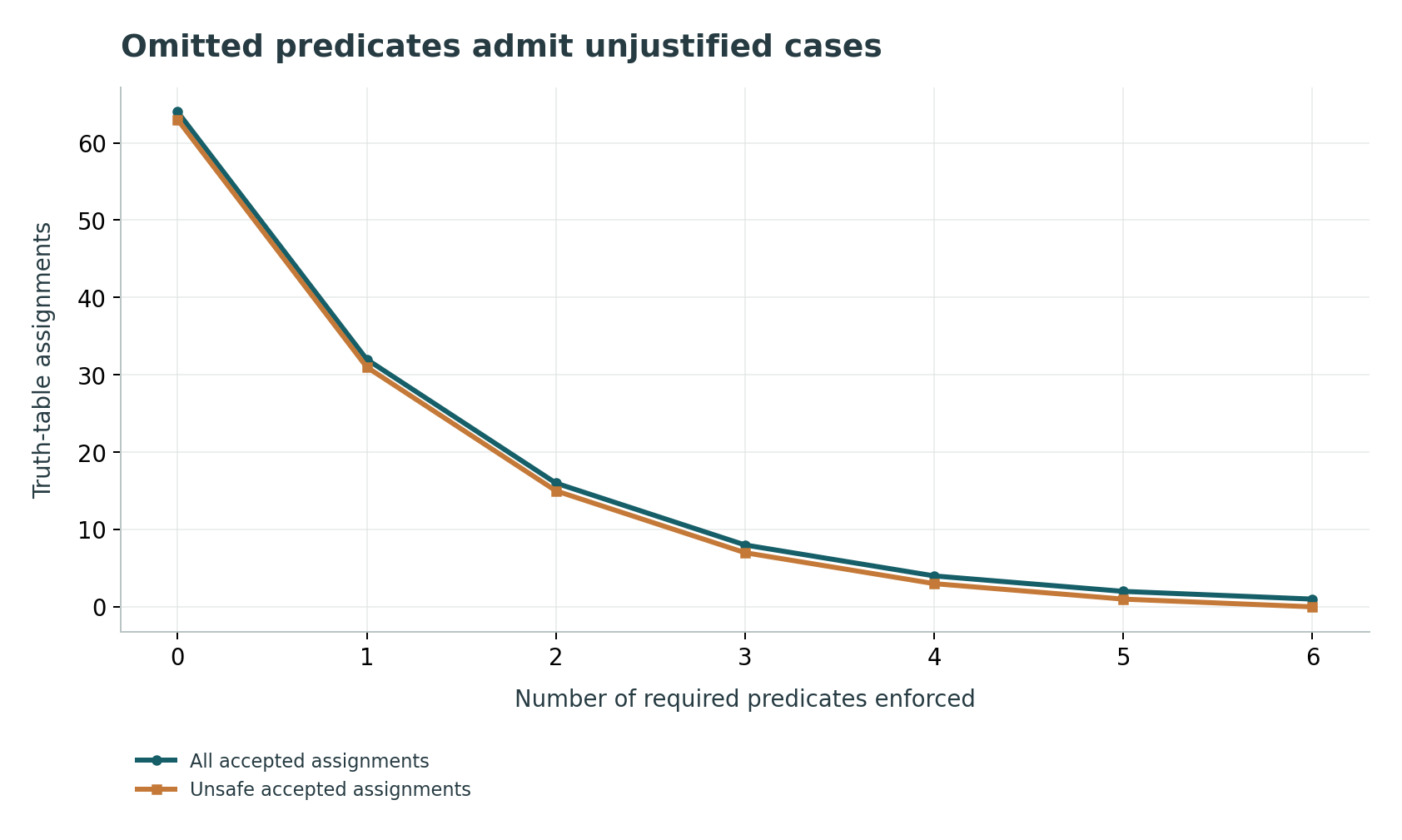
Assumptions: Six predicates all required; First k predicates enforced; No claim of exhaustive platform security

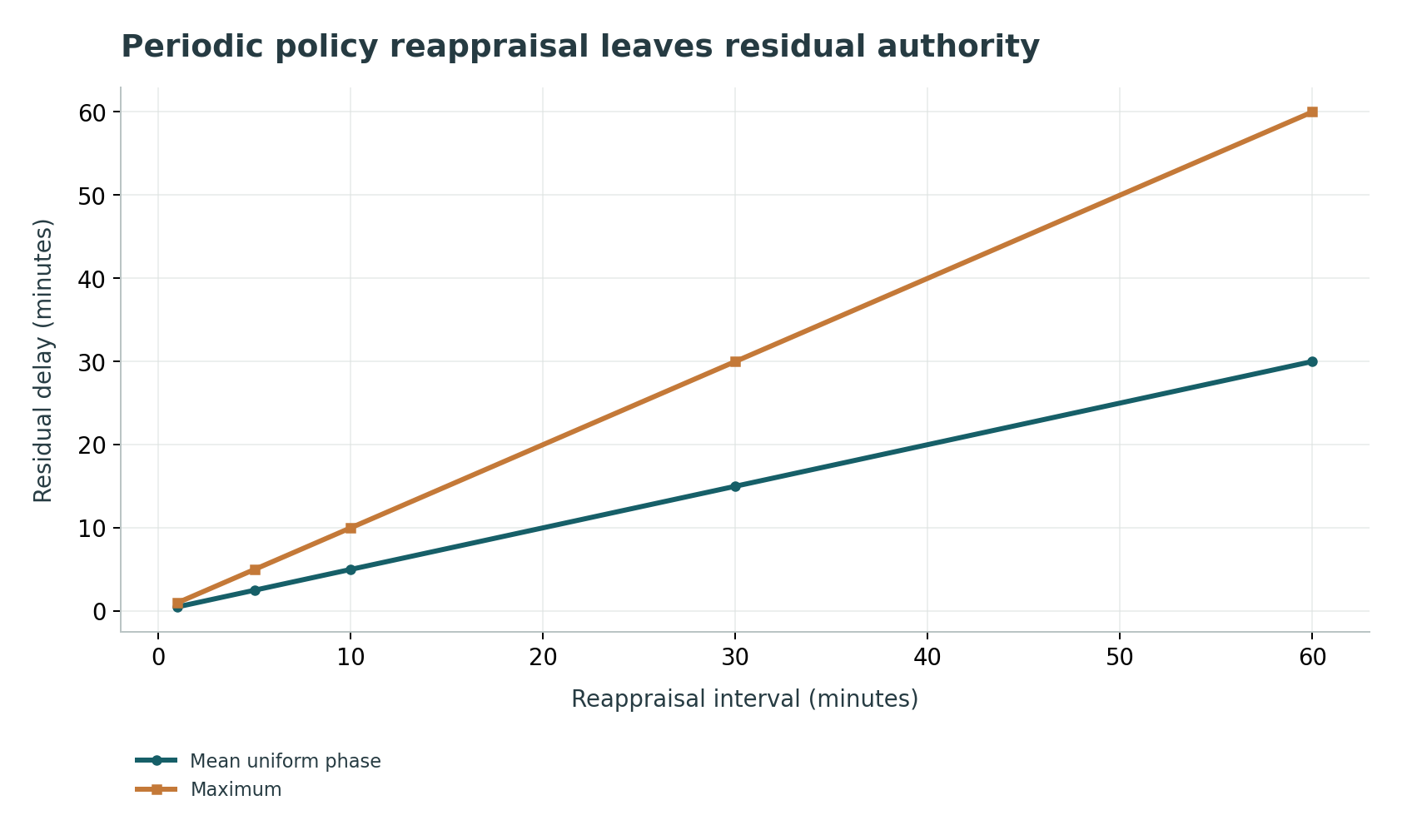
Assumptions: Uniform policy-change phase; No propagation delay; Expiry enforced at resource use

Executed finite checks
3 check groups passed. The listed cases validate this model; they are not independent experiments or system benchmarks.
- Policy truth table versus closed-form count · 7 cases. 64 complete flag assignments enumerated for each enforcement depth; counts are not probabilities.
- Channel-binding omission counterexample · 2 cases. Wrong recipient with other flags true is rejected; complete positive case accepts.
- Reappraisal delay independent midpoint average · 5 cases. Exact rational averages agree with T/2 under uniform phase.
Comparison
| Constructed policy | Accepted assignments | Unsafe assignments |
|---|---|---|
| Signature only | 32 | 31 |
| All six required predicates | 1 | 0 |
| Reappraisal interval 10 min | Mean delay 5 min | Maximum 10 min |
| Reappraisal interval 60 min | Mean delay 30 min | Maximum 60 min |
Proposed validation protocol
- Fix report profile, platform version, and key-release action.
- Map each policy premise to verified evidence or trusted state.
- Verify measurement coverage for runtime, loader, libraries, and configuration.
- Generate valid-signature cases with unacceptable measurement and freshness.
- Attempt recipient-key substitution and cross-service evidence replay.
- Test expired or unavailable collateral without implicit acceptance.
- Restore old application state and attempt repeated logical release.
- Test policy update, verifier restart, and delayed challenge responses.
- Verify lease expiry at the actual resource access point.
- Report acceptance errors independently of latency and availability.
Limitations
- No real hardware or report-verification implementation is tested.
- The six-predicate policy is a deliberately incomplete abstraction.
- Truth-table counts are not attack probabilities.
- Uniform reappraisal phase need not match a deployed schedule.
- SGX Explained is original scholarly analysis, not a vendor specification or proof review.
- Intel repository documentation is unpinned and may evolve.
- State continuity and side-channel protection require additional design.
Open research questions
- How can evidence appraisal remain complete as platform profiles evolve?
- Which state-continuity mechanisms prevent rollback and forked authority efficiently?
- What key-lease duration meets a measurable policy-change objective?
Evidence and its boundaries
- [1] Attester, Verifier, and Relying Party roles separate evidence from decisions.
- Attestation does not freeze future state. Inspected: Roles and section 10.
- [2] EAT defines a nonce claim for freshness-related use.
- A claim alone does not prove application session binding. Inspected: Section 4.1.
- [3] SGX architectural analysis distinguishes documented material from inferred details.
- Not a current vendor guarantee. Inspected: Original abstract.
- [4] Keystone supports customized TEE configurations.
- A particular configuration still needs a stated trusted computing base. Inspected: Original abstract.
- [5] Quote verification uses libraries and collateral services.
- Successful verification alone is not application authorization. Inspected: Service architecture overview.
- [6] SNP reports include authenticated platform and guest-supplied report fields.
- Report data needs application interpretation and binding. Inspected: Attestation report; REPORT_DATA.
References
- Remote ATtestation procedureS (RATS) Architecture
Henk Birkholz, Dave Thaler, Michael Richardson, Ned Smith, Wei Pan. RFC 9334 (2023). https://www.rfc-editor.org/rfc/rfc9334.txtSource access and scope
Official RFC roles, appraisal concepts, and section 10 Freshness inspected.
- The Entity Attestation Token (EAT)
Laurence Lundblade, Giridhar Mandyam, Jeremy O'Donoghue, Carl Wallace. RFC 9711 (2025). https://www.rfc-editor.org/rfc/rfc9711.txtSource access and scope
Official RFC section 4.1 nonce and freshness-related text inspected.
- Intel SGX Explained
Victor Costan, Srinivas Devadas. Author manuscript (2016). https://eprint.iacr.org/2016/086Source access and scope
Original research-analysis abstract and revision record inspected; record explicitly distinguishes documented data from intelligent guesses; no full proof or current hardware review.
- Keystone: An Open Framework for Architecting TEEs
Dayeol Lee, David Kohlbrenner, Shweta Shinde, Dawn Song, Krste Asanovic. Author manuscript (2019). https://arxiv.org/abs/1907.10119Source access and scope
Original arXiv v2 abstract and architecture scope inspected; citation identifies preprint rather than later EuroSys version.
- Intel SGX and TDX DCAP Quote Verification Service
Intel. Intel documentation (2026). https://github.com/intel/SGX-TDX-DCAP-QuoteVerificationServiceSource access and scope
Official repository README Service architecture overview inspected; access year used, repository snapshot not pinned.
- SEV Secure Nested Paging Firmware ABI Specification
Advanced Micro Devices. AMD specification (2025). https://www.amd.com/content/dam/amd/en/documents/developer/56860.pdfSource access and scope
Official PDF revision 1.58, May 2025; attestation report and REPORT_DATA field inspected; not a full ABI audit.