
Scientific Deep Learning / DEEP LEARNING III
Interventions Do Not Name Latents: Causal Representation and Identifiability
Additional observations narrow latent ambiguity only through an explicit intervention and equivalence contract.
English original. Translations of this new review are not yet available.

Abstract
A latent representation may fit observations while changing the meaning of its coordinates. This review uses a rotationally symmetric Gaussian model to expose observational ambiguity and a labeled mean shift to quantify directional intervention information. A Gram-matrix construction shows why redundant intervention directions leave recovery weakly constrained. An invertible nonlinear coordinate change then demonstrates that latent editing and physical intervention are not interchangeable. Six primary records situate these controls among disentanglement, auxiliary-variable nonlinear ICA, conditional priors, weak supervision and temporal interventions. The finite calculations are independently executable; no image model or causal-discovery benchmark is newly trained. The proposed evaluation distinguishes population identifiability, finite-sample recovery, decoder coverage and individual counterfactual claims.
In this paper
- 1. Predictive coordinates need not be causal variables
- 2. What the primary records establish
- 3. Identifiability is always relative to a model class
- 4. Observational rotation gives a transparent ambiguity
- 5. A labeled mean shift adds directional information
- 6. Intervention diversity determines the visible subspace
- 7. An intervention changes a mechanism, not merely a label
- 8. Nonlinear reparameterization changes intervention semantics
- 9. Temporal order provides structure but not automatic causality
- 10. Auxiliary variables can carry shortcuts
- 11. Metrics may hide permitted transformations
- 12. Counterfactual claims require additional commitments
- 13. A proposed study separates identification from optimization
- 14. Intervention effects should be evaluated on observables too
- 15. A causal variable is an experimentally grounded abstraction
1. Predictive coordinates need not be causal variables
A latent representation can reconstruct observations accurately while assigning its coordinates meanings that differ from the physical or causal factors a researcher hopes to recover. If an invertible transformation of the latent space can be absorbed by the decoder, the observed data distribution may remain unchanged. Better reconstruction alone cannot select between those equivalent descriptions. Causal representation learning therefore needs a statement about which additional information breaks the ambiguity and which transformations remain admissible.
This review examines that statement through a two-dimensional Gaussian construction. A rotationally symmetric observational distribution admits multiple latent orientations. A labeled intervention that shifts one coordinate creates directional information, while interventions spanning only one direction leave other aspects unresolved. A second construction shows how a nonlinear coordinate transformation changes the meaning of an intervention. These are finite mathematical controls, not new image-generation or causal-discovery experiments. Their purpose is to distinguish recovering a useful predictive coordinate system from identifying variables whose interventions have the intended semantics.
2. What the primary records establish
Locatello and colleagues show that unsupervised disentanglement requires assumptions beyond fitting observations. Hyvarinen, Sasaki, and Turner use auxiliary variables in nonlinear independent-component analysis. Khemakhem and colleagues analyze conditional latent priors within a variational framework, with qualified identifiability and a noted corrigendum in the inspected record. These directions show how extra structure can matter; they do not make every auxiliary label sufficient for every latent model.
Weakly supervised disentanglement work by Locatello and colleagues uses structured pairs of observations. Schölkopf and colleagues frame the discovery of causal variables as a distinct problem from causal inference with variables already given. Lippe and colleagues use temporal sequences and observed intervention targets in CITRIS. The inspected author abstracts establish these scope-level distinctions, not a blanket guarantee that any learned latent dimension has a unique scientific interpretation. This review does not independently audit the source proofs or reproduce their empirical benchmarks. The following constructions are separate author analyses designed to make residual equivalence classes and intervention assumptions explicit.
3. Identifiability is always relative to a model class
A parameter or representation is identifiable when the permitted observations distinguish it from other members of a declared model class, possibly up to an allowed equivalence. The phrase "up to permutation" differs from "up to componentwise invertible transformations," and both differ from arbitrary invertible mixing. A method can be identifiable under one restricted class and ambiguous under a larger one without contradiction.
The data regime belongs in the definition. Independent samples, paired observations, temporal sequences, environment labels, intervention targets, and intervention values provide different information. The decoder class, latent dimension, noise assumptions, and intervention mechanism also matter. A learned representation should therefore be accompanied by the exact equivalence being claimed and a description of how the experiment supports the assumptions. A visually interpretable latent traversal is useful evidence of a behavior, but it does not prove uniqueness. Another representation may produce equally plausible traversals while assigning different meanings to coordinates. The scientific question is which of those differences matter for the downstream interventions or explanations.
4. Observational rotation gives a transparent ambiguity
Let Z be a two-dimensional standard Gaussian with independent coordinates, and let the observed variable be X=AZ for an invertible matrix A. For any orthogonal rotation R, define Z'=RZ and A'=AR transpose. Then X=A'Z' has exactly the same distribution as before, and Z' remains standard Gaussian. Observational likelihood cannot prefer the original orientation over a rotated one within this model class.
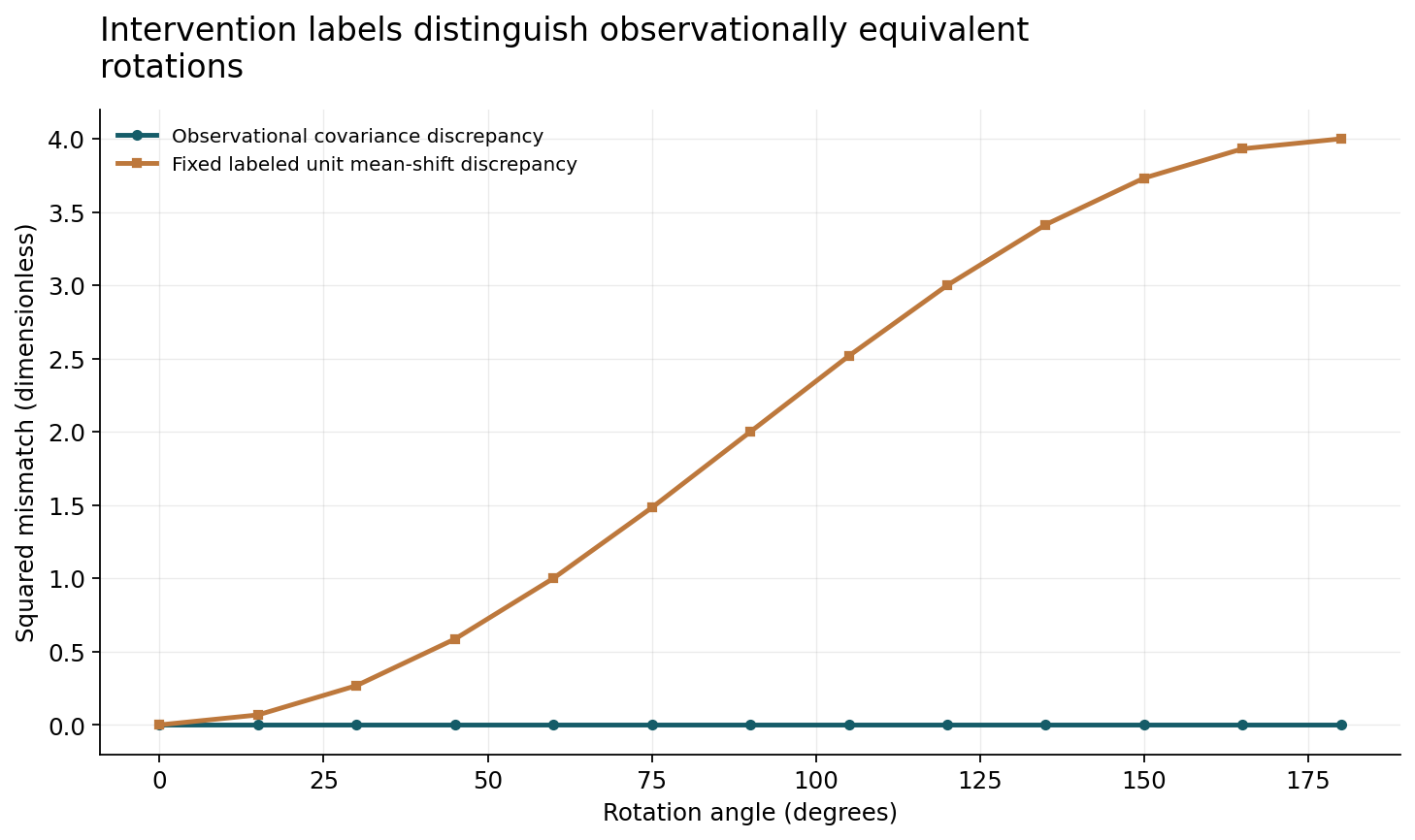
This is a classical linear-Gaussian symmetry used here as an explicit control, not a new impossibility theorem for all causal models. It shows why a factorized isotropic prior and exact reconstruction do not by themselves name the coordinates. Figure 1 plots the observational covariance mismatch across rotation angles; it remains zero within numerical tolerance. The same figure compares the mismatch after a labeled intervention whose intended direction is fixed. The contrast isolates the information supplied by the intervention rather than by the observation density. It also illustrates why numerical optimization can select a stable orientation without that orientation being statistically identified.
5. A labeled mean shift adds directional information
In the construction, an intervention adds a known mean shift delta along the first latent coordinate while preserving the covariance. In the original coordinates the intervention mean is (delta,0). A candidate rotated representation that insists on assigning that same intervention to its own first coordinate generally predicts a different mean. The squared discrepancy is 2 delta squared times (1-cos theta) for a rotation by theta.
This calculation depends on knowing how the intervention label corresponds to a coordinate. If the intervention target is unknown and may rotate with the representation, the observational ambiguity can reappear in another form. If only the magnitude of the shift is known, its sign or orientation may remain ambiguous. The intervention is therefore not a magic source of semantics; its metadata and mechanism determine what it identifies. The executable verifies the discrepancy directly from rotated vectors and checks the zero-shift control. When delta is zero, no new directional information is introduced, regardless of how confidently the event is labeled as an intervention in the dataset.
6. Intervention diversity determines the visible subspace
Suppose several environments induce mean shifts collected as columns of a matrix M. Directions outside the span of those shifts are not constrained by mean-shift evidence alone. In a higher-dimensional isotropic model, rotations within the unexcited subspace can preserve the observed intervention means. More intervention records do not necessarily add more identifying information if they repeat the same direction.
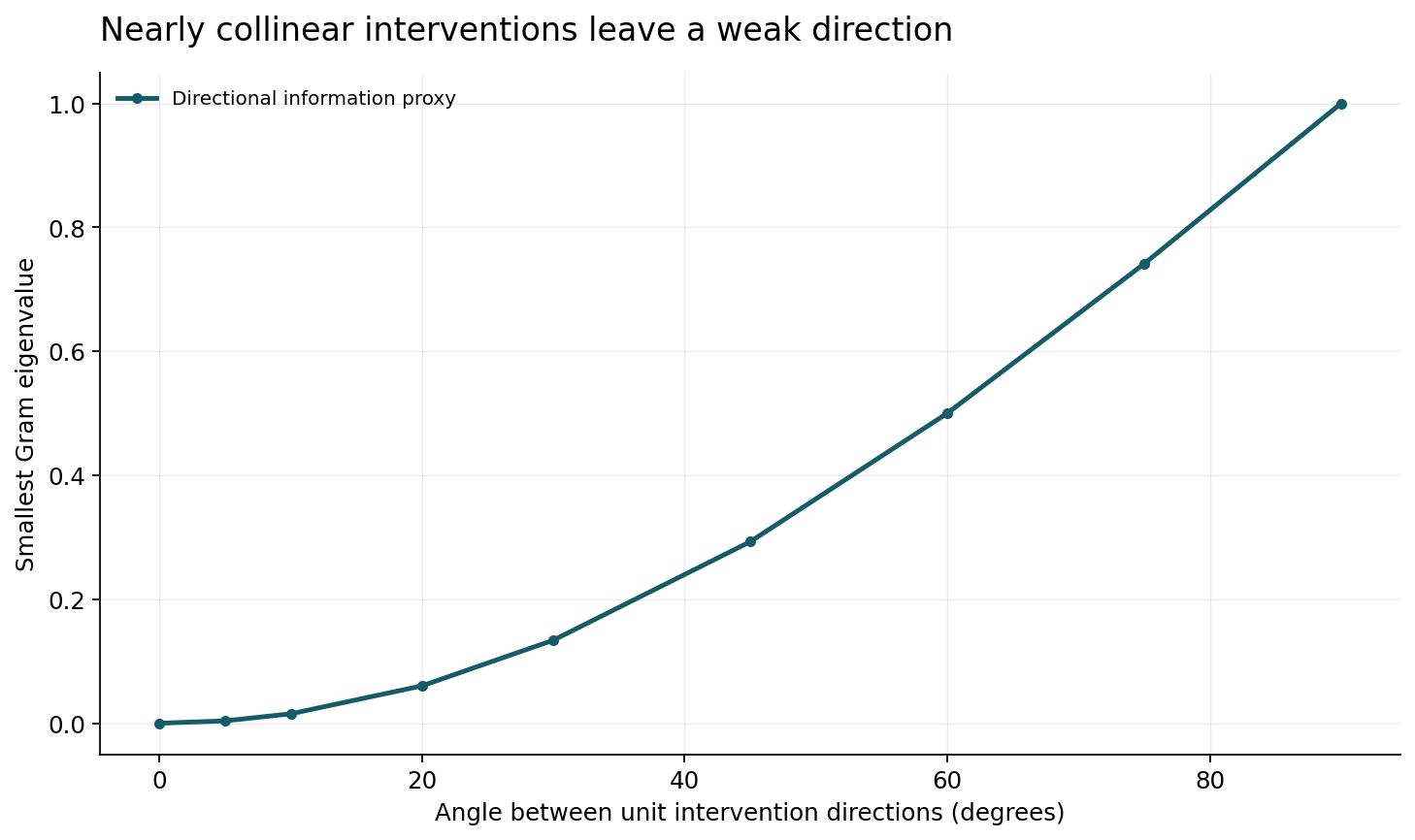
A useful diagnostic separates sample count from intervention diversity. The rank and conditioning of an estimated shift matrix can reveal whether distinct directions are being excited, although finite-sample estimation and nonlinear decoders complicate interpretation. Figure 2 uses a two-dimensional Gram matrix with two intervention directions separated by an angle. Its smaller eigenvalue approaches zero when the directions become collinear. This is a conditioning diagnostic for the declared linear construction, not a universal sample-complexity formula. It shows why nearly redundant interventions can make recovery unstable even when exact algebra would distinguish the factors in an ideal noiseless limit.
7. An intervention changes a mechanism, not merely a label
In a structural causal model, an intervention modifies a specified mechanism. A dataset field saying "intervention occurred" does not reveal which mechanism changed, whether the change was perfect or soft, or whether other variables were affected simultaneously. Measurement artifacts, selection effects, and environmental changes can accompany a physical intervention and create additional shifts in observations.
A representation-learning experiment should describe the intervention process independently of the learned model. Which variables were targeted? Was the intervention value known? Were targets randomized? Did the observation mechanism remain stable? Were there hidden simultaneous changes? These questions determine whether the assumed model class is plausible. A network may learn to classify intervention labels from an incidental visual cue without recovering the underlying causal factor. Holding out the cue or varying it independently can test that shortcut. Such tests require experimental design, not only a stronger reconstruction objective. The present Gaussian controls assume the intervention mechanism exactly and therefore cannot establish robustness to these violations.
8. Nonlinear reparameterization changes intervention semantics
Let W1=Z1 and W2=Z2+Z1 squared. This map is invertible, with Z2=W2-W1 squared. A decoder can absorb it without changing observations. However, setting W1 to a value while holding W2 fixed implies a change in Z2 as well. That operation is different from setting Z1 while holding Z2 fixed. Coordinate manipulation in a learned representation is therefore not automatically the intended physical intervention.
The distinction is visible without any probabilistic estimation. Choose a point, change the first coordinate under each convention, and map back. The resulting physical states differ by the induced squared-coordinate adjustment. This example does not imply that nonlinear representations are unusable. It implies that intervention semantics must be specified in addition to reconstruction equivalence. An encoder may provide a useful control interface if its transformations are calibrated against real interventions, even when its coordinates are not uniquely identified. Calling that interface causal requires evidence about the mapping between latent edits and mechanism changes, rather than relying on the visual plausibility of generated outputs.
9. Temporal order provides structure but not automatic causality
Sequential observations can reveal dynamics and constrain representations, especially when intervention targets are known. Yet temporal predictability alone does not uniquely identify causal variables. Hidden common drivers, instantaneous interactions, measurement delays, and changes in observation noise can produce dependencies that a recurrent model fits without recovering the intended mechanisms.
A temporal experiment should state the sampling interval and which effects can occur within one step. A model that assumes no instantaneous interactions may be inappropriate when the observation rate is slow relative to the system dynamics. Conversely, increasing the sampling rate can introduce strong measurement-noise correlations. The relationship between latent state and observation should remain part of the model. A successful next-frame predictor demonstrates a predictive capability under the tested distribution. Stronger claims about intervention transfer require interventions that were not simply interpolated from the same observed trajectories, together with an evaluation of whether the learned variables retain their meanings across those changes.
10. Auxiliary variables can carry shortcuts
An environment label can help identify latent structure under appropriate assumptions, but it can also correlate with nuisance features. A camera identifier, simulation seed, or acquisition protocol may change both the underlying process and the rendering. If a model uses the nuisance channel to separate environments, it may satisfy an auxiliary prediction objective without learning the factors of interest.
The evaluation should vary the observation process and intervention process independently where possible. For a synthetic visual study, one can change lighting or texture while holding latent mechanisms fixed, and change mechanisms while holding rendering fixed. For real data, complete independence may be unavailable, so the limitation should be reported rather than assumed away. A useful diagnostic compares representation stability across nuisance changes and intervention sensitivity across mechanism changes. Neither a low auxiliary loss nor a high disentanglement score is sufficient by itself. The key question is whether the additional information narrows the scientific equivalence class in the way claimed, rather than merely making one dataset easier to classify.
11. Metrics may hide permitted transformations
A learned coordinate can correlate strongly with a ground-truth factor after a flexible nonlinear mapping. That result may be compatible with a broad equivalence class while failing a stricter interpretation that expects direct intervention control. Conversely, a representation equivalent up to a harmless permutation can look poor under a metric that compares coordinates without alignment. The metric must match the intended identifiability statement.
Report the alignment procedure, its training data, and its capacity. If a powerful supervised decoder is fitted on the evaluation set, the resulting score may measure recoverability with extra labels rather than unsupervised identification. For intervention tasks, evaluate predicted effects and transfer under held-out interventions in addition to coordinate similarity. A metric should distinguish latent reconstruction, factor recovery, causal graph recovery, and counterfactual prediction. These are related but not identical outcomes. The Gaussian construction provides a simple test: every rotation reconstructs observations, yet only some align with a fixed labeled intervention convention. A single score that ignores the convention cannot distinguish those achievements.
12. Counterfactual claims require additional commitments
Predicting an interventional distribution and predicting an individual counterfactual are different tasks. The latter typically requires a model of how the same unit's exogenous factors persist across alternative interventions. Observational and interventional marginals may not determine that coupling uniquely. A latent representation that predicts average intervention effects can therefore remain insufficient for individual counterfactual questions.
An evaluation should identify which counterfactuals are observable in a controlled simulator and which are inherently unobserved in real data. Synthetic paired outcomes can be valuable, but their validity depends on the simulator's assumptions. The model should not inherit a real-world causal claim merely because it succeeds under a renderer with known factors. For deployment, sensitivity analyses can vary plausible structural assumptions and report how conclusions change. The present review offers no real-world intervention recommendation. Its role is to clarify why the words identifiable, causal, and counterfactual impose progressively specific obligations on the data, model class, and evaluation design.
13. A proposed study separates identification from optimization
Begin with the linear-Gaussian control, where the equivalence class and intervention signatures are known. Vary intervention strength and directional diversity independently. Measure both the population-level ambiguity and finite-sample estimation error. Only then add nonlinear decoders, observation noise, partial interventions, and unknown targets. This progression makes it easier to determine whether failure comes from missing information or from a learning algorithm that cannot exploit available information.
For each setting, compare multiple random initializations and explicitly aligned solutions. Preserve models with similar likelihood but different intervention behavior. An experiment that reports only the best aligned run can conceal nonidentifiability or optimization instability. Use held-out interventions to test transfer, and keep alignment data separate from the final evaluation. Report computation budgets and failed configurations. These are proposed experiments, not newly executed neural studies. The included standard-library code checks rotations, covariance equivalence, mean-shift mismatch, Gram eigenvalues, and the nonlinear intervention counterexample exactly enough to serve as initial controls for such a study.
14. Intervention effects should be evaluated on observables too
A latent score can improve while observable intervention predictions remain wrong. This can happen when the alignment metric rewards a coordinate relationship that the decoder does not preserve under edits, or when evaluation visits latent states far outside the training support. A useful study should therefore compare generated or predicted observations after intervention with independently available outcomes, not only compare latent coordinates with simulator labels.
The intervention range matters. In the Gaussian mean-shift construction, the algebra is valid for every finite shift under the declared distribution, but a learned decoder trained only on a narrow region may extrapolate poorly. Population identifiability does not imply finite-data coverage or numerical stability. An experiment should vary shift magnitude separately from intervention direction and report where predictions become unsupported. A model that abstains outside its validated range may be more useful than one that produces visually plausible but untested counterfactuals.
The observer also needs a stable measurement convention. If an intervention changes illumination, sensor calibration, or the mapping from physical state to observations, the decoder-invariance assumption fails. The resulting change may be attributed incorrectly to a latent causal mechanism. Controlled experiments can distinguish these possibilities by measuring or varying the observation process independently. In real settings where that separation is impossible, sensitivity to alternative observation models should remain part of the reported uncertainty.
These requirements help avoid a category error between a theorem's equivalence class and a deployed model's scientific meaning. The theorem concerns all models satisfying stated assumptions with sufficient information. The deployed model is one estimated object with finite data, imperfect optimization, and a particular decoder. Its intervention behavior must be tested at that level. The finite controls in this review support the conceptual distinction but do not bridge the empirical gap automatically.
15. A causal variable is an experimentally grounded abstraction
The promise of causal representation learning is not that an attractive latent visualization will name the world's mechanisms. It is that structured observations and interventions can support abstractions whose transformations remain meaningful across changing conditions. That promise becomes testable only when the remaining ambiguities are stated and the intervention semantics are grounded in the data-generating process.
Our constructions show how observations can leave orientations unidentified, how labeled interventions add information, and how insufficiently diverse interventions leave weak directions. They also show why an invertible representation change can preserve predictions while changing the meaning of a latent edit. Future work should connect equivalence-class statements with task-specific control requirements, distinguish population identification from finite-sample recovery, and test nuisance changes independently of mechanism changes. The strongest result would specify not merely that a representation is causal, but which interventions it supports, which transformations remain unresolved, and what evidence would falsify that interpretation.
Core equations and definitions
(1) For orthogonal R, X=AZ also equals A_new Z_new; observational orientation is ambiguous.
(2) Mismatch for a fixed labeled mean-shift direction under a planar rotation.
(3) Unit intervention directions separated by angle phi; collinearity gives a zero weak-direction eigenvalue.
(4) Invertible coordinate mixing preserves reconstructability but changes the semantics of holding W2 fixed while editing W1.
Constructed analytical figures
Comparison and reporting contract
| Diagnostic | What it establishes | What remains unproved |
|---|---|---|
| Reconstruction | Fit to observations | Unique latent semantics |
| Auxiliary prediction | Information about an auxiliary variable | Correct mechanism identification |
| Intervention transfer | Behavior under tested interventions | Individual counterfactual identification |
| Latent alignment | Agreement under selected mapping | Decoder validity outside observed support |
Evaluation protocol
- State the model class and allowed equivalence.
- Vary intervention strength and directional diversity separately.
- Separate nuisance changes from mechanism changes.
- Use held-out interventions and independent alignment data.
- Measure observable intervention outcomes as well as latent metrics.
Limitations
- Finite linear-Gaussian and explicit coordinate constructions only.
- No real-world causal effect or individual counterfactual is estimated.
- Intervention targets and mechanisms are assumed known in the control.
- Source theorem proofs, including corrigendum details, are not independently audited.
Open research questions
- How can intervention diversity be measured beyond a linear shift model?
- Which latent equivalences preserve the desired control semantics?
- How can empirical protocols distinguish nonidentifiability from optimization failure?
Evidence and its boundaries
- Unsupervised disentanglement requires assumptions beyond fitting the observed distribution.
- [1] — Scope-level source statement only; no independent reproduction, priority ranking or theorem-proof audit. Inspected: Primary author abstract and bibliographic record.
- Auxiliary variables can provide conditional information supporting identifiability.
- [2] — Scope-level source statement only; no independent reproduction, priority ranking or theorem-proof audit. Inspected: Primary author abstract and bibliographic record.
- Conditional factorized latent priors support qualified identifiability.
- [3] — Scope-level source statement only; no independent reproduction, priority ranking or theorem-proof audit. Inspected: Primary author abstract and bibliographic record.
- Structured pairs provide information absent from independent observations.
- [4] — Scope-level source statement only; no independent reproduction, priority ranking or theorem-proof audit. Inspected: Primary author abstract and bibliographic record.
- The primary perspective identifies learning causal variables as a problem distinct from a given-variable graph.
- [5] — Scope-level source statement only; no independent reproduction, priority ranking or theorem-proof audit. Inspected: Primary author abstract and bibliographic record.
- Temporal sequences and observed intervention targets support structured identifiability results.
- [6] — Scope-level source statement only; no independent reproduction, priority ranking or theorem-proof audit. Inspected: Primary author abstract and bibliographic record.
References
- Challenging Common Assumptions in the Unsupervised Learning of Disentangled Representations
Francesco Locatello, Stefan Bauer, Mario Lucic, Gunnar Rätsch, Sylvain Gelly, Bernhard Schölkopf, Olivier Bachem. arXiv author manuscript (2018). https://arxiv.org/abs/1811.12359Source scope
Primary author record title, complete author list, submission history and abstract inspected through web tools on 2026-10-28. Full proof and benchmark execution not independently checked.
- Nonlinear ICA Using Auxiliary Variables and Generalized Contrastive Learning
Aapo Hyvarinen, Hiroaki Sasaki, Richard E. Turner. arXiv author manuscript (2018). https://arxiv.org/abs/1805.08651Source scope
Primary author record title, complete author list, submission history and abstract inspected through web tools on 2026-10-28. Full proof and benchmark execution not independently checked.
- Variational Autoencoders and Nonlinear ICA: A Unifying Framework
Ilyes Khemakhem, Diederik P. Kingma, Ricardo Pio Monti, Aapo Hyvärinen. arXiv author manuscript (2019). https://arxiv.org/abs/1907.04809Source scope
Primary author record title, complete author list, submission history and abstract inspected through web tools on 2026-10-28. Full proof and benchmark execution not independently checked.
- Weakly-Supervised Disentanglement Without Compromises
Francesco Locatello, Ben Poole, Gunnar Rätsch, Bernhard Schölkopf, Olivier Bachem, Michael Tschannen. arXiv author manuscript (2020). https://arxiv.org/abs/2002.02886Source scope
Primary author record title, complete author list, submission history and abstract inspected through web tools on 2026-10-28. Full proof and benchmark execution not independently checked.
- Towards Causal Representation Learning
Bernhard Schölkopf, Francesco Locatello, Stefan Bauer, Nan Rosemary Ke, Nal Kalchbrenner, Anirudh Goyal, Yoshua Bengio. arXiv author manuscript (2021). https://arxiv.org/abs/2102.11107Source scope
Primary author record title, complete author list, submission history and abstract inspected through web tools on 2026-10-28. Full proof and benchmark execution not independently checked.
- CITRIS: Causal Identifiability from Temporal Intervened Sequences
Phillip Lippe, Sara Magliacane, Sindy Löwe, Yuki M. Asano, Taco Cohen, Efstratios Gavves. arXiv author manuscript (2022). https://arxiv.org/abs/2202.03169Source scope
Primary author record title, complete author list, submission history and abstract inspected through web tools on 2026-10-28. Full proof and benchmark execution not independently checked.