

Abstract
Congestion control is an inference problem embedded in a feedback loop. A sender observes acknowledgements, delay, loss or explicit marks, then changes a rate whose consequences become visible later. This review uses BBR, DCTCP and TIMELY to distinguish model-based bandwidth estimation, explicit congestion feedback and delay-based control. We derive bandwidth-delay and queue-delay relationships and use Jain's index to show why aggregate throughput alone cannot establish fairness. Two analytical figures relate buffer occupancy to added delay and describe the fairness of a two-flow allocation. A finite fluid-queue example checks conservation and drainage under a burst. These constructions are intentionally simpler than the cited protocols and do not rank them. The proposed measurement design requires declared topology, feedback timing, queue discipline, cross traffic and transport implementation, so that a performance conclusion remains attached to the conditions that produced it.
1. The sender observes consequences, not the bottleneck
A transport sender does not directly see a complete, instantaneous network state. An acknowledgement summarizes earlier packet delivery after forward-path queueing, receiver processing and reverse-path delay. A loss event may reflect congestion, a transmission error or a policer. A delay increase can originate in a bottleneck queue or elsewhere along the path. These ambiguities matter because the controller chooses an action before it can observe all consequences of its previous action. A useful analysis therefore separates the physical state, the observation process and the control law. Calling every delay increase "congestion" skips the inference step, while reporting a high delivery rate without queue information skips the effect on other traffic.
2. Three primary designs, three kinds of evidence
BBR builds a model using bottleneck bandwidth and round-trip propagation time estimates. DCTCP uses explicit congestion notification to obtain more information than a binary loss event provides. TIMELY uses round-trip-time measurements and their changes in a datacenter setting. These mechanisms expose different requirements for measurement and infrastructure. An ECN-based result presupposes a particular marking behavior; a delay-based result depends on measurement resolution and noise; a model-based result depends on the validity of its estimates. The papers are used here to distinguish mechanisms, not to claim that one protocol dominates all others. In particular, the cited BBR record is the 2017 Communications of the ACM article, not an assertion about every later implementation or version. [1], [2], [3]
3. Bandwidth-delay product is an accounting identity
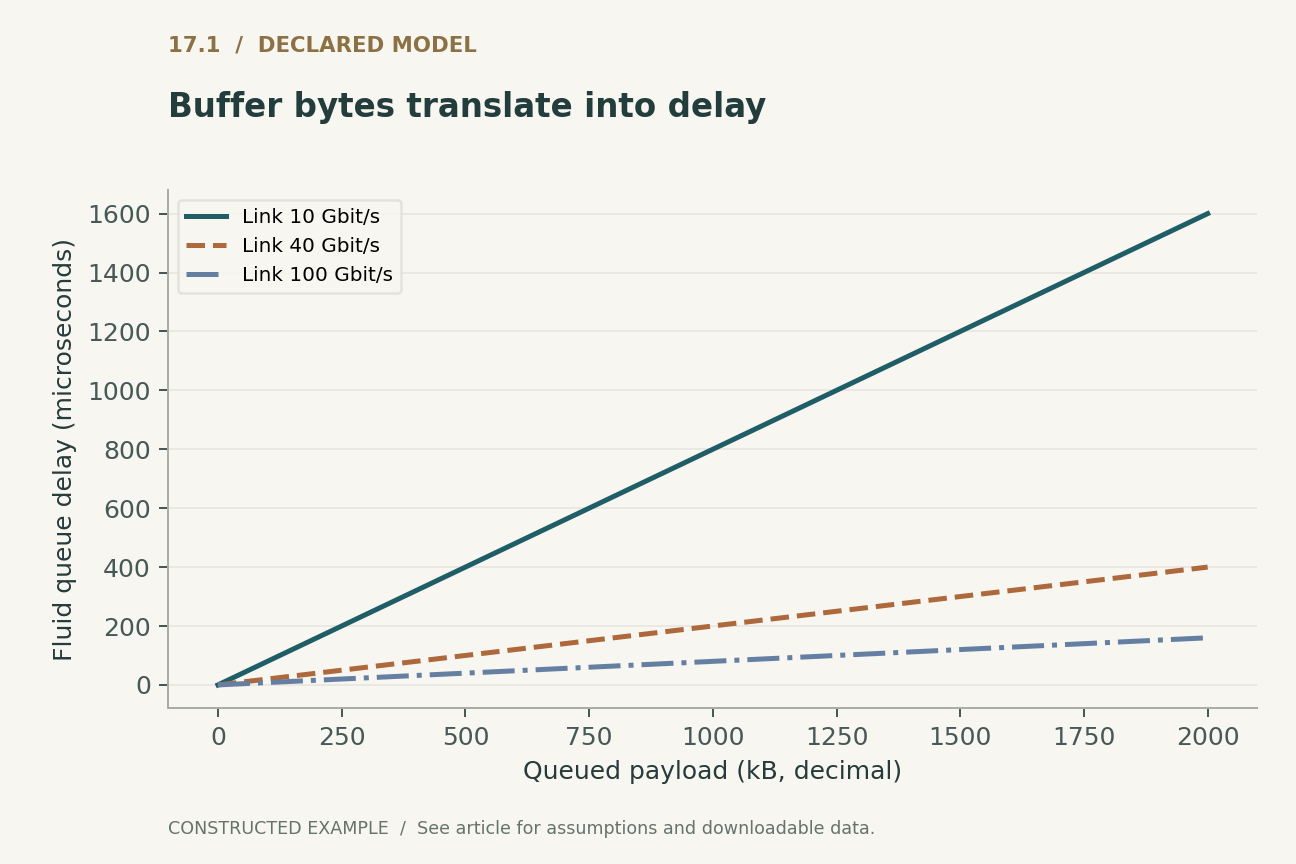
At a fixed bottleneck rate C and propagation round-trip time R, the bandwidth-delay product is C times R. It describes the amount of in-flight data associated with filling that path at the stated rate. It does not imply that a sender should add an arbitrary buffer on top. If q bytes accumulate in a bottleneck queue served at C bytes per second, the associated service delay is q divided by C in a simple fluid model. A one-megabyte queue has very different delay implications on a ten-gigabit and a hundred-gigabit link. Units must be explicit: network rates commonly use decimal bits per second, while operating-system memory displays may use binary bytes. The figure uses decimal kilobytes and gigabits throughout.
4. Queue growth reveals a mismatch of rates
In a lossless fluid approximation, queue occupancy grows when aggregate arrival rate exceeds service capacity and shrinks when service exceeds arrival, stopping at zero. This is a conservation statement rather than a congestion-control algorithm. A short burst can create a queue even when the long-run average input is below capacity. If the sender reacts only to a smoothed average, it may miss the burst; if it reacts strongly to each noisy sample, it may create oscillation. Neither behavior can be diagnosed from a time-averaged throughput number. Record queue occupancy and arrival rate on a common clock, and state whether sampling is fine enough to resolve the events that the controller is supposed to manage.
5. Delayed feedback changes what a gain means
A correction based on an old queue measurement may arrive after the queue has already drained or after another sender has made the same correction. This can produce alternating overload and underutilization even when each sender's local rule appears reasonable. The simplest undelayed linear recurrence approaches its target only for an appropriate gain range; inserting a delay changes its characteristic roots and stability conditions. Real controllers also include saturation, pacing, probing and discrete packet effects, so a scalar recurrence is not a faithful implementation model. Its conceptual value is narrower: control strength cannot be interpreted independently of feedback delay. An experiment that changes path round-trip time without retuning or at least reporting this relationship has changed the controller's effective operating regime.
6. Utilization is compatible with unequal service
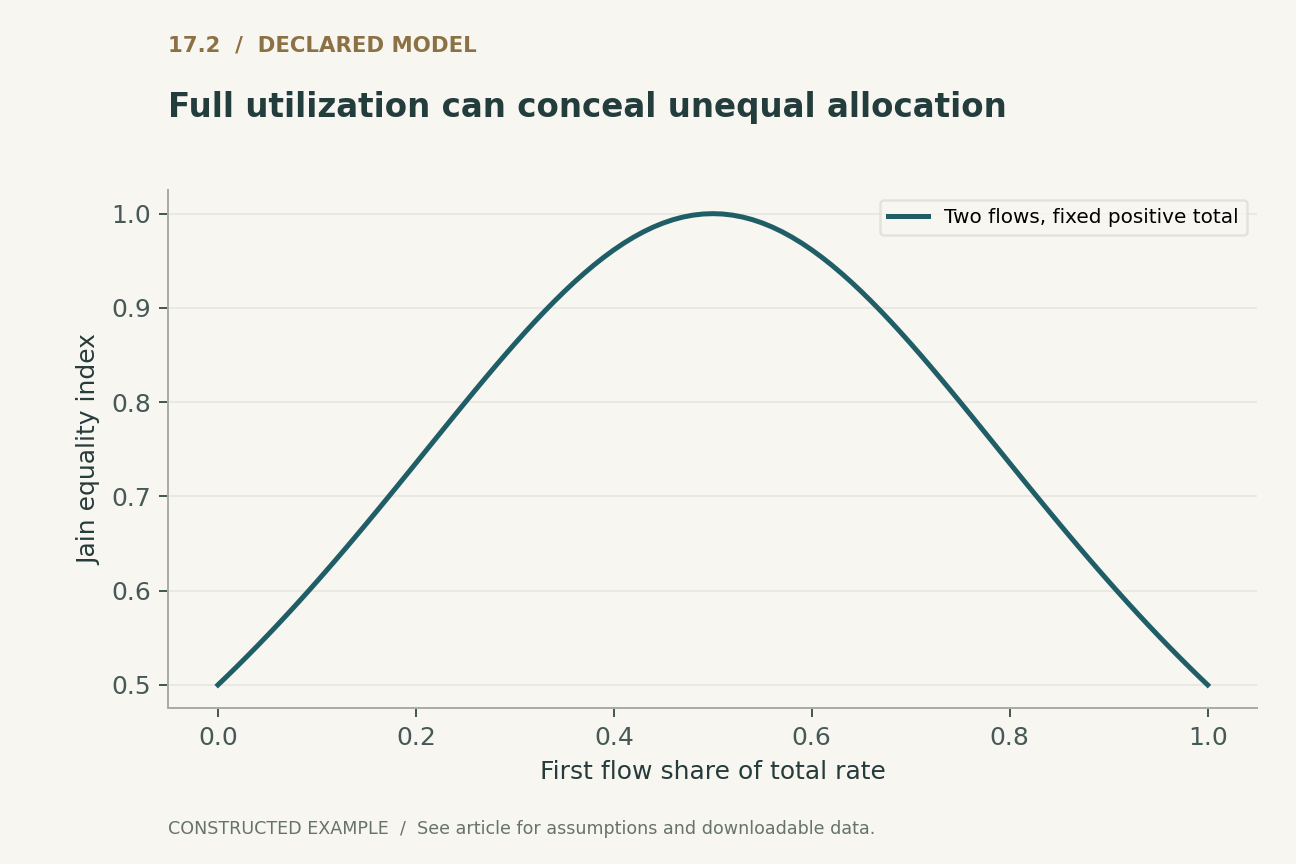
Two flows can fully utilize a link while receiving very unequal rates. Jain's index equals one for equal positive allocations and falls toward one divided by the number of flows when one flow receives almost everything. For rates eight and two in the same units, the index is approximately 0.735 despite complete utilization of a capacity-ten link. This metric is scale invariant, so changing the unit from megabits to gigabits does not change the conclusion. It is not a universal fairness definition: unequal allocations may be intentional under weighted service classes, and equal throughput can still conceal unequal completion times for different object sizes. The service contract must define what fairness means before the index is used as evidence.
7. Coexistence is part of the experiment
A new controller may behave well when every sender uses it and poorly when it shares a bottleneck with another algorithm. Queue discipline, packet marking thresholds and scheduling weights can determine who receives the scarce capacity. A useful experiment includes homogeneous and mixed populations, short and long flows, different round-trip times, and controlled reverse-path interference. It reports per-flow results rather than only a total. The comparison should also pin software versions and offload settings, because a change in pacing or timestamp behavior can alter the observation process. This is especially important when a paper proposes a mechanism but a benchmark actually measures a later implementation with additional policies.
8. What the reproducible models cover
The first figure converts declared buffer sizes into fluid queueing delay for three link rates. The second evaluates the fairness index of a two-flow allocation as one flow's share varies. Neither uses packet traces or performance numbers from the source papers. The executable appendix applies a burst at one-and-a-half times capacity, follows it with an arrival rate at half capacity, and checks that the queue grows and drains according to conservation. It also checks fairness under positive scaling and permutation. These bounded calculations can catch unit errors and misleading aggregate summaries. They cannot validate ECN marking, pacing, retransmission, packet scheduling or the convergence behavior of BBR, DCTCP or TIMELY.
9. A measurement design that preserves causality
To attribute an improvement to a congestion mechanism, vary that mechanism while holding the workload, topology and service objectives fixed. Record the offered workload independently of achieved throughput, including requests that time out. Synchronize sender, receiver and queue observations where possible, and quantify the uncertainty when clocks cannot be aligned. Run independent repetitions with reset state; repeated samples from one long transient are not independent experimental runs. Report the distribution of completion times, queue occupancy and per-flow rates together. If the change also requires different switch settings, describe the intervention as a joint transport-and-network configuration rather than crediting the endpoint algorithm alone.
10. The claim that survives these distinctions
A convincing congestion-control result identifies which information improves a decision, which network conditions make that information reliable, and what competing objectives are traded away. Maximum throughput, minimum standing queue and perfect fairness cannot be assumed to coincide. A paper should therefore state the relevant service contract and show where its controller ceases to meet it. The present review supplies identities, counterexamples and a controlled evaluation framework; it supplies no winner among the cited systems. That restraint is substantive. Once mechanism, measurement and objective are kept separate, later implementation studies can produce conclusions that remain meaningful when topology, workload or controller version changes.
Executed locally · Bounded scope
Fluid queue conservation and rate-equality invariants
Piecewise fluid arrivals and equal-weight rate fairness; no transport protocol executed.
10 assertions passed. These checks validate the supplied example, not the cited systems.
Inspect the recorded witness
{
  "peak_bytes": 1000.0,
  "final_bytes": 0,
  "eight_two_Jain": 0.7352941176470589
}
Download all 20 executable examplesRead the complete check results
A declared analytical model
Four equations, explicit assumptions
(1) C is in bytes per second and R in seconds when BDP is reported in bytes.
(2) Fluid service delay for q queued bytes at a fixed capacity C; additional scheduling and propagation delays are excluded.
(3) Piecewise-constant fluid arrivals and service; sufficiently specified intervals and no finite-buffer losses.
(4) Positive total rate; equal weighting. The all-zero vector is undefined and excluded.
Constructed examples · Reproducible data
Inspect the quantitative argument
These curves are calculated from the declared models. They are not observations from the cited studies. Every figure includes its numeric data and vector version.


Which evidence answers which question?
| Observed quantity | What it can support | What it cannot establish alone |
|---|---|---|
| Delivery rate | Achieved throughput over the interval | Queue delay or fair sharing |
| Round-trip time | End-to-end feedback delay | Location or cause of every queue |
| ECN marks | Configured marking feedback | A universal congestion magnitude |
| Jain index | Equality of specified allocations | Deadline fairness or correct service weights |
A proposed validation protocol
This is a proposed evaluation design. No production-system or hardware benchmark was performed. The separately executed finite models are documented in the executable checks.
- Pin transport versions, topology, switch queues, marking and offloads.
- Define offered arrivals and the throughput, delay and fairness objectives.
- Measure sender, receiver and bottleneck state with clock uncertainty.
- Include heterogeneous round-trip times and mixed controller populations.
- Repeat independent runs with declared warm-up and reset procedures.
- Publish per-flow distributions, time series, exclusions and sensitivity to feedback delay.
What the primary sources establish
Neal Cardwell, Yuchung Cheng, C. Stephen Gunn et al. · 2017 [1]
Contribution. A model of bandwidth and propagation delay can guide congestion-control decisions.
Boundary. This review cites the 2017 article and makes no claim about all later BBR versions.
Source locator. Communications of the ACM article, mechanism description.
Mohammad Alizadeh, Albert Greenberg, David A. Maltz et al. · 2010 [2]
Contribution. Explicit congestion marks can provide a richer feedback signal in a datacenter design.
Boundary. The marking policy and deployment assumptions are part of the result.
Source locator. DCTCP, design and evaluation framing.
Radhika Mittal, Vinh The Lam, Nandita Dukkipati et al. · 2015 [3]
Contribution. Round-trip-time measurements can be used to control datacenter transport rates.
Boundary. Measurement quality and feedback conditions limit generalization.
Source locator. TIMELY, design description.
Limits of this analysis
- No packet-level or hardware benchmark was run.
- Fluid queues omit packet granularity, losses and detailed scheduling.
- Equal-rate fairness is one objective and may not match weighted service contracts.
- The three foundational source records do not characterize all later protocol versions.
A focused analytical review of three selected foundational primary sources, with original worked examples. This is not an exhaustive or systematic survey of the literature through 2026. Source access and version notes are recorded with the bibliography.
Questions that would change the conclusion
- How should a controller distinguish forward-path queue growth from reverse-path interference?
- Which fairness metric best matches deadline-sensitive scientific workloads?
- Can reported performance gains be preserved under mixed controller populations and clock uncertainty?
References
- Neal Cardwell, Yuchung Cheng, C. Stephen Gunn et al.. BBR: congestion-based congestion control. Communications of the ACM (2017). 10.1145/3009824.
- Mohammad Alizadeh, Albert Greenberg, David A. Maltz et al.. Data center TCP (DCTCP). Proceedings of the ACM SIGCOMM 2010 conference (2010). 10.1145/1851182.1851192.
- Radhika Mittal, Vinh The Lam, Nandita Dukkipati et al.. TIMELY: RTT-based Congestion Control for the Datacenter. Proceedings of the 2015 ACM Conference on Special Interest Group on Data Communication (2015). 10.1145/2785956.2787510.
Source [1] access. Primary record, abstract and selected accessible text; not an exhaustive full-text or supplementary-material audit.
Source [2] access. Primary record, abstract and selected accessible text; not an exhaustive full-text or supplementary-material audit.
Source [3] access. Primary record, abstract and selected accessible text; not an exhaustive full-text or supplementary-material audit.
Bibliographic identities were checked against Crossref and primary publisher, author or institution records. Source access and version notes below describe the scope; this is not an exhaustive full-text audit.
Authorship and provenance
Written and technically self-reviewed by Codex (AI). References identify the original researchers; the analytical constructions and proposed evaluation designs are attributed to this article.
Covers are conceptual ImageGen illustrations. Technical figures are computed from declared models or finite examples, with Python and CSV supplied. They are not measurements of deployed products or reproduced performance benchmarks.
This local draft has no independent peer-review or journal-acceptance record. Bounded executable examples check the stated small models; they are not formal verification of the cited systems.