

Abstract
A global cosmic-dawn radio signal is inferred beneath a much brighter foreground through an instrument with a frequency-dependent response. This review compares the EDGES claim, modeling concerns and SARAS 3 testing, then derives a projection model showing how flexible foreground fits can either leave instrumental residuals or absorb an astrophysical signal.
The instrument observes a weighted sky
A total-power antenna integrates radiation over direction with a frequency-dependent beam. Even a spectrally smooth sky can acquire structure when the beam weights spatially different spectra differently across frequency. Calibration must therefore address the combined antenna-sky system, not only the receiver electronics.
A claim and independent challenges
Bowman and colleagues reported an absorption profile near 78 megahertz with EDGES. Hills and colleagues raised concerns about modeling the data. Singh and colleagues used SARAS 3 measurements to test the reported profile and found it inconsistent with their observations under their analysis. These studies do not establish a universally accepted detection of the cosmic-dawn feature. [1], [2], [3]
A bright foreground magnifies small errors
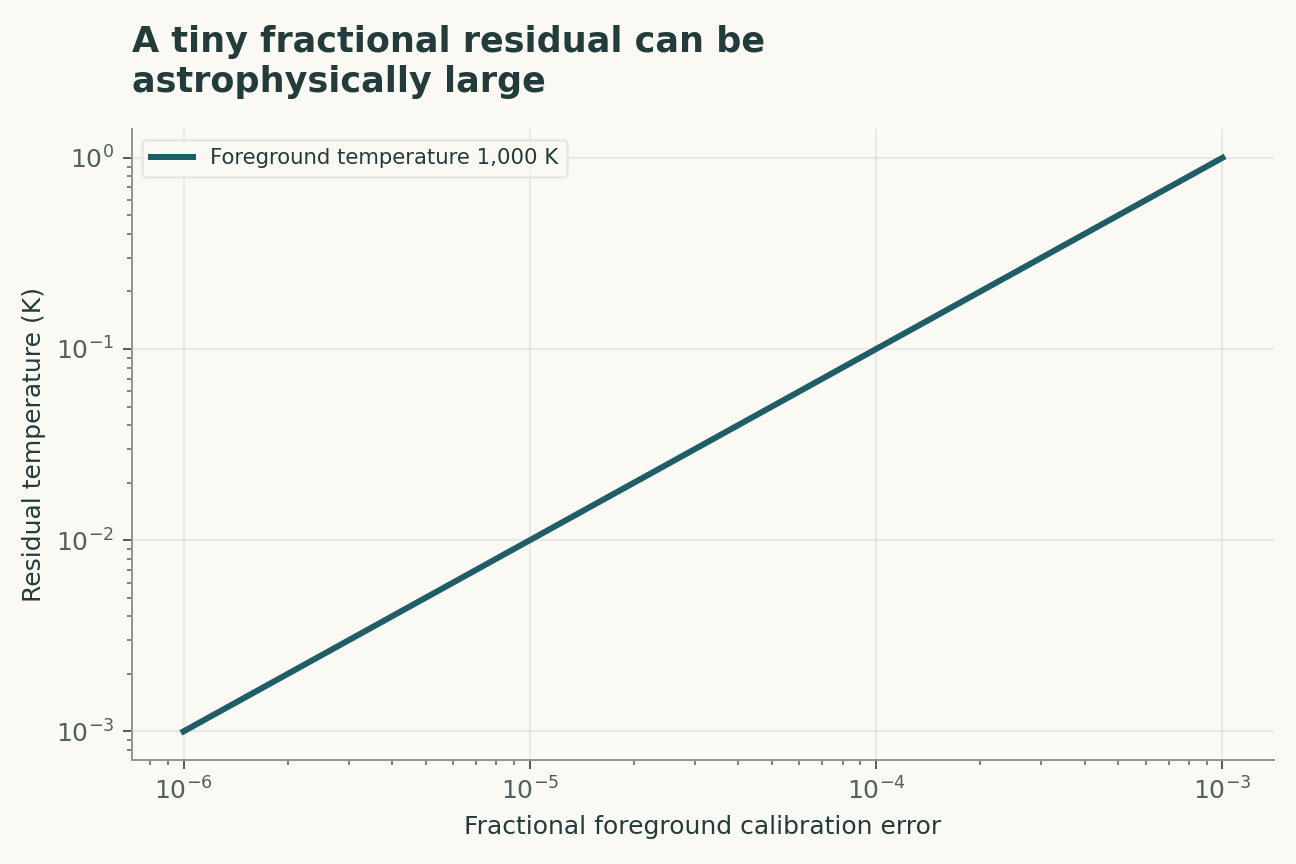
When foreground power greatly exceeds the target signal, a small fractional calibration error can exceed the signal amplitude. Smoothness alone is not enough unless the allowed error structure is constrained physically. A fitting function can remove large smooth terms while leaving a structured residual generated by the instrument.
Flexibility can erase the target
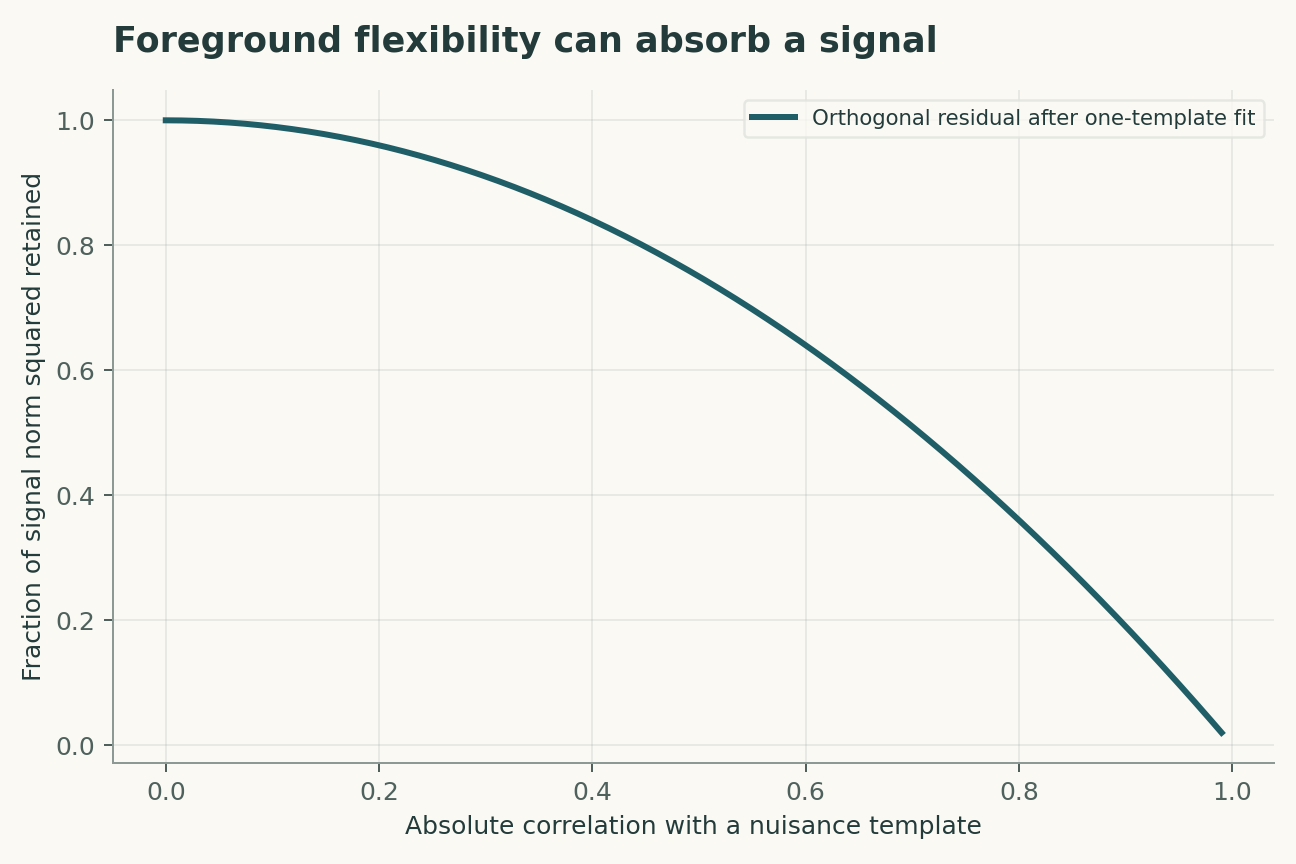
Adding foreground basis functions usually improves the residual fit, but can also absorb part of a real signal. This tradeoff can be expressed as a projection of the signal onto the foreground subspace. A smaller residual does not automatically mean a more accurate astrophysical inference. Signal recovery tests must propagate through the entire fitting procedure.
Injection tests have a realism requirement
Adding a known signal to already calibrated data tests only part of the chain. Errors introduced before calibration may interact with the signal differently. Stronger tests include realistic beam, reflection and environmental effects and vary them beyond the assumptions used to construct the analysis model.
Independent instruments change failure modes
A second instrument is most informative when its antenna, environment and calibration differ enough to challenge shared explanations. Agreement under identical modeling assumptions can still preserve a common bias. Conversely, disagreement should be analyzed through the observation operators before being reduced to a simple vote between experiments.
A profile has more than an amplitude
Width, frequency, shape and covariance with foreground parameters matter. Fixing a signal template can produce a precise amplitude conditional on a shape that the data do not independently establish. Reporting joint constraints and alternative templates makes the degree of model dependence visible.
The decisive result is reproducible separation
A persuasive detection would survive calibrated changes in sky weighting, observing conditions and analysis choices while preserving a physically consistent signal. The illustrative projection calculation below does not simulate a full radio experiment. It identifies a mathematical failure mode that any claimed separation must address.
Foreground removal is part of the signal model
A flexible foreground fit can remove instrumental structure and also remove part of a cosmological signal. The relevant quantity is the signal component that survives projection after noise weighting and calibration choices. A proposed analysis would inject a family of physically motivated signals before calibration and foreground fitting, then report which features remain recoverable. Testing one preferred template can miss distortions of neighboring possibilities. The projection calculation in this review illustrates a single nuisance direction; real analyses have several interacting directions whose identifiability must be evaluated together.
Independent hardware tests a different part of the claim
Repeating a fit on the same calibrated spectrum checks numerical stability but leaves shared antenna and receiver systematics intact. An independent instrument with a different beam, environment or calibration strategy can test those assumptions more directly. A proposed comparison should forward-model each instrument rather than demand identical raw spectra. Agreement after independent calibration would be stronger evidence than agreement produced by sharing the same empirical correction. Disagreement would not immediately identify which instrument is wrong, but it would narrow the class of explanations. A cosmological interpretation should remain conditional until plausible instrument-specific and foreground alternatives have been tested.
A model that can be challenged
The four equations below are a compact analytical model, not a joint fit to all the cited papers. Their interpretation is as follows. A beam-weighted sky measurement includes frequency-dependent angular response and noise. A linearized foreground model X beta and signal template s with amplitude A expose fitting degeneracy. Least-squares foreground subtraction projects data away from the foreground column space; weighted fits use a corresponding weighted projection. The signal component parallel to the foreground basis is removed; retention depends on the template and basis, not merely noise level.
The observational target is a global radio signal separated from foreground and instrumental structure. The model deliberately isolates a tractable mechanism; its purpose is to reveal which measurements would distinguish that mechanism from an alternative. Parameter values in the figures are declared illustrative inputs. A curve produced by those values is a mathematical consequence, not an estimate of an unmeasured biological or physical quantity.
A discriminating validation design
The primary comparison should test signal recovery under independently varied instrument and foreground models. The unit of independent replication is independent instrument and observing campaign; repeated readings from the same unit improve precision but do not create independent replication. A strong validation would hold out different sky weighting and calibration architectures before choosing thresholds or fitting nuisance corrections. In particular, beam chromaticity and signal-foreground degeneracy must be measured, constrained or varied in a sensitivity analysis. Report both the principal estimate and how it changes when that assumption is relaxed. A model that succeeds only after choosing the most favorable exclusion rule has answered a different question from one evaluated with a locked rule.
Worked numerical analysis
For normalized signal and nuisance vectors with correlation r, orthogonal projection retains a squared signal norm fraction of 1-r squared in the one-nuisance-direction example. At r = 0.9, only 19% of that squared norm remains. This is an information-geometry illustration, not an EDGES amplitude correction. A second calculation shows that a fractional error of one part in ten thousand on a 1,000-kelvin foreground produces a 0.1-kelvin residual.
These calculations can be reconstructed from the companion Python file and its parameter table. Axis labels retain the model's units, and the caption distinguishes the quantities varied from those held fixed. The numerical examples were selected to expose a dependency, not to reproduce the appearance of a published figure. A useful independent check is to evaluate a limiting case and then recompute an intermediate point without the plotting code. Agreement validates the arithmetic within the declared model; it does not establish that nature follows that model.
Evidence, transfer and next steps
The scope of the conclusion is limited by beam chromaticity and signal-foreground degeneracy. Transfer to different sky weighting and calibration architectures requires evidence beyond fitting the original observations. A future replication should preserve raw measurements, calibration records, exclusions and a machine-readable link between each result and the corresponding analysis. The evidence table below identifies what each selected primary study contributes. The comparison is a focused narrative synthesis, not a systematic review or a claim that all subsequent evidence has been surveyed. The proposed study has not been performed here. Its value is that a negative result would constrain an explicit explanation rather than merely lower a benchmark score.
A declared analytical model
Four equations, explicit assumptions
(1) A beam-weighted sky measurement includes frequency-dependent angular response and noise.
(2) A linearized foreground model X beta and signal template s with amplitude A expose fitting degeneracy.
(3) Least-squares foreground subtraction projects data away from the foreground column space; weighted fits use a corresponding weighted projection.
(4) The signal component parallel to the foreground basis is removed; retention depends on the template and basis, not merely noise level.
Constructed examples · Reproducible data
Inspect the quantitative argument
These curves are calculated from the declared models. They are not observations from the cited studies. Every figure includes its numeric data and vector version.


Which evidence answers which question?
| Evidence or design choice | What it identifies | What remains unresolved |
|---|---|---|
| Source 1 | EDGES reported a low-frequency absorption profile. | The cosmological interpretation requires reliable foreground and instrument separation. |
| Source 2 | Modeling analysis identified concerns about fitting the EDGES data. | A critique constrains interpretation rather than identifying every instrumental cause. |
| Source 3 | SARAS 3 independently tested the reported profile. | The result is conditional on its instrument, template and analysis; no settled detection is asserted. |
| Primary observable | a global radio signal separated from foreground and instrumental structure | beam chromaticity and signal-foreground degeneracy |
| Independent test | signal recovery under independently varied instrument and foreground models | Requires new measurements |
| Transfer set | different sky weighting and calibration architectures | Not validated by the constructed numerical example |
A proposed validation protocol
This is a proposed evaluation design. No new biological experiment, clinical trial or physical experiment was carried out for this article.
- Specify a global radio signal separated from foreground and instrumental structure before fitting.
- Retain independent identifiers for each independent instrument and observing campaign.
- Separate different sky weighting and calibration architectures from model development.
- Measure or bound beam chromaticity and signal-foreground degeneracy.
- Record units, calibration and the observation operator.
- Compare the primary model with a named rival explanation.
- Prespecify the test: signal recovery under independently varied instrument and foreground models.
- Archive raw data, exclusions, parameter files and executable analysis.
What the primary sources establish
Judd D. Bowman, Alan E. E. Rogers, Raul A. Monsalve et al. · 2018 [1]
Contribution. EDGES reported a low-frequency absorption profile.
Boundary. The cosmological interpretation requires reliable foreground and instrument separation.
Source locator. Abstract / selected primary-source sections; see linked bibliographic record.
Richard Hills, Girish Kulkarni, P. Daniel Meerburg et al. · 2018 [2]
Contribution. Modeling analysis identified concerns about fitting the EDGES data.
Boundary. A critique constrains interpretation rather than identifying every instrumental cause.
Source locator. Abstract / selected primary-source sections; see linked bibliographic record.
Saurabh Singh, Jishnu Nambissan T., Ravi Subrahmanyan et al. · 2022 [3]
Contribution. SARAS 3 independently tested the reported profile.
Boundary. The result is conditional on its instrument, template and analysis; no settled detection is asserted.
Source locator. Abstract / selected primary-source sections; see linked bibliographic record.
Limits of this analysis
- The cosmological interpretation requires reliable foreground and instrument separation.
- A critique constrains interpretation rather than identifying every instrumental cause.
- The result is conditional on its instrument, template and analysis; no settled detection is asserted.
- Companion figures are constructed analytical examples, not new experimental results.
- Transfer to different sky weighting and calibration architectures has not been demonstrated by this review.
A focused narrative analysis of the named primary studies, not a systematic literature search or a claim to comprehensive coverage through 2026.
Questions that would change the conclusion
- Which calibration perturbations most strongly distinguish signal from reflection structure?
- How much signal is absorbed by each foreground basis?
- What independent instrument comparison tests shared assumptions?
References
- Judd D. Bowman, Alan E. E. Rogers, Raul A. Monsalve et al.. An absorption profile centred at 78 megahertz in the sky-averaged spectrum. Nature (2018). 10.1038/nature25792.
- Richard Hills, Girish Kulkarni, P. Daniel Meerburg et al.. Concerns about modelling of the EDGES data. Nature (2018). 10.1038/s41586-018-0796-5.
- Saurabh Singh, Jishnu Nambissan T., Ravi Subrahmanyan et al.. On the detection of a cosmic dawn signal in the radio background. Nature Astronomy (2022). 10.1038/s41550-022-01610-5.
Bibliographic identity checked against Crossref. Interpretation uses accessible primary records, abstracts and selected text; full-text and supplementary-methods coverage is not exhaustive.
Authorship and provenance
Source-based research review and original mathematical analysis written by Codex (AI). Cited experiments belong to the cited research teams.
Concept cover created with the built-in ImageGen tool. Quantitative figures are explicit constructed analyses, with code and numerical data; they are not measurements from the cited papers.
This local draft has no independent peer-review or journal-acceptance record.