

Abstract: What Remains to Be Done after Degradation
Enzymes can help cleave chemical bonds in specific polyesters, but turning this capability into circular materials requires substrate treatment, monomer recovery, purification, and repolymerization. This article connects the original research on PET-degrading microorganisms with machine-learning-aided hydrolase engineering, examining surface accessibility, crystalline state, enzyme deactivation, and overall process yield. We emphasize that mass loss, measurable monomers, and closed-loop products are distinct outcomes. All calculations in the figures use transparent analytical models; they are not new plastic recycling experiments.[1] A bacterium that degrades and assimilates poly(ethylene[2] Machine learning-aided engineering of hydrolases for PE
English abstract
Enzymatic PET recycling couples polymer accessibility, enzyme kinetics, deactivation and downstream recovery. We connect the original PET-degrading bacterium with machine-learning-aided hydrolase engineering, derive an integrated active-enzyme model and a multiplicative recovery ledger, and distinguish depolymerization from closed-loop material performance.
What the Original Microbial Study Established
Yoshida and colleagues discovered a bacterium capable of degrading and utilizing PET and investigated the roles of the associated enzymes. Their study provides evidence for a specific polyester and biological system; it does not establish that all plastics can be treated in the same way. Materials such as polyethylene have different bond types from PET and cannot be assigned the same mechanism simply because they are all called plastics. This article also does not directly extrapolate experimental film conditions into a uniform degradation rate for mixed waste streams or natural environments.[1] A bacterium that degrades and assimilates poly(ethylene
Evidence for Machine-Learning-Aided Enzyme Engineering
Lu and colleagues combined modeling and experiments to study PET hydrolases, examining different post-consumer substrates and associated conditions. Their work shows that computational design can propose testable candidates, while substrate state remains important. This article retains the temperature, geometry, and material scope of the original experiments. It does not present the complete degradation time of a selected favorable sample as the treatment time for all waste plastics, nor does it treat a model prediction itself as validated enzyme activity.[2] Machine learning-aided engineering of hydrolases for PE
PET and Other Waste Streams Must Be Distinguished
Packaging, textiles, and composites may contain different polymers, dyes, coatings, and additives. Even when the main polymer is PET, post-processing and impurities can alter accessibility and product purification. Research should first define the input composition and sorting boundaries before comparing treatment outcomes. Directly comparing results from pretreated pure substrates with unsorted mixed waste makes process burdens disappear from the metrics.作者分析与复核建议 / Author analysis
Mass Loss Is Not Monomer Yield
Thinning, fragmentation, or dissolution of a material can reduce its measured weight without ensuring complete recovery of the target monomers. The solution may contain oligomers, other organic compounds, or mixtures that are difficult to separate. Independent analysis and mass balances are needed to confirm the target monomers, and residual solids must also be examined. If only the disappearance of solids is reported, the conclusion should remain confined to that measurement endpoint; it cannot automatically be elevated to a closed loop based on high-purity monomers.作者分析与复核建议 / Author analysis
Surface Area and Geometric Scale
For similar flat plates, the surface-area-to-mass ratio varies approximately with the inverse of thickness. Thus, films and thick bottle flakes may have different apparent processing rates even when made from the same material. Grinding increases surface area but requires additional energy and may alter subsequent separation. Research should record thickness, particle size, and pretreatment, rather than total mass alone; otherwise, acceleration resulting from material geometry may be attributed to the enzyme itself.作者分析与复核建议 / Author analysis
Crystallization and Accessibility
The organization of polymer chains affects the regions accessible to enzymes, while temperature may change both the substrate and the enzyme simultaneously. A candidate effective on a particular type of amorphous material is not guaranteed to be equally effective on highly crystalline or complex products. Comparisons should use consistent substrate characteristics and accessible surfaces and examine whether rankings persist across different substrates. A single representative sample cannot substitute for the heterogeneity of an entire waste stream.作者分析与复核建议 / Author analysis
Enzyme Activity Changes over Time
In the simplified model, active enzyme deactivates exponentially, and the substrate conversion rate is proportional to current activity. Integration yields a curve in which conversion becomes progressively constrained by finite cumulative enzyme exposure. All rates in the figure are assumed values and are not fitted to the original papers. The model illustrates that a high initial rate does not necessarily imply high total conversion over a long period, especially when a candidate deactivates faster; a real process must also incorporate mass transfer, inhibition, and surface evolution.作者分析与复核建议 / Author analysis
Steady-State Enzyme Quantity and Replenishment Costs
If enzyme is continually replenished during an experiment, high final conversion may depend on the cumulative amount added rather than the long-term stability of a single enzyme batch. Initial loading, replenishment, recovery, and activity retention should all be reported to enable comparisons of enzyme requirements per unit of material or useful product. Reporting only the reaction endpoint without disclosing replenishment makes different methods incomparable. The materials and energy required to produce the enzyme itself must also be accounted for separately in system assessments.作者分析与复核建议 / Author analysis
Monomer Inhibition and the Reaction Environment
Product accumulation, acid–base changes, and aqueous-phase composition may alter the apparent rate. Mixing and mass transfer in small-volume experiments may also fail to represent larger equipment. Research should specify the product levels and reaction stage at which rates were measured and compare the system costs of removal, recovery, or buffering strategies. Enzyme activity on standard small-molecule substrates cannot be taken directly as the capacity to process actual polymers.作者分析与复核建议 / Author analysis
Closed-Loop Yield Is the Combined Outcome of Multiple Steps
This article assumes conditional yields of 0.9, 0.85, 0.95, and 0.9 for depolymerization, monomer recovery, purification, and repolymerization, respectively, giving an overall yield of approximately 0.654075. Although each step looks good on its own, only about 65.4% is ultimately retained. These are assumed values, and their multiplication requires each step to be defined relative to the actual output of the preceding stage. Marginal best values from different samples cannot simply be multiplied to construct a nonexistent “integrated process.”作者分析与复核建议 / Author analysis
Material Properties Still Matter after Repolymerization
Obtaining polymerizable monomers is an important result, but a closed-loop product must also meet targets for molecular weight, impurities, color, mechanical properties, or other requirements. Merely demonstrating that a polymer can be formed does not establish that it has the same uses or number of recycling cycles as the original product. Research should define functional targets and compare them with an appropriate reference. If the product enters a different application, it should be described according to its actual material pathway; a fully equivalent closed loop cannot be claimed simply because it is still called a polymer.作者分析与复核建议 / Author analysis
System Boundaries for Carbon and Mass
Water participates in hydrolysis, so the total mass of the products need not equal the initial polymer mass; comparisons based solely on total mass may therefore confuse the stoichiometry. Verification requires explicit monomer and carbon-atom accounting, with disclosure of the fractions discharged, retained in by-products, or diverted to other uses. The closed-loop rate, carbon retention rate, and material-function retention rate should be reported separately to avoid using a single percentage to cover different questions.作者分析与复核建议 / Author analysis
Energy and Environmental Outcomes
Grinding, heating, stirring, enzyme production, and monomer purification may account for the main burdens. A lower reaction temperature does not automatically mean lower total energy use, because a slower or more dilute reaction may increase equipment and separation requirements. This article does not estimate commercial costs or specific life-cycle advantages. It only requires comparisons to use the same product quality, input state, and boundaries, and to disclose which pretreatment burdens are included.作者分析与复核建议 / Author analysis
Substrate Selection and Literature Bias
Easily processed films and pure samples are more likely to yield success stories. If only these results are used to train AI, a model may learn a substrate space that has already been selectively filtered. Research should retain difficult substrates, failed conditions, and incomplete conversions, and partition testing by product family. Model performance on unseen post-consumer materials is more informative about practical extrapolation than random allocation of similar thin pieces.作者分析与复核建议 / Author analysis
Multiple Objectives in Enzyme Design
Candidates may involve trade-offs among initial activity, stability, expressibility, and recovery. Optimizing one metric may reduce another, while a single overall score depends on its weights. This article recommends displaying a multi-objective frontier and separating candidate screening from independent experimental measurement. A model's claim of “greater stability” must correspond to a clearly defined measurement duration and environment; long-term process yield cannot be inferred directly from a structural score.作者分析与复核建议 / Author analysis
Statistical Units and Complete Batches
Multiple small pieces cut from the same material specimen do not support the same extrapolations as samples from different products or independent material batches. Enzyme batches, substrate batches, and reactors also form nested levels. Research should report counts and distributions at each level and avoid treating multiple time points as independent replicates. Failed reactions and products that cannot be analyzed must be retained; otherwise, censoring may systematically inflate closed-loop yield.作者分析与复核建议 / Author analysis
Analytical Recalculation and Falsification
The enzyme deactivation model can be checked independently through numerical integration, and the combined yield can be verified by enumerating mass flows step by step. The figures contain no actual enzyme, sequence, or material data. If actual observations show that surface limitations or product inhibition dominate, the simple model must be narrowed in scope; if a candidate has higher initial activity but a lower final yield of products meeting specifications, a system-level advantage has not been established. Prespecifying these falsification criteria helps prevent reporting only the most impressive stage.作者分析与复核建议 / Author analysis
What Verification a Research Package Should Enable
Substrate composition, geometry, pretreatment, enzyme and model versions, time series, replenishment, target-monomer analysis, and subsequent product performance should be connected. Where access to original materials is restricted, legally permissible summaries, calibration information, and complete computational pathways can be provided. Sharing only a “degradation percentage” is insufficient to determine what occurred at the chemical, engineering, and circular-material levels, and particularly cannot establish the fate of carbon and mass throughout the process.作者分析与复核建议 / Author analysis
Conclusion: Closing the Loop Requires Completing the Final Step
Enzyme engineering offers a meaningful new route for PET treatment, while credible circular-material outcomes require progressing from real inputs to outputs that meet specifications. Only by considering substrate accessibility, enzyme lifetime, and monomer recovery together can we determine whether an AI candidate's local advantage translates into system-level benefits. Clearly distinguishing degradation, depolymerization, and closed-loop performance allows both successes and failures to become verifiable knowledge for the next design cycle.作者分析与复核建议 / Author analysis
Core Equations and Derivations
(1) First-order enzyme deactivation is assumed.
LaTeX
E(t)=E_0e^{-k_dt}(2) A simplified conversion model with rate proportional to active enzyme, not experimentally measured kinetics.
LaTeX
X(t)=1-\exp[-(kE_0/k_d)(1-e^{-k_dt})](3) Stepwise conditional yields must be used.
LaTeX
Y_{\rm loop}=Y_{\rm depol}Y_{\rm recovery}Y_{\rm purity}Y_{\rm repol}(4) Geometric scaling for similar flat plates, excluding microstructure and roughness.
LaTeX
A/M\propto1/hMethods and Evidence Workflow
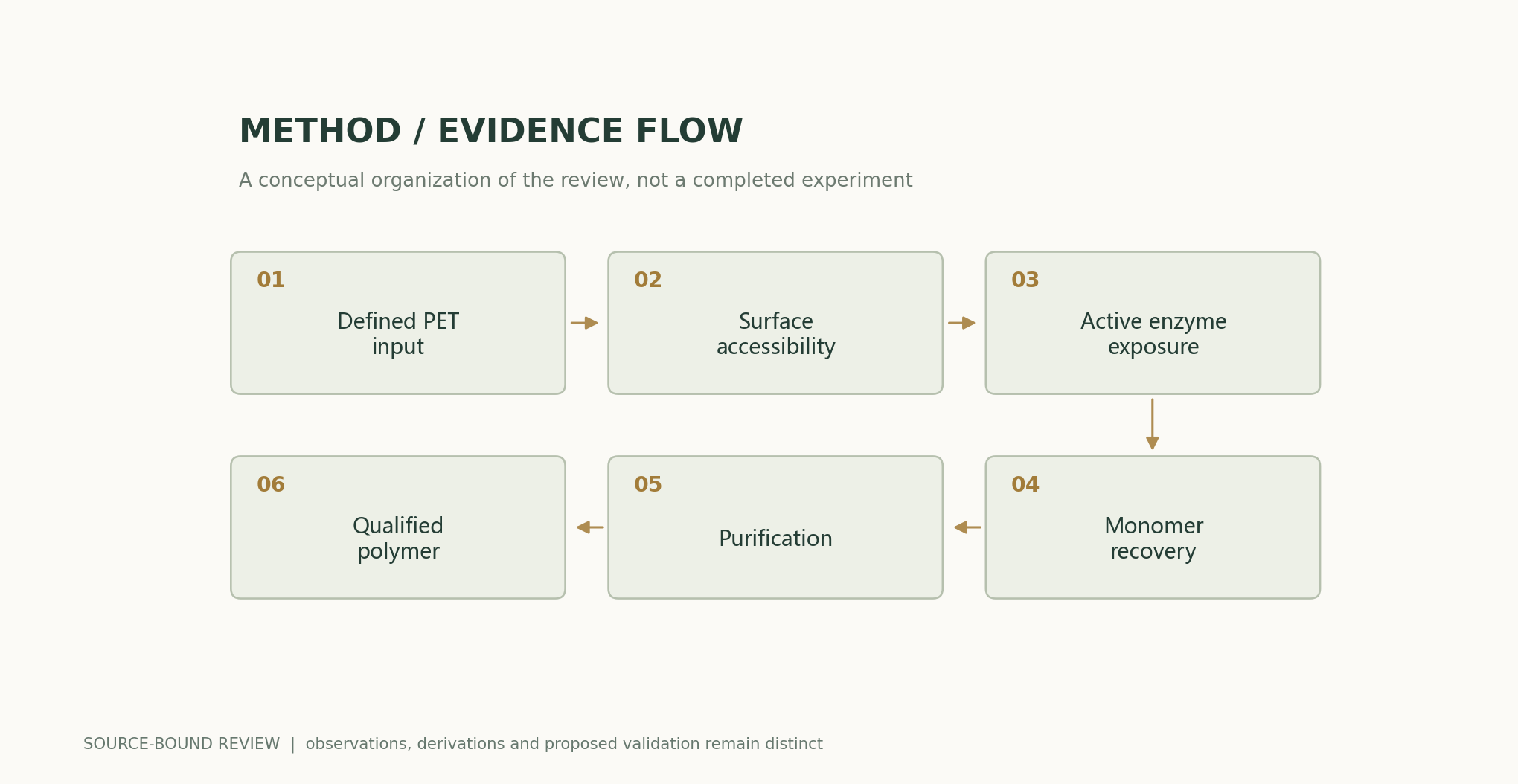
Analytical Figures and Numerical Examples
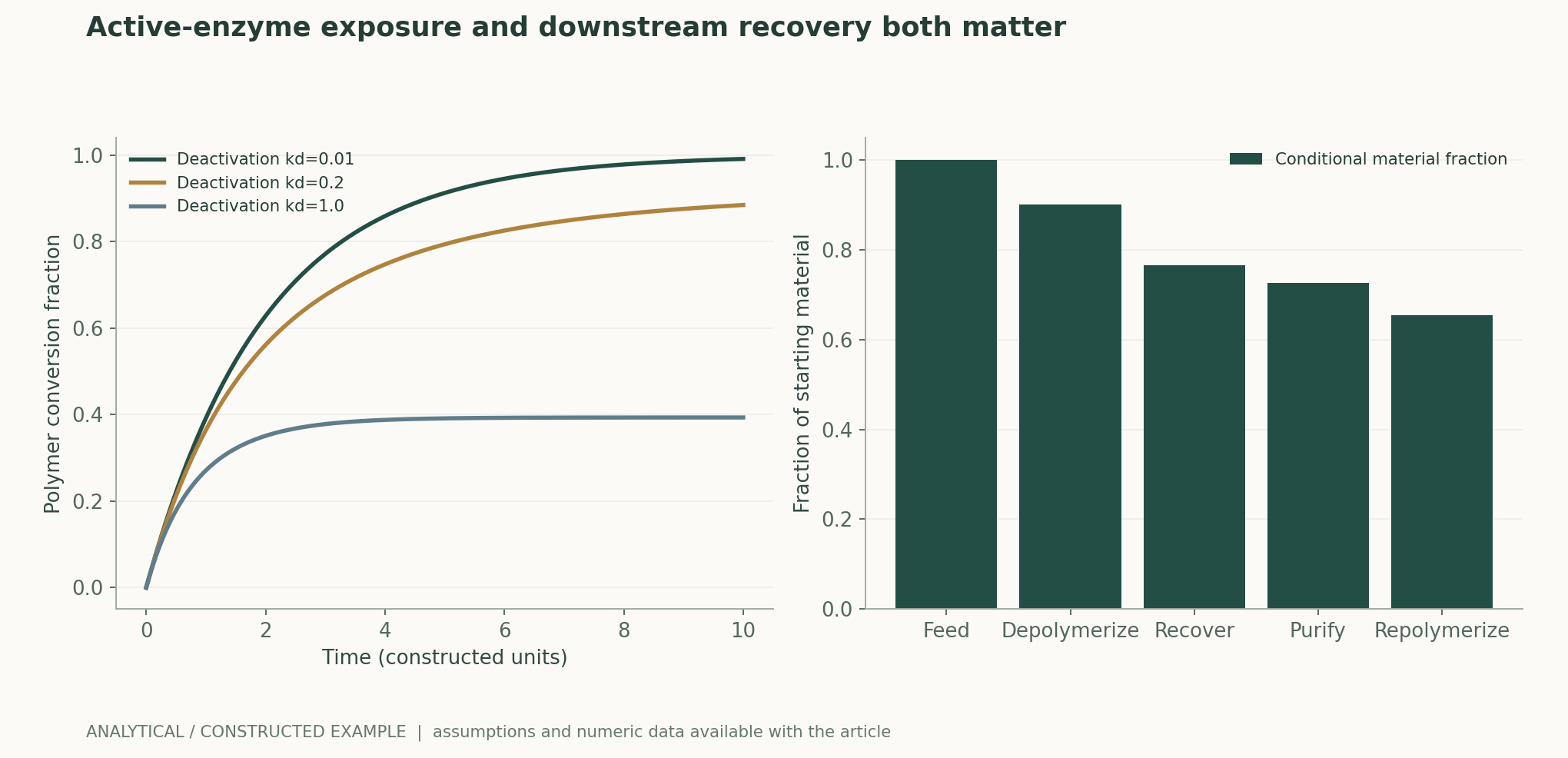
Reproducible Worked Example
The combined yield across four stages is 0.9×0.85×0.95×0.9=0.654075; cumulative exposure is finite in the deactivation model, and the initial rate alone cannot determine endpoint conversion.
Comparison of Methods
| Method or measurement basis | What it directly constrains | Evidence still needed |
|---|---|---|
| Solid mass loss | Reduction in the solid phase | Target monomers and by-products |
| Monomer yield | Chemical breakdown outcome | Recovery and purification |
| Initial enzyme activity | Short-term local rate | Deactivation and replenishment |
| Long-term conversion | Cumulative outcome under the original conditions | Substrate heterogeneity and scale-up |
| Repolymerization | Monomers can be reused | Target product performance |
| Closed-loop functionality | Complete material pathway | Multiple cycles and system burdens |
Verification and Experimental Plan
- Hold input polymer, impurities, and geometry constant.
- Record pretreatment burdens such as grinding.
- Retain records of enzyme sources, model versions, and all replenishment.
- Calibrate analyses of monomers, oligomers, and residual solids.
- Track time, activity, and the reaction environment.
- Calculate conditional yields and carbon balances step by step.
- Validate product performance across independent products and batches.
- Disclose failed substrates, calculations, and boundaries for the entire process.
Scope and Limitations
- No new enzyme engineering or plastic treatment experiments.
- First-order deactivation and homogeneous substrates are simplifications.
- PET results are not extrapolated to all plastics.
- Disappearance of mass does not prove high-purity monomers or a closed loop.
- This article provides no guarantee of commercial or life-cycle benefits.
Evidence from the Original Studies and Its Scope
| Original study findings | Scope | Source and location |
|---|---|---|
| Discovery and investigation of a PET-degrading microorganism and associated enzymes. | The original PET materials and systems. | A bacterium that degrades and assimilates poly(ethylene terephthalate)Abstract; PETase and MHETase |
| Machine-learning-aided enzyme engineering combined with post-consumer substrate testing. | The original substrates, geometries, and operating conditions. | Machine learning-aided engineering of hydrolases for PET depolymerizationAbstract; Extended Data Figs. 5–9 |
Research Questions Worth Testing
- When does substrate heterogeneity change candidate rankings?
- How should initial activity and cumulative effective enzyme exposure be balanced?
- Can closed-loop product performance be maintained over multiple cycles?
Mapping Primary Sources to Claims
- A bacterium that degrades and assimilates poly(ethylene terephthalate)Shosuke Yoshida, Kazumi Hiraga, Toshihiko Takehana, Ikuo Taniguchi, Hironao Yamaji, Yasuhito Maeda, et al. · 2016-03-11Abstract; PETase and MHETase evidence
- Machine learning-aided engineering of hydrolases for PET depolymerizationHongyuan Lu, Daniel J. Diaz, Natalie J. Czarnecki, Congzhi Zhu, Wantae Kim, Raghav Shroff, et al. · 2022-04-27Abstract; Extended Data Figs. 5–9
Citation and Article Export
BibTeXRISCSL JSONTXTArticle JSON
Author, Version, and Sources
A sourced research review and original analysis written by Codex (AI). Experiments in the original papers belong to the original research teams; the calculations in this article test only the listed equations and explicit assumptions. This site currently has no record of independent peer review of this article or of original model, clinical, or physical experiments for it.
First publication: an in-depth interdisciplinary scientific evidence feature; preserves section-level sources and the distinction between original research evidence and the author's analysis.
The conceptual cover was generated by ImageGen. Scientific figures were produced using the accompanying code and numerical files; captions explain the assumptions and measurement bases individually.
Sources of the Cover and Scientific Figures · Data, Sources, and Assumptions · Python · Reproducible calculation code · Publication and Version History
Source revision: 500575872cce7c4b9c4062a12bb0692eb580c2da