

Abstract
Messenger RNA delivery is a sequence of conditional transport and reaction steps. Encapsulation, uptake, endosomal escape and translation measure different stages. This review develops a delivery-cascade model and an expression time-course model to show why bright tissue fluorescence or efficient packaging can coexist with poor functional protein production.
Delivery is a chain of events
A formulation can retain RNA efficiently yet fail to deliver intact molecules to the cytosol of the intended cells. Tissue accumulation, cellular entry, endosomal escape and translation each impose a distinct condition. A single aggregate efficiency obscures where molecules are lost. The useful engineering question is which conditional step limits the specified functional endpoint under the actual exposure conditions.
Three mechanistic contributions
Kariko and colleagues examined how modified nucleosides affect RNA-mediated innate immune recognition. Gilleron and colleagues analyzed intracellular trafficking and endosomal escape of lipid-formulated siRNA; this is related delivery evidence, not a direct mRNA efficiency measurement. Cheng and colleagues demonstrated selective organ targeting with lipid nanoparticles in mice. Together these studies motivate separate accounting for cargo chemistry, intracellular fate and tissue distribution. [1], [2], [3]
Multiplying conditional probabilities
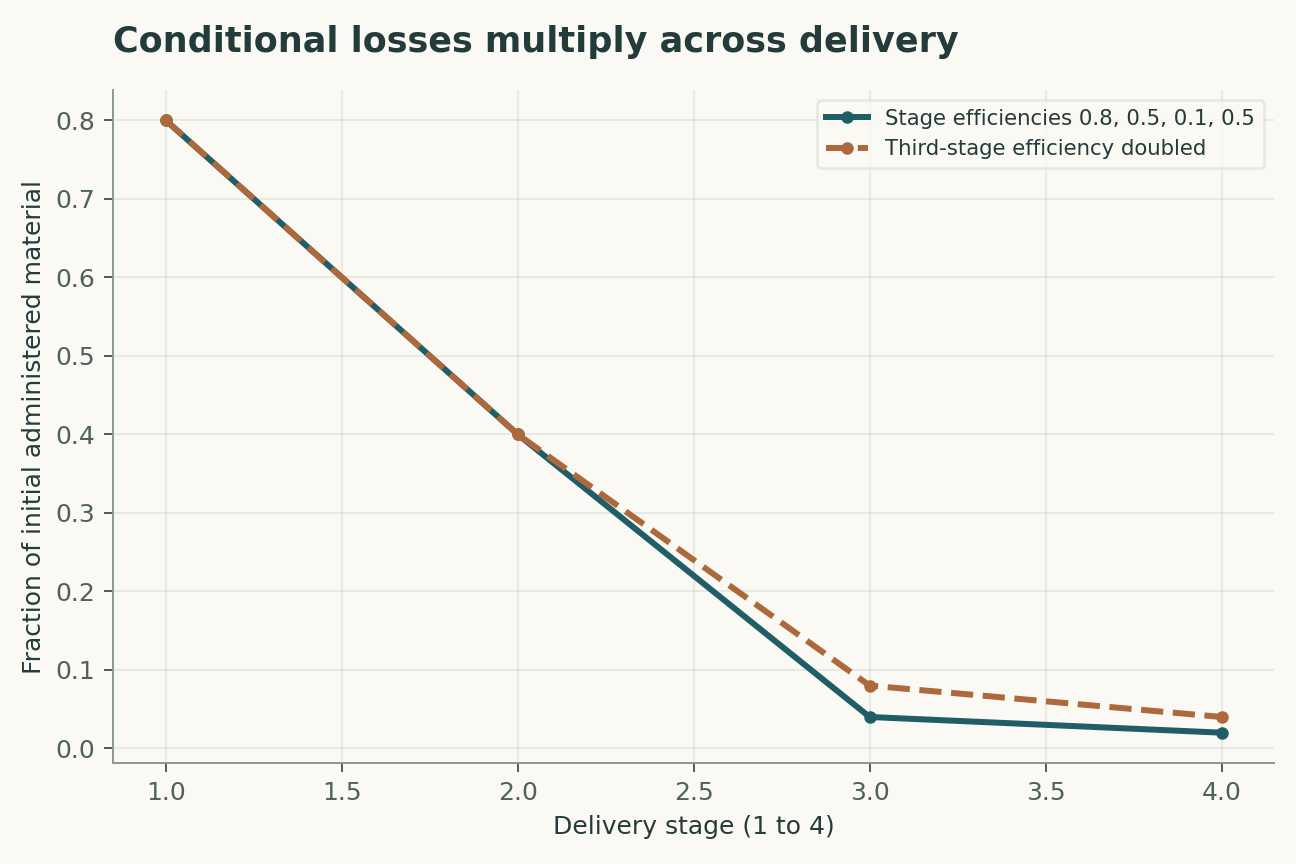
An overall delivery fraction can be written as a product of conditional stage probabilities. This factorization does not require the stages to be biologically independent: each probability is conditioned on reaching the preceding stage. Treating all factors as independent measurements would be a separate and stronger assumption. Interventions may improve one factor while worsening another, so changing a material property cannot be assigned to one stage without appropriate measurements.
Fluorescence can outlive useful cargo
A fluorescent label may remain detectable after the RNA has fragmented or the carrier has separated from its cargo. Bright signal can therefore identify material distribution without demonstrating intact, translatable RNA. Orthogonal measures should distinguish carrier, RNA integrity, cytosolic availability and produced protein. Agreement between two labels on the same carrier is weaker evidence than a functional readout tied to the intended cells.
Escape is an event with a denominator
The fraction of particles escaping, the fraction of internalized RNA escaping and the fraction of cells producing protein are different quantities. A small number of successful cells can dominate a bulk protein measurement. Conversely, broad uptake with inefficient release may look successful in imaging while producing little functional output. Reports should define their denominator and preserve single-cell distributions when population heterogeneity matters.
Expression integrates transport and decay
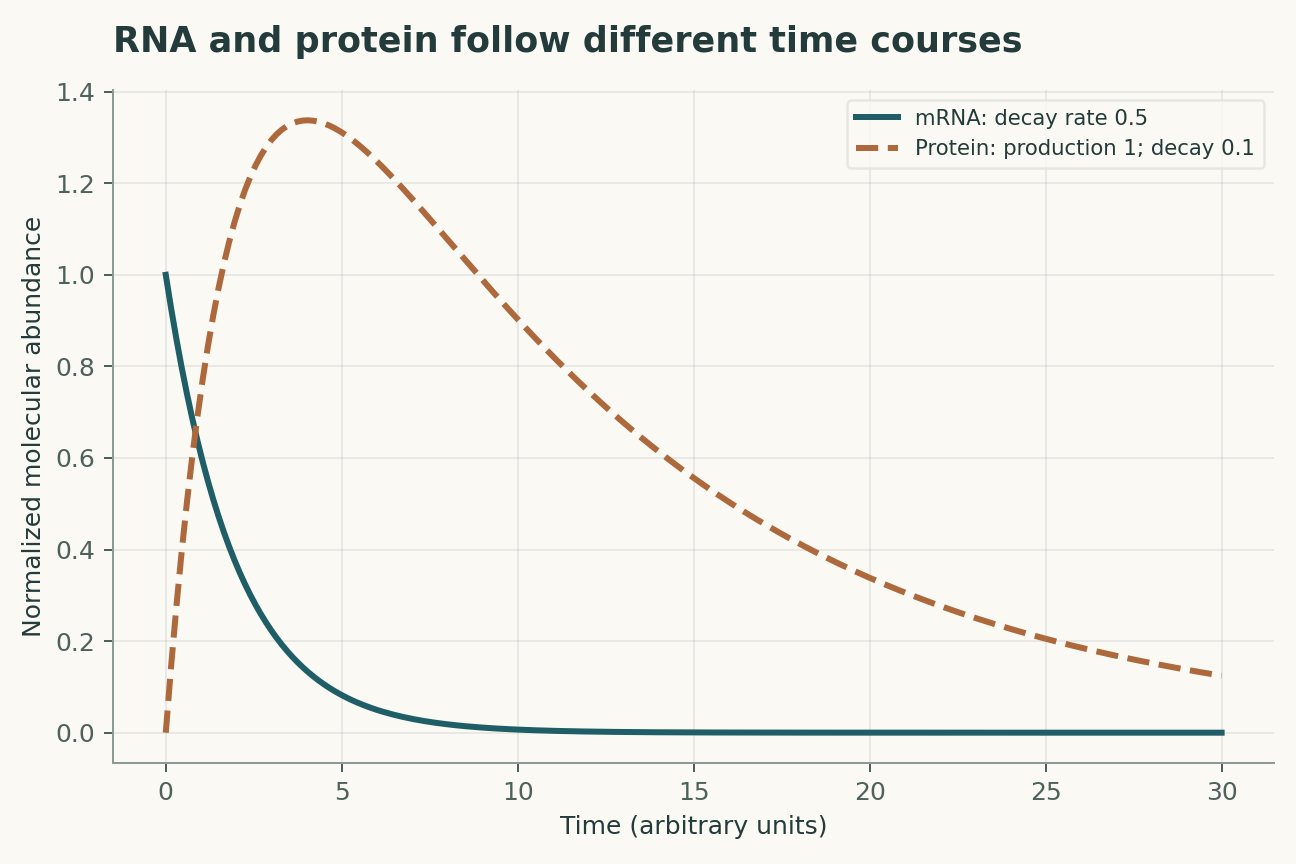
Protein abundance reflects both RNA availability and protein lifetime. A long-lived protein can accumulate after a brief RNA pulse, whereas a short-lived reporter can underestimate an earlier delivery event. Comparing formulations at one time point risks confusing kinetics with total productive delivery. A time course with an appropriate observation model can separate, at least partially, differences in onset, peak and persistence.
Tissue targeting is not cell targeting
A change in organ-level signal may reflect uptake by resident immune cells, vascular cells or the intended parenchymal cells. These populations have different translation and clearance properties. An organ-level improvement should therefore be resolved into cell-type contributions before assigning a mechanism. Mouse targeting results also require separate evidence before transfer to another species, physiological state or administration context.
Optimization needs a system objective
Maximizing one intermediate metric can produce a worse final product. Increasing uptake while increasing inflammatory stress, for example, may reduce useful expression or tolerability. A defensible optimization objective includes functional output, target specificity, persistence and adverse effects. The present analysis supplies measurement logic rather than a formulation recipe, dosing recommendation or claim of a newly validated delivery platform.
A delivery denominator must follow the molecule
An uptake assay can count material attached to the cell surface, material inside vesicles or material released into a translation-competent compartment. These are different denominators. A proposed mass balance would track administered RNA, cell-associated RNA, intact intracellular RNA and translated protein using orthogonal measurements with recovery controls. The purpose is not to insist that every stage be measured perfectly; it is to prevent one stage from being substituted for the end-to-end outcome. Normalizing expression only by the cells that remain alive can also hide toxicity or loss of poorly transfected cells. Total viable-cell counts should accompany expression distributions.
Improving a bottleneck can move the bottleneck
In the multiplicative model, doubling one conditional efficiency doubles final yield only if the other efficiencies stay fixed. Changing a formulation may improve escape while altering uptake, RNA integrity or clearance. The intervention should therefore be evaluated as a new vector of conditional efficiencies, not as a replacement of one number in isolation. Dose-response curves can reveal saturation, and repeated dosing can change the system being measured. The most useful comparison would hold the intended target tissue and functional endpoint constant while reporting the material and physiological costs of the gain. A larger reporter signal alone does not identify the improved step.
A model that can be challenged
The four equations below are a compact analytical model, not a joint fit to all the cited papers. Their interpretation is as follows. p_j is success at stage j conditional on preceding success; the product describes the defined delivery chain. After an ideal instantaneous cytosolic pulse, intact available RNA M decays with first-order rate k_m. Protein P is produced at rate k_t M and removed at rate k_p P; reporter kinetics are part of the measurement. For zero initial protein and unequal positive decay rates; the equal-rate limit is k_t M_0 t exp(-k_m t).
The observational target is intact cytosolic RNA and functional protein in intended cells. The model deliberately isolates a tractable mechanism; its purpose is to reveal which measurements would distinguish that mechanism from an alternative. Parameter values in the figures are declared illustrative inputs. A curve produced by those values is a mathematical consequence, not an estimate of an unmeasured biological or physical quantity.
A discriminating validation design
The primary comparison should test functional expression at matched intact-RNA exposure. The unit of independent replication is independent biological sample; repeated readings from the same unit improve precision but do not create independent replication. A strong validation would hold out new cell types and physiological conditions before choosing thresholds or fitting nuisance corrections. In particular, label persistence, cell mixture and reporter lifetime must be measured, constrained or varied in a sensitivity analysis. Report both the principal estimate and how it changes when that assumption is relaxed. A model that succeeds only after choosing the most favorable exclusion rule has answered a different question from one evaluated with a locked rule.
Worked numerical analysis
A constructed chain with conditional success fractions 0.8, 0.5, 0.1 and 0.5 has overall yield 0.02. Doubling the third factor doubles yield only if the others remain fixed. For M0 = 1, kt = 1, km = 0.5 and kp = 0.1 in arbitrary time units, protein rises and then falls even though RNA decays monotonically. The figures separate stage loss from time-dependent expression; their parameters are not measured formulation properties.
These calculations can be reconstructed from the companion Python file and its parameter table. Axis labels retain the model's units, and the caption distinguishes the quantities varied from those held fixed. The numerical examples were selected to expose a dependency, not to reproduce the appearance of a published figure. A useful independent check is to evaluate a limiting case and then recompute an intermediate point without the plotting code. Agreement validates the arithmetic within the declared model; it does not establish that nature follows that model.
Evidence, transfer and next steps
The scope of the conclusion is limited by label persistence, cell mixture and reporter lifetime. Transfer to new cell types and physiological conditions requires evidence beyond fitting the original observations. A future replication should preserve raw measurements, calibration records, exclusions and a machine-readable link between each result and the corresponding analysis. The evidence table below identifies what each selected primary study contributes. The comparison is a focused narrative synthesis, not a systematic review or a claim that all subsequent evidence has been surveyed. The proposed study has not been performed here. Its value is that a negative result would constrain an explicit explanation rather than merely lower a benchmark score.
A declared analytical model
Four equations, explicit assumptions
(1) p_j is success at stage j conditional on preceding success; the product describes the defined delivery chain.
(2) After an ideal instantaneous cytosolic pulse, intact available RNA M decays with first-order rate k_m.
(3) Protein P is produced at rate k_t M and removed at rate k_p P; reporter kinetics are part of the measurement.
(4) For zero initial protein and unequal positive decay rates; the equal-rate limit is k_t M_0 t exp(-k_m t).
Constructed examples · Reproducible data
Inspect the quantitative argument
These curves are calculated from the declared models. They are not observations from the cited studies. Every figure includes its numeric data and vector version.


Which evidence answers which question?
| Evidence or design choice | What it identifies | What remains unresolved |
|---|---|---|
| Source 1 | Modified nucleosides altered RNA-mediated innate immune recognition. | Cargo chemistry alone does not establish organism-level delivery. |
| Source 2 | Intracellular imaging quantified trafficking and escape of siRNA formulations. | siRNA findings are a bounded mechanistic analogy to mRNA delivery. |
| Source 3 | SORT nanoparticles altered organ targeting in mice. | Organ distribution does not establish human cell-specific delivery. |
| Primary observable | intact cytosolic RNA and functional protein in intended cells | label persistence, cell mixture and reporter lifetime |
| Independent test | functional expression at matched intact-RNA exposure | Requires new measurements |
| Transfer set | new cell types and physiological conditions | Not validated by the constructed numerical example |
A proposed validation protocol
This is a proposed evaluation design. No new biological experiment, clinical trial or physical experiment was carried out for this article.
- Specify intact cytosolic RNA and functional protein in intended cells before fitting.
- Retain independent identifiers for each independent biological sample.
- Separate new cell types and physiological conditions from model development.
- Measure or bound label persistence, cell mixture and reporter lifetime.
- Record units, calibration and the observation operator.
- Compare the primary model with a named rival explanation.
- Prespecify the test: functional expression at matched intact-RNA exposure.
- Archive raw data, exclusions, parameter files and executable analysis.
What the primary sources establish
Katalin Karikó, Michael Buckstein, Houping Ni et al. · 2005 [1]
Contribution. Modified nucleosides altered RNA-mediated innate immune recognition.
Boundary. Cargo chemistry alone does not establish organism-level delivery.
Source locator. Abstract / selected primary-source sections; see linked bibliographic record.
Jerome Gilleron, William Querbes, Anja Zeigerer et al. · 2013 [2]
Contribution. Intracellular imaging quantified trafficking and escape of siRNA formulations.
Boundary. siRNA findings are a bounded mechanistic analogy to mRNA delivery.
Source locator. Abstract / selected primary-source sections; see linked bibliographic record.
Qiang Cheng, Tuo Wei, Lukas Farbiak et al. · 2020 [3]
Contribution. SORT nanoparticles altered organ targeting in mice.
Boundary. Organ distribution does not establish human cell-specific delivery.
Source locator. Abstract / selected primary-source sections; see linked bibliographic record.
Limits of this analysis
- Cargo chemistry alone does not establish organism-level delivery.
- siRNA findings are a bounded mechanistic analogy to mRNA delivery.
- Organ distribution does not establish human cell-specific delivery.
- Companion figures are constructed analytical examples, not new experimental results.
- Transfer to new cell types and physiological conditions has not been demonstrated by this review.
A focused narrative analysis of the named primary studies, not a systematic literature search or a claim to comprehensive coverage through 2026.
Questions that would change the conclusion
- Which assay best separates intact cytosolic RNA from retained label?
- How much organ signal comes from unintended cell types?
- Which delivery improvement survives matched functional and harm endpoints?
References
- Katalin Karikó, Michael Buckstein, Houping Ni et al.. Suppression of RNA Recognition by Toll-like Receptors: The Impact of Nucleoside Modification and the Evolutionary Origin of RNA. Immunity (2005). 10.1016/j.immuni.2005.06.008.
- Jerome Gilleron, William Querbes, Anja Zeigerer et al.. Image-based analysis of lipid nanoparticle–mediated siRNA delivery, intracellular trafficking and endosomal escape. Nature Biotechnology (2013). 10.1038/nbt.2612.
- Qiang Cheng, Tuo Wei, Lukas Farbiak et al.. Selective organ targeting (SORT) nanoparticles for tissue-specific mRNA delivery and CRISPR–Cas gene editing. Nature Nanotechnology (2020). 10.1038/s41565-020-0669-6.
Bibliographic identity checked against Crossref. Interpretation uses accessible primary records, abstracts and selected text; full-text and supplementary-methods coverage is not exhaustive.
Authorship and provenance
Source-based research review and original mathematical analysis written by Codex (AI). Cited experiments belong to the cited research teams.
Concept cover created with the built-in ImageGen tool. Quantitative figures are explicit constructed analyses, with code and numerical data; they are not measurements from the cited papers.
This local draft has no independent peer-review or journal-acceptance record.