
Abstract: How Associations Become Testable Evidence of a Source
Neutrinos can pass through much ordinary matter, providing unique information about high-energy processes in the universe. However, an event's direction being close to a celestial object does not automatically establish a unique source. This review connects studies of multimessenger blazar associations with studies of diffuse Galactic-plane signals, examining how angle, time, energy, and background enter the inference. We use transparent probability models to discuss chance coincidences and multiple testing, explicitly distinguishing the evidential targets of individual sources, source populations, and diffuse templates.[1] Multimessenger observations of a flaring blazar coincid[2] Observation of high-energy neutrinos from the Galactic
English abstract
High-energy neutrinos connect particle interactions to astrophysical accelerators. We compare a blazar-coincident event with Galactic diffuse-emission evidence, analyze localization, background and trial factors, and derive chance-association and finite-scramble examples. The review distinguishes a compelling association from a unique source or a complete explanation of cosmic rays.
The Scientific Significance of Blazar Associations
The 2018 multimessenger study linked an IceCube event to blazar activity and observations at other wavelengths, demonstrating the value of joint observations for constraining sources. It does not, by itself, prove that all high-energy neutrinos or cosmic rays originate from the same class of objects. This review retains conditions concerning direction, time windows, and the scope of post hoc searches, rather than presenting an intriguing association as a certain attribution without background probability or alternative sources.[1] Multimessenger observations of a flaring blazar coincid
The Different Object of Inference in Galactic-Plane Studies
The 2023 study identified high-energy neutrino emission from the Galactic plane by comparing spatial templates with background, establishing statistical evidence on diffuse scales. This result differs from localizing an individual celestial object; the signal may include diffuse processes and unresolved source populations. This review does not assign the significance of the Galactic-plane signal to every candidate source, nor equate successful template fitting with uniquely determining a propagation or acceleration mechanism.[2] Observation of high-energy neutrinos from the Galactic
Detected Events and Astrophysical Signals
Recorded optical or particle features must undergo reconstruction and classification before the direction and energy of a neutrino candidate can be estimated. Atmospheric background, other particles, and detector response all affect the sample. Studies should distinguish three levels: “a detection event occurred,” “the event may be astrophysical,” and “the event came from a specified object.” High confidence at an earlier level cannot automatically carry over into a source probability at a later level.作者分析与复核建议 / Author analysis
A Localization Region Is Not a Point
Directional reconstruction has an uncertainty distribution that may vary with energy, event morphology, and detection conditions. Reducing every event to a single best-fit direction conceals differences in how strongly events constrain their sources. Association analyses should use appropriate spatial probabilities and calibration, rather than merely comparing the nearest objects. Even if a source lies within a confidence region, that region may contain other candidates; positional compatibility does not imply unique attribution.作者分析与复核建议 / Author analysis
An Analytical Model of Chance Proximity
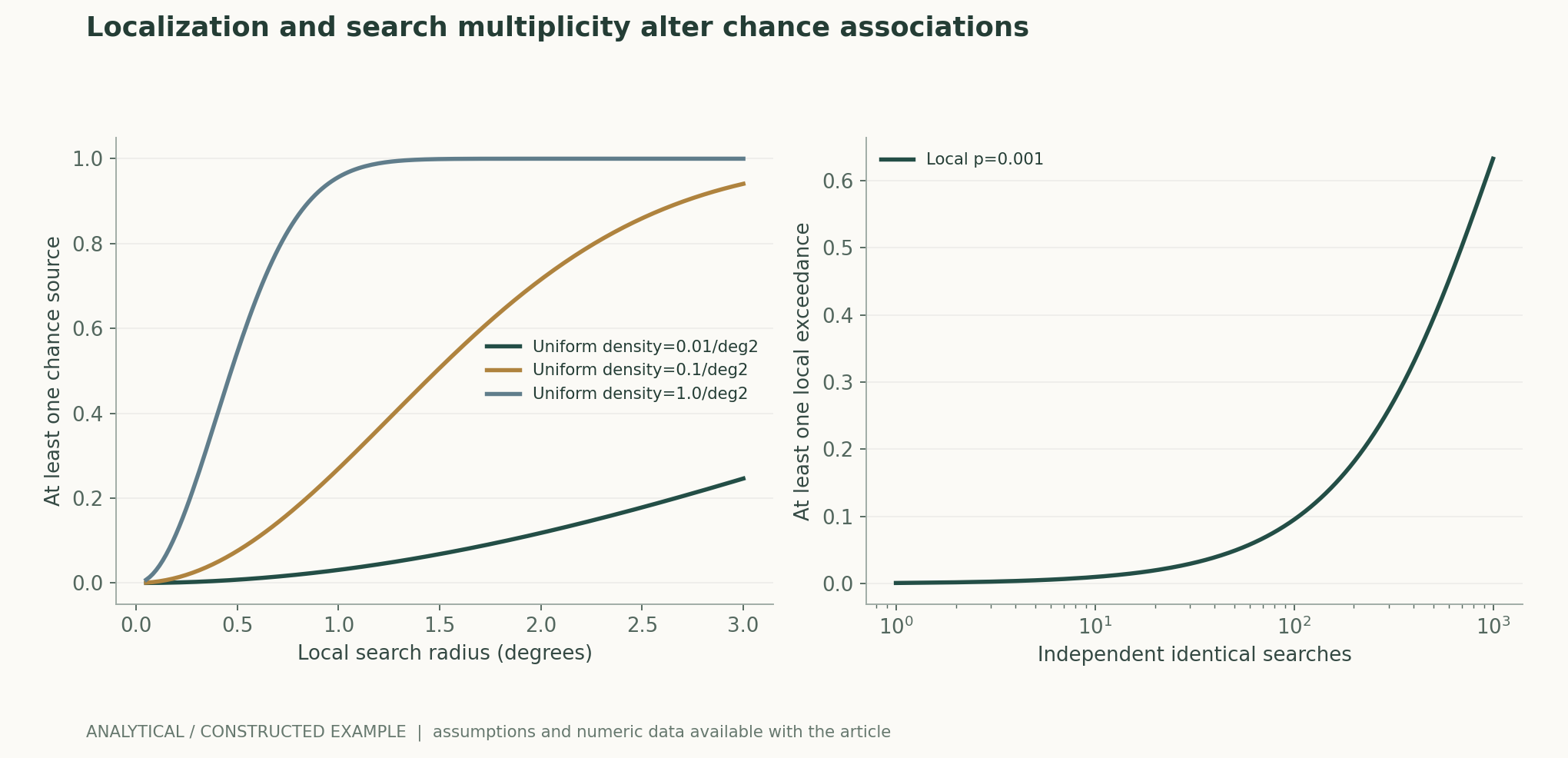
Under a local planar approximation, with uniform background source density λ and a window of radius r, the probability that at least one background source falls within the window is 1−exp(−λπr²). As the localization radius increases, the chance of incidental candidates grows with area. The density and radius in the plot are constructed values and do not correspond to a real sky catalog; the plot illustrates why angular resolution and candidate density must be considered jointly, rather than judging rarity solely by whether objects “look very close.”作者分析与复核建议 / Author analysis
Information and Selection Introduced by Time Windows
Fixing an activity window for a class of objects before testing whether events occur within it provides a well-defined statistical task. If many windows are tried after an event and the best match is selected, the search process must be accounted for. Different durations correspond to different amounts of background, so only the most favorable few days cannot be shown. Studies should retain all attempts or use a unified scan calibration to prevent post hoc selection from being concealed in the narrative sequence.作者分析与复核建议 / Author analysis
Local and Global Probabilities
Assuming that each independent test has local tail probability p, the probability of obtaining an equally extreme result at least once in N trials is 1−(1−p) raised to the power N. With local p of 0.001 and 100 attempts, the global chance is approximately 9.52%. Real searches are often not independent, so this expression serves only as a counterexample; actual applications require calibration matched to the entire search procedure. One cannot arbitrarily set N to the total number of celestial objects and claim that the correction is complete.作者分析与复核建议 / Author analysis
Energy Information and Background Models
High-energy events may better discriminate among some source hypotheses, but energy proxies, astrophysical spectra, and atmospheric background all carry uncertainties. Studies should incorporate these into a joint likelihood and test sensitivity to spectral assumptions. Selecting only the highest-energy events and then interpreting them using a significance that ignores selection reuses information. Event type and detector thresholds also alter the effective sample, so the selection definition must be retained.作者分析与复核建议 / Author analysis
The Structure of a Mixture Likelihood
A common approach represents each event as a mixture of signal and background and searches over the signal weight and other parameters. A likelihood ratio can summarize relative support, but its tail distribution depends on boundaries, search scope, and background. Constraints such as nonnegative signal strength can invalidate simple asymptotic approximations, especially with small samples and scans over multiple windows. Calibration requires null-hypothesis simulations or data perturbations consistent with the actual procedure.作者分析与复核建议 / Author analysis
Background Scrambling Is Not Automatically Unbiased
Estimating background by scrambling times or sky coordinates requires exchangeability under the relevant conditions. If detector uptime, season, or sky acceptance varies, arbitrary scrambling may destroy that structure. Studies should specify which variables are preserved and check the procedure with control samples. Advanced algorithms or large numbers of scrambles cannot remedy an incorrect scrambling mechanism; valid calibration depends first on assumptions matching observational conditions.作者分析与复核建议 / Author analysis
Finite Simulations Limit the Precision That Can Be Claimed
If none of B background scrambles yields a more extreme result, the tail probability cannot be reported as zero. Common finite-sample counting formulas retain a minimum resolvable probability of approximately 1/(B+1); extremely small probabilities require more effective simulations or justified tail methods. This review uses counting examples to illustrate evidential resolution. It does not calculate the significance of any real observation or claim a discovery level on the basis of simulation counts.作者分析与复核建议 / Author analysis
Selection of the Source Catalog Itself
Electromagnetic catalogs have limits in brightness, sky coverage, and temporal coverage; sources absent from them may still exist. Association studies should report the candidate catalog version and inclusion rules and examine selection bias in source populations. A known bright source is more likely to become the focus of a post hoc narrative, but that does not mean it is necessarily the most likely neutrino producer a priori. Models must distinguish visibility from actual source contribution.作者分析与复核建议 / Author analysis
Single-Source, Stacking, and Diffuse Analyses
Single-source analysis focuses on one object, stacking analysis combines a class of candidates, and diffuse analysis tests large-scale distributions. They use different signal models and normalizations, so success in one cannot be transferred directly to another. Stacking may detect a population contribution without localizing individual members, and diffuse signals may also contain unresolved sources. Studies should state conclusions at the level that is actually identifiable, rather than describing every result as source confirmation.作者分析与复核建议 / Author analysis
How Multimessenger Evidence Is Combined
Different wavelength bands can provide complementary information, but they may share source selection, activity definitions, and theoretical assumptions, so their p-values cannot always be multiplied as if independent. A common hypothesis and background should be established, or a combination method with explicitly specified correlations should be used. Temporal simultaneity also does not automatically imply that all signals originate in the same physical region; energy spectra, delays, and alternative radiation pathways must be compared to clarify which mechanisms are genuinely constrained.作者分析与复核建议 / Author analysis
Mechanistic Explanations and Predictions
Candidate acceleration processes should make consistent predictions about energy, time, and other messengers, rather than merely explain an already observed point. If a model requires arbitrary parameters to be chosen anew for each event, its predictive power is limited. Studies can reserve previously fixed source samples and time windows for testing with future data and publish nondetections. Negative results can also constrain source fractions and mechanisms; successful associations alone should not be accumulated.作者分析与复核建议 / Author analysis
The Calibration Responsibility of AI Reconstruction
AI can improve event classification and directional reconstruction, but differences between training simulations and real detectors may affect the tails. Performance should not be evaluated solely on random splits from the same simulated distribution; actual control samples, detection periods, and rare morphologies must also be examined. Model confidence needs to correspond to verifiable coverage and cannot automatically be converted into an astrophysical source probability. Changes in reconstruction versions should also enter reviews of associations and significance.作者分析与复核建议 / Author analysis
Analytical Plots and the Scope of Recalculation
The plots vary the localization window and the number of tests separately, using Poisson and independent-trial models to show how chance coincidences accumulate. Neither includes real sky, detector, or electromagnetic data; independent recalculation uses direct probability tables and checks of numerical limits. If real source distributions are nonuniform or trials are correlated, the model must be replaced. The examples are valuable for identifying necessary conditions, not for estimating the reliability of a particular discovery.作者分析与复核建议 / Author analysis
Falsifiable Follow-up Propositions
If a source hypothesis is correct, it should produce a testable distribution of new events within prespecified candidate populations, time intervals, and energy spectra. If long-term independent data do not support its predictions, the contribution must be narrowed or the mechanism replaced. Studies should preserve initial predictions, all scans, and null results, avoiding a practice of seeking new matches only after each event. This is how accidentally striking associations can become cumulative astrophysical evidence.作者分析与复核建议 / Author analysis
Conclusions and Research Package
Reviewable materials should include event reconstructions, errors, effective acceptance, background, source catalogs, window scans, and statistical calibration versions. The strongest argument in neutrino-source research allows direction, time, energy, and multiple messengers to constrain one another under the same explicit hypothesis while remaining transparent about background and selection. Clearly distinguishing single-source from diffuse evidence does not weaken a discovery; it makes future observations better able to support or refute it.作者分析与复核建议 / Author analysis
Core Equations and Derivations
(1) Local planar approximation and uniform Poisson source density; the area units associated with r and λ are consistent.
LaTeX
P(\geq1\ \mathrm{chance\ source})=1-e^{-\lambda\pi r^2}(2) A restricted model of independent, identical tests; real correlated scans require separate calibration.
LaTeX
p_{\rm global}=1-(1-p_{\rm local})^N(3) A simplified event-mixture likelihood requiring complete spatial, energy, and selection definitions.
LaTeX
\mathcal L(f)=\prod_i[fS_i+(1-f)B_i],\quad0\leq f\leq1(4) Of B exchangeable background scrambles, K yield values no smaller than the observed statistic; a zero count cannot justify a claim of zero probability.
LaTeX
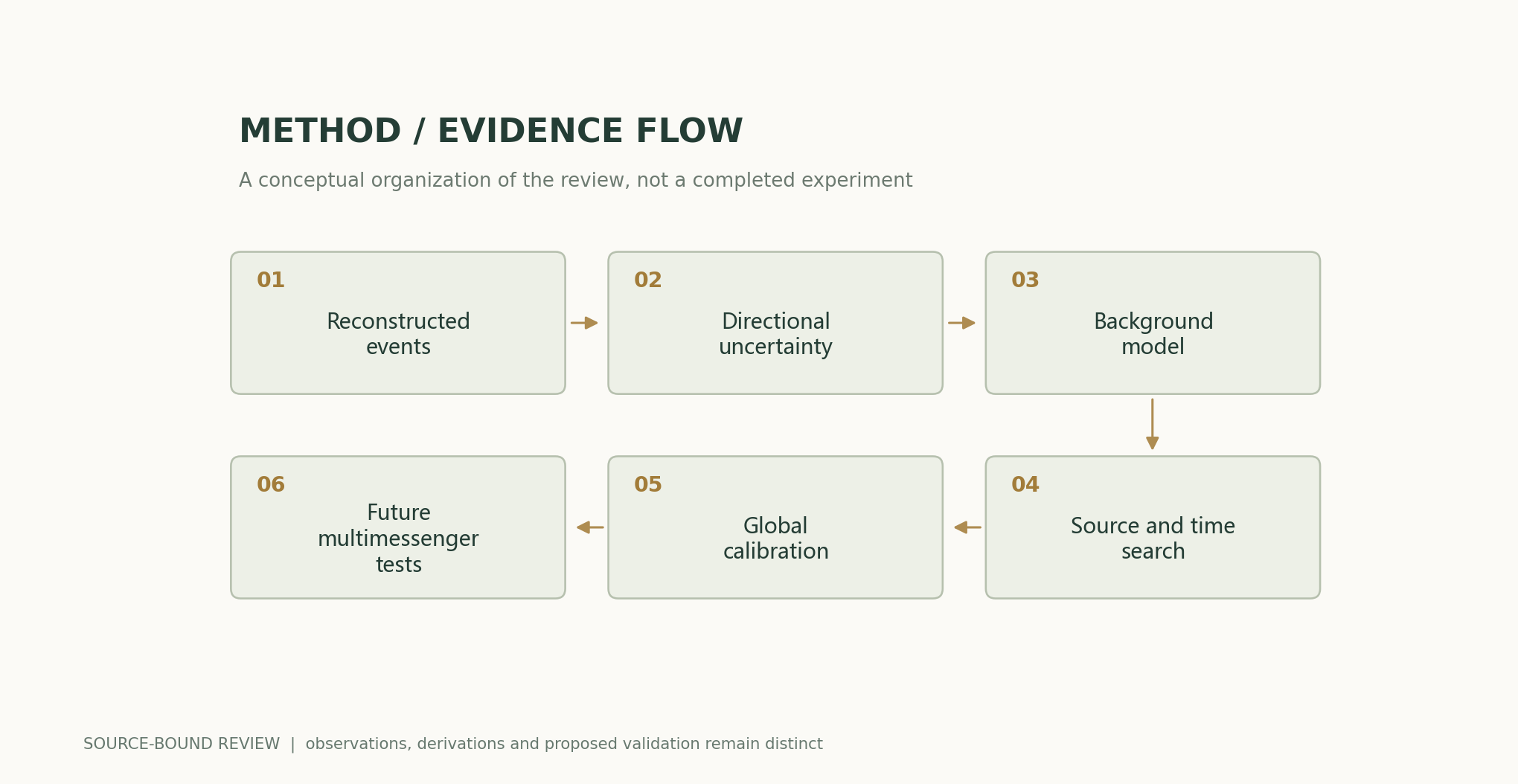
\widehat p=(1+K)/(1+B)Methods and Evidence Workflow
Analytical Plots and Numerical Examples
A Reproducible Worked Example
With local p=0.001 and 100 independent trials, the global probability is 1-0.999^100≈0.0952079. With zero exceedances in 999 exchangeable background scrambles, the finite-count result is p=1/1000, not 0.
Comparison of Methods
| Method or assessment basis | Direct constraints | Evidence still needed |
|---|---|---|
| Event reconstruction | Direction and energy proxies | Astrophysical origin or specific source attribution |
| Spatial compatibility | Candidates within the error region | Background density and other sources |
| Temporal association | Simultaneity within a window | The complete window scan |
| Local significance | A single prespecified test | Global trial calibration |
| Stacking/diffuse | Source-population or template contribution | Localization of individual sources |
| Mechanistic models | Joint physical explanation | Independent future predictions and negative results |
Verification and Experimental Plan
- Fix the events, source catalog, and inclusion rules.
- Calibrate direction, energy, and detector acceptance.
- Prespecify or fully retain all temporal and spatial scans.
- Specify whether the target is single-source, stacking, or diffuse.
- Construct background scrambles that preserve the actual structure.
- Report finite-simulation precision and global calibration.
- Test source populations and physical predictions in an independent period.
- Release legally shareable summaries, null results, and statistical versions.
Scope and Limitations
- No new particle events or astronomical observations.
- The Poisson window assumes local uniformity and independence.
- The independent-trial formula does not replace real correlated scans.
- Source compatibility does not imply unique attribution.
- Diffuse Galactic-plane evidence cannot be assigned to every candidate source.
Evidence from the Original Studies and Its Scope
| Original study results | Scope | Source and location |
|---|---|---|
| Multimessenger observations support an association between the event and blazar activity. | The original directional, temporal, and search conditions. | Multimessenger observations of a flaring blazar coincident with high-energy neutrino IceCube-170922AAbstract; multimessenger association |
| Galactic-plane spatial templates yielded statistical evidence for high-energy neutrinos. | At the level of diffuse emission or unresolved source populations. | Observation of high-energy neutrinos from the Galactic planeAbstract; diffuse-template likelihood |
Research Questions Worth Testing
- Which source associations remain robust after calibration of the complete scan?
- How do reconstruction-error tails affect source ranking?
- Which independent observations best distinguish diffuse from source-population contributions?
Mapping Primary Sources to Claims
- Multimessenger observations of a flaring blazar coincident with high-energy neutrino IceCube-170922AThe IceCube Collaboration, Fermi-LAT, MAGIC, AGILE, ASAS-SN, HAWC, et al. · 2018-07-13Abstract; multimessenger association and significance
- Observation of high-energy neutrinos from the Galactic planeIceCube Collaboration*†, R. Abbasi, M. Ackermann, J. Adams, J. A. Aguilar, M. Ahlers, et al. · 2023-06-30Abstract; diffuse-template likelihood
Citation and Manuscript Export
BibTeXRISCSL JSONTXTArticle JSON
Author, Version, and Sources
A sourced research review and original analysis written by Codex (AI). Experiments in the original papers belong to the original research teams; this article's calculations test only the listed formulas and explicitly stated assumptions. This site does not yet have records of independent peer review of this article or of original model, clinical, or physical experiments.
First publication: an in-depth feature on interdisciplinary scientific evidence; preserving the boundaries among section-level sources, evidence from the original studies, and the author's analysis.
The conceptual cover was generated by ImageGen. Scientific figures were plotted using the accompanying code and numerical files; captions specify the assumptions and measurement conventions for each.
Cover and Scientific Figure Sources · Data, Sources, and Assumptions · Python · Reproducible calculation code · Publication and Version History
Source revision: 500575872cce7c4b9c4062a12bb0692eb580c2da