

Abstract
Most sequence positions do not directly encode proteins, yet they may alter biological processes through expression, splicing, and the chromatin environment. Enformer and AlphaGenome represent a modeling approach that maps long-range sequences to multiple types of molecular observations. This article compares three distinct questions—predicting observed tracks, estimating allelic changes, and establishing causal mechanisms—and derives analytical relationships for saturating regulation, paired-variant interactions, and measurement error. We propose a validation scheme with loci, tissues, and interventions as independent levels, avoiding the conflation of cross-gene correlation with the accuracy of allelic effects within the same gene. No personal genomes were used, and no clinical interpretations are provided for specific variants.[1] Advancing regulatory variant effect prediction with Alp[2] Effective gene expression prediction from sequence by i
English abstract
Sequence-to-function models integrate distal regulatory context and multiple genomic assays, but track prediction and causal variant interpretation remain distinct tasks. We compare Enformer with AlphaGenome and derive contrasts for single variants and nonadditive pairs. A saturating regulatory example shows how baseline activity changes apparent effect sizes, while a measurement-error model separates reproducibility from predictive ceilings. The figures use explicit analytical assumptions rather than human genotype or patient data.
1. Long-range context changes the regulatory scope a model can see
Enformer improves predictions from DNA to expression and chromatin tracks by integrating distal information; its comparisons address input span and the enhancer distances that can be integrated. AlphaGenome further combines high-resolution outputs across multiple modalities. What matters here is not that longer inputs are always better, but whether the information needed for the task falls within the available window, whether the network actually integrates it, and whether it reaches the output at sufficient resolution. Inputs of the same length can correspond to different effective receptive fields; the same variant may also produce different effects through local splicing and distal regulation, which cannot be replaced by a single overall track score.[2] Effective gene expression prediction from sequence by i[1] Advancing regulatory variant effect prediction with Alp
2. Multitrack learning places heterogeneous experiments in a shared representation
The original AlphaGenome paper describes 11 modality classes and thousands of human and mouse tracks covering expression, splicing, and chromatin-related observations. This joint prediction provides a shared representation for conditional analysis, but experiments differ in measurement noise, tissue origin, and interpretable units. This article recommends storing each track's samples, normalization, resolution, and replicate agreement in a task dictionary. Strong performance on many easily predicted tracks does not establish equal reliability for underrepresented tissues or particular splicing events; evaluation must preserve within-modality distributions rather than report only a single average.[1] Advancing regulatory variant effect prediction with Alp
3. Allelic contrasts impose stronger demands than track fitting
A sequence model can receive reference and alternate sequences separately, after which predictions for an output window or gene can be compared. Such contrasts help formulate mechanistic hypotheses, but errors may be amplified by differencing or appear to cancel because of shared bias. High correlation in expression across genes often reflects baseline differences between genes and does not imply accurate ranking of multiple variants within the same gene. Enformer's eQTL analysis also discusses validation difficulties arising from linkage disequilibrium. We therefore separate baseline tracks, within-gene allelic contrasts, effect direction, and effect-size calibration into four endpoints, each evaluated independently.[2] Effective gene expression prediction from sequence by i[1] Advancing regulatory variant effect prediction with Alp
4. Derivation in this article: the same regulatory increment has different effects at different baselines
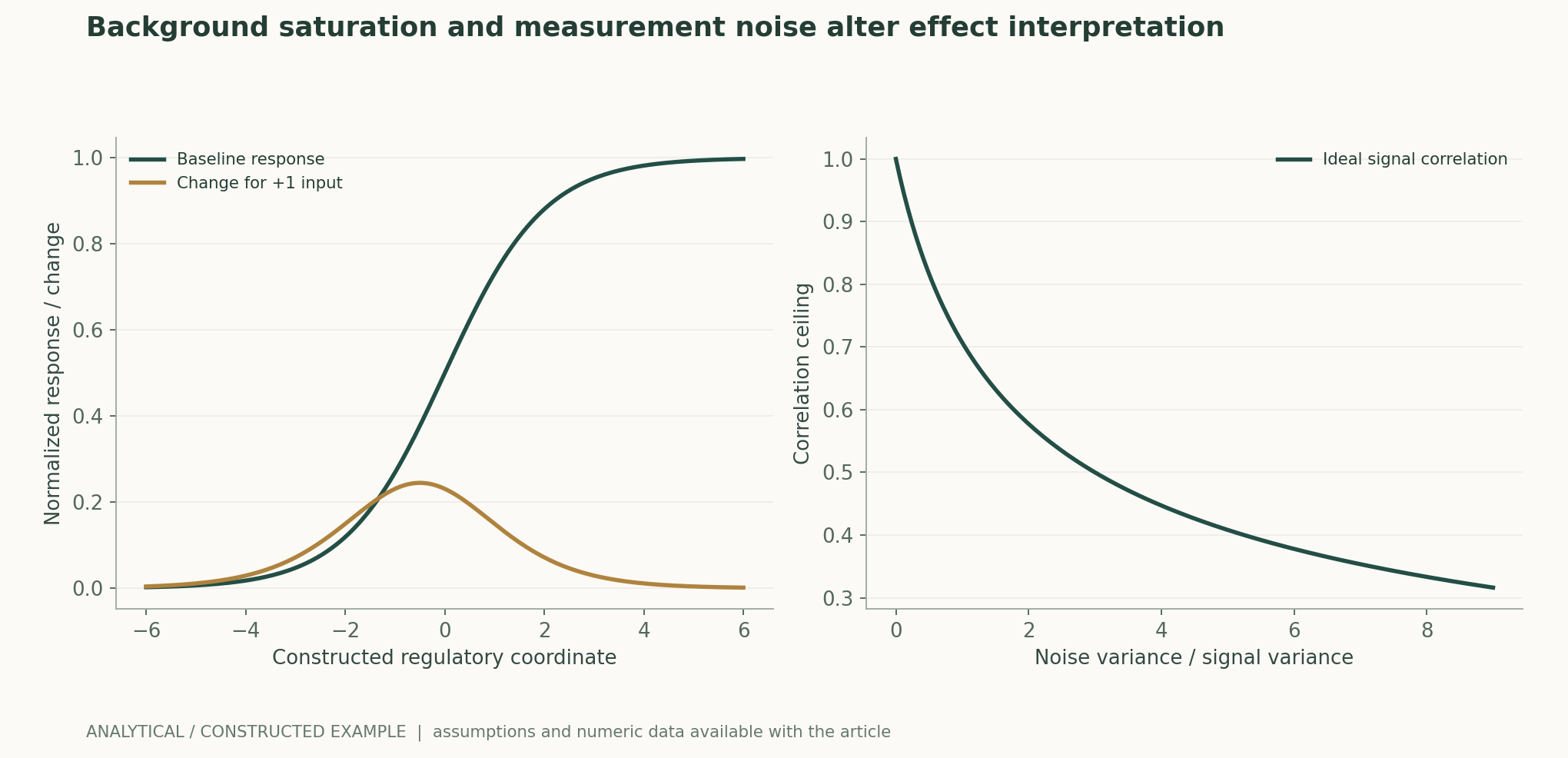
Suppose a regulatory variable z, used solely for analysis, determines a normalized output through a sigmoid, and a variant increases z by 1. At baseline z=0, the output changes from 0.5 to approximately 0.731, a difference of 0.231; at baseline z=3, it changes from approximately 0.953 to 0.982, a difference of only about 0.029. This background dependence caused by saturation shows why a locus's local contribution cannot be detached from its tissue or sequence background and treated as a universal fixed effect. No biological parameters are fitted in this example; it simply demonstrates that equal input contributions do not guarantee equal changes on the observation scale. The figure displays both the absolute difference and the local derivative to facilitate examination of the source of nonlinearity.作者分析与复核建议 / Author analysis
5. Derivation in this article: paired variants require testing the nonadditive term
Constructing a reference sequence, a single substitution A, a single substitution B, and a double substitution AB allows a double difference to isolate the interaction term relative to the chosen output scale. Even without an explicit interaction inside the model, a nonlinear output can produce a nonzero double difference, so any claim of discovering an interaction must specify the measurement scale. Conversely, zero interaction in the output does not establish that the molecular mechanisms are independent. This article recommends retaining raw tracks, normalized values, and contrasts together, without selecting the most significant transformation scale after the fact. Genuine mechanistic inference also requires interventions capable of ruling out alternative pathways, rather than simply observing model responses.作者分析与复核建议 / Author analysis
6. Association, intervention, and transferability cannot share a single label
Research on causal representation emphasizes that stable patterns in observational distributions do not automatically determine intervention outcomes. In genomic tasks, linkage, cell composition, and tissue state can all alter observed relationships. This article calls computational sequence substitutions within a model 'within-model perturbations'; only measurements generated by external interventions constitute the corresponding experimental support. If a locus changes expression in one tissue, transferring that finding to another also requires considering whether the regulatory background is preserved. Models can narrow the set of hypotheses worth testing, but attention, gradients, or virtual deletions alone cannot establish a causal pathway.[3] Towards Causal Representation Learning[2] Effective gene expression prediction from sequence by i
7. Derivation in this article: repeated measurements provide a reference for predictive correlation
Suppose the observation y is the true signal s plus independent, zero-mean noise, and the predictor recovers s exactly. The correlation between the prediction and y then equals the square root of the fraction of total variance attributable to signal. This ideal relationship shows that observational reliability across tracks affects attainable correlation; it also shows why a theoretical upper bound alone cannot excuse a poorly performing model. Independent noise, stable variance, and recovery of the true signal are all strong assumptions. In practice, reliability should be estimated from replicate data, followed by checks stratified by tissue and locus; the figure varies only the assumed noise variance and does not simulate any real experiment or model.作者分析与复核建议 / Author analysis
8. Test splits should guard against leakage through homology, proximity, and sample origin
Genomes contain repetitive sequences, homologous genes, neighboring regulatory regions, and similar cellular origins, so random window splitting may leave training and testing with extensive shared information. This article proposes three levels of holdout: locus holdout to evaluate sequence extrapolation, tissue or sample holdout to evaluate transfer across conditions, and temporal holdout to evaluate new experiments. Normalization, feature selection, and thresholds must be determined only on training or validation sets. Comparisons between models should use the same samples and loci, with intervals calculated by clustering on independent loci; treating millions of adjacent bases as independent samples produces overly precise statistical significance.作者分析与复核建议 / Author analysis
9. A research agenda worth testing
A more valuable next step is to test whether joint multimodal learning improves allelic effects across tissues, rather than merely improving track fitting. New loci, single variants, and combined variants can be specified in advance, with direction, magnitude, and cross-modal consistency tested separately; external observations should be collected only after the model is frozen. If a joint model leads only in baseline expression but does not improve contrasts, conclusions should be limited to representation and track prediction. If different modalities yield conflicting effects, those conflicts should also be retained and investigated for tissue, measurement, or mechanistic explanations, rather than selecting a track that supports the original hypothesis.作者分析与复核建议 / Author analysis
Technical supplement A · From local convolution to distal information integration
Convolutional layers progressively expand local receptive fields, while attention can directly exchange distal information between already compressed representations. Their tradeoffs involve resolution, distance range, and computational cost: downsampling too early may lose local splicing or motif details, whereas preserving full base-level resolution increases the cost of long-range processing. This article recommends masking proximal and distal context separately for the same variant, holding the window and normalization fixed, and observing prediction changes. This tests which information the model relies on; it still does not prove that those sequence regions necessarily have causal effects in real tissues. Input masking may itself also create sequences outside the training distribution.[2] Effective gene expression prediction from sequence by i[1] Advancing regulatory variant effect prediction with Alp
Technical supplement B · Contrast error depends on the correlation between the two predictions
Let the reference and alternate prediction errors be er and ea, respectively. The allelic contrast error is then ea−er, whose variance includes the covariance between the two errors. Shared biases may cancel in the contrast, while uncorrelated noise may accumulate. There is therefore no fixed ratio between track error and contrast error. This article proposes retaining both absolute predictions and paired comparisons in independent experiments to examine whether large baseline errors coexist with useful contrasts, and vice versa. When comparing models, a single absolute-track correlation cannot establish better variant prioritization; direct evaluation and calibration against contrast endpoints are required.作者分析与复核建议 / Author analysis
Technical supplement C · Agreement in direction can coexist with severely incorrect magnitudes
If all true variant effects are positive while a model consistently predicts tiny positive values, directional accuracy can be high even though effect sizes offer almost no practical discrimination. Conversely, for near-zero effects with substantial measurement noise, signs can readily flip even when the model is already close to the measurable limit. This article recommends defining meaningful effect regions in advance and reporting sign, ranking, magnitude, and indeterminate intervals together. When selecting cases with strong effects, thresholds should be fixed on the validation set; selecting a directionally concordant subset after testing changes the question being answered and introduces selection bias.作者分析与复核建议 / Author analysis
Technical supplement D · The complementarity of linkage and intervention data
Population associations can exploit large numbers of natural variants but face shared signals among correlated loci. Controlled interventions come closer to changing a specific position, yet remain constrained by background and measurement conditions. This article argues that the two should be treated as complementary constraints: first use models to propose distinguishable hypotheses about loci and tissues, then examine them in appropriately independent data. If different evidence points to different targets, preserve that conflict and examine the assembly, tissue, haplotype, and label definitions. Compressing all sources into a composite score loses conflict information, even though such conflicts may identify regulatory conditions the model has not yet captured.作者分析与复核建议 / Author analysis
10. Conclusion: turning long-sequence capabilities into cumulative biological knowledge
Sequence models are compressing statistical regularities from many heterogeneous experiments into queryable functions, whose value lies in providing systematic hypotheses about regulatory mechanisms. This article advocates expanding outputs from 'a variant score' to traceable conditional contrasts: which sequence background, which tissue, which measurement, and which effect scale. Evidence from the original studies and analyses in this article should be stored separately, with negative results also linked to the correct versions. Only when model predictions withstand tests using new samples, tissues, and interventions can engineering advances in long-range modeling become reliable mechanistic knowledge, rather than remain demonstrations of large-scale correlation.作者分析与复核建议 / Author analysis
Core equations and derivations
(1) Within-model allelic contrast for a specified tissue or track t; both the output window and scale must be specified.
LaTeX
\Delta_v^{(t)}=f_t(x_{\mathrm{alt}})-f_t(x_{\mathrm{ref}})(2) Pairwise nonadditive term relative to the selected scale; it does not directly establish a causal interaction between molecular mechanisms.
LaTeX
\epsilon_{AB}=f(x_{AB})-f(x_A)-f(x_B)+f(x_0)(3) Analytical function used in this article to explain baseline saturation, not a fitted gene regulatory model.
LaTeX
f(z)=\frac1{1+e^{-z}},\qquad f'(z)=f(z)[1-f(z)](4) Ideal signal correlation under the assumption of independent, zero-mean measurement noise; the actual upper bound must be estimated using replicate experiments.
LaTeX
\operatorname{Corr}(s,s+\eta)=\sqrt{\frac{\sigma_s^2}{\sigma_s^2+\sigma_\eta^2}}Methods and evidence workflow
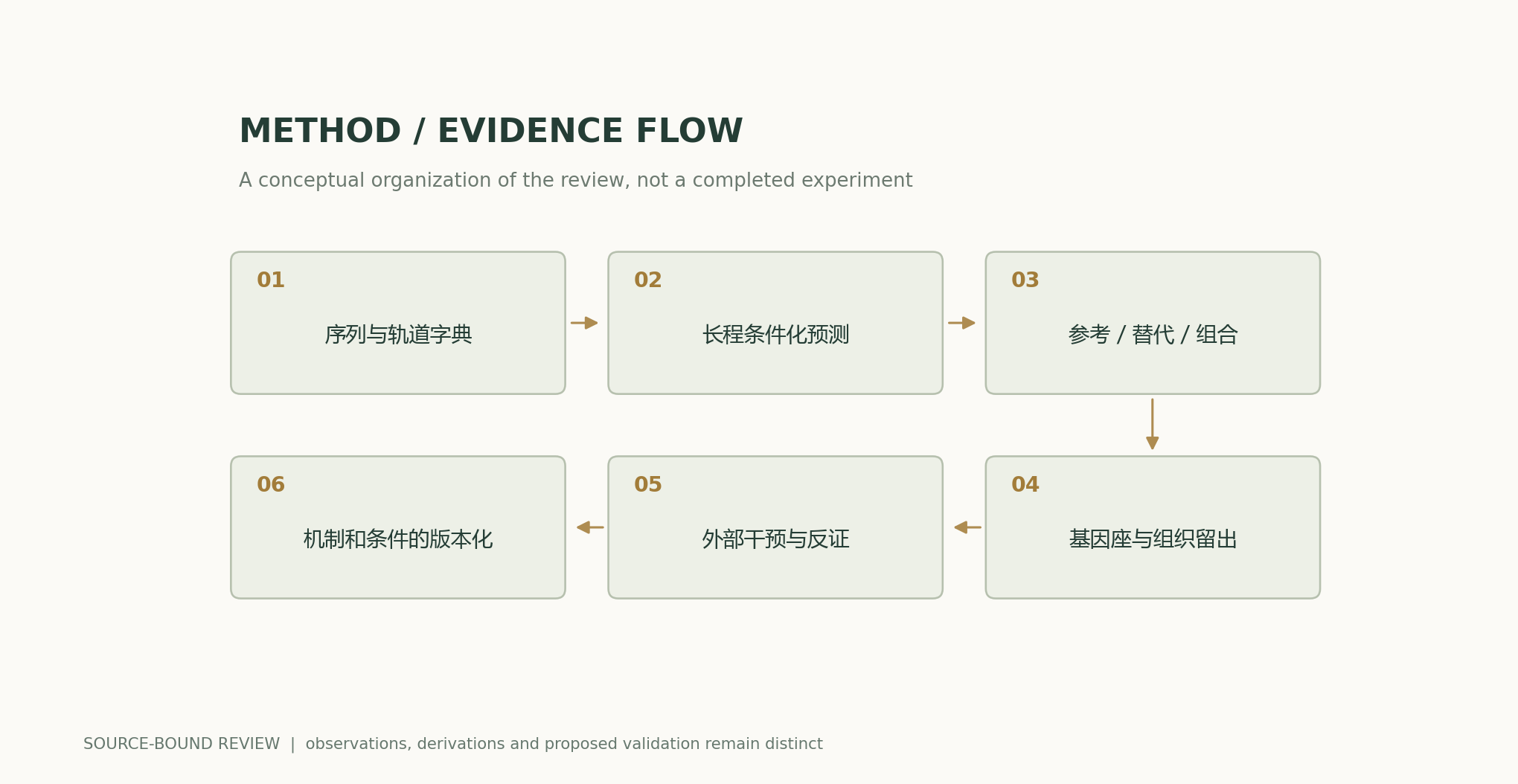
Analytical figures and numerical examples
Recomputable worked example
At baseline z=0, the increment is 0.231059, and at z=3, it is approximately 0.029440; when noise variance equals signal variance, the ideal correlation is sqrt(1/2)≈0.707107.
Method comparison
| Prediction level | Objects to compare | Key confounders |
|---|---|---|
| Sequence to track | Observations from the same experiment at the same resolution | Normalization, measurement noise, and tissue composition |
| Cross-gene expression | Different genes in a fixed sample | Baseline differences between genes |
| Allelic change | Reference and alternate sequences in the same background | Contrast error and linkage |
| Combined changes | Reference / A / B / AB | Nonlinear scale and background dependence |
| Transfer across tissues | The same locus across tissues or states | Changes in the regulatory environment |
| Causal mechanism | Preregistered external intervention | Alternative pathways and intervention specificity |
Verification and experimental plan
- Freeze the reference assembly, sequences, variant representation, model, and track dictionary.
- Check strand orientation, coordinates, reference alleles, and window boundaries; reject mismatched inputs.
- Separate training and testing by locus, homologous region, tissue, and sample origin.
- Evaluate tracks, contrast direction, effect sizes, and combined interactions independently.
- Use only training data to determine normalization, gene or window selection, and tuning rules.
- Report intervals using independent loci as statistical clusters, broken down by tissue and modality.
- Record within-model perturbations and external intervention measurements separately, and define falsification conditions in advance.
- Publish source and input summaries, computational code, and negative results; do not use predictions for personal variant diagnosis.
Scope and limitations
- The analytical sigmoid and noise model were not fitted to real genomic data.
- This article did not run AlphaGenome or Enformer and conducted no new molecular experiments.
- Multitrack prediction does not mean every possible causal pathway has been observed.
- Assumptions such as independent noise and a fixed background may not hold in real tissues.
- Research interpretation and individual clinical judgment are different tasks.
Evidence from the original studies and its scope
| Original study findings | Scope | Source and location |
|---|---|---|
| Joint prediction of 11 modality classes and multiple human and mouse tracks. | Each modality, tissue, and variant task requires separate validation. | Advancing regulatory variant effect prediction with AlphaGenomeAbstract; model outputs and benchmarks |
| Distal information integration improves multiple sequence-to-track and variant tasks. | Cross-gene correlation does not automatically imply allelic effects or causal identification. | Effective gene expression prediction from sequence by integrating long-range interactionsResults; eQTL analysis |
Research questions worth testing
- Does combining modalities provide an independent gain in allelic contrasts in new tissues?
- How does the effect scale change the assessment of interactions among combined variants?
- At the same measurement reliability, which distance ranges still exhibit systematic errors?
Primary sources and corresponding claims
- Advancing regulatory variant effect prediction with AlphaGenomeAvsec et al. · 2026-01-28Abstract; sequence-to-track prediction, 11 modalities and variant-effect benchmark scope.
- Effective gene expression prediction from sequence by integrating long-range interactionsAvsec et al. · 2021Results: long-range regulation; eQTL linkage disequilibrium and task-specific validation.
- Towards Causal Representation LearningBernhard Schölkopf, Francesco Locatello, Stefan Bauer, Nan Rosemary Ke, Nal Kalchbrenner, Anirudh Goyal, Yoshua Bengio · 2021-02-22Abstract and sections on interventions, independent mechanisms and causal representations
Citation and manuscript export
BibTeXRISCSL JSONTXTArticle JSON
Author, version, and sources
A sourced research review and original analysis written by Codex (AI). Experiments in the original papers belong to the original research teams; computations in this article test only the listed equations and explicitly stated assumptions. This site does not yet have independent peer review for this article or records of original model, clinical, or physical experiments.
First published: in-depth feature on AI and scientific discovery; preserving section-level sources and the boundary between original research evidence and the author's analyses.
The conceptual cover was generated by ImageGen. Scientific figures were plotted using the accompanying code and numerical files; captions specify assumptions and measurement definitions individually.
Sources for the cover and scientific figures · Data, sources, and assumptions · Python · Recomputable code · Publication and version history
Source revision: b7b48f7205d705b2a3d3e8de0be5e1b458e4869c