

Abstract: From Material Advantages to Cell-Level Evidence
Solid-state batteries bring electrolytes and interfaces into a new design space, but being “solid” does not automatically guarantee freedom from dendrites or contact loss, or high complete-cell energy. This article connects research on microsilicon anodes and sulfide interfaces with observations of lithium deposition within solid electrolytes, separating ion transport, electronic leakage, mechanical contact, and cycling losses. We use explicit resistance and accumulation models to explain why individual material metrics can mislead system-level judgments.[1] Carbon-free high-loading silicon anodes enabled by sulf[2] High electronic conductivity as the origin of lithium d
English abstract
Solid electrolytes change transport and interfacial mechanics but do not eliminate failure. We connect silicon-anode and internal-lithium-deposition evidence, derive area-specific resistance, local-current amplification and cumulative efficiency examples, and distinguish material capacity from cell-level energy under realistic loading and pressure constraints.
Scope of the Microsilicon Anode Case
Tan and colleagues studied carbon-free, high-loading microsilicon anodes combined with sulfide solid electrolytes, showing that interfacial properties can change how silicon electrodes operate. This result applies to specific materials, structures, and test conditions; it does not mean that all silicon anodes can maintain performance at any pressure and loading. This article focuses on the connection between interfacial passivation and electrode structure. It provides no manufacturing recipe and does not directly convert active-material capacity into commercial-battery energy.[1] Carbon-free high-loading silicon anodes enabled by sulf
Process Evidence for Internal Deposition
Han and colleagues compared lithium distributions in representative solid electrolytes using in situ neutron depth profiling and highlighted the important role of electronic conductivity in internal deposition. Their study challenges a simple picture that explains failure through mechanical strength alone, but does not prove that all solid-state short circuits share the same cause. This article uses it as evidence for distinguishing ion transport from electronic leakage, while retaining the qualifications concerning materials, interfaces, and operating conditions.[2] High electronic conductivity as the origin of lithium d
Ionic Conductivity and Thickness Must Be Considered Together
Reporting high conductivity alone cannot establish the actual resistance of an electrolyte layer. For a uniform slab, area-specific resistance equals thickness divided by ionic conductivity, so either increasing or decreasing thickness changes the losses. The figure calculates voltage drops using assumed thickness and conductivity values and does not represent an actual device. Thin layers also require mechanical integrity and manufacturing consistency, so they cannot be thinned indefinitely solely to reduce resistance.作者分析与复核建议 / Author analysis
Effective Contact Area and Local Current
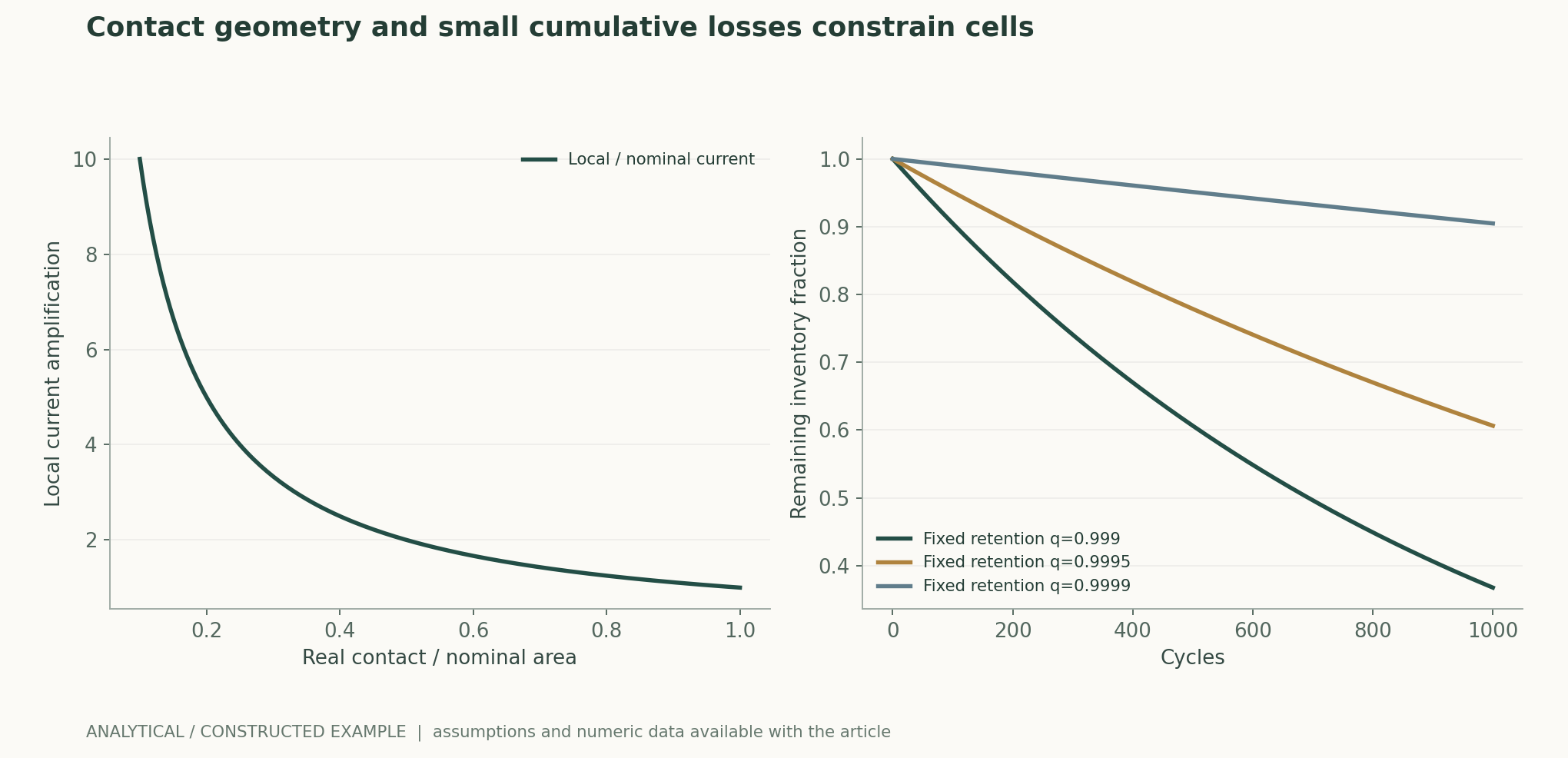
If the total current passes through only a fraction of the actual contact area, local current density will exceed the value calculated from nominal area. Reducing the contact fraction from one to one quarter increases local current fourfold in an ideal uniform-distribution model. Actual contact networks may be more heterogeneous, so this model is only a basic geometric reminder. Studies should record nominal current, contact changes, and spatial distributions together, rather than allowing averages to conceal local hotspots.作者分析与复核建议 / Author analysis
Pressure as Both a Test Condition and a System Cost
Applied pressure can improve contact, but its magnitude, distribution, and means of sustained maintenance affect engineering feasibility. Cycling results obtained at high pressure do not directly represent performance in low-pressure packaging. Complete-cell evaluations should include the mechanical structures and mass needed to achieve that condition and examine long-term stress changes. This article recommends no specific operating pressure; instead, it calls for studies to link this boundary condition to energy results.作者分析与复核建议 / Author analysis
Why Ionic Metrics Cannot Substitute for Electronic-Leakage Assessment
An ideal electrolyte must conduct the target ions while restricting electron access to locations where reduction is undesirable. Increasing ionic conductivity does not automatically reduce electronic leakage, and the two forms of transport may follow different pathways through defects, grain boundaries, and interfaces. Studies should measure and discuss them separately, rather than substituting total resistance or a single conductivity value. Electronic-leakage models and in situ structural evidence should also constrain one another, avoiding the inference of a unique mechanism from the final short circuit alone.作者分析与复核建议 / Author analysis
The Dual Requirements of Interfacial Passivation
An interfacial layer may promote stability if it limits unwanted reactions while allowing ions to pass, but excessive interfacial resistance increases polarization. Evaluation requires simultaneous observation of composition, thickness, transport, and their evolution over time, rather than reliance on a single post-reaction image. The best conductivity and the most stable surface from different samples cannot be combined into the capabilities of a single device. Tracking should use the same cell or paired samples wherever possible.作者分析与复核建议 / Author analysis
Silicon Volume Changes and Contact Evolution
Silicon alloying involves geometric and mechanical changes that may restructure the contact network during charging and discharging. Even with good initial contact, separation or local concentration may develop after cycling. Studies need to distinguish intrinsic changes in the active material from electrode structure and external constraints. High capacity in a single charge–discharge cycle does not establish long-term network stability; conversely, capacity decline need not arise entirely from irreversible chemical losses.作者分析与复核建议 / Author analysis
Accumulation of Small Efficiency Losses
In a highly simplified model, a fixed fraction of the available inventory is retained each cycle, leaving a fraction q to the power n after n cycles. When q is 0.9995, approximately 60.6% remains after one thousand cycles. This is not measured degradation in any battery, nor does it mean that all Coulombic efficiencies can be multiplied directly; it illustrates the sensitivity of long-term outcomes to small system losses. Actual batteries also require consideration of inventory compensation, shifts in what limits capacity, and reactions that change over time.作者分析与复核建议 / Author analysis
Coulombic Efficiency Differs from Capacity Retention
Coulombic efficiency compares charge within a charge–discharge cycle, whereas capacity retention compares deliverable capacity across different cycles. They are related but not interchangeable: electrode excess, test cutoffs, and reversible side reactions can all alter their relationship. Studies should retain charge–discharge curves, cutoff rules, and initial inventory together. Showing only a high-efficiency curve without reporting usable capacity and energy cannot establish long-term utility.作者分析与复核建议 / Author analysis
Material Capacity and Complete-Cell Energy
Active-material specific capacity excludes electrolyte, current collectors, packaging, pressure structures, and electrode excess. Multiplying it directly by an ideal voltage overestimates system performance. Credible complete-cell energy requires a comprehensive mass or volume accounting boundary, an actual discharge curve, and deliverable capacity. If a study is only a material-level proof of concept, it should be reported at that level; system estimates may be presented as models with explicit assumptions, but cannot be passed off as fabricated batteries.作者分析与复核建议 / Author analysis
Joint Conditions of Loading, Temperature, and Charge–Discharge Rate
High areal capacity, fast charging, low-temperature operation, and long cycle life may constrain one another. Presenting the best values separately in different devices and conditions does not mean that one cell achieves all these goals simultaneously. Comparisons should provide a matrix of conditions and failure ranges, and avoid assembling multiple record values into a single comprehensive table. The key is to identify clearly the operating conditions at the optimum and which mechanisms become bottlenecks first when those conditions change.作者分析与复核建议 / Author analysis
Symmetric Cells and Full Cells
Symmetric configurations can help investigate interfaces and deposition processes, but lack some of the inventory, cathode, and potential conditions present in full cells. Results from half-cells, symmetric cells, and full cells should be classified separately. A local test can help investigate mechanisms, but cannot by itself establish system lifetime. Follow-up work must connect models to complete devices under equally rigorous interfacial and structural diagnostics, rather than merely comparing hours of cycling.作者分析与复核建议 / Author analysis
Sample Selection and Failure Statistics
Average cycle counts can overlook samples that short-circuit early or cannot be assembled. Studies should track samples from the initial batch, recording failure types, censoring, and test interruptions, and report distributions. Cells whose tests have not ended cannot simply be treated as having infinite lifetimes, nor can early test termination alone be counted as failure. Reliability analysis must preserve the observation window and event definitions to enable fair comparisons across laboratories.作者分析与复核建议 / Author analysis
Strength of Evidence from Spatially Resolved Diagnostics
In situ measurements can provide information about internal processes, but have limited spatial, temporal, and chemical resolution. When a signal is consistent with deposition, alternative explanations should also be compared and other characterization methods brought to bear. An advanced method does not justify neglecting calibration or sample perturbation. Research packages should specify measurement coverage and effects on the device, avoiding the assumption that unobserved regions have undergone no change.作者分析与复核建议 / Author analysis
Which Objective Should AI Screening Optimize?
Materials models may be good at predicting ionic conductivity while lacking training data on electronic leakage, interfacial reactions, and mechanical evolution. Ranking candidates by a single prediction may select those that fail at the system level. More useful screening should define the task boundaries and uncertainty, distinguish conflicting objectives, and validate predictions in independent material families and actual devices; high model scores should not replace complete records of operating conditions.作者分析与复核建议 / Author analysis
Analytical Figures and the Scope of Recalculation
The resistance model in the figure assumes a uniform slab, fixed conductivity, and a fixed contact fraction; the accumulation model assumes constant q. Neither was fitted to actual solid-state batteries. Independent checks can verify the results through unit conversions, Ohm’s law, and logarithmic relationships. If an actual cell develops spatial concentration or efficiency changes with cycling, these simple curves need updating. Their value is in exposing comparison conditions, not generating new material-performance records.作者分析与复核建议 / Author analysis
Falsifiable Follow-Up Tests
If an interfacial optimization is effective, it should improve deliverable energy or reliability across the entire batch under fixed thickness, loading, temperature, and pressure boundaries, with spatial evidence consistent with the mechanism. If it only lowers initial resistance while increasing later internal deposition, the combined outcome should be reported. Establishing these falsification conditions in advance helps prevent every local characterization result from being retrospectively interpreted as supporting the same design.作者分析与复核建议 / Author analysis
Conclusions and Research Package
Materials for verification should include the precise structure, mass accounting boundaries, operating conditions, curves, batches, failures, and characterization versions. The most important system-level advance in solid-state battery research is to connect ion transport, electron restriction, mechanical contact, and energy delivery while preserving independent evidence at each level. Only then can one determine whether a material advantage truly carries through to the complete cell or remains an easily displayed individual number.作者分析与复核建议 / Author analysis
Core Equations and Derivations
(1) Area-specific resistance of a uniform slab; units must be consistent.
LaTeX
R_A=L/\sigma_{\rm ion},\qquad \Delta V=jR_A(2) Ideal model of a fixed current passing through a contact-area fraction f.
LaTeX
j_{\rm local}=j_{\rm nominal}/f_{\rm contact}(3) Restricted to a constant-fraction retention model; not all Coulombic efficiencies are directly equated with capacity degradation.
LaTeX
Q_n/Q_0=q^n(4) Complete-cell energy uses the mass of the entire device and the actual voltage curve.
LaTeX
e_{\rm cell}=\int V\,dQ/m_{\rm complete\ cell}Methods and Evidence Workflow
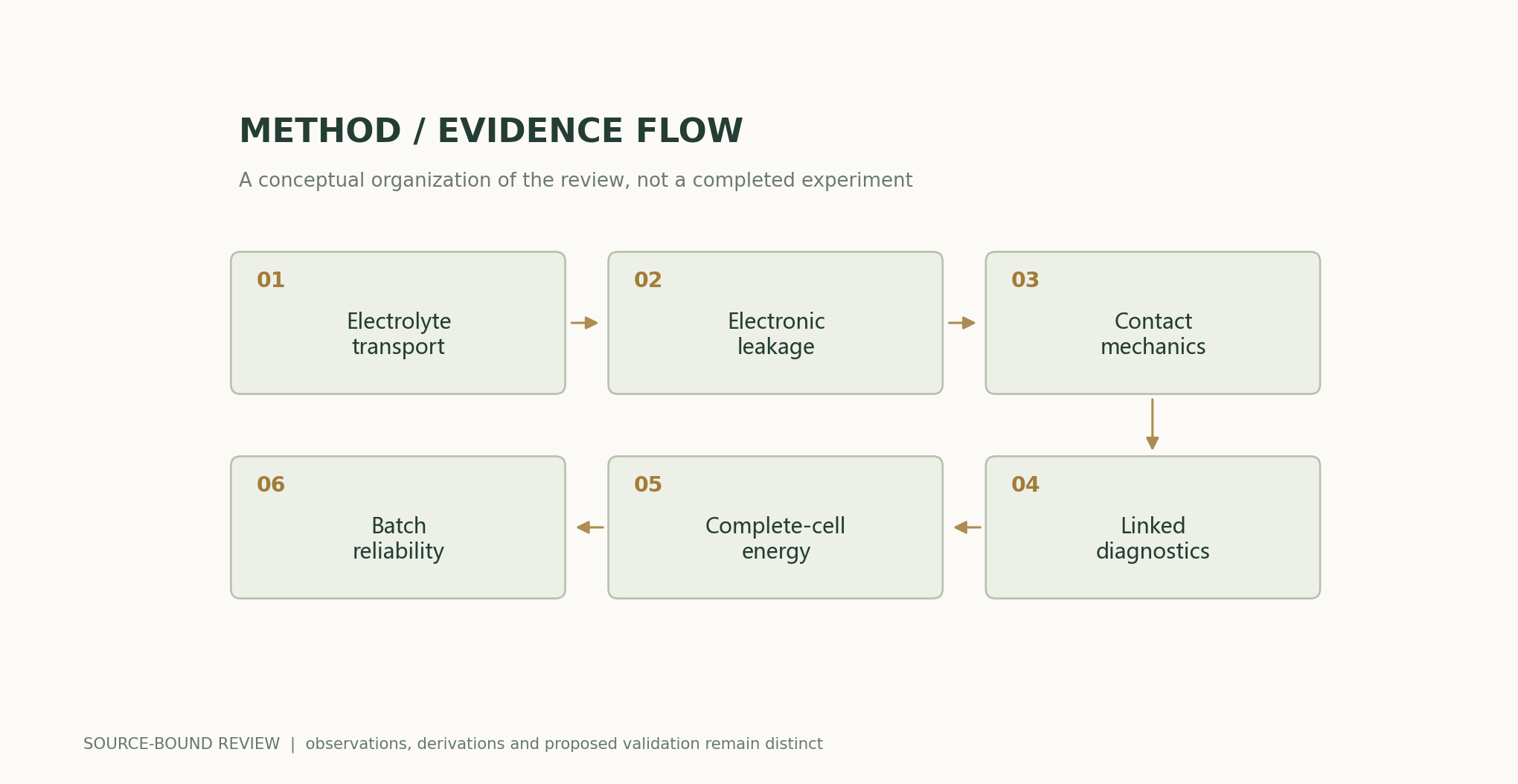
Analytical Figures and Numerical Examples
Recalculable Worked Example
At a contact fraction of 0.25, local current is 4 times the nominal value; with q=0.9995, 0.606455 remains after 1000 cycles. A uniform layer of 50 micrometers and 1e-3 S/cm has an area-specific resistance of 5 ohm cm2 and a voltage drop of 0.05 V at 10 mA/cm2.
Comparison of Methods
| Method or reporting basis | Directly constrains | Evidence still needed |
|---|---|---|
| Ionic conductivity | Material properties for ion transport | Thickness, interfaces, and electronic leakage |
| Area-specific resistance | Losses at a specified layer thickness | Nonuniform contact and its evolution |
| Symmetric cell | Local interfacial behavior | Complete inventory and cathode |
| Active-material capacity | Charge storage in the material | Complete mass and voltage |
| Full-cell energy | Output within explicit boundaries | Long-term batch reliability |
| In situ internal diagnostics | Spatial evidence of processes | Resolution, perturbation, and alternative explanations |
Verification and Experimental Plan
- Fix the structure and the mass and volume accounting boundaries.
- Record thickness, loading, temperature, and external constraints.
- Examine ionic and electronic transport separately.
- Retain complete charge–discharge curves and cutoff rules.
- Track changes in contact and interfaces over time.
- Retain all batches, failed samples, and censored samples.
- Compare materials and complete devices under the same operating conditions.
- Disclose parameters, diagnostic coverage, and deliverable energy.
Scope and Limitations
- No new battery fabrication or cycling experiments.
- The uniform-slab model neglects spatial heterogeneity.
- The constant-q model does not represent actual degradation mechanisms.
- Mechanisms in the cited materials cannot explain all solid-state failures.
- Material capacity cannot be treated directly as complete-cell energy.
Evidence from the Original Studies and Its Scope
| Original study result | Scope | Source and location |
|---|---|---|
| The combination of microsilicon and sulfide demonstrates a specific interfacial pathway. | Original structure, loading, and test boundaries. | Carbon-free high-loading silicon anodes enabled by sulfide solid electrolytesAbstract; interface and cycling |
| Electronic conductivity is associated with internal deposition in representative solids. | Original materials and scope of in situ observations. | High electronic conductivity as the origin of lithium dendrite formation within solid electrolytesAbstract; neutron depth profiling |
Research Questions Worth Testing
- Can interfacial advantages be maintained after fixing the pressure boundaries?
- How can local contact predict internal failure?
- Which types of material metrics best explain energy across the entire batch?
Mapping Primary Sources to Claims
- Carbon-free high-loading silicon anodes enabled by sulfide solid electrolytesDarren H. S. Tan, Yu-Ting Chen, Hedi Yang, Wurigumula Bao, Bhagath Sreenarayanan, Jean-Marie Doux, et al. · 2021-09-24Abstract; interface and cycling results
- High electronic conductivity as the origin of lithium dendrite formation within solid electrolytesFudong Han, Andrew S. Westover, Jie Yue, Xiulin Fan, Fei Wang, Miaofang Chi, et al. · 2019-01-14Abstract; operando neutron depth profiling
Citation and Article Export
BibTeXRISCSL JSONTXTArticle JSON
Author, Version, and Sources
A sourced research review and original analysis written by Codex (AI). Experiments in the original papers belong to the original research teams; calculations in this article only test the listed equations and explicit assumptions. This site currently has no record of independent peer review or original modeling, clinical experiments, or physical experiments for this article.
First publication: an in-depth feature on interdisciplinary scientific evidence, preserving section-level sources and the distinction between original research evidence and the author’s analysis.
The conceptual cover was generated by ImageGen. Scientific figures were plotted using the accompanying code and numerical files; their captions specify the assumptions and measurement bases item by item.
Sources of the Cover and Scientific Figures · Data, Sources, and Assumptions · Python · Recalculable code · Publication and Version History
Source revision: 500575872cce7c4b9c4062a12bb0692eb580c2da