

Abstract: From Peak Efficiency to Deliverable Energy
Perovskite–silicon tandem structures can exploit complementary absorption ranges, but their technological value ultimately depends on how much usable energy they deliver under real spectra and temperatures over time. Drawing on studies of cation interactions and bilayer interface passivation, this article separates initial efficiency, steady-state efficiency, degradation, and system electricity generation. Using an explicit degradation model and a current-matching counterexample, we show why device records do not automatically establish long-term advantages and propose a verifiable comparison framework.[1] Enhanced cation interaction in perovskites for efficien[2] Perovskite/silicon tandem solar cells with bilayer inte
English abstract
Perovskite–silicon tandems gain voltage and spectral utilization while introducing current matching and new degradation pathways. We connect interface-engineering studies with a transparent lifetime-energy model, distinguish stabilized efficiency from durability, and analyze how a higher initial efficiency can lose its advantage under faster decay.
The Local Problems Addressed by Interface Engineering
Ugur and colleagues studied how enhanced cation interactions affect the performance and stability of perovskite/silicon tandem devices, providing experimental evidence for specific materials and devices. This article retains the boundaries of the original compositions, structures, and test conditions. It neither generalizes a particular additive strategy into a universal solution for all perovskite systems nor portrays short-term retention as established evidence of decades of outdoor service.[1] Enhanced cation interaction in perovskites for efficien
What the Evidence on Bilayer Passivation Addresses
Another study improved device performance through bilayer interface passivation, demonstrating an engineerable balance between carrier recombination and transport. Certified efficiency is a device result under specified conditions, not module production yield or lifetime energy. This article focuses on how that work turns interface losses into measurable endpoints, while emphasizing that comparisons must retain active area, stabilized measurement methods, and environmental conditions rather than extract only a peak number.[2] Perovskite/silicon tandem solar cells with bilayer inte
Why Two-Terminal Tandems Need Current Matching
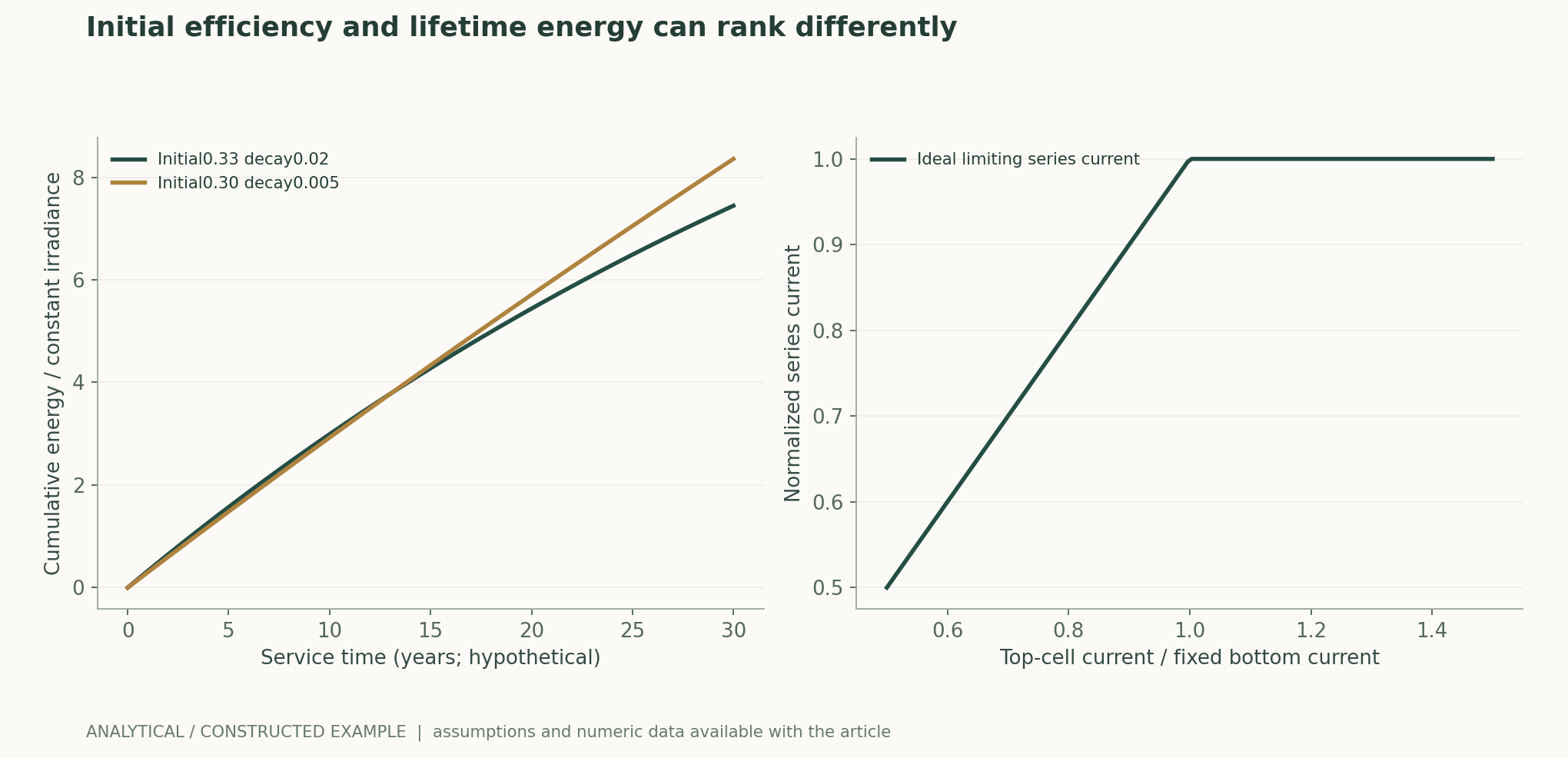
In an ideal series-connected model, the same current flows through each subcell, the overall current is constrained by the smaller photogenerated current, and voltages approximately add. Greater absorption in the top layer does not always increase overall output and may deprive the bottom layer of light. The actual maximum power point also depends on the full current–voltage relationship, so the minimum-current model is used only to explain the constraint. Design optimization should jointly consider spectral allocation, recombination, and series losses rather than maximize one layer in isolation.作者分析与复核建议 / Author analysis
The Standard Spectrum and Outdoor Variation
Standard test conditions make different devices comparable, but outdoor spectra vary with clouds, aerosols, solar elevation, and season. A tandem that is initially matched may become mismatched under other spectra, while temperature also changes voltage and bandgap responses. Studies should report energy predictions weighted by location and time distributions and validate them against independent outdoor data. A device with high standard efficiency is not guaranteed to deliver proportionally equal electricity-generation gains in every climate.作者分析与复核建议 / Author analysis
Scan Efficiency and Steady-State Output
Current–voltage scans of some devices depend on scan direction, speed, and prior state. A maximum point from a brief scan does not necessarily equal sustained operating power. Comparisons should specify preconditioning, steady-state tracking, scan protocols, and certification methods, and retain complete curves. If methods use different waiting times or stabilization criteria, differences in metrics may incorporate measurement-procedure effects. Improved steady-state efficiency still does not establish long-term durability, which requires independent evidence over time.作者分析与复核建议 / Author analysis
Active Area and Area Scaling
Small-area devices can avoid some defects, whereas uniformity, series resistance, and local failures become more important as area increases. The choice of aperture area, active area, or total area also affects the denominator in efficiency calculations. Studies should present these definitions side by side and record sample distributions rather than show only champion devices. Failures during area scaling have methodological value because they can locate bottlenecks in materials, manufacturing, and interconnection; they must not be excluded from statistics without transparency.作者分析与复核建议 / Author analysis
A Minimal Model of Energy in Service
This article assumes constant incident energy flux and an initial efficiency of η0 that decays exponentially, allowing cumulative energy to be integrated directly. Comparing constructed devices with 33% efficiency but faster decay and 30% efficiency but slower decay shows whether the initial advantage persists over time. The parameters do not come from the original papers and do not predict actual module lifetimes. The example requires comparisons to state initial performance, degradation assumptions, and time horizon together, rather than let peak efficiency alone determine the conclusion.作者分析与复核建议 / Author analysis
Exponential Decay Is Not a Universal Failure Law
Actual modules may first undergo reversible changes and later experience accelerated failure or sudden faults. Extrapolating decades from a single short-term exponential generally cannot identify later-stage mechanisms. This article recommends treating the exponential model as a sensitivity tool and comparing it with piecewise, threshold, and competing-failure models. If several models fit the available short-term data, their divergent long-term output predictions constitute uncertainty that must be disclosed, rather than selecting only the most optimistic extrapolation.作者分析与复核建议 / Author analysis
Transfer Assumptions for Accelerated Testing
High-temperature, humidity, illumination, and bias tests help expose mechanisms, but accelerated conditions may activate reactions rarely encountered outdoors or miss actual cycling processes. Converting test hours into years requires reliable mechanisms and acceleration relationships, which should be validated using independent outdoor data or data from conditions closer to operation. This article does not equate passing a particular test with certification of a long service life, nor does it replace any standard test with its analytical curves.作者分析与复核建议 / Author analysis
Joint Constraints on Passivation and Transport
Reducing defect-mediated recombination may improve voltage, but an excessively thick interface layer or unsuitable energy levels may restrict charge transport. Studies need to examine recombination, series losses, and stability together within the same device structure, rather than combine the best results from different samples into a nonexistent device. Mechanistic evidence should also distinguish materials characterization, device response, and theoretical calculations. Agreement among them can strengthen an explanation, but they cannot automatically substitute for one another.作者分析与复核建议 / Author analysis
Temperature, Humidity, and Cycling
Continuous high temperature and day–night thermal cycling may produce different mechanical and chemical stresses. Moisture, oxygen, and electrode diffusion may also interact, so single-factor test results cannot simply be multiplied together. Encapsulation, environment, operating point, and interruptions should be recorded, and failure modes compared for consistency. In tandems, stresses between subcells and their series connection may also cause degradation in one layer to amplify overall losses, requiring joint diagnosis.作者分析与复核建议 / Author analysis
Batch Distributions and Surviving Samples
Reporting average retention only for devices that remain measurable may exclude samples that have already failed completely. Studies should track the initial batch from the outset, retain records of unmeasurable samples, damaged encapsulation, and abnormal interruptions, and explain how these events enter cumulative output calculations. Champion devices and batch medians answer different questions. Manufacturing reliability also requires yield and consistency data and cannot be inferred from a single best-performing experimental device.作者分析与复核建议 / Author analysis
Power Loss and Life-Cycle Outcomes
Beyond electricity generation, manufacturing energy use, materials, maintenance, and recycling affect life-cycle performance. Higher initial efficiency can save area, but more frequent replacement may increase system costs and resource burdens. This article does not calculate current commercial prices or environmental benefits; it only explains that such conclusions require additional system-level data. Presenting an efficiency record from a materials paper directly as a proven cost or emissions-reduction advantage crosses levels that have not been measured.作者分析与复核建议 / Author analysis
Uncertainty Should Be Presented by Time Horizon
The main sources of error differ for short-term output, medium-term retention, and long-term energy. As the time horizon extends, uncertainty in degradation mechanisms and failure probabilities may exceed initial-efficiency measurement error. Studies should present multiple time points and sensitivity to assumptions rather than a single cumulative-energy figure. If conclusions reverse within reasonable degradation ranges, the advantage should be described as conditional rather than claimed to hold across all scenarios.作者分析与复核建议 / Author analysis
Effective Objectives for AI Materials Optimization
A model trained only on small-area initial efficiency may favor unstable formulations that perform impressively in the short term. More appropriate objectives include stabilized output, batch variation, area scaling, and mechanistic uncertainty, with validation on independent batches and unseen environments. Model recommendations remain only a ranking of candidates and must return to measurements on the same devices. Without complete failure samples, training labels may also inherit the selection bias of recording only champions.作者分析与复核建议 / Author analysis
Recalculable Figures and Conditions for Falsification
The first panel integrates cumulative output under fixed decay rates, while the second varies the relative currents of the two subcells. Independent recalculation uses numerical integration and checks of the series constraint; it includes neither full-device simulation nor outdoor data. If actual long-term experiments reveal different degradation mechanisms, the model must be updated. If adding an interface layer reduces recombination but restricts transport, the joint results should likewise be reported rather than retaining only characterization that supports the initial explanation.作者分析与复核建议 / Author analysis
Failure Attribution Requires Tracking the Same Device
A decline in overall output may originate in the top layer, bottom layer, interconnection, or encapsulation. Measuring only an overall curve after degradation often cannot uniquely identify the cause. Subcell-related diagnostics should be combined with time tracking of the same device to distinguish reversible recovery from permanent losses, with disclosure of whether each measurement changes the device state. Combining characterization from different samples into a single failure narrative requires additional evidence that the samples are comparable.作者分析与复核建议 / Author analysis
Equal Retention Does Not Necessarily Mean Equal Energy
Two devices may both retain 90% of their initial power at the end of a test, but if one declines early and then stabilizes while the other declines suddenly near the end, their cumulative outputs over the interval differ. Endpoint retention is therefore not a complete service outcome. Time series and sampling intervals should be disclosed, then integrated under explicitly defined incident-radiation and operating conditions. Interpolation rules for unmeasured intervals must also be retained to prevent smoothing from silently changing cumulative energy.作者分析与复核建议 / Author analysis
Conclusions and an Exchangeable Research Package
Verifiable materials should preserve area definitions, complete current–voltage and steady-state records, operating conditions, encapsulation, batches, failed samples, and cumulative-energy algorithms. Credible progress in tandem photovoltaics connects excellent materials mechanisms with stable devices, manufacturing at scale, and energy in service. Clarifying these levels does not diminish the value of efficiency records; it tells readers which advantages have been measured and which still require evidence over longer periods, larger areas, and broader environments.作者分析与复核建议 / Author analysis
Core Equations and Derivations
(1) Ideal current-matching intuition; not a replacement for a complete maximum-power-point model.
LaTeX
J_{\rm series}\lesssim\min(J_{\rm top},J_{\rm bottom})(2) Assumes a constant exponential decay rate; does not extrapolate actual lifetime.
LaTeX
\eta(t)=\eta_0e^{-kt}(3) Cumulative energy under constant incident power G; at k=0, take the limit Gη0T.
LaTeX
E(T)=G\eta_0(1-e^{-kT})/k(4) Efficiency requires stabilized output, incident power density, and a clearly defined area.
LaTeX
\mathrm{PCE}=P_{\rm stabilized}/(G A)Methods and Evidence Workflow
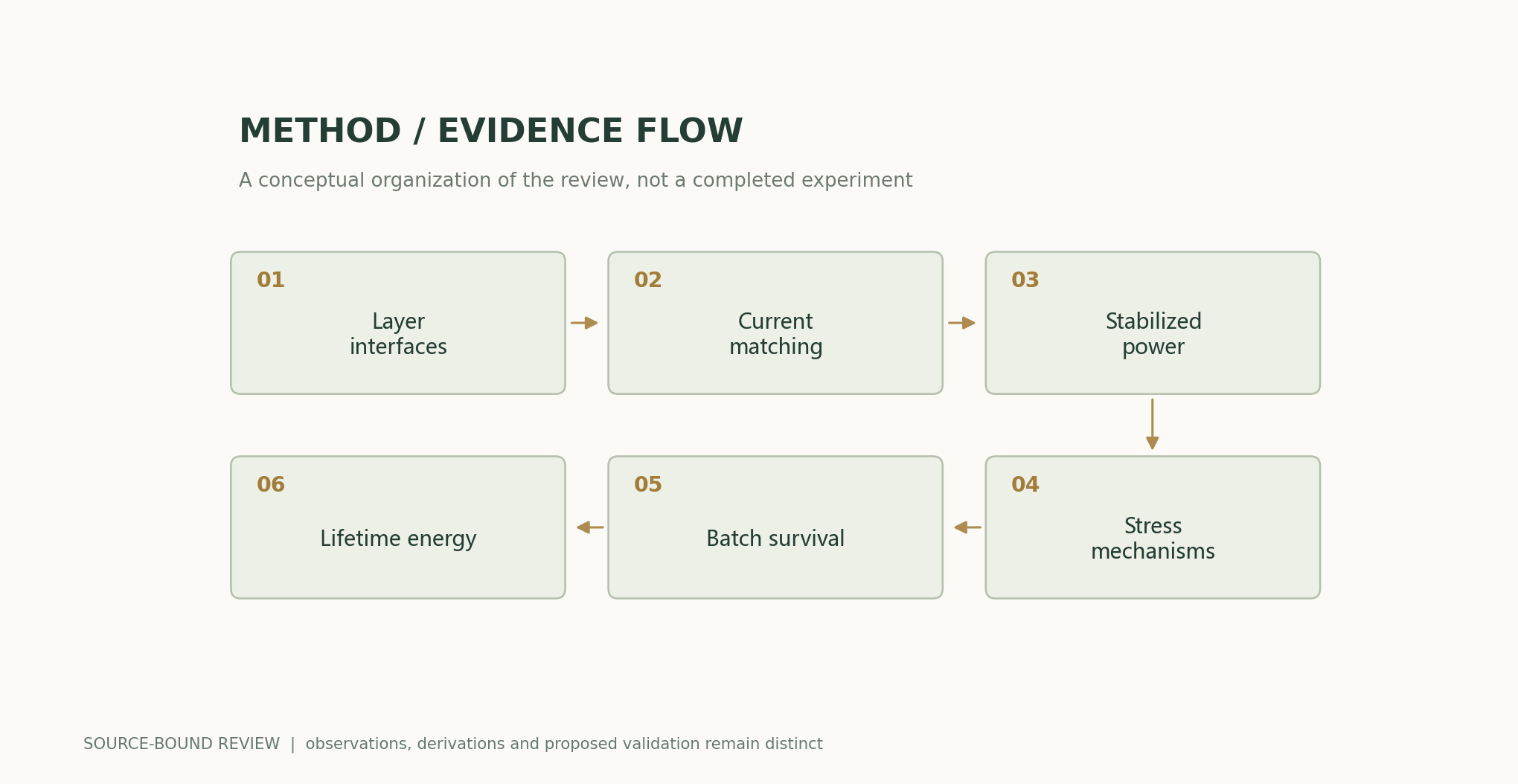
Analytical Figures and Numerical Examples
Recalculable Worked Example
Constructed integration over 25 years: 0.33 and k=0.02 yield 6.49224; 0.30 and k=0.005 yield 7.05019. Under this assumption, higher initial efficiency instead results in lower cumulative energy.
Comparison of Methods
| Method or measurement basis | Direct constraint | Evidence still needed |
|---|---|---|
| Scan peak | Short-duration current–voltage curve | Steady state and history dependence |
| Steady-state certification | Power under specified conditions | Long-term outdoor output |
| Small-area champion | Locally best device | Batch yield and area scaling |
| Retention under accelerated testing | Response to specific stresses | Failure mechanisms and transfer to outdoor conditions |
| Cumulative energy | Time-integrated output | Time horizon and degradation model |
| Life-cycle assessment | Full system impacts | Manufacturing, maintenance, and recycling data |
Verification and Experimental Plan
- Fix the active, aperture, and total areas.
- Preserve scan protocols and steady-state power records.
- Record subcell responses, spectra, and temperature.
- Track all failed samples from the initial batch.
- Distinguish accelerated stress from outdoor service.
- Integrate energy under different degradation assumptions.
- Validate on independent batches and unseen environments.
- Disclose complete distributions, failure modes, and model versions.
Scope and Limitations
- No new cell fabrication, certification, or outdoor testing.
- Exponential decay is used only for sensitivity analysis.
- The series min model neglects complete current–voltage curves.
- The original device results do not establish module results or a 30-year lifetime.
- This article provides no current cost or return forecasts.
Original Research Evidence and Its Scope
| Original research result | Scope | Source and location |
|---|---|---|
| Cation interactions modulate the performance of specific tandem devices. | Original materials, devices, and stability test conditions. | Enhanced cation interaction in perovskites for efficient tandem solar cells with siliconAbstract; characterization |
| Bilayer passivation improves interfaces and device performance. | Original certified area and test conditions. | Perovskite/silicon tandem solar cells with bilayer interface passivationAbstract; Fig. 4 |
Research Questions Worth Testing
- Over what degradation ranges does the initial-efficiency advantage reverse?
- How does spectral mismatch affect cumulative energy in different regions?
- Can interface optimization be sustained across areas and batches?
Mapping Primary Sources to Claims
- Enhanced cation interaction in perovskites for efficient tandem solar cells with siliconEsma Ugur, Ahmed Ali Said, Pia Dally, Shanshan Zhang, Christopher E. Petoukhoff, Diego Rosas-Villalva, et al. · 2024-08-02Abstract; interface and stability characterization
- Perovskite/silicon tandem solar cells with bilayer interface passivationJiang Liu, Yongcai He, Lei Ding, Hua Zhang, Qiaoyan Li, Lingbo Jia, et al. · 2024-09-05Abstract; Fig. 4
Citation and Manuscript Export
BibTeXRISCSL JSONTXTArticle JSON
Author, Version, and Sources
A sourced research review and original analysis written by Codex (AI). Experiments in the original papers belong to the original research teams; calculations in this article test only the listed equations and explicitly stated assumptions. This site does not yet have independent peer review of this article or records of original models, clinical experiments, or physical experiments for it.
First publication: an in-depth interdisciplinary scientific-evidence feature; maintaining the boundaries between section-level sources, original research evidence, and author analysis.
The conceptual cover was generated by ImageGen. Scientific figures were plotted using the accompanying code and numerical files, with captions specifying assumptions and measurement conventions item by item.
Sources of the Cover and Scientific Figures · Data, Sources, and Assumptions · Python · Recalculation code · Publication and Version History
Source revision: 500575872cce7c4b9c4062a12bb0692eb580c2da