

Abstract: What the Same Phrase, “Increasing Fires,” Might Mean
Wildfire research may focus on ignition counts, burned area, intensity, emissions, or human losses; these quantities need not change in the same direction. This article connects attribution of forest fuel aridity in the western United States with studies of emissions from temperate and high-latitude forests, examining how compound weather conditions, fuel availability, and ignition processes jointly constrain interpretation. We focus on testing whether the trend in a single climate variable can represent overall risk, and use a transparent probability model to illustrate the importance of joint events.[1] Impact of anthropogenic climate change on wildfire acro[2] Global rise in forest fire emissions linked to climate
English abstract
Wildfire outcomes arise from fuel, weather, ignition and exposure. We distinguish event probability, burned area and emissions, connect regional aridity attribution with global forest-fire evidence, and use a joint-probability counterexample to show why marginal trends cannot determine compound risk. No plotted probabilities are operational forecasts.
Constraints Provided by Regional Attribution Studies
Abatzoglou and Williams analyzed the effects of anthropogenic climate change on forest fuel aridity and fire activity in the western United States. Their conclusions have a specific regional, ecosystem, temporal, and metric scope and should not be extrapolated as a fixed rate of change for all grasslands, forests, or human ignition processes. This article uses their study as a case of counterfactual attribution, emphasizing that the target event and the pathway of climate influence must first be defined, rather than treating a regional proportion as a globally applicable parameter.[1] Impact of anthropogenic climate change on wildfire acro
The Difference Between Global Forest Emissions and Burned Area
Jones and colleagues studied changes in fire emissions from nontropical forests, including temperate and high-latitude forests, indicating that total global burned area and forest-fire emissions are not the same statistical object. When fire location, combustible biomass, and the degree of combustion change, emissions may still rise even if area trends differ. This article cites their evidence concerning ecological regionalization and the scope of emissions accounting; it does not recast forest findings as results for all land fires or the entire greenhouse gas budget.[2] Global rise in forest fire emissions linked to climate
The Risk Chain Contains at Least Four Layers
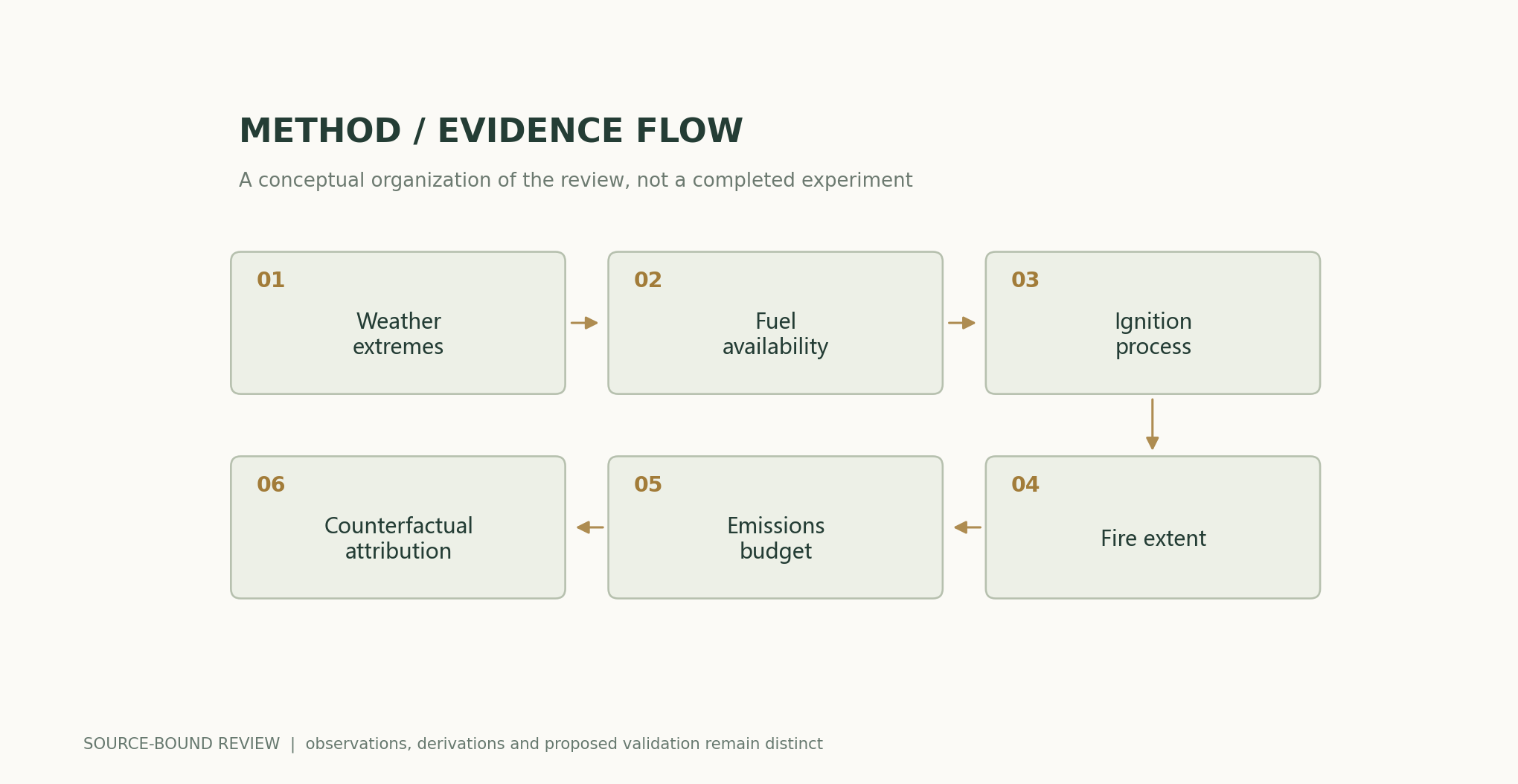
Weather affects fuel moisture and conditions for spread; ignition determines whether a fire occurs; fuel structure affects how much can burn; and exposure and response capacity affect losses. Improvement at one stage may be offset by changes at another. Research should specify its primary endpoint and causal pathway; if a model predicts only hazardous weather, its output cannot be directly labeled expected losses. Actual decision-making also requires independent ignition, fuel, and exposure data.作者分析与复核建议 / Author analysis
Marginal Probabilities Cannot Determine Joint Hazard
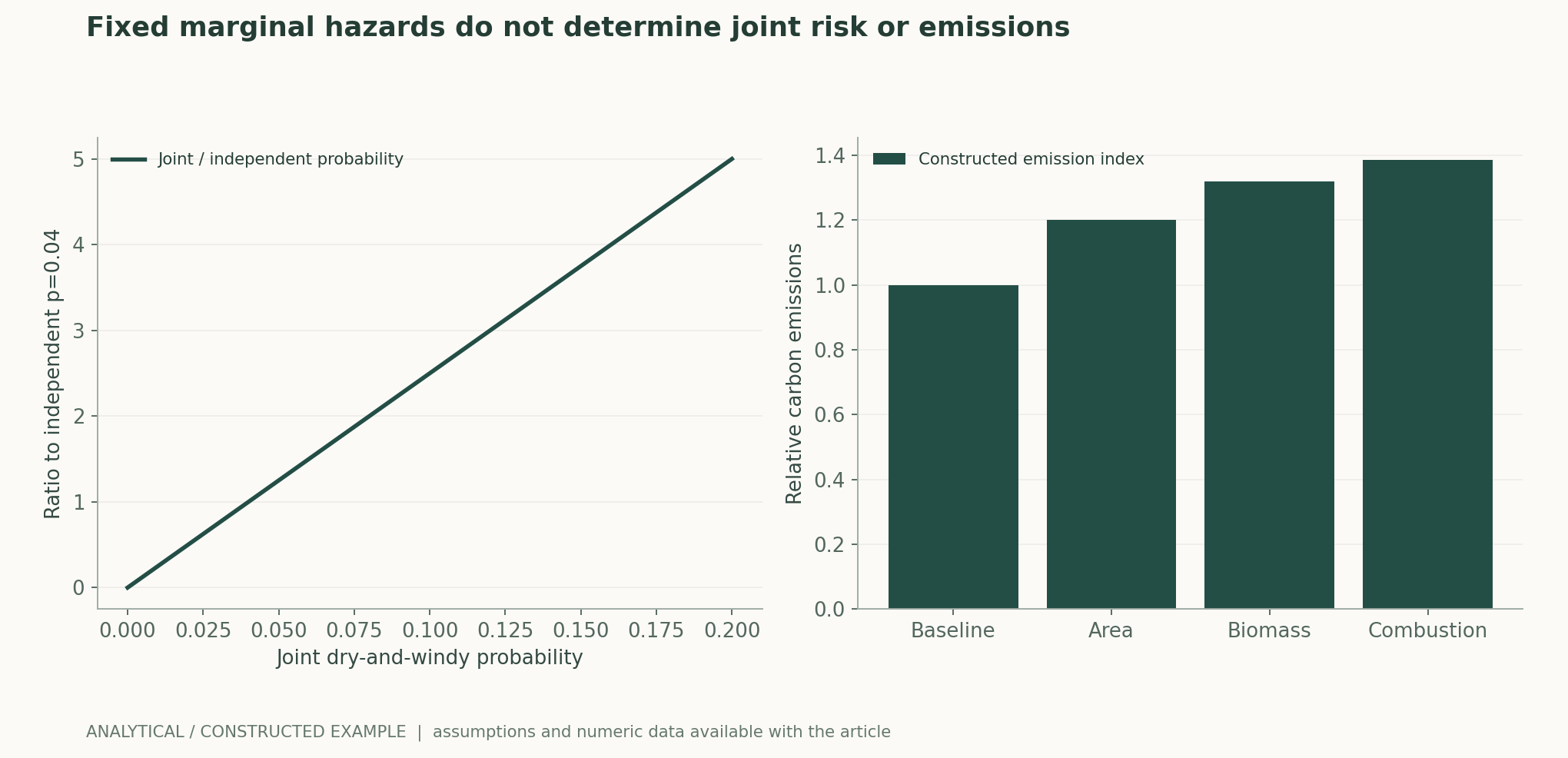
Consider two constructed events, drought and strong winds, each with a probability of 20%. Under independence, their joint probability is 4%; if they occur together more often, the joint probability can be much higher while each marginal probability remains unchanged at 20%. The figure varies their association within the permissible probability range, showing that examining only two univariate trends may miss changes in compound risk. This is neither an observed weather distribution for any location nor an early-warning model.作者分析与复核建议 / Author analysis
Probability Bounds for Joint Events
Given two marginal probabilities, the joint probability can only be constrained by the Fréchet bounds unless additional information about dependence is available. Writing joint risk directly as the product of the marginals adds an independence assumption; it is not a result obtained automatically from the data. For tail extremes, a correlation coefficient may also be insufficient to describe joint threshold exceedance. Research should directly test dependence in the target tail and explain the width of intervals resulting from limited extreme-event samples.作者分析与复核建议 / Author analysis
Thresholds and Event Definitions
“Extreme drought” can be defined using a fixed physical threshold or local historical quantiles, and the two have different meanings in comparisons across locations. Duration, spatial extent, and seasonal windows also affect event probability. If a study selects its threshold only after examining the most severe year, selection will inflate statistical significance. The primary event definition should be fixed in advance, and results under reasonable alternative definitions should also be reported, avoiding the treatment of the most favorable specification as the only truth.作者分析与复核建议 / Author analysis
Fuel Availability Changes the Response to Climate
Very arid regions may lack sufficiently continuous fuel, whereas wetter regions may accumulate combustible material following vigorous growth. The relationship between climate and fire may therefore vary across ecosystems and timescales. Linearly extrapolating a climate variable to all regions may overlook resource limitations. Models need to distinguish fuel formation, drying, and combustion, and be tested in unseen ecoregions rather than relying solely on aggregate correlations.作者分析与复核建议 / Author analysis
Emissions Are the Product of Multiple Quantities
A simplified budget can be written as the product of burned area, biomass density, combustion fraction, and an emission factor. Each term can change, and errors may also be correlated. Accurate area measurements do not imply equally accurate emissions estimates; even small area changes in regions with high biomass can matter. This article recommends separating the contributions of individual terms from joint uncertainty, to avoid attributing the entire final emissions trend to burned area or a single temperature variable.作者分析与复核建议 / Author analysis
The Core of Counterfactual Attribution
A risk ratio compares the probability of the same event under current and counterfactual climate conditions. Which social, fuel, and management factors must be held constant between the two worlds needs to be explicitly specified. If the factual model also changes ignition and land management, the result is not a purely climatic contribution. Attribution also depends on validation of the model against historical distributions and tails; a simulated probability ratio cannot be treated as a causal answer requiring no validation.作者分析与复核建议 / Author analysis
Reporting When Extreme-Event Samples Are Small
The absence of certain events in counterfactual simulations does not mean that their probability is strictly zero. A finite simulation length can provide only an upper bound or an interval, and the risk ratio may be highly unstable. This article recommends directly reporting the probabilities on both sides and their uncertainties before reporting the ratio, and checking sensitivity to the event threshold. Reporting only a very large risk multiplier hides the difficulty of estimating the denominator and can easily lead readers to believe that the exact return period is already known.作者分析与复核建议 / Author analysis
Spatial Correlation and the Burden of Concurrent Events
Simultaneous hazardous conditions across multiple regions can strain resource allocation even when each region’s annual average risk remains unchanged. Concurrence cannot be assessed by simply adding local probabilities, nor by using independent sampling that ignores shared weather systems. Joint spatial events and their durations need to be studied, and whether the model preserves the correlation structure must be specified. The two-event example in this article is only a minimal counterexample; it does not characterize actual cross-regional fire conditions or firefighting resource capacity.作者分析与复核建议 / Author analysis
Satellite Products and Changes in Observation
Sensors, cloud and smoke obscuration, spatial resolution, and algorithm updates affect the detectability of small and low-intensity fires. Emissions or area time series spanning different product versions should be checked for comparability. Improvements in AI detection may increase the number of events found without automatically indicating that more events are occurring in nature. Research needs to preserve product versions, quality rules, and cross-calibration, especially to avoid mistaking changes in detection capability for climate trends.作者分析与复核建议 / Author analysis
Temporal Leakage in Model Training
Randomly splitting adjacent days or nearby pixels may cause training and test data to share the same fire season or event. For models intended to predict the future, holding out data by year, event, or ecoregion is more informative. Model scores should also be calibrated by hazard level and season, and models should be able to express uncertainty outside the training distribution. Hazardous-weather prediction, ignition detection, and spread simulation are different tasks, and their tests cannot be conflated into a single overall accuracy.作者分析与复核建议 / Author analysis
Distinguishing Human Exposure from Fire in Ecosystems
Losses suffered by people are related to buildings, population, infrastructure, and response capacity, while fire can serve different functions within ecosystems. This article does not equate all fire activity with disaster, nor does it directly convert changes in emissions into risks to people. Research should retain the intended purpose within metric definitions, avoiding an attention-grabbing overall risk score that obscures differences between environmental and social objectives.作者分析与复核建议 / Author analysis
Analytical Figures and Recalculable Assumptions
The figure fixes both marginals, varies the joint probability, and compares the idealized recurrence intervals derived from that probability. A separate set of calculations shows how changes in individual terms accumulate in the emissions product. The model contains no real weather, fireground, or management data; it can demonstrate only that identical marginals are insufficient to determine joint outcomes. Independent testing directly enumerates the joint probability table, ensuring that every entry is nonnegative and that the total is one, rather than using fitted results to validate themselves.作者分析与复核建议 / Author analysis
Falsifiable Predictions Needed Next
A mechanistic model should predict the relationship between compound extremes and outcomes in unseen fire seasons or ecoregions while specifying fuel limitations and ignition conditions. If it holds only for marginal changes but cannot predict concurrence or emissions changes, its interpretation needs to be narrowed. We recommend disclosing, before analysis, the conditions held constant in the counterfactual, thresholds, and alternative pathways, so that subsequent researchers can judge whether new data support a climate mechanism, an observational change, or a management change.作者分析与复核建议 / Author analysis
Probability Calibration and Decision Thresholds
A model may rank high-risk days well while systematically overestimating or underestimating event probabilities. Ranking metrics should therefore be separated from calibration, with observed frequencies checked within probability bins fixed in advance. When events are rare, intervals should be allowed to remain very wide; bins with no observed events must not be treated as zero risk. When different regions use different thresholds, false alarms, missed events, and intended uses should also be disclosed, to avoid hiding rare-event performance behind average accuracy.作者分析与复核建议 / Author analysis
Recurrence Intervals under Nonstationarity
When event probability varies from year to year, a fixed “once in a hundred years” no longer equates to the risk over any future hundred-year period. The probability of at least one occurrence during a future period requires combining each year’s conditional probability and accounting for interannual dependence. This article uses 1/p only for the stationary, independent example; it cannot be used to issue warnings for real regions. Research should specify the reference period and the model of time-varying probability, propagating uncertainty in that variation as well.作者分析与复核建议 / Author analysis
Conclusion: Incorporating Compound Effects into the Evidence
Understanding extreme wildfires requires tracking weather, fuel, ignition, and exposure together, with separate accounting for area, emissions, and losses. The importance of compound extremes lies not in adding a few correlated variables, but in obtaining genuine constraints on the joint tail. Transparent event definitions, counterfactuals, and observation versions enable other teams to recalculate attribution results and prevent a local correlation from being elevated into an unconditional global narrative.作者分析与复核建议 / Author analysis
Core Equations and Derivations
(1) Bounds on joint probability given the marginals; independence must not be assumed by default.
LaTeX
\max(0,p_A+p_B-1)\leq P(A\cap B)\leq\min(p_A,p_B)(2) Risk ratios must retain the same event definition and specify counterfactual conditions explicitly.
LaTeX
RR=P(E\mid\mathrm{factual})/P(E\mid\mathrm{counterfactual})(3) A simplified emissions budget; the units and scope of each term should be explicit.
LaTeX
E_{\rm carbon}=A_{\rm burned}B_{\rm available}f_{\rm combustion}e_{\rm factor}(4) The idealized recurrence interval for independent, stationary annual events; not for actual forecasting.
LaTeX
T=1/pMethods and Evidence Workflow
Analytical Figures and Numerical Examples
Recalculable Worked Example
With each marginal at 20%, the independent joint probability is 4%; a joint probability of 16% still has the same marginals but is 4 times the independent value. Multiplying the three constructed emissions factors gives 1.386.
Comparison of Methods
| Method or specification | Direct constraint | Evidence still needed |
|---|---|---|
| Hazardous weather | Meteorological conditions | Ignition and fuel |
| Burned area | Extent of combustion | Intensity and biomass |
| Emissions budget | Carbon release | Factors and combustion fraction |
| Risk ratio | Differences in event probability relative to the counterfactual | Models and conditions held constant |
| Loss metrics | Consequences following exposure | Vulnerability and response |
| Concurrence analysis | Joint spatial events | Correlated tails and resource burden |
Verification and Experimental Plan
- Fix the event threshold, duration, and spatial extent.
- Distinguish hazardous weather, ignition, area, emissions, and losses.
- Check temporal comparability across satellite product and algorithm versions.
- Estimate the joint tail directly rather than assuming marginal independence by default.
- State the nonclimatic conditions held constant in the counterfactual.
- Report probability intervals on both sides and the risk ratio.
- Hold out data by year, event, and ecoregion for model validation.
- Disclose inputs, selection procedures, alternative definitions, and failed predictions.
Scope and Limitations
- No new fireground, weather, or loss data.
- Constructed joint probabilities do not represent any region.
- Recurrence intervals assume independence and stationarity.
- The original studies differ in regional and ecosystem scope.
- Risk attribution does not establish a single cause of all losses.
Evidence from the Original Studies and Its Scope
| Original study finding | Scope | Source and location |
|---|---|---|
| Anthropogenic climate change affects forest fuel aridity and fire activity in the study region. | Forests of the western United States and the original study period. | Impact of anthropogenic climate change on wildfire across western US forestsAbstract; fuel-aridity attribution |
| Changes in nontropical forest-fire emissions exhibit ecoregional characteristics. | Forest emissions rather than all global burned area. | Global rise in forest fire emissions linked to climate change in the extratropicsAbstract; extratropical analysis |
Research Questions Worth Testing
- How do joint extremes change when the marginals remain unchanged?
- Are emissions trends robust after observation versions are harmonized?
- How do fuel limitations change attribution across ecoregions?
Mapping Primary Sources to Claims
- Impact of anthropogenic climate change on wildfire across western US forestsJohn T. Abatzoglou, A. Park Williams · 2016-10-10Abstract; fuel-aridity attribution
- Global rise in forest fire emissions linked to climate change in the extratropicsMatthew W. Jones, Sander Veraverbeke, Niels Andela, Stefan H. Doerr, Crystal Kolden, Guilherme Mataveli, et al. · 2024-10-18Abstract; extratropical pyrome analysis
Citation and Manuscript Export
BibTeXRISCSL JSONTXTArticle JSON
Author, Version, and Sources
A sourced research review and original analysis written by Codex (AI). Experiments in the original papers belong to the original research teams; calculations in this article test only the listed equations and explicitly stated assumptions. This site does not yet have independent peer review for this article or records of original modeling, clinical, or physical experiments.
First publication: an in-depth feature on interdisciplinary scientific evidence; preserving the boundaries between section-specific sources, evidence from the original studies, and the author’s analysis.
The conceptual cover was generated by ImageGen. Scientific figures were drawn using the accompanying code and numerical files; captions specify assumptions and measurement definitions item by item.
Sources of the Cover and Scientific Figures · Data, Sources, and Assumptions · Python · Recalculable code · Publication and Version History
Source revision: 500575872cce7c4b9c4062a12bb0692eb580c2da