

Abstract
A dark-matter exclusion curve is the result of an exposure, response and statistical model, not simply the absence of visible events. This review compares liquid-xenon search logic with ideal counting limits, showing how threshold, acceptance and backgrounds determine sensitivity and why different regions of a limit curve improve at different rates.
A null result is structured evidence
A search can observe events without finding evidence for its target signal. The inference compares their distribution with modeled backgrounds and detector response. Conversely, zero events provide a strong constraint only if exposure and acceptance are known. The scientific meaning lies in the likelihood and calibration, not in the phrase 'nothing was seen.'
Three liquid-xenon searches
XENON1T reported a dark-matter search using a one-tonne-year exposure. The first LZ results and the first XENONnT nuclear-recoil search extended liquid-xenon sensitivity with different exposures and background conditions. These historical results are used to examine search methodology. They are not presented as the latest limits or as interchangeable measurements with identical detector response. [1], [2], [3]
Exposure is necessary but not sufficient
Mass multiplied by live time measures an opportunity to observe interactions. It does not include the probability that a recoil is detected and accepted. Fiducial cuts, trigger efficiency and analysis selection reduce effective exposure in an energy-dependent way. A single exposure number cannot describe sensitivity to every candidate mass.
Threshold shapes the low-mass reach
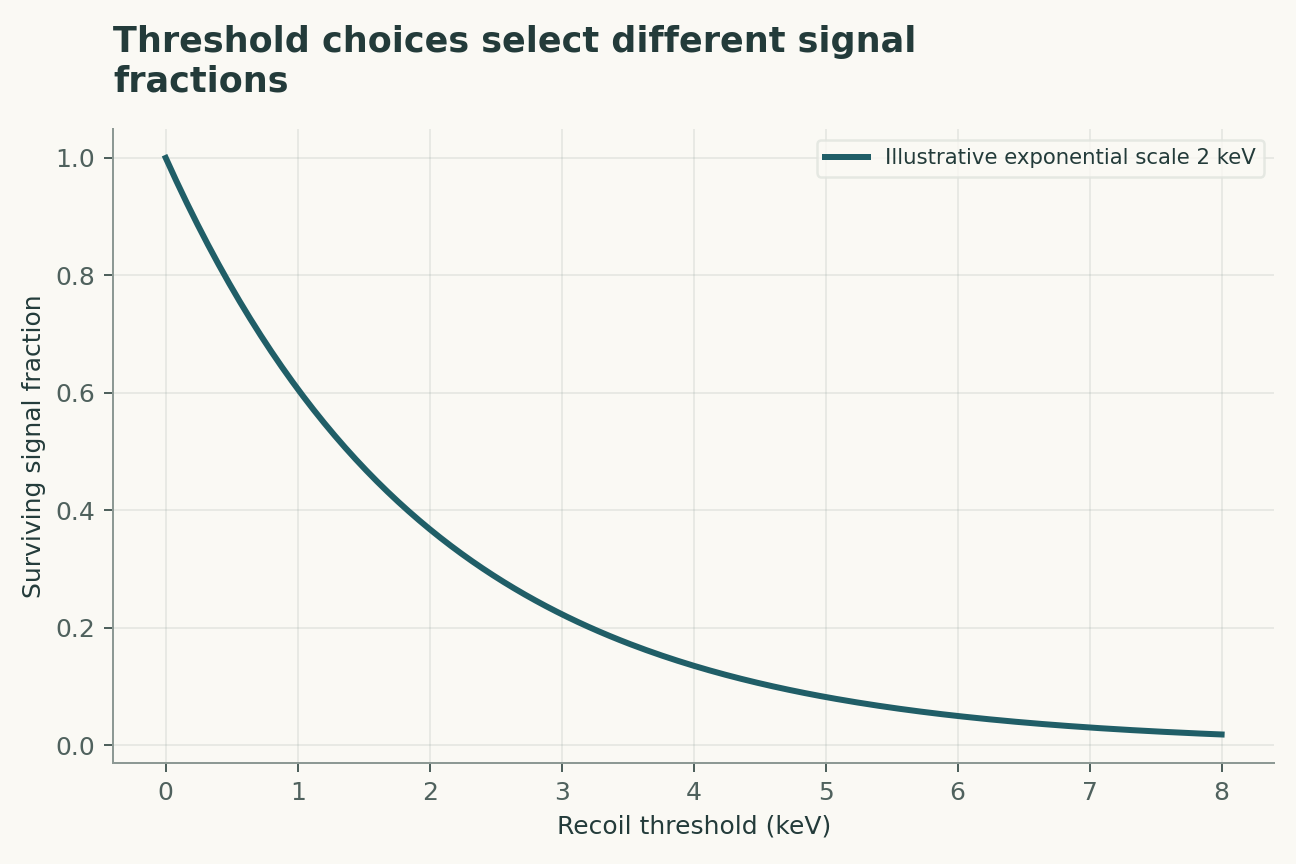
A low-mass dark-matter particle tends to produce a softer recoil spectrum under common interaction models. Raising the threshold can remove a large fraction of its expected events. Calibration near threshold is therefore central, and extrapolating response below directly measured energies requires an explicit uncertainty treatment.
Backgrounds change scaling
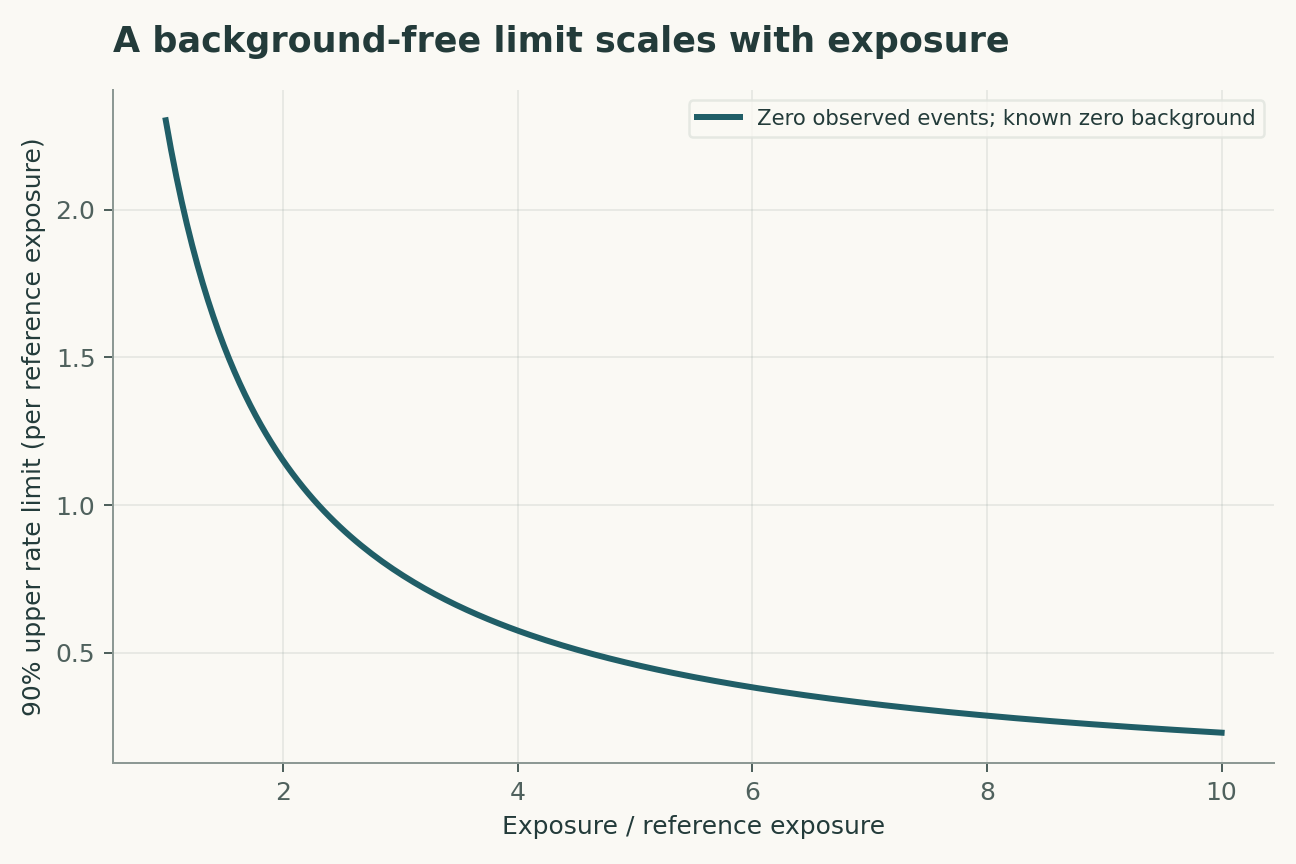
In an ideal background-free counting experiment, an upper limit on signal rate improves approximately inversely with exposure. When background fluctuations dominate, improvement is closer to the inverse square root of exposure under simple assumptions. Systematic background uncertainty can weaken scaling further. Larger detectors do not automatically retain the most favorable regime.
Discrimination retains uncertainty
Charge and light responses help distinguish electronic and nuclear recoils, but their distributions overlap. Leakage estimates depend on calibration statistics and the stability of detector conditions. A model trained or tuned on calibration data should be tested against independent subsets and operating periods. A small predicted leakage is not equivalent to exact knowledge of zero leakage.
The interaction model defines the curve
A cross-section limit assumes a candidate mass, interaction type and astrophysical distribution. Changing those assumptions changes the predicted recoil spectrum and its relation to observed events. A limit plot is therefore a conditional statement. It should not be summarized as excluding dark matter in general.
Blind analysis protects the comparison
Keeping a signal region hidden while fixing selection and background procedures reduces the opportunity to tune an apparent result. After unblinding, unexpected features still require investigation, but post hoc changes should be recorded. The ideal calculations below illustrate statistical scaling and do not reproduce any collaboration's profile-likelihood analysis.
Exposure is not a universal currency across searches
Two experiments with the same mass-times-time exposure can probe different recoil energies, target responses and background populations. A proposed comparison would propagate a common signal hypothesis through each detector's efficiency and resolution before comparing limits. The background-free inverse-exposure law is useful as a limiting case, but it does not describe a background-limited analysis or one with uncertain acceptance. A threshold change can alter both signal yield and background composition. Reporting only total exposure hides these dependencies, while reporting the response model allows a reader to ask which classes of signal the null result actually constrains.
A null result should preserve the alternatives it excludes
An upper limit depends on the likelihood, nuisance constraints and coverage or posterior convention. The zero-count Poisson example is intentionally transparent because every assumption is visible. A real result should offer comparable traceability through response data and a reproducible statistical prescription. A proposed reanalysis would verify a known injected signal and check the behavior under plausible background mismodeling before interpreting an exclusion. Failure to see an event is an observation; excluding a particular interaction strength is an inference conditional on the signal and detector models. Maintaining that distinction makes null results cumulative rather than merely competitive curves.
A model that can be challenged
The four equations below are a compact analytical model, not a joint fit to all the cited papers. Their interpretation is as follows. Expected signal counts combine exposure, energy-dependent acceptance and the predicted recoil rate. For an ideal Poisson count with zero background, zero observed events constrain the expected signal s. A one-sided 90% zero-count Poisson upper bound is about 2.303 under the stated ideal assumptions. An illustrative exponential recoil spectrum shows threshold sensitivity; real spectra and detector smearing are more complex.
The observational target is signal-rate limits under a declared recoil and detector model. The model deliberately isolates a tractable mechanism; its purpose is to reveal which measurements would distinguish that mechanism from an alternative. Parameter values in the figures are declared illustrative inputs. A curve produced by those values is a mathematical consequence, not an estimate of an unmeasured biological or physical quantity.
A discriminating validation design
The primary comparison should test coverage and sensitivity under independently calibrated response models. The unit of independent replication is independent calibration or search exposure; repeated readings from the same unit improve precision but do not create independent replication. A strong validation would hold out different candidate masses and operating conditions before choosing thresholds or fitting nuisance corrections. In particular, near-threshold response and background uncertainty must be measured, constrained or varied in a sensitivity analysis. Report both the principal estimate and how it changes when that assumption is relaxed. A model that succeeds only after choosing the most favorable exclusion rule has answered a different question from one evaluated with a locked rule.
Worked numerical analysis
The ideal zero-event 90% signal bound is 2.3026 expected events. Dividing by exposure gives a rate bound that halves when exposure doubles, provided efficiency and negligible background remain fixed. For a constructed exponential recoil scale E0 = 2 energy units, increasing threshold from one to three units reduces the surviving fraction from 0.6065 to 0.2231. These examples are not published cross-section limits.
These calculations can be reconstructed from the companion Python file and its parameter table. Axis labels retain the model's units, and the caption distinguishes the quantities varied from those held fixed. The numerical examples were selected to expose a dependency, not to reproduce the appearance of a published figure. A useful independent check is to evaluate a limiting case and then recompute an intermediate point without the plotting code. Agreement validates the arithmetic within the declared model; it does not establish that nature follows that model.
Evidence, transfer and next steps
The scope of the conclusion is limited by near-threshold response and background uncertainty. Transfer to different candidate masses and operating conditions requires evidence beyond fitting the original observations. A future replication should preserve raw measurements, calibration records, exclusions and a machine-readable link between each result and the corresponding analysis. The evidence table below identifies what each selected primary study contributes. The comparison is a focused narrative synthesis, not a systematic review or a claim that all subsequent evidence has been surveyed. The proposed study has not been performed here. Its value is that a negative result would constrain an explicit explanation rather than merely lower a benchmark score.
A declared analytical model
Four equations, explicit assumptions
(1) Expected signal counts combine exposure, energy-dependent acceptance and the predicted recoil rate.
(2) For an ideal Poisson count with zero background, zero observed events constrain the expected signal s.
(3) A one-sided 90% zero-count Poisson upper bound is about 2.303 under the stated ideal assumptions.
(4) An illustrative exponential recoil spectrum shows threshold sensitivity; real spectra and detector smearing are more complex.
Constructed examples · Reproducible data
Inspect the quantitative argument
These curves are calculated from the declared models. They are not observations from the cited studies. Every figure includes its numeric data and vector version.


Which evidence answers which question?
| Evidence or design choice | What it identifies | What remains unresolved |
|---|---|---|
| Source 1 | XENON1T reported a one-tonne-year dark-matter search. | The result is conditional on detector response and interaction assumptions. |
| Source 2 | LZ reported its first dark-matter search results. | Exposure alone does not capture background and threshold differences. |
| Source 3 | XENONnT reported a nuclear-recoil search without a significant excess. | A null search constrains modeled signals rather than dark matter universally. |
| Primary observable | signal-rate limits under a declared recoil and detector model | near-threshold response and background uncertainty |
| Independent test | coverage and sensitivity under independently calibrated response models | Requires new measurements |
| Transfer set | different candidate masses and operating conditions | Not validated by the constructed numerical example |
A proposed validation protocol
This is a proposed evaluation design. No new biological experiment, clinical trial or physical experiment was carried out for this article.
- Specify signal-rate limits under a declared recoil and detector model before fitting.
- Retain independent identifiers for each independent calibration or search exposure.
- Separate different candidate masses and operating conditions from model development.
- Measure or bound near-threshold response and background uncertainty.
- Record units, calibration and the observation operator.
- Compare the primary model with a named rival explanation.
- Prespecify the test: coverage and sensitivity under independently calibrated response models.
- Archive raw data, exclusions, parameter files and executable analysis.
What the primary sources establish
E. Aprile, J. Aalbers, F. Agostini et al. · 2018 [1]
Contribution. XENON1T reported a one-tonne-year dark-matter search.
Boundary. The result is conditional on detector response and interaction assumptions.
Source locator. Abstract / selected primary-source sections; see linked bibliographic record.
J. Aalbers, D. S. Akerib, C. W. Akerlof et al. · 2023 [2]
Contribution. LZ reported its first dark-matter search results.
Boundary. Exposure alone does not capture background and threshold differences.
Source locator. Abstract / selected primary-source sections; see linked bibliographic record.
E. Aprile, K. Abe, F. Agostini et al. · 2023 [3]
Contribution. XENONnT reported a nuclear-recoil search without a significant excess.
Boundary. A null search constrains modeled signals rather than dark matter universally.
Source locator. Abstract / selected primary-source sections; see linked bibliographic record.
Limits of this analysis
- The result is conditional on detector response and interaction assumptions.
- Exposure alone does not capture background and threshold differences.
- A null search constrains modeled signals rather than dark matter universally.
- Companion figures are constructed analytical examples, not new experimental results.
- Transfer to different candidate masses and operating conditions has not been demonstrated by this review.
A focused narrative analysis of the named primary studies, not a systematic literature search or a claim to comprehensive coverage through 2026.
Questions that would change the conclusion
- Which calibration most constrains low-energy acceptance?
- When does a search leave the background-free regime?
- How do alternative interaction models change the useful exposure?
References
- E. Aprile, J. Aalbers, F. Agostini et al.. Dark Matter Search Results from a One Ton-Year Exposure of XENON1T. Physical Review Letters (2018). 10.1103/physrevlett.121.111302.
- J. Aalbers, D. S. Akerib, C. W. Akerlof et al.. First Dark Matter Search Results from the LUX-ZEPLIN (LZ) Experiment. Physical Review Letters (2023). 10.1103/physrevlett.131.041002.
- E. Aprile, K. Abe, F. Agostini et al.. First Dark Matter Search with Nuclear Recoils from the XENONnT Experiment. Physical Review Letters (2023). 10.1103/physrevlett.131.041003.
Bibliographic identity checked against Crossref. Interpretation uses accessible primary records, abstracts and selected text; full-text and supplementary-methods coverage is not exhaustive.
Authorship and provenance
Source-based research review and original mathematical analysis written by Codex (AI). Cited experiments belong to the cited research teams.
Concept cover created with the built-in ImageGen tool. Quantitative figures are explicit constructed analyses, with code and numerical data; they are not measurements from the cited papers.
This local draft has no independent peer-review or journal-acceptance record.