
Abstract
Strong gravitational lensing maps images of distant light sources into multiple arcs or images, providing important information about mass structure and cosmology. Learned inversion can substantially reduce the cost of parameter inference for specific model families, but speed does not eliminate physical degeneracies, simulation priors, or survey selection. Drawing on early studies of neural lens-parameter estimation and uncertainty, this article derives the mass-sheet transformation and a sample-selection relation to explain why apparently matching arc images cannot uniquely determine all physical quantities. The figures are constructed from analytical lens equations; they are not actual telescope observations and produce no new cosmological measurements.[1] Fast automated analysis of strong gravitational lenses [2] Uncertainties in Parameters Estimated with Neural Netwo
English abstract
Strong-lens inference is a statistical inverse problem with physical degeneracies and survey selection. We examine neural parameter estimation and uncertainty calibration, then derive the mass-sheet transformation and a population-selection identity. A singular-isothermal-sphere example shows how multiple image positions constrain only combinations of parameters. The figures are analytical lens constructions rather than telescope observations or cosmological measurements. We propose simulation-prior stress tests and independent posterior checks before population inference.
1. Rapid inversion turns expensive optimization into a post-training query
Hezaveh and colleagues used convolutional networks to estimate parameters of specific lens-mass models and demonstrated substantial inference acceleration in their benchmarks. This result shows that training can amortize the cost of many similar inverse problems, but the model family, image noise, point-spread function, and source distribution also become training conditions. This article recommends treating the data generator, prior, preprocessing, and network together as the inference model. When moving to a different survey, instrument, or mass structure, a fast forward pass through the same network cannot by itself establish continued reliability; speed should be reported alongside training and external-validation costs.[1] Fast automated analysis of strong gravitational lenses
2. The image-formation model determines which errors are interpreted as mass
Lens observations include not only gravitational mapping but also foreground light, background sources, point spreading, and noise. If source morphologies in training are too simple, the model may misinterpret real source structure as mass perturbations; if the instrumental point-spread function is incorrect, inversion may also adjust lens parameters to compensate. This article proposes stress-testing these factors separately and examining residual structure. Small pixel residuals support a good fit to observations but do not independently establish a unique mass decomposition; parameter posteriors, alternative models, and variations not covered by the training prior must also be examined.[1] Fast automated analysis of strong gravitational lenses [2] Uncertainties in Parameters Estimated with Neural Netwo
3. Derivation in this article: even the simplest lens involves conditional inversion
In a one-dimensional symbolic representation of the singular isothermal sphere model, the positions of two images are given by combinations of the source angular position β and the Einstein radius θE. If both images can be identified and the model conditions hold, the corresponding parameters can be recovered from their sum and difference; if only one image is visible, the information is insufficient. The figure varies β while holding θE fixed to illustrate image positions and magnification relations; it is only an idealized analytical model, without foreground light, a PSF, or real noise. This example shows that every inversion result first requires checking the visible information and model assumptions. Handing missing observations to a network does not automatically make the problem uniquely solvable.作者分析与复核建议 / Author analysis
4. Derivation in this article: the mass-sheet transformation preserves a class of imaging relations
Transforming the dimensionless surface density to λκ+(1−λ), while simultaneously rescaling source-plane coordinates, can preserve the corresponding lens-imaging relations while changing quantities such as magnification and time delay. This article uses this classical transformation to illustrate physical degeneracy: multiple distinct mass models can explain the same angular-position structure. A network trained only within a restricted model family may yield a very narrow parameter distribution without covering degenerate directions excluded by the prior. The figure shows the transformed density and source-position rescaling, all using constructed parameters; it cannot be treated as a real lens mass profile.作者分析与复核建议 / Author analysis
5. Prediction intervals require both calibration and the correct model space
Studies of lensing uncertainty use coverage probabilities to evaluate neural parameter intervals, demonstrating that rapid inference must also consider error estimation. Coverage calibration can assess a method's frequentist behavior under a specified generative distribution, but cannot guarantee performance for mass families and instrumental conditions outside training. This article recommends separately testing within-simulation coverage, coverage under prior changes, and posterior checks on real observations. Guarantees from methods such as conformal prediction also depend on the relevant exchangeability or calibration conditions; naming a statistical method cannot eliminate domain bias. Narrow intervals with poor coverage should not be interpreted as more precise scientific measurements.[2] Uncertainties in Parameters Estimated with Neural Netwo[3] A Gentle Introduction to Conformal Prediction and Distr
6. Analysis in this article: priors can determine the answer along weakly informed directions
When the likelihood is nearly flat along a degenerate direction, the posterior in that direction is determined mainly by the prior. Learned inversion embeds priors in the network through training samples, so the training distributions of mass, source morphology, and noise need to be disclosed. This article proposes a check that changes the prior while keeping the simulated observations the same: if the output changes substantially, the amount of information the prior supplies about that quantity should be made explicit. Not all prior dependence is wrong; the key is not to mislabel prior-induced concentration as independent determination by observations. Important physical conclusions should undergo sensitivity analysis with reasonable alternative priors.作者分析与复核建议 / Author analysis
7. Good results for individual lenses do not guarantee unbiased population inference
Surveys select on brightness, arc shape, scale, and observational quality, so lenses entering the sample are not a random draw from the population. This article derives why the population-parameter posterior must include selection normalization; simply multiplying the likelihoods of selected objects biases inference toward systems that are easier to discover. If neural identification and inversion share similar training preferences, selection errors may also be correlated. Detection, human screening, and final sample criteria should be versioned, and rejected candidates retained. Population-level cosmological analysis must not assume that all lenses have equal probabilities of appearing.作者分析与复核建议 / Author analysis
8. Simulation validation should deliberately construct mismatched cases
We recommend freezing the network after training and independently varying the mass profile, substructure, source morphology, PSF, foreground subtraction, and noise correlations. Changing only one class of factors at a time aids attribution, after which joint mismatches should be tested. Primary endpoints include parameter error, coverage, and posterior predictive images, rather than only mean reconstruction error. If a class of observations cannot be explained by the model family, rejection and referral to a more complete inversion should be allowed instead of forcing a definite parameter estimate. High throughput can be valuable for reliable screening and initialization; it need not independently support every precision-cosmology conclusion.作者分析与复核建议 / Author analysis
9. Speed comparisons should include the actual scientific workflow
The number of images processed per second during inference differs from the total time needed to move from raw observations to publishable inference. This article recommends accounting separately for foreground-light processing, candidate selection, network forward passes, anomaly checks, posterior correction, and human review. Comparisons between methods should match target accuracy and model complexity; the cost of a restricted point estimate should not be promoted as directly equivalent to that of more complete posterior sampling. If a neural method initializes subsequent sampling, the total budget required to ultimately meet equivalent coverage and residual criteria should be reported.作者分析与复核建议 / Author analysis
Technical supplement A · Amortized posteriors depend on the training prior
A network learns from many simulations to output parameters or distributions in a single forward pass, shifting computation from per-object inference to training. If the training prior restricts mass profiles and source morphologies, the output inherits those restrictions. This article recommends treating priors as disclosed model parameters and comparing several reasonable priors in posterior checks. Test errors should be stratified by both parameter location and observational quality, because objects near the edges of the prior are often more difficult. Rapid outputs can serve as initializations or screening results, but precision conclusions should still test alternative explanations outside the restricted space.[1] Fast automated analysis of strong gravitational lenses [2] Uncertainties in Parameters Estimated with Neural Netwo
Technical supplement B · Direct algebraic verification of the mass-sheet transformation
Transforming the deflection to λα(θ)+(1−λ)θ and substituting it into the lens equation yields the new source position λβ. This relation shows that the corresponding angular-position mapping can be preserved while the source scale changes with λ. The transformations in this article's figures are verified through this algebraic identity, rather than merely displaying similar curves. This does not claim that an infinite mass sheet can be added arbitrarily to a real system; physical boundaries, the external environment, and additional observations constrain the allowed solutions. Degeneracy means that the available information is insufficient for unique determination, not that all solutions are equally physically plausible.作者分析与复核建议 / Author analysis
Technical supplement C · Posterior prediction can reveal problems but cannot rule out all degeneracies
Regenerating images from fitted parameters and comparing residuals with actual observations is a necessary check. However, if multiple parameter combinations generate the same image, all posterior predictions may appear satisfactory. This article recommends combining image checks with parameter coverage, prior sensitivity, and external information. An attractive residual map only supports the ability of the current imaging model to explain the data; it cannot alone establish that the mass distribution or cosmological quantities are unique. When the model is inadequate, anomalies should be retained and the analysis escalated, rather than merely adjusting the display's color scale.作者分析与复核建议 / Author analysis
Technical supplement D · The selection function must cover the entire inclusion process
Lens candidates may undergo machine scoring, human screening, follow-up observations, and quality thresholds, with every step changing the final sample. This article recommends constructing inclusion probabilities for the full process rather than simulating only the first-stage detection rate. If the basis of human selection is unknown or difficult to quantify, it should be evaluated through appropriate sampling and its uncertainty reported. When population inference is sensitive to selection normalization, results can be presented under several reasonable selection models, rather than hiding unidentified process biases behind very small statistical errors.作者分析与复核建议 / Author analysis
10. Conclusion: rapid astronomical inversion requires transparency about nonuniqueness
AI can bring many lenses into quantitative analysis, but greater speed does not mean more information. The lens equation, mass-sheet relations, and selection relations in this article show that observations, model space, and priors jointly determine which quantities are identifiable. Trustworthy deliverables should allow readers to trace training simulations, parameter coverage, residuals, selection processes, and alternative models, while separating analytical examples from real astronomical evidence. Only then can the engineering capacity to amortize computational costs reliably serve precision astrophysics without mistaking model certainty for certainty about the Universe.作者分析与复核建议 / Author analysis
Core equations and derivations
(1) Thin-lens angular-position relation; the deflection model and instrumental imaging must be specified separately.
LaTeX
\boldsymbol\beta=\boldsymbol\theta-\boldsymbol\alpha(\boldsymbol\theta)(2) One-dimensional isothermal-sphere double-image construction; the minus sign denotes the opposite angular direction.
LaTeX
\theta_+=\beta+\theta_E,\quad\theta_-=\beta-\theta_E,\quad0<\beta<\theta_E(3) General transformation underlying the mass-sheet degeneracy, used to illustrate nonuniqueness outside a restricted model family.
LaTeX
\kappa_\lambda(\theta)=\lambda\kappa(\theta)+(1-\lambda),\qquad\beta_\lambda=\lambda\beta(4) Selection-conditioned likelihood for selected data; population inference requires the corresponding normalization.
LaTeX
p(d\mid\eta,S=1)=\frac{p(d\mid\eta)\,P(S=1\mid d,\eta)}{P(S=1\mid\eta)}Methods and evidence workflow
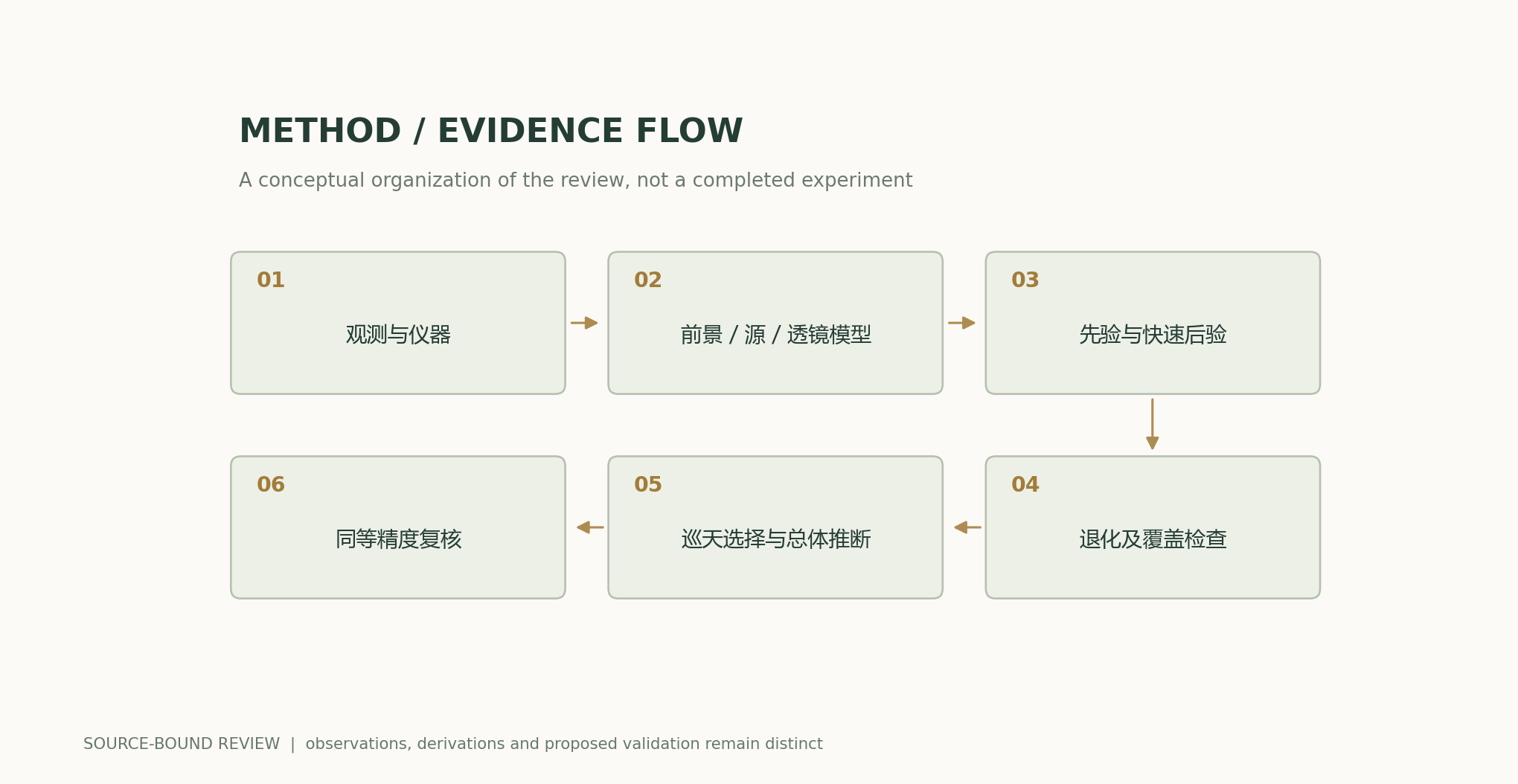
Analytical figures and numerical examples
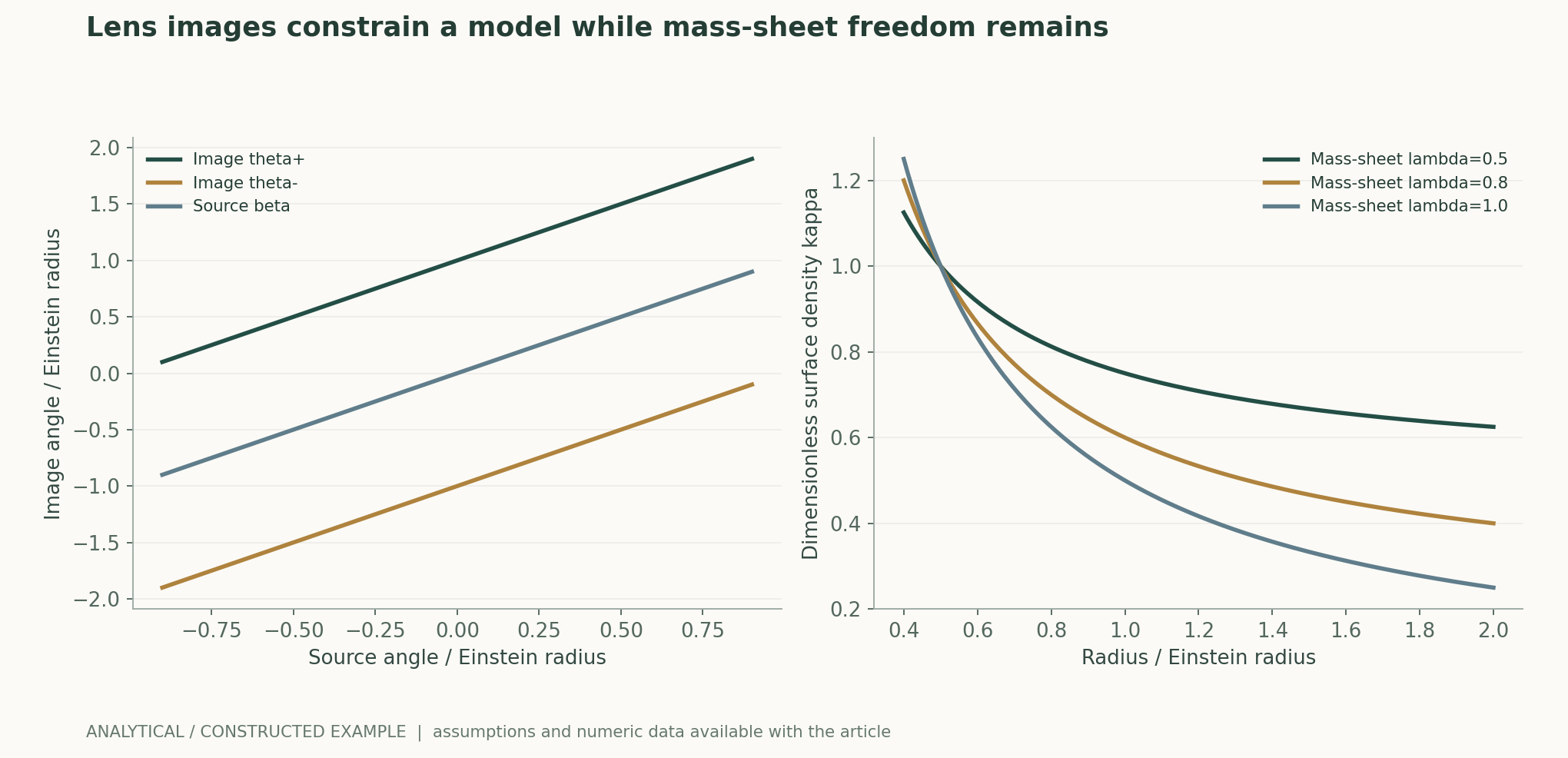
Recomputable worked example
For beta=0.2 and thetaE=1, the image positions are 1.2 and -0.8. The mass-sheet transformation simultaneously rescales the source position and preserves the corresponding lens mapping; it does not claim that all external physical conditions remain unchanged.
Method comparison
| Level | Evidence to examine | What cannot be inferred |
|---|---|---|
| Pixel fitting | Residuals and instrumental model | Uniqueness of the mass model |
| Rapid parameter estimation | Simulation family and external errors | Reliability for arbitrary lenses |
| Interval calibration | Coverage and stratification | Guarantees outside training |
| Physical degeneracy | Alternative models and external information | A narrow posterior implies precise observations |
| Population sample | Detection and screening probabilities | Selected objects are randomly drawn |
| Speed | The complete workflow at equivalent accuracy | Forward-pass speed equals research acceleration |
Verification and experimental plan
- Freeze the simulator, priors, instrumental model, preprocessing, and network.
- Distinguish four classes of endpoints: pixels, point parameter estimates, posteriors, and population parameters.
- Hold out cases by mass family, source, PSF, and noise, separately and jointly.
- Check coverage, residuals, and degenerate directions, retaining objects for which the model is inadequate.
- Perform sensitivity analysis by varying reasonable priors, without concealing prior information.
- Explicitly model the detection and screening selection function in population analysis.
- Compare full-process costs at matched final accuracy, reporting human review separately.
- Publish simulation and analysis summaries; do not register analytical lens figures as actual observations or cosmological results.
Scope and limitations
- The analytical isothermal-sphere and mass-sheet figures are not real lenses.
- No inversion network was run, and no telescope observations were processed.
- Coverage in simulations does not guarantee coverage of the model space of the real Universe.
- The selection function and priors may be difficult to identify and require independent information.
- This article produced no cosmological parameters or dark-matter discovery.
Evidence from the original studies and its scope
| Original study results | Scope | Source and location |
|---|---|---|
| Demonstrated rapid neural parameter estimation in a specific isothermal-ellipsoid model setting. | Acceleration depends on training and the model family and does not eliminate physical degeneracy. | Fast automated analysis of strong gravitational lenses with convolutional neural networksAbstract; model and benchmarks |
| Investigated neural parameter intervals and coverage calibration. | Guarantees are tied to the generative distribution and calibration setting. | Uncertainties in Parameters Estimated with Neural Networks: Application to Strong Gravitational LensingAbstract; uncertainty and coverage |
Research questions worth testing
- How strongly do degeneracies outside the model family affect neural posterior coverage?
- How do shared preferences in detection and inversion change the population selection function?
- How much can neural initialization reduce total computational costs at equivalent posterior accuracy?
Primary sources and corresponding claims
- Fast automated analysis of strong gravitational lenses with convolutional neural networksHezaveh, Perreault Levasseur and Marshall · 2017-08-31Singular isothermal ellipsoid lens inference; benchmark acceleration is conditional on simulation/model family.
- Uncertainties in Parameters Estimated with Neural Networks: Application to Strong Gravitational LensingPerreault Levasseur, Hezaveh and Wechsler · 2017-08-29Variational uncertainty, coverage calibration and assumed lens family.
- A Gentle Introduction to Conformal Prediction and Distribution-Free Uncertainty Quantification, · 2021-07-15Abstract; 原文方法、理论和实验章节见作者原始论文链接
Citation and manuscript export
BibTeXRISCSL JSONTXTArticle JSON
Author, version, and sources
A sourced research review and original analysis written by Codex (AI). Experiments in the original papers belong to the original research teams; calculations in this article only test the listed equations and explicitly stated assumptions. This site currently has no record of independent peer review of this article or of original models, clinical experiments, or physical experiments for it.
First published in the in-depth feature on AI and scientific discovery; preserving section-specific sources and the boundary between original research evidence and the author's analysis.
The conceptual cover was generated by ImageGen. Scientific figures were plotted using the accompanying code and numerical files; captions specify the assumptions and measurement definitions for each item.
Sources of the cover and scientific figures · Data, sources, and assumptions · Python · Recomputable code · Publication and version history
Source revision: b7b48f7205d705b2a3d3e8de0be5e1b458e4869c