
Scientific Deep Learning / DEEP LEARNING III
Handedness Is Information: Molecular Equivariance Beyond Distances
Reflection, rotation and output parity impose different information contracts on molecular learning.
English original. Translations of this new review are not yet available.

Abstract
Geometric equivariance is only useful when its transformation law matches the target. This review separates proper rotations, reflections, atom permutations and output parity through a labeled tetrahedron. Pairwise distances agree for mirror configurations while signed volume reverses. A balanced mirror-pair task gives an exact accuracy and cross-entropy limit for reflection-invariant representations; class imbalance shows how aggregate accuracy can conceal that information loss. Six primary architecture records motivate the discussion without assigning the counterexample to uninspected implementations. The finite code checks distances, volumes, transformations and predictor bounds. The review distinguishes isolated parity-even energies from environment-dependent responses and proposes tests for preprocessing, pooling, degeneracy and energy-force consistency. It reports no molecular simulation or biological measurement.
In this paper
- 1. Symmetry should preserve the target information
- 2. What the selected primary architectures establish
- 3. Proper rotations and reflections are different groups
- 4. Pairwise distances erase orientation
- 5. Signed volume is a minimal handedness witness
- 6. Permutation symmetry must respect the meaning of labels
- 7. Output parity is as important as input equivariance
- 8. A mirror-pair learning lower bound
- 9. Geometric noise creates a separate robustness question
- 10. Energy and biological response require different contracts
- 11. Local neighborhoods can omit relevant relationships
- 12. Dataset splits can reward memorized stereochemical families
- 13. A proposed architecture audit begins with transformation tests
- 14. Differentiation introduces another consistency check
- 15. Handedness must survive the entire prediction pipeline
1. Symmetry should preserve the target information
Molecular learning benefits from respecting transformations that do not change the physical prediction. Translating or properly rotating a molecule usually should not change a scalar property. Reflection requires more care. A reflected configuration can be an enantiomer, and a target involving a chiral environment may distinguish the two. Enforcing reflection invariance on a representation can therefore remove information needed by the task, even while improving performance on a benchmark whose labels are reflection-even.
This review focuses on the information carried by handedness. It separates proper rotations, reflections, permutations, and the transformation behavior of outputs. An explicit labeled tetrahedron provides a signed-volume feature that survives proper rotations but changes sign under reflection. A balanced mirror-pair classification problem then gives a simple lower bound for any representation that identifies both configurations. These are geometric constructions, not quantum-chemical calculations or new measurements of molecular activity. Their purpose is to make the symmetry contract testable before interpreting architectural sophistication or low average prediction error as evidence that stereochemical distinctions have been learned.
2. What the selected primary architectures establish
Satorras, Hoogeboom, and Welling explicitly construct graph networks equivariant to rotations, translations, reflections, and permutations. Thomas and colleagues introduce tensor field networks with geometric feature types. Fuchs and colleagues construct attention respecting proper three-dimensional rotations and translations. These primary records illustrate that equivariance is a specified transformation law, not a single interchangeable label attached to every geometric network.
Batzner and colleagues investigate equivariant tensor interactions for interatomic potentials. Batatia and colleagues analyze a broader design space of equivariant atom-centered potentials, while Musaelian and colleagues develop strictly local equivariant interactions. We use their inspected author abstracts to identify architecture families and declared goals. We do not claim that their models universally lose chirality or that a benchmark score proves stereochemical recognition. The analysis below concerns the mathematical consequences of a chosen input representation and output parity. A particular implementation may contain parity-sensitive tensor channels, atom features, or environmental information that change the conclusion. Those details must be inspected before applying any counterexample to an actual model.
3. Proper rotations and reflections are different groups
An orthogonal transformation Q preserves distances and inner products. Its determinant is either plus one or minus one. Proper rotations have determinant plus one; reflections and other orientation-reversing transformations have determinant minus one. Adding translations produces corresponding Euclidean transformation groups. A scalar output invariant to all orthogonal transformations must agree on a configuration and its mirror image.
That requirement can be correct for an isolated molecule's parity-even energy under an appropriate physical model. It can be incorrect for a handedness label or for a response measured relative to a fixed chiral environment. The question is not whether reflection invariance is generally good or bad. It is whether the target changes under the transformation being imposed. For a molecule interacting with a receptor, reflecting only the molecule while leaving the receptor fixed is not the same operation as reflecting the entire physical system. This distinction prevents a common false inference: global physical symmetry does not imply that every partial transformation of the input should leave the conditional target unchanged.
4. Pairwise distances erase orientation
Take a central point at the origin and three labeled displacement vectors a, b, and c. All pairwise distances remain unchanged under any orthogonal transformation because dot products are preserved. Consequently, a deterministic scalar function of the complete distance matrix alone cannot distinguish this configuration from its reflection, provided labels and all other input features are the same. Adding more capacity to that same representation cannot restore the discarded orientation.
This statement is about information in the inputs, not a claim that every distance-based molecular task is impossible. Many targets are intentionally reflection-invariant. Labels such as atom type, bond order, or an explicitly supplied stereochemical descriptor can also carry additional information. The complete representation must be considered. A model may receive a molecular graph with chirality tags even if its geometric message computation uses distances. In that case the mirror-pair argument must include how those tags transform. An audit that tests only coordinates while accidentally leaving a parity-sensitive tag unchanged can create physically inconsistent examples and draw the wrong conclusion about the model.
5. Signed volume is a minimal handedness witness
Define V=a dot (b cross c). Under a proper rotation Q, V becomes det(Q)V=V; under a reflection it changes sign. Translation disappears because the vectors are measured relative to a common point. The magnitude measures a volume scale, while the sign records orientation for the stated ordering of labels. A normalized version divides by the product of vector lengths when all are nonzero, yielding a dimensionless orientation measure.
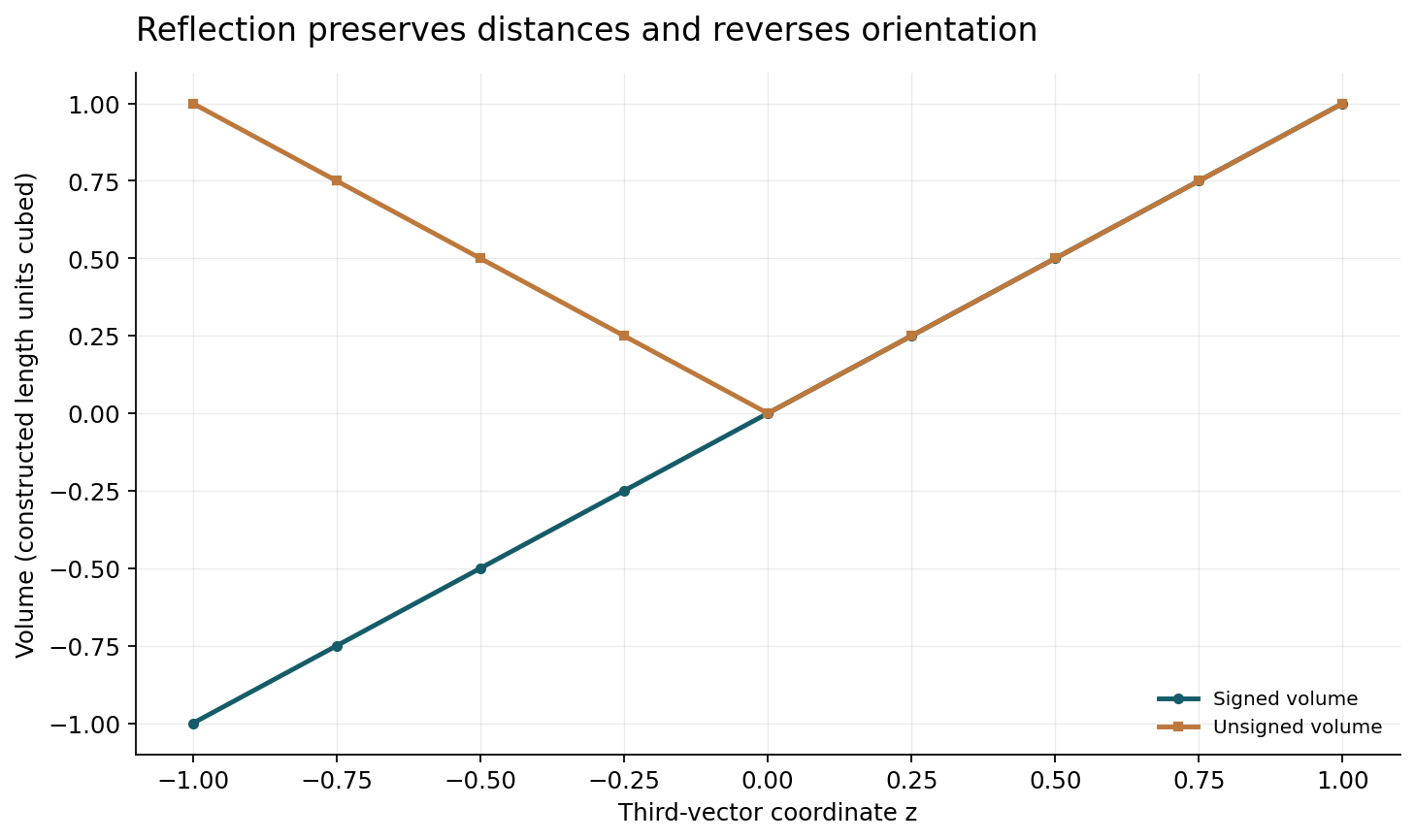
Our construction uses a=(1,0,0), b=(0,1,0), and c=(0,0,z). Its signed volume is exactly z. Reflecting the third coordinate gives -z while preserving every pairwise distance. Figure 1 plots signed and unsigned volume across positive and negative z. The example is deliberately a labeled geometric object rather than a claim about a specific chemical species. It exposes the representation difference with no learned parameters. At z=0 the configuration is coplanar and the signed volume vanishes, so sign becomes discontinuous under arbitrarily small perturbations. That degeneracy matters when discussing robustness of a handedness classifier.
6. Permutation symmetry must respect the meaning of labels
Swapping b and c reverses the triple-product sign. If those points represent chemically identical atoms and are genuinely exchangeable, an arbitrary index order cannot define a physically meaningful chirality label. A signed-volume feature therefore needs a chemically meaningful ordering or an aggregation scheme that handles permutations consistently. Otherwise the representation confuses array indexing with molecular handedness.
For the constructed example, the three displacement vectors are explicitly labeled and distinguishable. This makes the orientation witness unambiguous within the model. Extending it to molecular graphs requires a canonical or equivariant treatment of atom identities, local neighborhoods, and stereochemical conventions. A data preprocessing pipeline can accidentally change ordering between training and inference, producing apparent model instability that is actually a representation bug. Tests should permute atoms together with all associated features and verify the intended output transformation. A coordinate-only permutation with stale bonds or labels is not a valid symmetry test. The same discipline applies when creating mirrored examples: every field with geometric meaning must be transformed according to its declared type.
7. Output parity is as important as input equivariance
A polar vector transforms as Qv under an orthogonal transformation. A cross product of two polar vectors transforms as det(Q)Q(a cross b), making it an axial vector. A scalar triple product is a pseudoscalar. These distinctions disappear if one discusses only rotations, because det(Q)=1 there, but become essential under reflection. A model can carry parity-sensitive information through equivariant channels while producing a parity-even scalar at the end.
The output head determines which information can affect the target. If a pseudoscalar channel is discarded or squared before prediction, its sign is lost even though the internal representation once contained it. Conversely, a parity-sensitive output may be appropriate for an orientation label but inappropriate for an isolated energy under a reflection-symmetric model. Architecture documentation should identify feature types and permitted contractions, not merely state that spherical harmonics or tensor products are used. A practical test can compare outputs under proper rotations, full reflections, and partial transformations with the environment held fixed. These transformations probe different scientific assumptions and should not be merged into one invariance score.
8. A mirror-pair learning lower bound
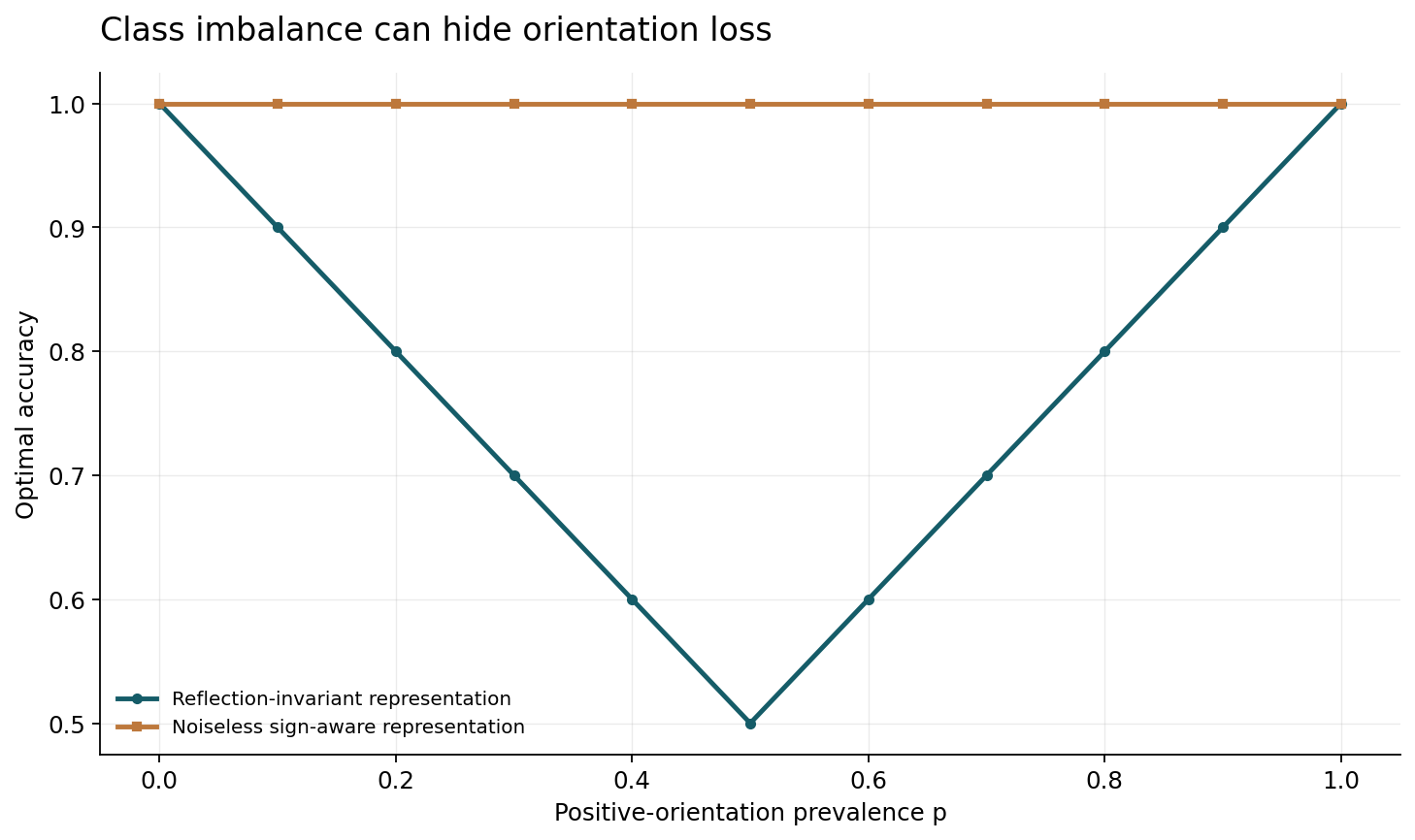
Construct a balanced dataset containing each labeled tetrahedron and its reflection, with class labels determined by the sign of V. A representation invariant under reflection maps both members of every pair to the same value. Any classifier using only that representation must assign the same predicted distribution to both, so its optimal deterministic accuracy on a balanced pair is one half. Under binary cross-entropy, the optimum for the pair is probability one half with loss log two.
This is a representation-level impossibility statement for the declared data and labels. It is not a general lower bound on molecular prediction. If the dataset has unequal pair frequencies, a majority guess can exceed one half while still failing to recover handedness. Figure 2 varies the class imbalance and compares the optimal invariant predictor with a noiseless sign-aware predictor. The invariant accuracy rises with imbalance, making clear why aggregate accuracy can conceal information loss. A benchmark should therefore report paired performance or balanced metrics when the scientific question concerns chirality, and should distinguish exploiting prevalence from recognizing the geometric distinction.
9. Geometric noise creates a separate robustness question
Near a coplanar configuration, a tiny perturbation can change the sign of V. This is not necessarily a numerical failure; the underlying orientation measure is genuinely close to zero. A classifier that outputs a confident discrete label in that regime should justify how uncertainty in coordinates and atom assignments is handled. The margin |V| or its normalized counterpart provides one diagnostic, though it is not a universal chemical confidence score.
The executable perturbs the third coordinate in the constructed tetrahedron and checks the exact sign threshold. It also verifies volume scaling under uniform dilation and invariance under selected proper rotations. These controls distinguish orientation, scale, and degeneracy. A molecular application would need a richer uncertainty model, including conformational variability, measurement precision, and stereochemical stability. The present construction does not estimate those quantities. Its methodological lesson is that invariance and robustness are different properties: exact rotation equivariance does not guarantee resistance to coordinate noise, and robustness to small perturbations does not authorize reflection invariance when the label changes under reflection.
10. Energy and biological response require different contracts
An interatomic potential and a receptor-binding predictor need not use the same symmetry assumptions. A potential for an isolated system often predicts energy and derives forces from spatial gradients. A conditional interaction model may include a fixed receptor, solvent approximation, or external field. Reflecting the whole combined system can preserve a symmetry while reflecting only one component changes the relative geometry and therefore the target.
A benchmark should specify what the input contains and what is held fixed. If the environment is omitted, the same isolated molecular representation may correspond to different outcomes across environments. A model may then learn an average over hidden contexts rather than a universal intrinsic property. This is a data-identifiability issue distinct from reflection parity. Adding chirality-sensitive features cannot recover an unobserved environment by logic alone. The evaluation should separate tasks with well-defined isolated-system targets from context-dependent response tasks, and it should avoid presenting performance on one as evidence of capability on the other. No clinical or pharmacological conclusion follows from the geometric examples in this review.
11. Local neighborhoods can omit relevant relationships
A representation can preserve parity within a local neighborhood and still miss a task-relevant global arrangement. A finite cutoff excludes distant atoms; a limited number of message-passing steps restricts information propagation; pooling can discard relationships among local features. These are different sources of information loss from reflection invariance. A chirality-aware architecture is therefore not automatically a complete molecular representation.
Controlled tests can hold local neighborhoods fixed while varying a distant context, or preserve a local orientation while changing the arrangement of multiple stereocenters. The expected target behavior must be specified independently of the model. If the task is deliberately local, such changes may be irrelevant; if it concerns a global conformation, they may matter. Computational efficiency and physical range should be reported together rather than treated as competing slogans. The cited local-potential work motivates studying this tradeoff, but its reported accuracy does not settle every molecular task. A useful study compares receptive-field assumptions with the physical mechanisms relevant to the chosen labels and retains cases where the model's context is insufficient.
12. Dataset splits can reward memorized stereochemical families
Randomly splitting molecular records may place closely related scaffolds or paired conformers in both training and test sets. A model can then exploit family-specific correlations without demonstrating robust recognition of a new stereochemical configuration. Conversely, an excessively difficult split can combine multiple shifts and make it unclear whether failure comes from chirality, chemistry, or geometry. The split should match the scientific question.
For a focused handedness audit, retain explicit mirror pairs and keep related structures grouped. Report whether chirality tags are available, whether coordinates are experimentally measured or generated, and whether conformer generation used information correlated with the label. A paired diagnostic should transform all relevant inputs consistently and preserve any fixed environment deliberately. These controls can be performed before a large training study. They do not replace chemically meaningful datasets or expert validation, but they can reveal a representation mismatch that a larger random benchmark might hide. A strong result should remain interpretable when shortcuts such as scaffold identity and class imbalance are removed or measured separately.
13. A proposed architecture audit begins with transformation tests
First document the transformation group and output representation. Then construct a small labeled geometry with known signed volume. Apply translations, proper rotations, reflections, and consistent atom permutations separately. Check both hidden features, where accessible, and final predictions. Repeat near a degenerate geometry and under uniform scaling to distinguish exact equivariance from numerical tolerance and unit conventions.
Next evaluate balanced mirror pairs under the intended task labels. Compare a distance-only baseline, a representation with explicit parity information, and the proposed architecture under matched data and optimization budgets. If the model fails the finite control, inspect preprocessing and output pooling before interpreting a large benchmark. If it passes, proceed to realistic molecular cases with independent chemical validation. The public program accompanying this review verifies only the finite geometric identities and optimal-predictor bounds. It neither trains the compared architectures nor produces a new molecular dataset. The proposed audit is an experimental design that remains to be executed on any concrete implementation.
14. Differentiation introduces another consistency check
When forces are derived from an energy model, the transformation behavior of the gradient follows from the transformation behavior of the energy and the coordinate convention. A scalar energy invariant under an orthogonal transformation produces a force that transforms as a polar vector, assuming differentiability and consistent treatment of all coordinates. Predicting energy and force with unrelated heads can violate that relation even when each head approximately satisfies separate symmetry tests.
A molecular audit should therefore distinguish geometric equivariance from energy-force consistency. Finite-difference checks on small configurations can compare predicted forces with derivatives of the predicted energy. Rotation and reflection checks can then test the expected vector transformation. Numerical tolerances should account for precision and differentiation step size. A successful test does not certify the physical energy surface, but a failure can identify an implementation or modeling inconsistency before a long simulation is run.
The signed-volume witness in this review is not an energy model. Squaring it produces a reflection-even quantity, while retaining its sign produces a pseudoscalar. Differentiating either object yields different transformation behavior. This small distinction is useful when designing output heads: choosing a scalar label, a signed orientation, a vector response, or an energy-derived force is not a cosmetic change. Each target imposes a different contract on the representation and its final operations. A complete architecture description should state that contract explicitly rather than relying on the general term geometric learning.
15. Handedness must survive the entire prediction pipeline
The central issue is not choosing the largest equivariant model. It is preserving exactly the information that the target requires while removing transformations that are genuinely irrelevant. Pairwise distances, parity-typed channels, stereochemical tags, local cutoffs, pooling, and environmental inputs all participate in that contract. A correct statement about one layer does not establish the behavior of the complete pipeline.
Our constructions show two complementary facts. Reflection-invariant inputs cannot solve a balanced parity-sensitive task, and a parity-aware geometric witness becomes uncertain near degeneracy. Both facts are easy to verify and easy to obscure in aggregate performance. Future work should connect transformation-level tests with chemically validated outcomes, measure uncertainty under conformational variation, and make target parity explicit in benchmark documentation. The resulting claims would be narrower but more useful: they would identify which molecular distinctions are represented, which are intentionally ignored, and which remain unresolved because the necessary information was never present in the observations.
Core equations and definitions
(1) Orthogonal transformations include proper rotations and orientation reversals.
(2) Signed volume for explicitly ordered, distinguishable displacement vectors.
(3) Distances cannot distinguish a configuration from its reflection when other features are identical.
(4) Balanced mirror pairs with identical invariant representations have optimal q=1/2.
(5) With class prevalence p, an invariant predictor can exploit imbalance without recovering handedness.
Constructed analytical figures
Comparison and reporting contract
| Diagnostic | What it establishes | What remains unproved |
|---|---|---|
| Rotation equivariance | Proper-rotation behavior | Reflection-sensitive task solvability |
| Distance matrix | Metric geometry up to orthogonal ambiguity | Orientation sign |
| Signed volume | Labeled local orientation | Chemical correctness under arbitrary atom ordering |
| Energy-force consistency | Derivative agreement | Accuracy of physical energy surface |
Evaluation protocol
- Declare target parity and transformation group.
- Transform coordinates, labels and environment consistently.
- Test translations, rotations, reflections and atom permutations separately.
- Evaluate balanced mirror pairs and degeneracy margins.
- Check energy-force consistency when forces derive from energy.
Limitations
- Constructed tetrahedra are labeled geometric objects, not chemical benchmark molecules.
- No clinical, binding or quantum-chemical result is measured.
- The impossibility applies only to representations that identify the mirror pair.
- Specific cited implementations are not audited for chirality behavior.
Open research questions
- Which task labels require preserving parity-odd information?
- How should uncertainty behave near geometric degeneracy?
- How can local parity features retain global stereochemical relationships?
Evidence and its boundaries
- EGNN explicitly includes reflection equivariance.
- [1] — Scope-level source statement only; no independent reproduction, priority ranking or theorem-proof audit. Inspected: Primary author abstract and bibliographic record.
- Geometric tensor features encode transformation behavior.
- [2] — Scope-level source statement only; no independent reproduction, priority ranking or theorem-proof audit. Inspected: Primary author abstract and bibliographic record.
- Attention is constructed to respect proper rotations and translations.
- [3] — Scope-level source statement only; no independent reproduction, priority ranking or theorem-proof audit. Inspected: Primary author abstract and bibliographic record.
- NequIP uses equivariant tensor interactions for interatomic potentials.
- [4] — Scope-level source statement only; no independent reproduction, priority ranking or theorem-proof audit. Inspected: Primary author abstract and bibliographic record.
- Body-order and equivariant potential design choices are studied in a unified framework.
- [5] — Scope-level source statement only; no independent reproduction, priority ranking or theorem-proof audit. Inspected: Primary author abstract and bibliographic record.
- Allegro uses strictly local equivariant interactions without message passing.
- [6] — Scope-level source statement only; no independent reproduction, priority ranking or theorem-proof audit. Inspected: Primary author abstract and bibliographic record.
References
- E(n) Equivariant Graph Neural Networks
Victor Garcia Satorras, Emiel Hoogeboom, Max Welling. arXiv author manuscript (2021). https://arxiv.org/abs/2102.09844Source scope
Primary author record title, complete author list, submission history and abstract inspected through web tools on 2026-10-28. Full proof and benchmark execution not independently checked.
- Tensor field networks: Rotation- and translation-equivariant neural networks for 3D point clouds
Nathaniel Thomas, Tess Smidt, Steven Kearnes, Lusann Yang, Li Li, Kai Kohlhoff, Patrick Riley. arXiv author manuscript (2018). https://arxiv.org/abs/1802.08219Source scope
Primary author record title, complete author list, submission history and abstract inspected through web tools on 2026-10-28. Full proof and benchmark execution not independently checked.
- SE(3)-Transformers: 3D Roto-Translation Equivariant Attention Networks
Fabian B. Fuchs, Daniel E. Worrall, Volker Fischer, Max Welling. arXiv author manuscript (2020). https://arxiv.org/abs/2006.10503Source scope
Primary author record title, complete author list, submission history and abstract inspected through web tools on 2026-10-28. Full proof and benchmark execution not independently checked.
- E(3)-Equivariant Graph Neural Networks for Data-Efficient and Accurate Interatomic Potentials
Simon Batzner, Albert Musaelian, Lixin Sun, Mario Geiger, Jonathan P. Mailoa, Mordechai Kornbluth, Nicola Molinari, Tess E. Smidt, Boris Kozinsky. arXiv author manuscript (2021). https://arxiv.org/abs/2101.03164Source scope
Primary author record title, complete author list, submission history and abstract inspected through web tools on 2026-10-28. Full proof and benchmark execution not independently checked.
- The Design Space of E(3)-Equivariant Atom-Centered Interatomic Potentials
Ilyes Batatia, Simon Batzner, Dávid Péter Kovács, Albert Musaelian, Gregor N. C. Simm, Ralf Drautz, Christoph Ortner, Boris Kozinsky, Gábor Csányi. arXiv author manuscript (2022). https://arxiv.org/abs/2205.06643Source scope
Primary author record title, complete author list, submission history and abstract inspected through web tools on 2026-10-28. Full proof and benchmark execution not independently checked.
- Learning Local Equivariant Representations for Large-Scale Atomistic Dynamics
Albert Musaelian, Simon Batzner, Anders Johansson, Lixin Sun, Cameron J. Owen, Mordechai Kornbluth, Boris Kozinsky. arXiv author manuscript (2022). https://arxiv.org/abs/2204.05249Source scope
Primary author record title, complete author list, submission history and abstract inspected through web tools on 2026-10-28. Full proof and benchmark execution not independently checked.