
Abstract: The Reference Is Part of the Measurement
A complete reference addresses “which sequences remain unassembled,” while a pangenome further asks “how a coordinate system can accommodate the real paths of different individuals.” This article compares evidence from telomere-to-telomere references and multihaplotype graphs, analyzing how reference bias enters read alignment, allelic proportions, and variant truth. The central question is not whether graphs are inherently superior to linear references, but whether, under clearly specified tasks and population coverage, newly representable paths reduce verifiable measurement errors.[1] The complete sequence of a human genome[2] A draft human pangenome reference
English abstract
A pangenome is both a representation of variation and a measurement interface. We connect complete-reference assembly with graph-based population references, analyze allele-dependent mapping and finite panel coverage, and propose benchmarks that separate added sequence, coordinate portability and variant-call accuracy across underrepresented haplotypes.
The Difference Between Complete Assembly and Diversity Coverage
The T2T study filled in sequence regions that had long been difficult to resolve, showing that complete assembly can expand the observable genome. Yet no single assembly, however complete, can automatically contain the variant paths of all human populations. This article treats sequence completeness and population representativeness as two axes: the former concerns whether a single object has been sufficiently reconstructed, and the latter whether the different structures of multiple objects can be represented. Success along one dimension cannot substitute for testing along the other.[1] The complete sequence of a human genome
What the Draft Pangenome Provides
Liao and colleagues constructed a pangenome reference from 47 diploid assemblies, demonstrating the value of added sequence and variant analysis. The improvements in the original study have specific input data, comparison procedures, and benchmark conditions; they should not be converted into a guarantee of equal benefits for every ancestry, platform, and locus. This article uses the draft as a case of expanded representability, retaining its scope as a “draft” and a finite-sample panel.[2] A draft human pangenome reference
How Graph Paths Change Measurement
With a linear reference, genuine reads that diverge from the reference may be harder to align; providing the corresponding path in a graph can reduce this penalty. But more paths may also increase multiple matches, making unique placement more difficult. Evaluation should jointly examine recall, misplacement, and the proportion of reads that cannot be placed. If accuracy is calculated only for successfully aligned reads, ambiguous reads introduced by added paths may be excluded, producing a conditional metric that appears improved.作者分析与复核建议 / Author analysis
An Analytical Account of Allelic Proportion Bias
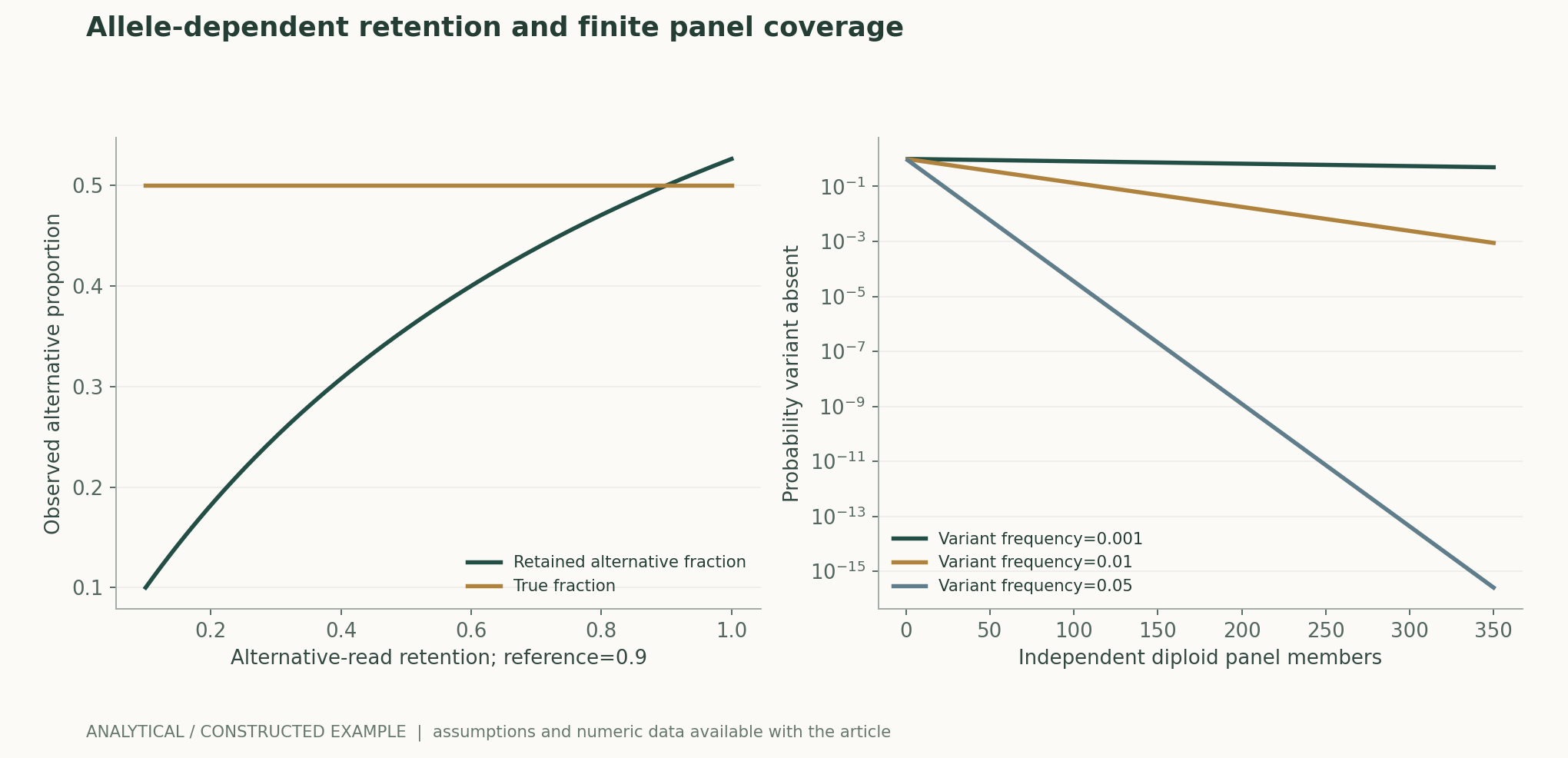
Consider a genuinely heterozygous locus at which each allele accounts for 50%. If reads from the reference allele are retained with probability 0.9, but those from the alternative allele with only 0.5, the alternative proportion among retained reads is 0.5/(0.9+0.5), approximately 35.7%. This is an observation mechanism, not biological allelic imbalance. The figure varies the two retention probabilities to demonstrate the bias, reminding us that both genotype and expression inference require scrutiny of allele-dependent measurement processes.作者分析与复核建议 / Author analysis
Panel Size and Rare Paths
If a variant has frequency f in a population and sampled haplotypes are independent, the probability that a panel of N diploid individuals entirely misses the variant is (1−f) raised to the power 2N. Rare paths may be absent even from relatively large panels. Actual population structure, relatedness, and recruitment strategies alter the independence model, so the curve is only an idealized lower-bound consideration of coverage, not the actual omission rate of any pangenome database.作者分析与复核建议 / Author analysis
More Samples Do Not Mean Proportionally More Information
Multiple assemblies from close relatives or the same narrow background may increase panel size while adding only limited new paths. Haplotype diversity, structural variant coverage, and added information in difficult regions should be shown, rather than merely counting individuals. Conversely, a high-quality assembly from an insufficiently covered background may have substantial value at particular loci. The most appropriate panel expansion strategy should focus on variants that are not yet representable, rather than pursuing sample size alone.作者分析与复核建议 / Author analysis
Truth Sets Can Also Inherit Reference Bias
If benchmark truth is established only in regions that are easy to resolve with the original linear reference, the benefits of a new method in added regions cannot be fairly evaluated; if truth is generated solely by the new graph itself, it will instead favor the new method. Independent assemblies, family relationships, long molecules, or other orthogonal evidence are needed to provide cross-constraints, with high-confidence and unresolved regions explicitly identified. Absence from a truth set does not mean that the new method is wrong, but neither is it automatic proof of correctness.作者分析与复核建议 / Author analysis
Variant Representations and the Same Event
The same biological change can be split into multiple small variants or represented as one complex event. Comparing methods by exact textual coordinate matching may incorrectly count equivalent representations as errors. Studies should specify event-matching rules and the treatment of phase and nearby variants. Structural variants particularly require comparison of actual sequence paths or explicit breakpoint tolerances; otherwise, “discovering more” may merely reflect more fragmented representation, rather than the discovery of more independent biological information.作者分析与复核建议 / Author analysis
Coordinate Stability and Migration Between Versions
New reference paths change the localization interface, requiring traceable migration of coordinates from earlier studies. Loci whose migration fails, multiple possible correspondences, and orientation changes should all be retained as results. A reference must not be replaced in the background while old coordinates still appear to retain their original meaning. A trustworthy research package should bind the reference version, graph-construction parameters, and path identifiers, allowing readers to reconstruct the measurement coordinates used at the time rather than obtaining only today's updated interpretation.作者分析与复核建议 / Author analysis
Computational Costs Must Be Tied to the Task
Graph alignment, index construction, and variant calling may consume different resources at different stages. Reporting only the speed of the calling stage omits the cost of building large indexes or preprocessing; reporting only total time may obscure amortizable costs. This article recommends reporting one-time costs, per-sample costs, peak memory, and failed samples together. Only comparisons with the same input quality and output requirements can support discussion of a method's suitability for actual study scales.作者分析与复核建议 / Author analysis
Population Equity Requires Examination at Every Level
A lower overall error rate may conceal a lack of improvement, or even deterioration, in some backgrounds. Analyses should be stratified by genetic backgrounds permitted for public disclosure, variant type, difficult region, and platform, without directly treating coarse social labels as genetic strata. Intervals for small groups are often wider, and uncertainty needs to be presented. Claims of a “more inclusive reference” should provide evidence of both coverage and error, rather than relying only on the number of geographic regions represented in recruitment lists.作者分析与复核建议 / Author analysis
Phase and Complex Regions
Whether multiple nearby variants lie on the same chromosome affects the true path. An unphased variant set may contain combinations that do not actually exist, thereby changing the space of candidate paths in the graph. Evaluation should distinguish genuinely observed haplotypes from combinations introduced for computation. Complex repetitive regions also require consideration of copy number and structural homology; results from unique-sequence loci cannot substitute for dedicated tests of these difficult regions.作者分析与复核建议 / Author analysis
Data Governance and the Scope of Sharing
Human genomes are research material and may also contain information that identifies individuals or their relatives. Public panels and derived paths should comply with the original consent and sharing conditions; conversion into a graph must not remove usage restrictions. The arithmetic examples in this article contain no real human sequences. In actual collaborations, permissions, versions, and provenance need to be preserved alongside paths, enabling both verifiability and appropriate data use.作者分析与复核建议 / Author analysis
Uncertainty in Genotype Inference
Bias in allelic read proportions changes genotype likelihoods, but high coverage does not necessarily correct systematic differences in retention. An incorrect observation model may become more confident as coverage increases. This article recommends checking calibration on material known to be heterozygous and separating failure of unique placement from low coverage. If a new reference reduces systematic bias, its value should be reflected in calibrated errors and coverage, not merely higher alignment scores.作者分析与复核建议 / Author analysis
Panel Holdouts and Extrapolation Tests
A method can construct a graph after holding out assembly families or haplotype backgrounds, then test it on entirely held-out individuals. If the test individual's own assembly path is already included in the graph, the result is closer to reidentification of a known path. Both tasks can be reported, but they must be distinguished. For a reference intended to serve unknown individuals, performance in held-out backgrounds and the ability to handle new rare paths are more informative than the highest within-panel accuracy.作者分析与复核建议 / Author analysis
Open Research Questions
This article proposes comparing two forms of expansion under a fixed budget: adding high-quality assemblies from similar backgrounds, or adding diverse samples targeted at paths that are not yet representable; independent truth would simultaneously be used to evaluate errors, rejections, and coordinate portability. If coverage improves only because test individuals' paths entered the graph in advance, this does not support broad generalization. Falsifiable comparisons should be fixed before reference construction, avoiding repeated path customization after examining test errors.作者分析与复核建议 / Author analysis
Conclusion: References Should Be Auditable
The deepest value of a pangenome is to bring differences previously hidden by a single path into a space where they can be represented, measured, and debated. It does not eliminate problems of truth, selection bias, or data governance. Credible progress should simultaneously expand visibility, preserve coordinate traceability, and reduce real errors in unseen backgrounds. Complete references and population references thus become complementary research foundations, rather than interchangeable promotional labels.作者分析与复核建议 / Author analysis
Core Equations and Derivations
(1) Allele-dependent retention biases observed proportions.
LaTeX
P(A\mid\mathrm{retained})=\pi r_A/[\pi r_A+(1-\pi)r_R](2) Probability that a random panel of N independent diploid individuals does not cover a variant of frequency f.
LaTeX
P(\mathrm{absent})=(1-f)^{2N}(3) Genotype likelihood depends on the reference and observation model R.
LaTeX
P(g\mid D)\propto P(D\mid g,\mathcal R)P(g)(4) Overall recall requires a fixed scope of evaluable truth and must not be scored only among successful alignments.
LaTeX
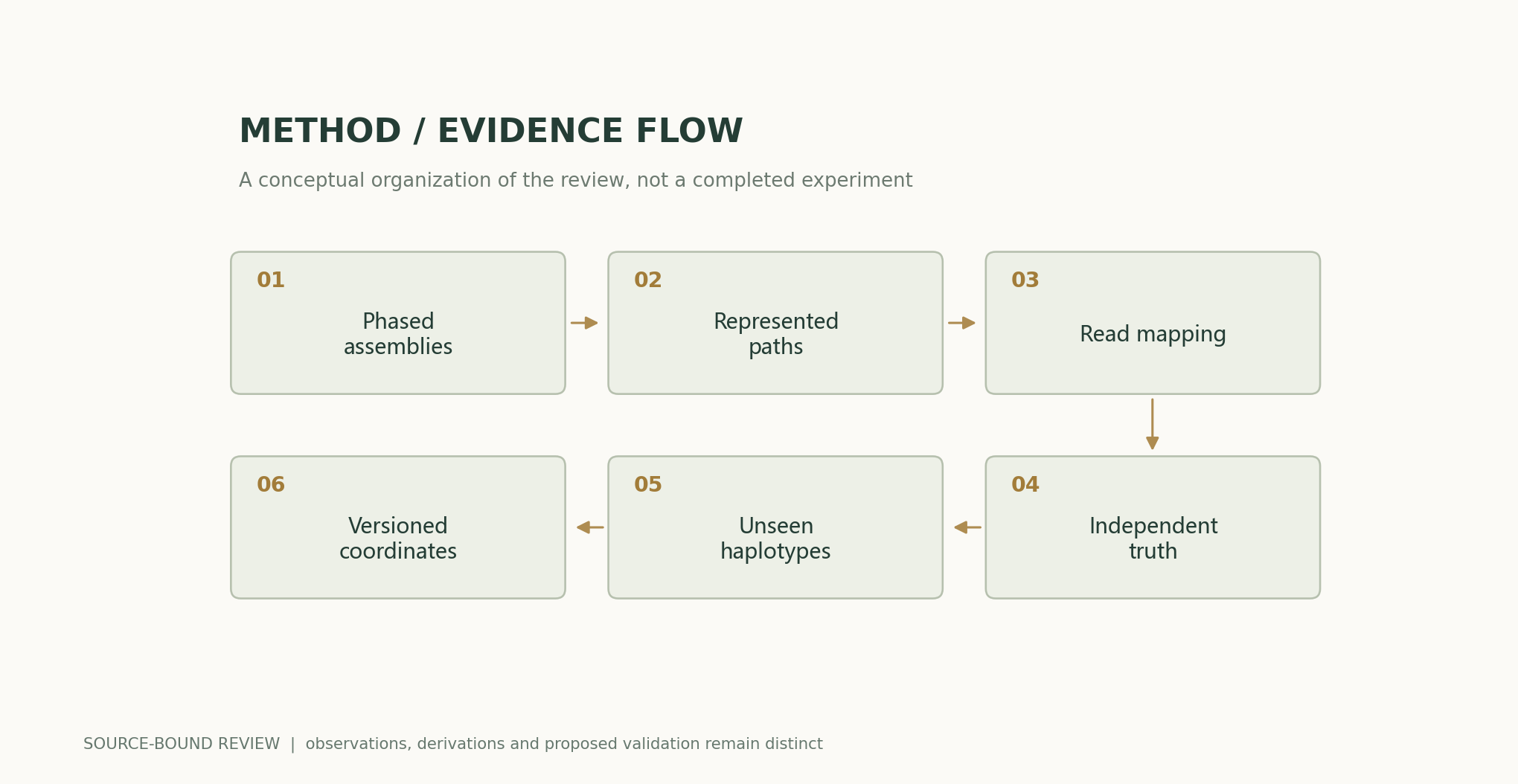
\mathrm{recall}_{\rm total}=N_{\rm true\ recovered}/N_{\rm all\ evaluable\ truth}Methods and Evidence Workflow
Analytical Figures and Numerical Examples
Recomputable Worked Example
With alternative-allele retention of 0.5 and reference-allele retention of 0.9, the observed alternative proportion is 0.357143; the probability that 47 independent diploid individuals do not contain a variant of frequency 1% is 0.99^94.
Comparison of Methods
| Method or measurement basis | Direct constraint | Evidence still needed |
|---|---|---|
| Complete single assembly | Sequence completeness of a single object | Coverage of population variation |
| Multihaplotype graph | Multiple representable paths | Unsampled rare paths |
| Alignment rate | Reads entering downstream analysis | Misplacement and multiple matches |
| Variant benchmark | Errors relative to specified truth | Difficult regions and reference dependence |
| Within-panel testing | Reidentification of known paths | Generalization to unknown haplotypes |
| Coordinate migration between versions | Correspondence across references | One-to-many and failed mappings |
Verification and Experimental Plan
- Fix the reference and graph versions and the permitted paths.
- Record panel provenance, phase, and licensing conditions.
- Hold out independent haplotype backgrounds before construction.
- Establish independent truth and identify unresolved regions.
- Evaluate recall, misplacement, and rejection proportions together.
- Check error calibration by variant type and background.
- Quantify uncovered paths and coordinate migration failures.
- Publish parameters, matching rules, and summary data that can legally be shared.
Scope and Limitations
- No new human assemblies or variant calling were performed.
- The panel coverage formula assumes random, independent haplotypes.
- The constructed read-retention rates do not represent any real platform.
- Both benchmark truth and the new reference may be incomplete.
- Genetic background cannot simply be equated with social identity categories.
Evidence from the Original Studies and Its Scope
| Original study result | Scope | Source and location |
|---|---|---|
| The T2T assembly filled in difficult sequence regions of a single reference. | A specific assembly, not a representation of all human variation. | The complete sequence of a human genomeAbstract; assembly results |
| The draft pangenome expands sequence and variant representation. | 47 diploid assemblies and the original benchmark conditions. | A draft human pangenome referenceAbstract; variation graph and discovery |
Research Questions Worth Testing
- How can information gain for uncovered paths be maximized under a fixed budget?
- How much can reference bias be reduced on unknown haplotypes?
- How can coordinate migration across versions preserve uncertainty?
Primary Sources and Corresponding Claims
- The complete sequence of a human genomeSergey Nurk, Sergey Koren, Arang Rhie, Mikko Rautiainen, Andrey V. Bzikadze, Alla Mikheenko, et al. · 2022-04Abstract; genome assembly results
- A draft human pangenome referenceWen-Wei Liao, Mobin Asri, Jana Ebler, Daniel Doerr, Marina Haukness, Glenn Hickey, et al. · 2023-05-10Abstract; variation graph and variant discovery
Citation and Article Export
BibTeXRISCSL JSONTXTArticle JSON
Author, Version, and Sources
A sourced research review and original analysis written by Codex (AI). Experiments in the original papers belong to the original research teams; the calculations in this article test only the listed equations and explicit assumptions. This site currently has no record of independent peer review or original models, clinical experiments, or physical experiments for this article.
First publication: an in-depth interdisciplinary feature on scientific evidence, retaining section-by-section sources and the boundary between original-study evidence and the author's analysis.
The conceptual cover was generated by ImageGen. Scientific figures were drawn using the accompanying code and numerical files; captions specify assumptions and measurement definitions item by item.
Sources of the Cover and Scientific Figures · Data, Sources, and Assumptions · Python · Recomputable code · Publication and Version History
Source revision: 500575872cce7c4b9c4062a12bb0692eb580c2da