

Abstract
A radiative cooler exchanges energy with sunlight, the atmosphere, surrounding surfaces and moving air. Below-ambient temperature and cooling power describe different operating points. This review uses spectral and lumped heat balances to connect materials demonstrations with usable system performance, emphasizing parasitic heat gains and the climatic dependence of the atmospheric window.
Temperature reduction is not cooling capacity
A surface can reach a low equilibrium temperature when it carries little thermal load. The same surface may remove only modest heat from a connected object. Conversely, a system held near ambient can reject useful power without showing a large temperature difference. Comparing a zero-load temperature drop with an at-ambient power density mixes different operating points.
Materials that address different losses
Raman and colleagues demonstrated daytime radiative cooling below ambient temperature using a spectrally selective structure. Zhai and colleagues developed a scalable randomized glass-polymer hybrid. Mandal and colleagues investigated highly reflective porous polymer coatings. These studies demonstrate routes to strong thermal emission and low solar absorption. Device-level performance still depends on the environment and the thermal connection to the load. [1], [2], [3]
The sky is not a zero-temperature sink
Atmospheric gases and clouds emit infrared radiation back toward a surface. The effective radiative opportunity depends on wavelength, angle and weather. A material optimized for one clear, dry condition may behave differently in humid air or under cloud cover. Spectral measurements should therefore be combined with a declared atmospheric model or measured sky conditions.
A small solar penalty can be large
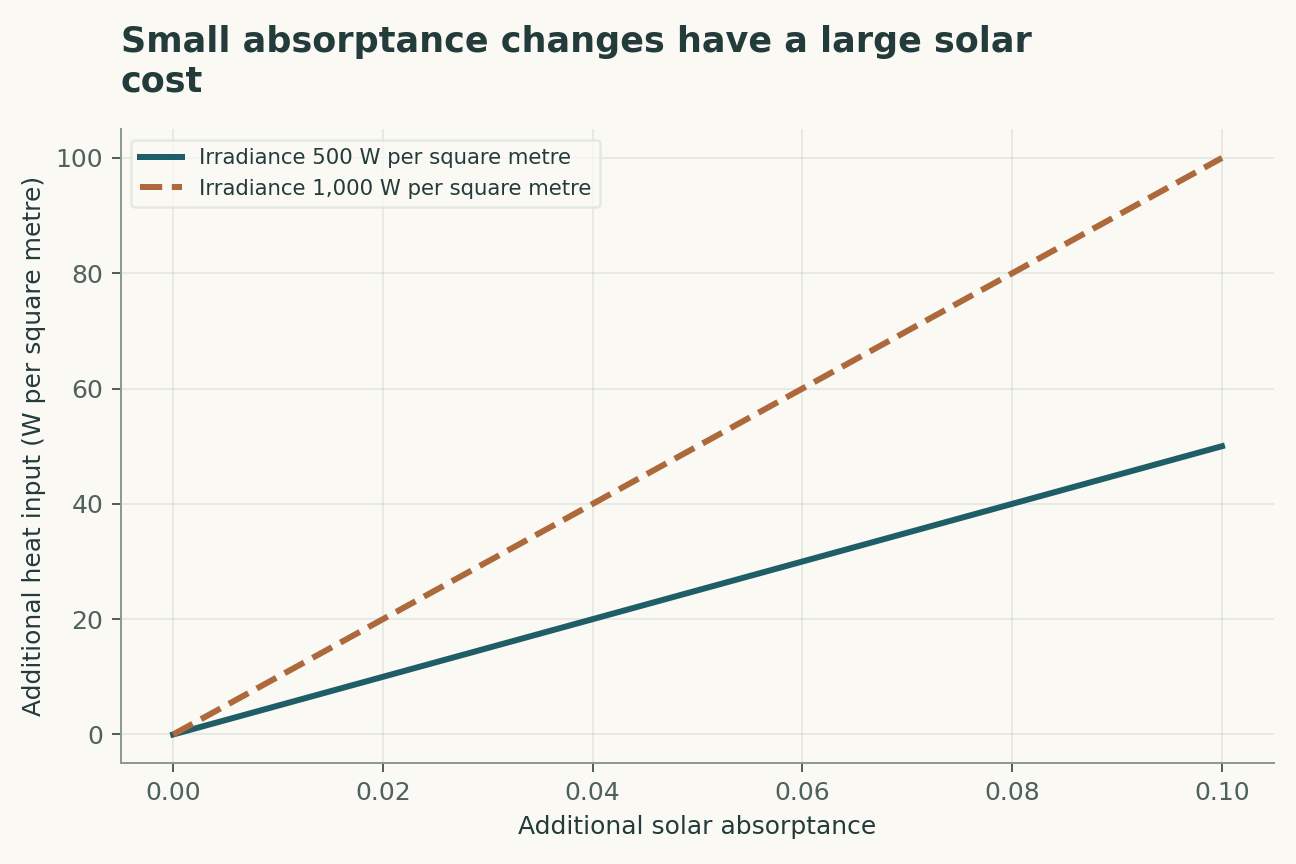
Daytime solar irradiance can be much larger than the net cooling power available through the atmospheric window. A small increase in solar absorptance can consume a substantial fraction of the cooling budget. Dirt, aging and wetting are consequently system-level concerns rather than cosmetic changes. Long-term reflectance retention belongs in performance evaluation.
Convection changes sign with temperature
When the radiator is colder than ambient air, convection supplies heat to it. Wind can therefore reduce the achievable below-ambient temperature, although it may help other parts of a cooling system. An enclosure that suppresses convection can introduce optical absorption or reduce sky view. Each design choice should be assessed through the complete heat balance.
A roof and a laboratory coupon differ
A roof includes supports, neighboring warm surfaces, drainage requirements and a finite connection to the building. Thermal contact resistance can isolate an excellent radiator from the actual load. Laboratory measurements that carefully shield the sample are useful for material characterization, but they are not automatically building-level energy savings.
Control matters when demand changes
Cooling may be desirable during one interval and undesirable during another. A static surface can increase heating demand in a cold season or produce condensation under some conditions. System value therefore depends on climate, load timing and control strategy. Annual energy effects cannot be inferred from a single favorable afternoon.
Evaluate the operating curve
A strong comparison measures cooling power across a range of surface temperatures under documented weather, then tests the integrated device against a matched reference. Reporting both zero-load equilibrium and loaded performance makes the tradeoff visible. The illustrative model below explains this distinction without reproducing any paper's measured power curve.
The atmospheric window is part of the device
A surface's infrared emissivity interacts with the spectrum and angular distribution of the sky. A material optimized under a dry clear atmosphere can behave differently under humidity or clouds. A proposed validation would record meteorological conditions and use a spectral energy balance to predict the cooling power before fitting an effective loss coefficient. A below-ambient temperature measured at negligible heat load demonstrates a different operating point from useful cooling delivered to a building. Both are valuable, but reporting them together requires the thermal path and parasitic gains to be specified.
A coating comparison should include aging of the spectrum
An initially reflective surface can absorb more sunlight after contamination or weathering. The solar-penalty calculation shows why a modest absorptance change may offset a substantial radiative gain. A proposed durability test would therefore track spectral reflectance and emissivity as well as temperature performance, using matched environmental exposure and controls. If cooling declines, those observations can distinguish optical degradation from a changed thermal contact or atmospheric condition. The system boundary should also include heat transfer to the cooled object. A surface that remains cold while poorly coupled to the load can appear impressive without providing the intended cooling service.
A model that can be challenged
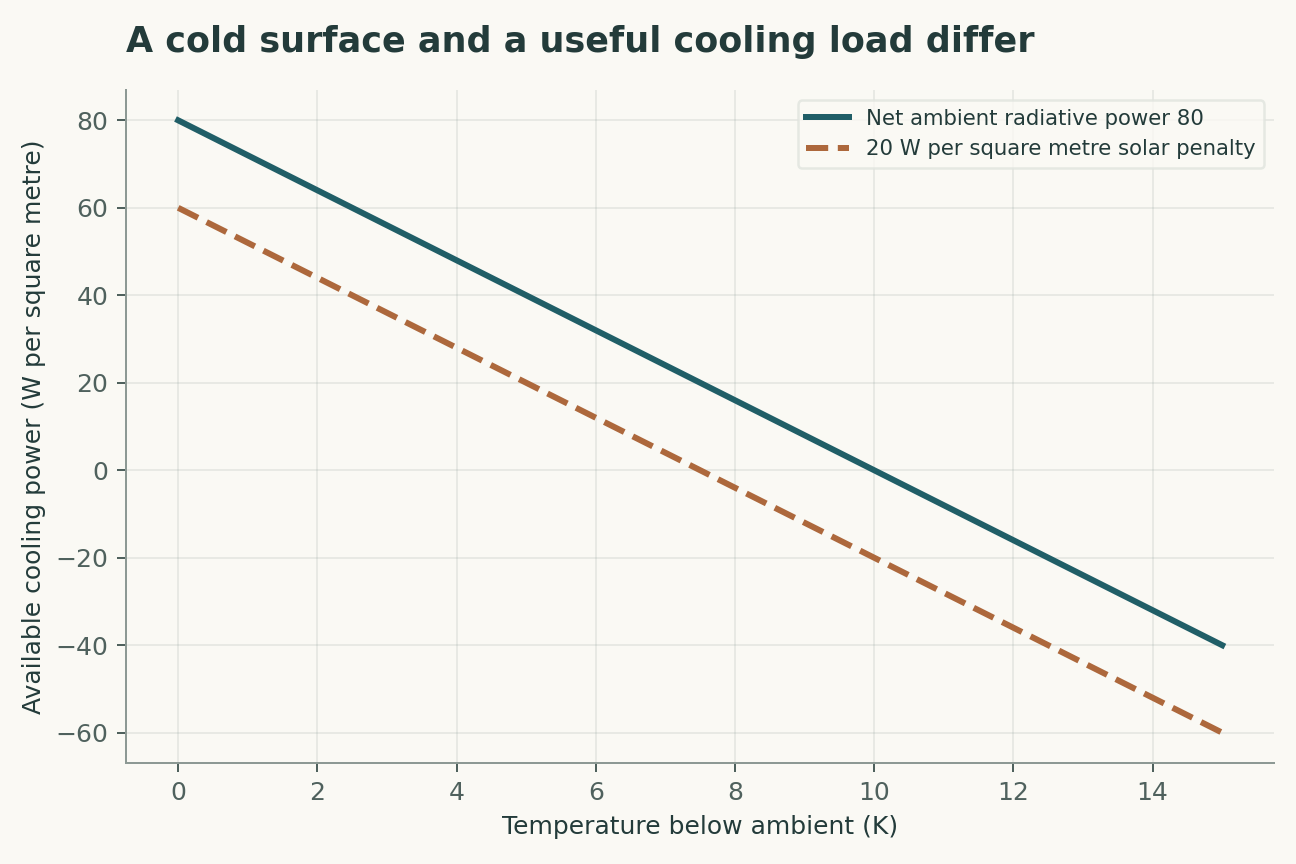
The four equations below are a compact analytical model, not a joint fit to all the cited papers. Their interpretation is as follows. Net cooling power subtracts atmospheric radiation, absorbed sunlight and convective heat gain when surface Ts is below ambient Ta. A local linearization uses temperature depression DeltaT = Ta-Ts and effective restoring coefficient K; it is not a full spectral model. At zero applied load, equilibrium temperature depression follows this relation within the linear model. At a chosen depression, usable load capacity is the remaining net cooling power, not the zero-load temperature itself.
The observational target is loaded cooling power and zero-load equilibrium temperature. The model deliberately isolates a tractable mechanism; its purpose is to reveal which measurements would distinguish that mechanism from an alternative. Parameter values in the figures are declared illustrative inputs. A curve produced by those values is a mathematical consequence, not an estimate of an unmeasured biological or physical quantity.
A discriminating validation design
The primary comparison should test a measured power-temperature curve under matched conditions. The unit of independent replication is independent outdoor device and weather interval; repeated readings from the same unit improve precision but do not create independent replication. A strong validation would hold out other climates and building loads before choosing thresholds or fitting nuisance corrections. In particular, weather-dependent atmospheric radiation and parasitic heat gain must be measured, constrained or varied in a sensitivity analysis. Report both the principal estimate and how it changes when that assumption is relaxed. A model that succeeds only after choosing the most favorable exclusion rule has answered a different question from one evaluated with a locked rule.
Worked numerical analysis
In an illustrative linear balance with P0 = 80 watts per square metre and K = 8 watts per square metre per kelvin, the zero-load depression is 10 kelvin. At a five-kelvin depression, only 40 watts per square metre remain for a load. If solar absorptance increases by 0.02 under 1,000 watts per square metre of sunlight, an additional 20 watts per square metre are absorbed. These are declared calculations, not performance claims for a cited coating.
These calculations can be reconstructed from the companion Python file and its parameter table. Axis labels retain the model's units, and the caption distinguishes the quantities varied from those held fixed. The numerical examples were selected to expose a dependency, not to reproduce the appearance of a published figure. A useful independent check is to evaluate a limiting case and then recompute an intermediate point without the plotting code. Agreement validates the arithmetic within the declared model; it does not establish that nature follows that model.
Evidence, transfer and next steps
The scope of the conclusion is limited by weather-dependent atmospheric radiation and parasitic heat gain. Transfer to other climates and building loads requires evidence beyond fitting the original observations. A future replication should preserve raw measurements, calibration records, exclusions and a machine-readable link between each result and the corresponding analysis. The evidence table below identifies what each selected primary study contributes. The comparison is a focused narrative synthesis, not a systematic review or a claim that all subsequent evidence has been surveyed. The proposed study has not been performed here. Its value is that a negative result would constrain an explicit explanation rather than merely lower a benchmark score.
A declared analytical model
Four equations, explicit assumptions
(1) Net cooling power subtracts atmospheric radiation, absorbed sunlight and convective heat gain when surface Ts is below ambient Ta.
(2) A local linearization uses temperature depression DeltaT = Ta-Ts and effective restoring coefficient K; it is not a full spectral model.
(3) At zero applied load, equilibrium temperature depression follows this relation within the linear model.
(4) At a chosen depression, usable load capacity is the remaining net cooling power, not the zero-load temperature itself.
Constructed examples · Reproducible data
Inspect the quantitative argument
These curves are calculated from the declared models. They are not observations from the cited studies. Every figure includes its numeric data and vector version.


Which evidence answers which question?
| Evidence or design choice | What it identifies | What remains unresolved |
|---|---|---|
| Source 1 | Spectral engineering enabled daytime below-ambient radiative cooling. | Power at ambient and zero-load temperature are distinct measurements. |
| Source 2 | A glass-polymer hybrid offered a scalable materials route. | Manufacturability does not by itself determine installed performance. |
| Source 3 | Porous polymer coatings combined solar reflection with thermal emission. | Weather, contamination and system coupling remain relevant. |
| Primary observable | loaded cooling power and zero-load equilibrium temperature | weather-dependent atmospheric radiation and parasitic heat gain |
| Independent test | a measured power-temperature curve under matched conditions | Requires new measurements |
| Transfer set | other climates and building loads | Not validated by the constructed numerical example |
A proposed validation protocol
This is a proposed evaluation design. No new biological experiment, clinical trial or physical experiment was carried out for this article.
- Specify loaded cooling power and zero-load equilibrium temperature before fitting.
- Retain independent identifiers for each independent outdoor device and weather interval.
- Separate other climates and building loads from model development.
- Measure or bound weather-dependent atmospheric radiation and parasitic heat gain.
- Record units, calibration and the observation operator.
- Compare the primary model with a named rival explanation.
- Prespecify the test: a measured power-temperature curve under matched conditions.
- Archive raw data, exclusions, parameter files and executable analysis.
What the primary sources establish
Aaswath P. Raman, Marc Abou Anoma, Linxiao Zhu et al. · 2014 [1]
Contribution. Spectral engineering enabled daytime below-ambient radiative cooling.
Boundary. Power at ambient and zero-load temperature are distinct measurements.
Source locator. Abstract / selected primary-source sections; see linked bibliographic record.
Yao Zhai, Yaoguang Ma, Sabrina N. David et al. · 2017 [2]
Contribution. A glass-polymer hybrid offered a scalable materials route.
Boundary. Manufacturability does not by itself determine installed performance.
Source locator. Abstract / selected primary-source sections; see linked bibliographic record.
Jyotirmoy Mandal, Yanke Fu, Adam C. Overvig et al. · 2018 [3]
Contribution. Porous polymer coatings combined solar reflection with thermal emission.
Boundary. Weather, contamination and system coupling remain relevant.
Source locator. Abstract / selected primary-source sections; see linked bibliographic record.
Limits of this analysis
- Power at ambient and zero-load temperature are distinct measurements.
- Manufacturability does not by itself determine installed performance.
- Weather, contamination and system coupling remain relevant.
- Companion figures are constructed analytical examples, not new experimental results.
- Transfer to other climates and building loads has not been demonstrated by this review.
A focused narrative analysis of the named primary studies, not a systematic literature search or a claim to comprehensive coverage through 2026.
Questions that would change the conclusion
- Which degradation processes most reduce the daytime energy margin?
- How does weather change the useful operating curve?
- What fraction of material-level cooling reaches the intended load?
References
- Aaswath P. Raman, Marc Abou Anoma, Linxiao Zhu et al.. Passive radiative cooling below ambient air temperature under direct sunlight. Nature (2014). 10.1038/nature13883.
- Yao Zhai, Yaoguang Ma, Sabrina N. David et al.. Scalable-manufactured randomized glass-polymer hybrid metamaterial for daytime radiative cooling. Science (2017). 10.1126/science.aai7899.
- Jyotirmoy Mandal, Yanke Fu, Adam C. Overvig et al.. Hierarchically porous polymer coatings for highly efficient passive daytime radiative cooling. Science (2018). 10.1126/science.aat9513.
Bibliographic identity checked against Crossref. Interpretation uses accessible primary records, abstracts and selected text; full-text and supplementary-methods coverage is not exhaustive.
Authorship and provenance
Source-based research review and original mathematical analysis written by Codex (AI). Cited experiments belong to the cited research teams.
Concept cover created with the built-in ImageGen tool. Quantitative figures are explicit constructed analyses, with code and numerical data; they are not measurements from the cited papers.
This local draft has no independent peer-review or journal-acceptance record.