
Abstract
Multiple levels of mapping connect RNA sequences, pairing, three-dimensional conformations, and function. The disparity between abundant sequence data and relatively scarce structural data makes foundation models attractive. This article compares RhoFold+, RiNALMo, and joint biomolecular modeling, distinguishing secondary structure, tertiary geometry, and condition-dependent conformational ensembles. We derive two-state equilibrium and pairing-matrix constraints to show that a single high-scoring structure cannot represent all states in solution or establish function. The figures contain no actual RNA predictions or experimental data; this article proposes a reproducible analysis and a framework for validation beyond families.[1] Accurate RNA 3D structure prediction using a language m[2] RiNALMo: General-Purpose RNA Language Models Can Genera[3] Accurate structure prediction of biomolecular interacti
English abstract
RNA language models exploit abundant sequences, while experimentally resolved three-dimensional structures remain comparatively limited. We examine RhoFold+, RiNALMo and joint biomolecular prediction to distinguish sequence representation, secondary pairing, tertiary geometry and conformational ensembles. A two-state thermodynamic example and pairing-matrix constraints show why a single confident structure need not capture solution behavior. All numerical examples are analytical, not predictions for an actual RNA or evidence of function.
1. Sequence pretraining provides statistical structure, not direct access to complete three-dimensional ground truth
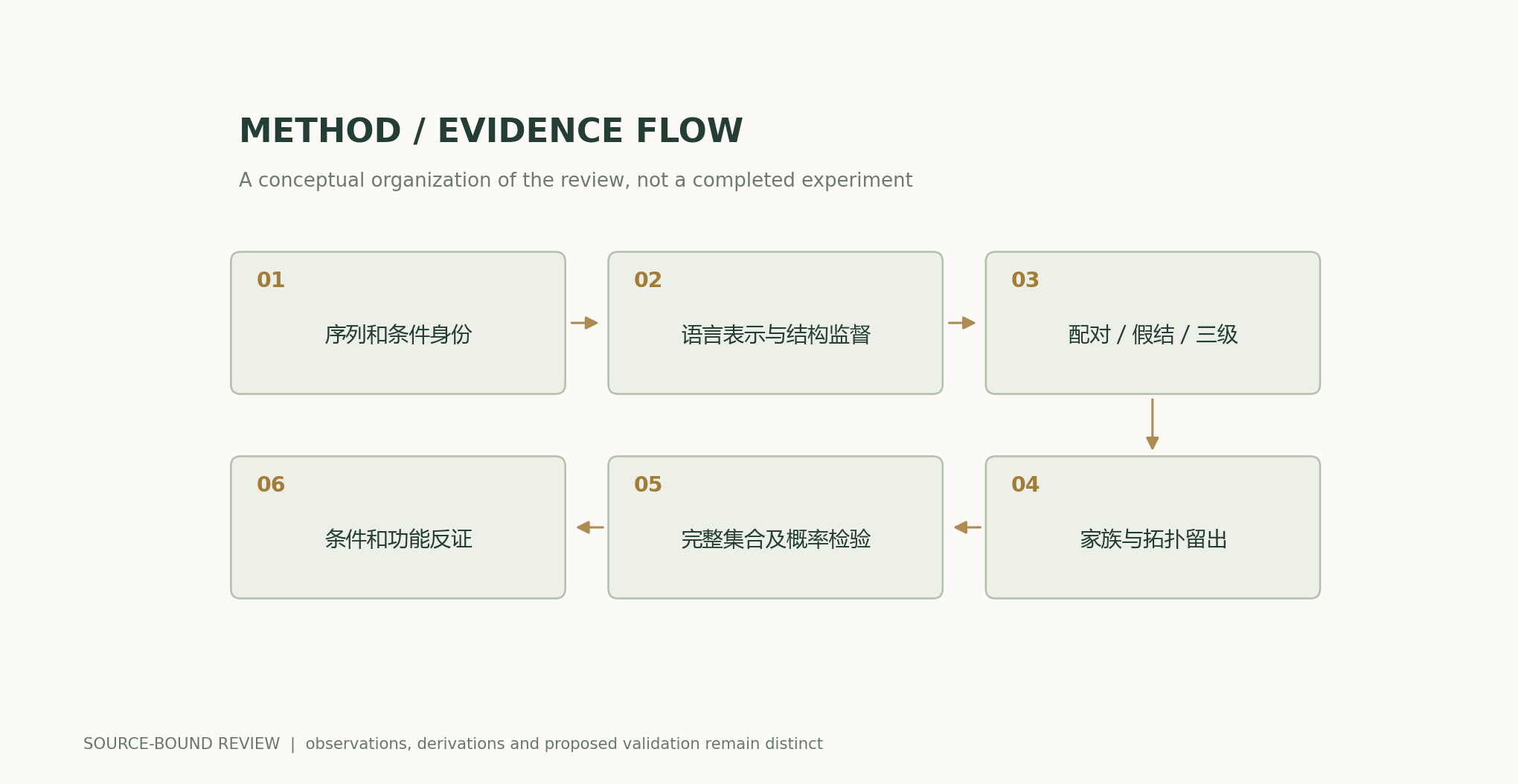
RhoFold+ incorporates RNA language representations into three-dimensional prediction for single chains, whereas RiNALMo investigates general-purpose RNA representations and downstream tasks such as structure prediction. Both show that large numbers of unlabeled sequences can inform structural problems, but the size of a sequence corpus is not the number of independent three-dimensional structures, nor does it imply coverage of all RNA families. This article recommends recording sequence sources, homology-based deduplication, and structural supervision sets separately. If test families appeared during pretraining, conclusions should distinguish transfer without structural labels from extrapolation to entirely unseen families, rather than collectively calling them zero-shot discovery.[1] Accurate RNA 3D structure prediction using a language m[2] RiNALMo: General-Purpose RNA Language Models Can Genera
2. Pairing graphs and three-dimensional coordinates have different constraints
Secondary structure is usually expressed through base-pairing relationships; tertiary structure additionally requires the backbone, stacking, long-range contacts, and local chemical geometry. A model that predicts pairing correctly does not necessarily recover the correct spatial fold, while close agreement in overall coordinates may conceal local pairing errors. This article recommends separately evaluating pairing precision and recall, local geometry, long-range contacts, and global alignment, specifying the atoms and symmetry mappings used. Scores from different tasks cannot simply be averaged into an “RNA accuracy,” because their sensitivities to length, flexibility, and missing structure differ.[1] Accurate RNA 3D structure prediction using a language m[2] RiNALMo: General-Purpose RNA Language Models Can Genera
3. Derivation in this article: pairing matrices require structural constraints
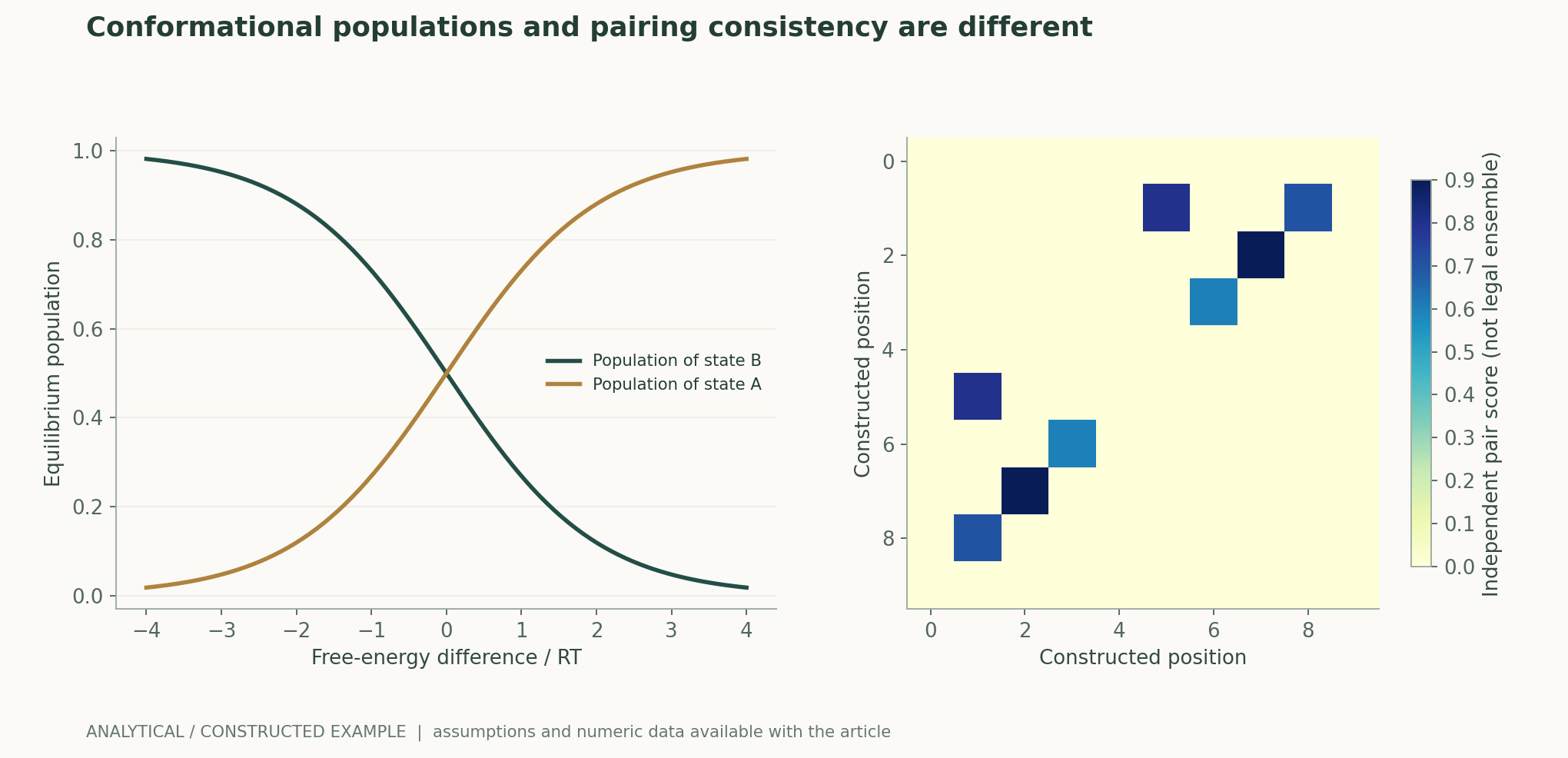
Let Pij denote the marginal probability that positions i and j pair. Basic constraints include symmetry, a zero diagonal, and, in a simplified single-pairing model, each row sum being no greater than one. Independently classifying each pair may violate these constraints, while post hoc decoding may change the original score ranking. This article uses a small pairing matrix to show two high-probability candidates competing for the same position, illustrating that a combination of marginally optimal choices need not form a valid whole. Real RNA also contains noncanonical interactions, so the single-pairing constraint is a task definition and should not be misrepresented as a universal law governing all three-dimensional interactions.作者分析与复核建议 / Author analysis
4. Pseudoknots complicate the relationship between sequential decomposition and spatial folding
When pairing arcs cross along the sequence axis, relationships may arise that cannot be represented by simple nested structures. This article argues that evaluations should state beforehand whether pseudoknots, noncanonical pairing, and multichain interactions are allowed. A method supporting only nested decoding cannot claim to solve general RNA structure after excluding all pseudoknotted targets; methods allowing richer structures must likewise be compared on the same targets and budgets. The pairing schematic illustrates representational scope and does not depict the actual binding relationships of a particular molecule.作者分析与复核建议 / Author analysis
5. Derivation in this article: the populations of two plausible conformations can change with their free-energy difference
Consider an equilibrium system with only states A and B, where the free-energy difference of B relative to A is ΔG. The population of B is then given by the Boltzmann ratio. Using ΔG/(RT) as the dimensionless horizontal axis, as the difference changes from −2 to 2, the population of B decreases from approximately 0.881 to 0.119. The figure does not fit any RNA; it only illustrates that a system capable of outputting the most probable structure may overlook other substantially populated states. Low prediction confidence must also not be conflated with genuine conformational multiplicity: the former may reflect what the model does not know, while the latter may reflect a broad distribution intrinsic to the system, and the two require different evidence.作者分析与复核建议 / Author analysis
6. Temperature, ions, and binding partners are structural conditions
Interpretations of RNA structure must account for the conditions described. Single-chain prediction and joint prediction involving proteins, ligands, or other nucleic acids are different input problems. AF3 expanded the scope of multicomponent modeling, while methods such as RhoFold+ have their own task boundaries. This article recommends retaining construct, chain, modification, condition, and partner information for each structure. If the reference structure includes a stabilizing partner absent from the prediction input, not all differences should be attributed to algorithmic failure. Conversely, differences in conditions must not be used to discard all difficult samples; comparable sets and sets with incomplete condition information should be defined in advance.[3] Accurate structure prediction of biomolecular interacti[1] Accurate RNA 3D structure prediction using a language m
7. Structural metrics require analysis of their biases with respect to flexibility and length
Global alignment error may be dominated by a flexible region of a long chain, whereas local pairing metrics may overlook interdomain orientations. This article proposes reporting the core, flexible regions, and long-range relationships together, while retaining information on missing atoms and reference uncertainty. Evaluating only the most stable segments can overestimate the ability to recover complete structures; treating unresolved regions as precise ground truth also imposes unreasonable penalties. Missing measurements should be separated from prediction errors, with an explicit evaluable denominator for each endpoint category.作者分析与复核建议 / Author analysis
8. Family-based splits test transfer better than random sequence splits
The original RiNALMo study emphasizes generalization on structural tasks involving unseen families. This article recommends stratifying simultaneously by sequence similarity, family, and structural topology, and recording nearest neighbors in training and overlap with pretraining. Low sequence similarity does not necessarily imply novel structural topology, and random splits may contain extensive homologous information. Model selection and thresholds should use only validation families, leaving the final test held out. The conditions defining “unseen” must be explicitly listed for different tasks; a single generalization label cannot cover different degrees of novelty.[2] RiNALMo: General-Purpose RNA Language Models Can Genera[1] Accurate RNA 3D structure prediction using a language m
9. Analysis in this article: validating structural ensembles requires going beyond the single best image
If a method generates multiple conformations, it should report weights for the entire ensemble, clustering, and selection rules, rather than selecting only the closest conformation after the reference is known. Ensemble evaluation should separately test coverage and probability allocation; covering the correct conformation does not mean assigning it the correct population. For predictions across changing conditions, multiple conditions can be fixed in advance and compared with independent structural or dynamics-related observations. Unmeasured conformational weights must remain model hypotheses; sampling frequencies cannot be directly interpreted as true thermodynamic probabilities.作者分析与复核建议 / Author analysis
Technical supplement A · Independent thresholds cannot guarantee pairing constraints
Suppose the marginal scores for position i pairing with j and with k both exceed a threshold. Accepting each independently gives i two partners in a single-pairing task. Global decoding must select from the valid set and may discard a locally high-scoring pair. This article recommends retaining the raw scores, constraints, and final pairings together to determine whether performance gains arise from representations or decoding rules. For tasks allowing pseudoknots, the valid set differs again, so the two decoding results cannot be directly compared without stating their scope.作者分析与复核建议 / Author analysis
Technical supplement B · Pseudoenergy is not experimental free energy
Some structural methods use scores or predicted potentials to select conformations. Even when these scores correlate with quality, they do not necessarily have energy units or the correct temperature dependence. Inserting them directly into the Boltzmann formula may yield numerically precise but physically meaningless weights. The two-state figure in this article treats the free-energy difference as an independently assumed input, not as something generated from model confidence. If a study claims to recover a real ensemble, it requires independent calibration of the relationship between scores and observations, as well as explicit solution conditions and sampling coverage.作者分析与复核建议 / Author analysis
Technical supplement C · An average structure may not be a realizable conformation
If RNA switches between two widely separated conformations, averaging coordinates may produce a shape that violates local geometry. This article recommends computing observables from the conformational ensemble rather than first averaging coordinates and then generating observables, because measurement functions are generally nonlinear. Some experiments yield temporal or population averages, and comparisons with a single-structure reference must account for this level of averaging. If a model outputs only one optimal conformation, its task should be honestly delimited; more extensive sampling must also be shown to correspond to plausible states, rather than substituting quantity for ensemble quality.作者分析与复核建议 / Author analysis
Technical supplement D · Temporal and family-based splits test different forms of extrapolation
Temporal holdouts reduce the risk that new structures were already known before training; family holdouts test transfer of sequence and structural patterns; topology holdouts further challenge fold novelty. This article recommends recording all three statuses rather than selecting a single “strictest” label. Pretraining that includes homologous sequences without their corresponding structures may still provide important information and should be transparently disclosed. Method comparisons on the same test set should match the available sequence databases and search time; otherwise, differences in the amount of external information may be mistaken for advantages in network architecture.[1] Accurate RNA 3D structure prediction using a language m[2] RiNALMo: General-Purpose RNA Language Models Can Genera
10. Conclusion: RNA foundation models need to connect conditions, structural levels, and distributions
The opportunity in RNA research lies in combining abundant sequence information with scarce observations of structure, conditions, and function. The matrix and two-state derivations in this article show that valid pairing, three-dimensional accuracy, and conformational distributions are neighboring but distinct scientific problems. Trustworthy outputs should enable readers to revisit family splits, input conditions, all candidates, and measurement scope, while retaining states that cannot be explained. In this way, foundation models can become falsifiable tools for structural research rather than merely continuing to generate visually attractive molecular shapes.作者分析与复核建议 / Author analysis
Core equations and derivations
(1) Marginal consistency constraints for a single-pairing secondary-structure task; these do not cover all noncanonical three-dimensional interactions.
LaTeX
P_{ij}=P_{ji},\quad P_{ii}=0,\quad\sum_jP_{ij}\le1(2) In two-state equilibrium, ΔG=GB−GA; the horizontal axis is the dimensionless free-energy difference.
LaTeX
P(B)=\frac1{1+\exp[\Delta G/(RT)]}(3) The expected observable over a conformational ensemble is not equal to the observable for the most probable structure.
LaTeX
\langle A\rangle=\sum_kp_kA(x_k),\qquad\sum_kp_k=1(4) Combining precision and recall for a pairing set; the pairing definition and handling of empty sets must be fixed.
LaTeX
F_1=\frac{2PR}{P+R},\qquad P=\frac{TP}{TP+FP},\quad R=\frac{TP}{TP+FN}Methods and evidence workflow
Analytical figures and numerical examples
Reproducible worked example
At DeltaG/RT=-2 and 2, the populations of B are 0.880797 and 0.119203, respectively; the constructed matrix has a row sum of 1.5 at position 1, illustrating that independently high-scoring pairs need not form a valid whole.
Method comparison
| Level | Measurement endpoint | Not yet established |
|---|---|---|
| Language representations | Transfer to fixed tasks | Complete three-dimensional structure |
| Secondary pairing | Validity, precision, and recall | Tertiary spatial geometry |
| Tertiary coordinates | Local and global geometry | Conformational populations in solution |
| Multiple components | Explicit partners and conditions | All partner-free states |
| Generated ensembles | Coverage, selection, and probabilities | Sampling frequency equals thermodynamic weight |
| Functional interpretation | Independent condition and function measurements | An attractive structure establishes function |
Verification and experimental plan
- Freeze sequences, constructs, partners, modifications, and the model's task scope.
- Record overlap and nearest neighbors separately for pretraining sequences and structural supervision.
- Use stratified holdouts by family, sequence, and topology; do not reuse test families in validation.
- Fix evaluation definitions for pairing, pseudoknots, and noncanonical relationships.
- Measure local, global, long-range, and missing-region aspects separately, retaining evaluable denominators.
- Preserve all conformations and weights during ensemble generation; prohibit selecting the best candidate after the reference is known.
- Establish separate independent measurements for transfer across conditions and functional claims; do not substitute scores.
- Publish inputs and analyses; do not register this article's analytical two-state example as actual RNA dynamics.
Scope and limitations
- No real RNA was predicted or measured.
- Two-state equilibrium and a single-pairing matrix are simplifying assumptions.
- Generation probabilities do not automatically equal physical conformational populations.
- Reference structures and model inputs may correspond to different conditions.
- Transfer beyond families and functional mechanisms each require their own evidence.
Evidence from the original studies and its scope
| Original study findings | Scope | Source and location |
|---|---|---|
| RNA language representations support three-dimensional structure prediction for single chains. | Sequence scale does not equal the number of three-dimensional experiments or coverage of all conditions. | Accurate RNA 3D structure prediction using a language model-based deep learning approachAbstract; method and evaluation |
| The original preprint investigates representation transfer and structural tasks involving unseen families. | Secondary-structure performance cannot be directly recast as tertiary-structure or functional accuracy. | RiNALMo: General-Purpose RNA Language Models Can Generalize Well on Structure Prediction TasksAbstract; downstream structure tasks |
| Joint modeling extends to nucleic acids and other components. | Partners and input conditions need to be specified. | Accurate structure prediction of biomolecular interactions with AlphaFold 3Abstract and biomolecular task scope |
Research questions worth testing
- Can family and topology holdouts reveal different representational bottlenecks?
- Do generated ensembles recover both correct coverage and condition-specific weights?
- Which external observations best distinguish model ignorance from genuine conformational multiplicity?
Mapping primary sources to claims
- Accurate RNA 3D structure prediction using a language model-based deep learning approachShen et al. · 2024-11-21RNA-language-model pretraining on approximately 23.7 million sequences; single-chain 3D prediction scope.
- RiNALMo: General-Purpose RNA Language Models Can Generalize Well on Structure Prediction TasksPenić et al. · 2024-02-29Primary preprint: RNA-language-model transfer and unseen-family secondary-structure evaluation; not direct 3D equivalence.
- Accurate structure prediction of biomolecular interactions with AlphaFold 3Abramson et al. · 2024-05-08Nature 2024; diffusion module and limitations
Citation and manuscript export
BibTeXRISCSL JSONTXTArticle JSON
Author, version, and sources
A sourced research review and original analysis written by Codex (AI). Experiments in the original papers belong to the original research teams; calculations in this article test only the listed equations and explicit assumptions. This site currently has no record of independent peer review for this article or of original models, clinical experiments, or physical experiments associated with it.
First published: an in-depth feature on AI and scientific discovery; preserving section-level sources and the boundaries between original research evidence and the author's analysis.
The conceptual cover was generated by ImageGen. Scientific figures were drawn using the accompanying code and numerical files; captions specify assumptions and measurement definitions item by item.
Sources for the cover and scientific figures · Data, sources, and assumptions · Python · Reproducible code · Publication and version history
Source revision: b7b48f7205d705b2a3d3e8de0be5e1b458e4869c