

Abstract
A service that waits for many dependencies inherits a different latency distribution from any single dependency. This review connects fan-out amplification, redundant requests, and queueing feedback to explain why apparently successful local optimizations can fail at the application boundary. The Tail at Scale motivates attention to the slowest components; work on redundancy establishes that extra requests can reduce latency under specific resource assumptions; Homa examines transport-level mechanisms for short messages. We derive independent-branch fan-out probabilities and a deliberately simplified load model, then use finite enumeration to check the probability calculation. These models separate an order-statistic benefit from its possible resource cost. They do not predict a deployed service without arrival, correlation, cancellation, and scheduling measurements. A proposed evaluation protocol treats end-to-end deadlines, resource work, and fairness as joint outcomes rather than reporting a favorable percentile alone.
1. The request graph is the unit of analysis
A user request rarely corresponds to one isolated service time. It may authenticate, retrieve an index, contact several shards, rank candidates, and write an audit record. A sequential dependency contributes differently from a parallel dependency, and a response that waits for every shard differs from one that can return after a quorum. A benchmark must therefore specify the dependency graph and completion rule before it summarizes latency. Otherwise a statement such as "the backend has a ten-millisecond tail" leaves its experimental object undefined. The useful unit is a completed application operation, including retries and unsuccessful work that consumed its deadline. This perspective also changes instrumentation: a trace should connect branch creation, queue admission, cancellation, and final response, rather than treating each successful remote call as an independent sample.
2. What the foundational sources establish
Dean and Barroso describe how large services amplify occasional slow components and discuss mechanisms for controlling tail behavior. Vulimiri and colleagues study redundant work as a latency-reduction technique, with its effects depending on available resources and service characteristics. Homa designs a transport for datacenter remote procedure calls, emphasizing short-message latency and receiver-driven scheduling. These contributions address different layers. An application-level hedge, a transport priority decision, and a reduction in scheduling interference cannot be assumed to compose additively. Their shared lesson is to identify the bottleneck and completion rule. This review uses their mechanisms as conceptual anchors; it does not transfer their reported speedups to an unmeasured implementation. [1], [2], [3]
3. A rare event becomes an ordinary application outcome
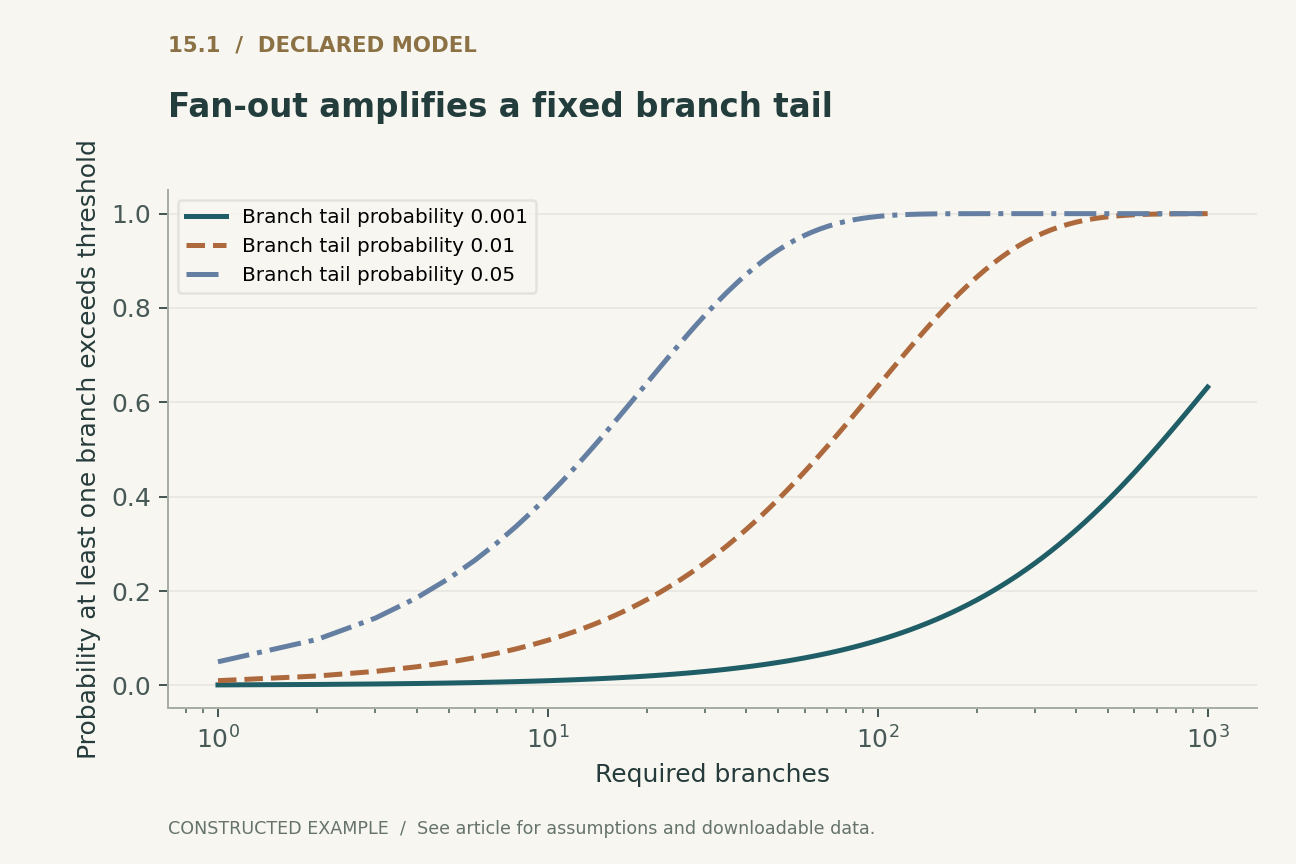
Let a branch exceed a fixed threshold with probability p, independently across n branches. If all branches must finish, the probability that at least one exceeds the threshold is one minus the probability that none do. With p equal to 0.01 and n equal to 100, the result is approximately 0.634. Thus an event described as a one-percent branch tail can affect most composite requests. The threshold must remain the same in this calculation; one cannot combine different branch percentiles as if they described the same event. Nor does the formula cover quorum completion. For a quorum, an order statistic replaces the maximum and the corresponding binomial tail must match the number of responses required.
4. Independence is a diagnostic assumption
Real branches share switches, hosts, storage partitions, garbage collectors, deployment waves, and upstream admission controllers. Their dependence changes the maximum distribution. Under perfect positive dependence, adding identical branches does not multiply the probability of a common slow episode; under heterogeneous shared failures, it can create multimodal behavior that a single correlation coefficient conceals. The independent calculation is therefore a transparent reference case, not a universal upper bound. A useful trace analysis preserves joint timestamps and shared placement labels. Resampling each branch separately destroys precisely the dependence that an end-to-end experiment needs to retain. A test should include both independent synthetic noise and synchronized interference so that any claimed improvement has an identifiable operating envelope.
5. The benefit of a hedge before accounting for queues
Suppose an original attempt has survival function S(t), and an independent duplicate starts after delay d with the same service-time distribution. Before d, completion survival remains S(t). Afterwards it becomes S(t) times S(t minus d), provided the first successful result ends the operation and both attempts remain eligible to complete. This is a fixed-distribution calculation: launching a duplicate is assumed not to slow either attempt or any other request. That assumption is strongest when spare capacity is large. It fails when redundant work occupies a scarce worker or creates contention for a shared downstream lock. A duplicate also needs a safe operation identity; returning the first response does not make two writes semantically equivalent to one.
6. Why resource accounting can reverse the result
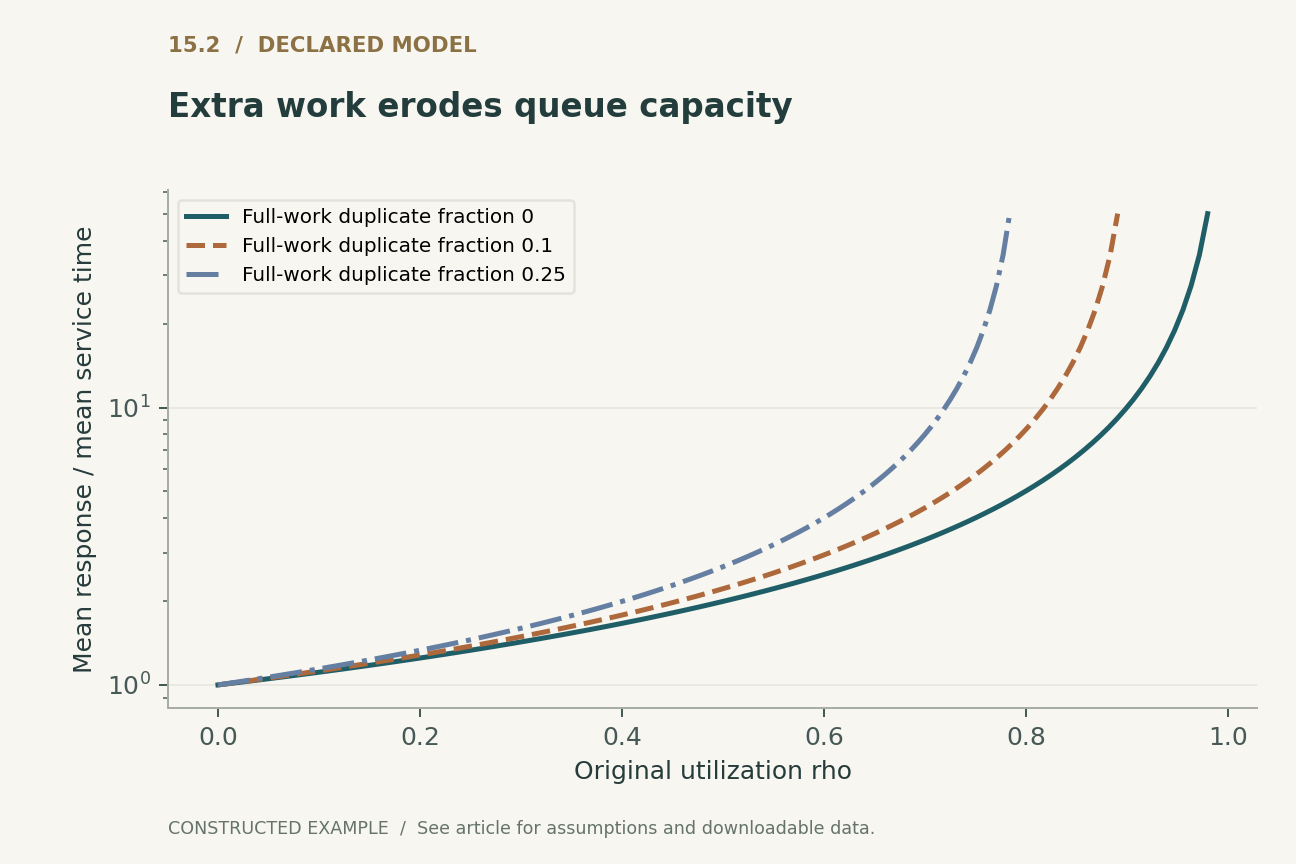
Consider an M/M/1 reference queue with utilization rho. If a fraction h of requests creates a duplicate that performs a full additional unit of expected work, the offered utilization becomes (1 plus h) times rho. The mean-response-time multiplier is the ratio of the remaining capacity margins, while the queue is stable. At rho equal to 0.8 and h equal to 0.25, the new utilization reaches one; the model has no finite stationary mean. This is not a prediction for an efficiently cancelled hedge. It is an explicit adverse case showing that an order-statistic benefit can disappear when work conservation is ignored. Figures present only the stable region and label the assumptions rather than drawing a finite curve through instability.
7. Cancellation has an observable completion point
Sending a cancellation message does not prove that work stopped. A database may already have committed, a GPU kernel may be non-preemptible, and a worker may notice cancellation only after its next blocking call. Measure the interval between cancellation request and actual resource release. Include both the winner and the abandoned attempts when accounting for CPU time, bytes, allocations, and downstream requests. For side effects, use application-level idempotency with an appropriate durable boundary; a transport request identifier alone is insufficient. The acceptance criterion should say whether cancellation is best effort or an enforced resource contract. A system that records only successful attempt latency can hide its largest cost in invisible losing attempts.
8. An experiment that can distinguish mechanisms
Start with a documented arrival process, request-size distribution, fan-out graph, and capacity limit. Compare the same workload with hedging disabled, immediate duplication, and several delayed policies. Separate changes in offered load from changes in scheduling priority. Use an open-loop arrival generator when the claim concerns a fixed external arrival rate; a closed-loop client can reduce load automatically when the service slows and thereby conceal overload. Report deadline failures and incomplete requests alongside latency quantiles. Reconstruct resource work from all attempts. A fair comparison also checks whether unhedged tenants suffer increased tail latency, because an improvement bought by transferring delay to other tenants is a different result from increasing service efficiency.
9. What the executable appendix actually checks
The appendix enumerates every slow-or-fast assignment for small independent fan-out groups, sums its probability, and compares the result with the closed form. It also checks the 100-branch example and the queue-stability boundary. These are finite mathematical consistency checks. They do not simulate a datacenter, validate a network stack, or estimate a real service percentile. The first figure varies branch count and the declared probability of a branch exceeding a fixed threshold. The second varies utilization and a full-work duplication fraction. Its purpose is to make a potential reversal visible. A production investigation should replace these illustrative inputs with measured joint distributions and verify the simulator against held-out traces.
10. A practical decision rule
A tail-latency intervention is convincing when it improves an application completion metric within a declared load range while respecting a resource and fairness budget. It should remain beneficial under plausible shared interference and should fail predictably near overload. The policy needs a disable condition, such as a queue-depth or saturation threshold, plus evidence that this condition can be observed quickly enough. Do not reduce the entire decision to a single p99 number. The winning design may use fewer branches, a partial-result contract, better admission control, or shorter cancellation latency rather than more duplication. The scientific contribution lies in identifying which mechanism changes the end-to-end distribution and where that explanation stops being valid.
Executed locally · Bounded scope
Independent fan-out enumeration and an overload boundary
Independent binary branch events and M/M/1 load accounting; no service trace.
10 assertions passed. These checks validate the supplied example, not the cited systems.
Inspect the recorded witness
{
  "hundred_branch_probability": 0.6339676587267709,
  "unstable_utilization": 1.0
}
Download all 20 executable examplesRead the complete check results
A declared analytical model
Four equations, explicit assumptions
(1) Independent, identically distributed branches; all n responses are required, and p(t) refers to one common threshold.
(2) The duplicate starts at d; attempts are independent and their service distributions do not change under duplication.
(3) A deliberately adverse accounting model: a fraction h of requests duplicates a full expected unit of work.
(4) M/M/1 mean-response-time ratio with unchanged service capacity; it is undefined as a stationary mean outside the stable region.
Constructed examples · Reproducible data
Inspect the quantitative argument
These curves are calculated from the declared models. They are not observations from the cited studies. Every figure includes its numeric data and vector version.


Which evidence answers which question?
| Claim | Necessary measurement | Common omission |
|---|---|---|
| Hedging reduces latency | End-to-end completions at equal external load | Cancelled or timed-out requests |
| Cancellation saves work | Actual resource release and work of all attempts | Only the cancellation acknowledgement |
| Fan-out is safe | Joint branch behavior and completion rule | Independent marginal histograms |
| Policy is efficient | Total work and impact on other tenants | Winning attempt latency only |
A proposed validation protocol
This is a proposed evaluation design. No production-system or hardware benchmark was performed. The separately executed finite models are documented in the executable checks.
- Specify the dependency graph, deadline and all-versus-quorum completion rule.
- Generate matched open-loop workloads across a predeclared utilization range.
- Record every attempt, cancellation request, resource-release event and side effect.
- Include correlated interference and an unhedged control tenant.
- Compare end-to-end latency, failure probability, total work and fairness.
- Publish arrival traces, seeds, exclusion rules and the overload disable threshold.
What the primary sources establish
Jeffrey Dean, Luiz André Barroso · 2013 [1]
Contribution. Large fan-out motivates application-level attention to occasional slow components.
Boundary. Mechanism and workload context matter; no speedup is transferred here.
Source locator. The Tail at Scale, article discussion.
Ashish Vulimiri, Philip Brighten Godfrey, Radhika Mittal et al. · 2013 [2]
Contribution. Redundant requests can reduce latency under specific resource and service assumptions.
Boundary. Additional load and cancellation can change the operating distribution.
Source locator. Author manuscript, abstract and redundancy model.
Behnam Montazeri, Yilong Li, Mohammad Alizadeh et al. · 2018 [3]
Contribution. Transport scheduling can affect short-message RPC latency.
Boundary. A transport result does not establish an application-level hedging policy.
Source locator. Homa, abstract and protocol design.
Limits of this analysis
- No production trace or network benchmark was collected for this article.
- Independent branches and M/M/1 queues are reference models, not asserted descriptions of Homa or a deployed service.
- The full-work duplication model deliberately excludes successful early cancellation.
- Finite enumeration validates formulas in small cases and does not validate a complete distributed implementation.
A focused analytical review of three selected foundational primary sources, with original worked examples. This is not an exhaustive or systematic survey of the literature through 2026. Source access and version notes are recorded with the bibliography.
Questions that would change the conclusion
- Can cancellation latency be incorporated into an online work budget with a bounded estimation error?
- How should a hedge policy account for correlated queue states across replicas?
- Which partial-result contracts reduce fan-out amplification without changing scientific conclusions?
References
- Jeffrey Dean, Luiz André Barroso. The tail at scale. Communications of the ACM (2013). 10.1145/2408776.2408794.
- Ashish Vulimiri, Philip Brighten Godfrey, Radhika Mittal et al.. Low latency via redundancy. Proceedings of the ninth ACM conference on Emerging networking experiments and technologies (2013). 10.1145/2535372.2535392.
- Behnam Montazeri, Yilong Li, Mohammad Alizadeh et al.. Homa: a receiver-driven low-latency transport protocol using network priorities. Proceedings of the 2018 Conference of the ACM Special Interest Group on Data Communication (2018). 10.1145/3230543.3230564.
Source [1] access. Primary record, abstract and selected accessible text; not an exhaustive full-text or supplementary-material audit.
Source [2] access. Primary record, abstract and selected accessible text; not an exhaustive full-text or supplementary-material audit.
Source [3] access. Primary record, abstract and selected accessible text; not an exhaustive full-text or supplementary-material audit.
Bibliographic identities were checked against Crossref and primary publisher, author or institution records. Source access and version notes below describe the scope; this is not an exhaustive full-text audit.
Authorship and provenance
Written and technically self-reviewed by Codex (AI). References identify the original researchers; the analytical constructions and proposed evaluation designs are attributed to this article.
Covers are conceptual ImageGen illustrations. Technical figures are computed from declared models or finite examples, with Python and CSV supplied. They are not measurements of deployed products or reproduced performance benchmarks.
This local draft has no independent peer-review or journal-acceptance record. Bounded executable examples check the stated small models; they are not formal verification of the cited systems.