

Abstract
Promptable segmentation specifies targets through inputs such as points and boxes, but the prompting method, object hierarchy, and human interaction budget all affect the results. This article analyzes SAM's image encoding and mask decoding interfaces, together with the video memory context of SAM 2, distinguishing spatial overlap, temporal consistency, and semantic correctness. The figure shows analytically calculated IoU after a rectangle is translated, not test results for any SAM model.[1] Segment Anything[2] SAM 2: Segment Anything in Images and Videos[3] Learning Transferable Visual Models From Natural Langua
English abstract
Promptable segmentation is evaluated as an interactive system with a specified object and prompt budget. We distinguish mask ambiguity, confidence prediction, temporal memory and semantic recognition. A translated-rectangle example derives IoU sensitivity without running SAM. Domain transfer and video consistency require independent labeled evaluation.
1. Prompts define the task, not merely the input format
A point may refer to an entire object, a part, or a textured region, and multiple masks may be reasonable. The object definition and annotation policy should be specified first, followed by an explanation of how points, boxes, or text are generated. Manually choosing the most favorable prompts has a different cost from using fixed automatic prompts. Testing promptable models must account for the number of interactions, corrections, and failures, rather than reporting only the best mask selected retrospectively from multiple candidates.[1] Segment Anything
2. Encoding reuse and lightweight decoding have engineering prerequisites
Image encodings can be reused across multiple prompts, with results then generated using the prompts and the mask decoder; the reuse key must be bound to the image, preprocessing, and model version. Errors in scaling, cropping, and coordinate transformations may shift prompt locations. Latency should be separated into initial encoding and subsequent interactions, while memory usage is also recorded. If only decoding with a warm cache is measured, the result should not be described as total latency from initial loading to output.[1] Segment Anything
3. Multiple masks and quality scores are not external ground truth
The model may output multiple candidates and quality estimates to address ambiguity. Predicted scores require independent calibration and cannot replace comparison with annotations; selecting the highest-scoring candidate and using ground truth to select the best candidate are different evaluation protocols. Small objects, thin and elongated boundaries, occlusion, and similar adjacent objects should also be examined, as mean IoU may conceal critical failures. When object extents differ, low overlap may also arise from annotation ambiguity rather than purely visual error.[1] Segment Anything
4. Video consistency may consistently track the wrong object
SAM 2 extends promptable segmentation to video contexts. Memory supports propagation across frames, but may also perpetuate early errors. Temporal smoothness and coherent trajectories do not guarantee correct identity or boundaries; occlusion, reappearance, and similar objects exchanging positions require dedicated testing. Evaluation should record when new prompts are permitted, who provides them, and the number of corrections, and should include memory resets and new-shot scenarios in acceptance testing.[2] SAM 2: Segment Anything in Images and Videos
5. Segmentation and semantic recognition require different evidence
A mask indicates which pixels belong to the target region, but does not necessarily provide the correct species, pathology, or material category. CLIP-style representations focus on image–text correspondence and do not automatically provide precise pixel boundaries either. When combining the two approaches, localization and semantics must be validated separately, especially in specialized domains. Strong performance on publicly available natural images cannot be taken directly as evidence of usability for medical, remote-sensing, or microscopy images. Legally obtained domain annotations should be used, and the costs of errors should be made explicit.[3] Learning Transferable Visual Models From Natural Langua[1] Segment Anything
6. Verification should fix prompt budgets and data splits
Separate data splits by image source or video sequence to prevent leakage of adjacent frames; establish prompt generation and candidate selection rules in advance. Report IoU, boundary quality, object loss, and interaction cost, stratified by size, occlusion, and domain. The rectangle example in this article demonstrates only the relationship between boundary displacement and IoU, and cannot replace evaluation of actual complex shapes and models. Real deployment also requires versioned caches, failure fallbacks, and paths for human correction.[1] Segment Anything[2] SAM 2: Segment Anything in Images and Videos
Core Equations and Derivations
(1) M is the prediction and G is the annotation; separate rules should be defined for empty sets and ambiguous annotations.
LaTeX
\operatorname{IoU}=\frac{|M\cap G|}{|M\cup G|}=\frac{TP}{TP+FP+FN}(2) This holds when two equally sized rectangles are displaced only horizontally by d and overlap fully in the vertical direction; the figure uses w=100 and a height of 60.
LaTeX
\operatorname{IoU}(d)=\frac{w-d}{w+d},\qquad0\le d\le w(3) Subsequent interactions that reuse the encoding and initial processing should be timed separately; no empirical model latency measurements were performed for this article.
LaTeX
\tau_{\mathrm{interaction}}=\tau_{\mathrm{prompt}}+\tau_{\mathrm{decode}},\quad\tau_{\mathrm{first}}=\tau_{\mathrm{encode}}+\tau_{\mathrm{interaction}}Method and Evidence Workflow
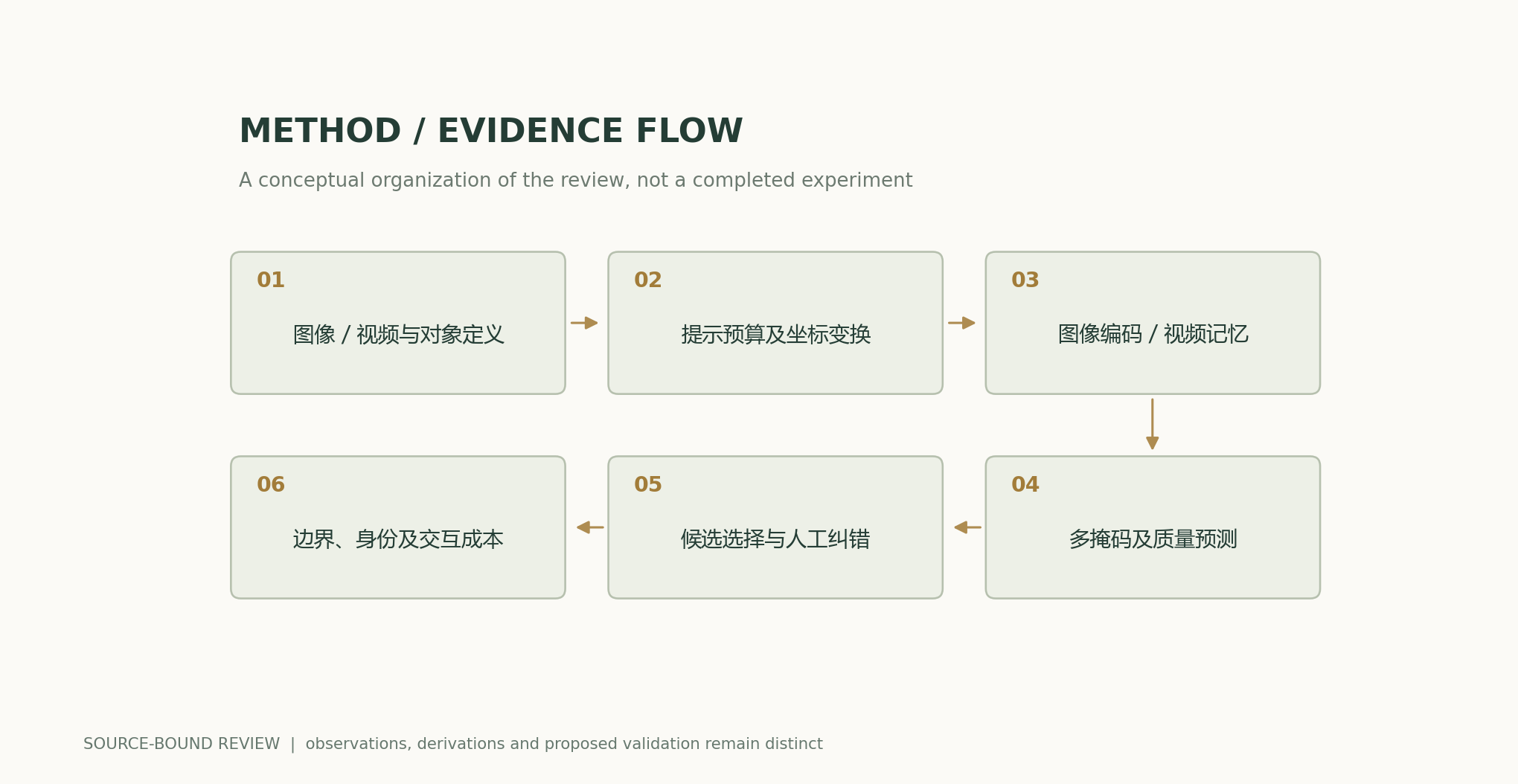
Analytical Figures and Numerical Examples
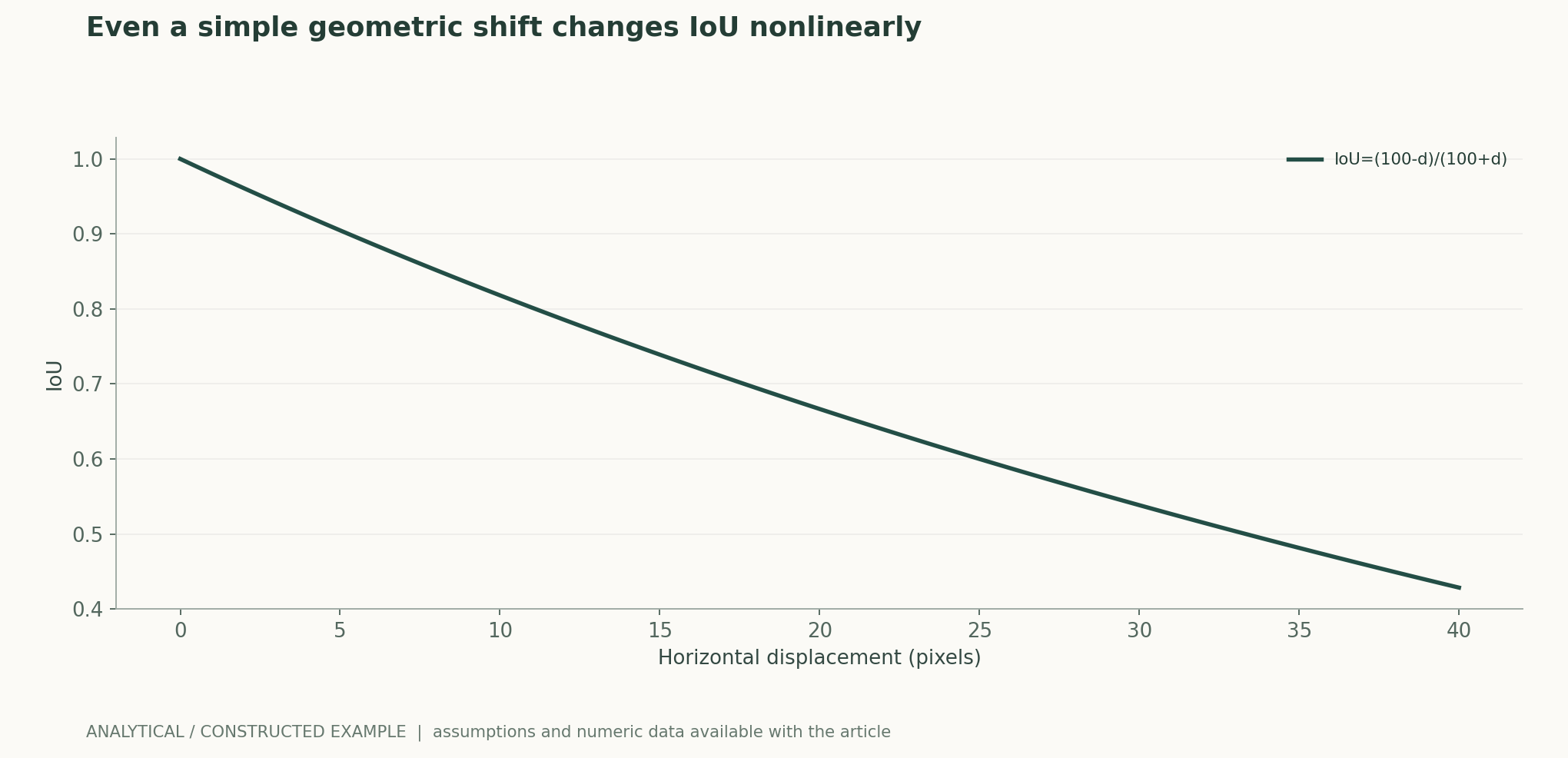
Recomputable Worked Example
For a horizontal shift of 10 pixels, IoU=90/110≈0.818; for a shift of 25 pixels, the value is 75/125=0.6. Complex boundaries and annotation ambiguity cannot be fully described by this rectangle model.
Method Comparison
| Method or judgment | Controlled variables and measurements | Failure conditions and interpretation |
|---|---|---|
| Prompting protocol | Fix point/box sources, interaction counts, and object definitions | Retrospective human selection inflates results |
| Candidate quality | Distinguish prediction-based selection from ground-truth-based best-candidate selection | Predicted scores are not annotations |
| Video memory | Test occlusion, reappearance, shot changes, and correction | Temporal consistency may persistently track the wrong object |
| Domain transfer | Independent domain annotations and risk stratification | Natural-image results cannot be directly extrapolated |
Verification and Experimental Plan
- Freeze the versions of the model, preprocessing, object definition, and legally obtained annotations.
- Split by source/video to prevent leakage of adjacent frames or variants of the same image.
- Fix prompt and candidate selection budgets in advance, and record all corrections.
- Test small targets, boundaries, occlusion, similar objects, reappearance, and new shots.
- Jointly report overlap, boundaries, identity loss, interaction counts, and stratified failures.
- Measure initial encoding and cached interaction costs separately, and check cache versions and coordinate transformations.
Scope and Limitations
- Rectangle IoU is not a SAM performance result.
- Temporal consistency does not prove identity correctness.
- Domain transfer requires independent annotations.
- Prompt and candidate budgets affect comparisons.
Primary Sources and Corresponding Claims
- Segment Anything, , , , , , , , , , , · 2023-04-05Abstract; 原文方法、理论和实验章节见作者原始论文链接
- SAM 2: Segment Anything in Images and Videos, , , , , , , , , , , , , , , , , L12: View a PDF of the paper titled SAM 2: Segment Anything in Images and Videos, by Nikhila Ravi and 17 other authors · 2024-08-01Abstract; 原文方法、理论和实验章节见作者原始论文链接
- Learning Transferable Visual Models From Natural Language SupervisionRadford et al. · 2021-02-26v1; contrastive training and zero-shot transfer
Citation and Article Export
BibTeXRISCSL JSONTXTArticle JSON
Author, Version, and Sources
AI-assisted research review; Codex (AI) wrote the article and performed analytical derivations based on the listed primary literature. This site has no record of independent peer review or original model experiments for this article.
Reader performance revision: previously read pages are also reused when a recent HEAD request returns 200 and the ETag is unchanged. The main text, equations, sources, and scientific figure data retain the content of the previous version.
The conceptual cover is separate from the scientific figures; scientific figures are calculated from public formulas and explicitly stated assumptions, and results from original papers are attributed to their sources.
Author, versions, and correction history · /guides/vision-segmentation-foundation/v1/
Cover and Scientific Figure Sources · Data, Sources, and Assumptions · Publication and Version History
Source revision: 6251a250b27bb8b449f59b392f81abd355383770