

Abstract
Structure prediction gives researchers access to important molecular hypotheses, but predicted structures, confidence, and experimental observations have different evidential standing. This article elaborates on the distinction between local error and relative inter-domain positions, the mathematical meaning of rigid alignment, and the experiments needed to move from static configurations to conclusions about interactions and function. The two-domain uncertainty matrix in the figure is an entirely constructed illustration intended to explain how to read the metrics; it does not correspond to any real protein, drug, or biological experiment, nor is it treated as evidence that this site has performed structure prediction or functional validation.[1] Highly accurate protein structure prediction with Alpha[2] Accurate structure prediction of biomolecular interacti[3] pLDDT: Understanding local confidence
English abstract
Protein-structure predictions are assessed at separate local, inter-domain and biological levels. The review distinguishes predicted confidence from errors measured against an experimental structure, explains why rigid alignment changes the question addressed by RMSD, and proposes versioned sequence, template and assay records. A constructed uncertainty matrix illustrates interpretation only and is not an AlphaFold prediction or experimental protein dataset.
1. What information AlphaFold 2 connects
AlphaFold 2 connects sequences, multiple sequence alignments, and residue-pair representations to three-dimensional coordinate prediction, using evolutionary and geometric information through its network architecture and training approach. Prediction does not directly deduce a unique, experimentally established native conformation from a sequence; input databases, templates, versions, and the target state still affect research interpretation. Structural evaluation in the paper and subsequent biological uses must be described separately.[1] Highly accurate protein structure prediction with Alpha
2. Local confidence is not a probability of function
EMBL-EBI interprets pLDDT as per-residue local confidence on a scale from 0 to 100. Values above 90 generally correspond to very high local accuracy; values above 70 generally support a reasonably good backbone prediction, although some side chains may be inaccurate. These interpretations do not mean that “this protein has a 90% probability of performing a particular function,” nor are they experimentally measured error bars. Dividing the score by 100 does not justify arbitrarily treating it as an event probability.[3] pLDDT: Understanding local confidence
3. How to interpret low-confidence segments
Different regions of the same protein chain can have different confidence levels. Low scores may indicate prediction uncertainty or may be associated with flexibility, disorder, or other conditions; a color map alone cannot establish the specific cause. This article recommends examining local regions according to the research question and incorporating independent information. Taking a single average over the entire protein can hide differences between critical and noncritical positions.[3] pLDDT: Understanding local confidence[1] Highly accurate protein structure prediction with Alpha
4. AlphaFold 3 expands the range of entities modeled
AlphaFold 3 uses a diffusion module to generate atomic coordinates directly, addressing a wider range of biomolecular interactions in a unified manner. The original paper also discusses the challenge of generative methods producing seemingly plausible structures in disordered regions, along with the training design used to address it. Broader capabilities do not mean that every generated conformation is correct; different tasks also have different sampling, ranking, and evaluation conditions.[2] Accurate structure prediction of biomolecular interacti
5. Prediction, interaction, and function cannot be linked by successive inferential leaps
A high-confidence structural hypothesis can help formulate experimental questions, but cannot by itself establish binding strength, reaction rates, or cellular effects. Beyond local geometry, relative conformations, environmental conditions, and dynamics also affect interpretation. Figure 1 organizes the evidence workflow linking prediction, confidence information, and independent experiments; Figure 2 is an explicitly constructed two-domain matrix. Each additional category of scientific conclusion requires corresponding independent measurements.作者分析与复核建议 / Author analysis
6. What to retain for a computational structural result
At a minimum, record sequences and modifications, model and database versions, template and alignment sources, random seeds, sampling counts, ranking rules, confidence metrics, and raw outputs. If only the best conformation is shown, explain how it was selected and whether the other candidates agree with one another. Reproduction requires an explicit definition of “the same run conditions”; retaining only an attractive structural rendering is insufficient. These are recommendations for reading the literature and maintaining records.作者分析与复核建议 / Author analysis
7. Defining the conclusions this article can support
This article summarizes model mechanisms and official interpretations of metrics. It makes no judgments about particular proteins, variants, or drugs, and has neither run AlphaFold nor generated new coordinates. The values in Figure 2 in this version are entirely constructed, replacing the confidence color-band illustration used in the previous version; they explain only the distinction between intra-domain and inter-domain information. New scientific claims should be assessed against original measurements, metric definitions, and task conditions, without treating a structural image as final evidence.[3] pLDDT: Understanding local confidence
The scale at which a metric applies is key to interpretation
Local structural metrics and metrics of relative inter-domain positions address different spatial scales. Even if two domains are each individually very stable, their relative placement may remain uncertain. Compressing all these issues into a single average score can cause readers to overlook relationships that actually affect research judgments. Confidence information should be selected according to the question, and raw outputs should be retained, rather than presenting only a visually polished final view.作者分析与复核建议 / Author analysis
What subsequent validation needs to answer
If a research claim concerns a particular interface or functional change, subsequent evidence should directly address that claim. Computational results used to propose hypotheses should be distinguished from new measurements used to test them, and circular justification using the same source should be avoided. Functional interpretations without independent evidence should explicitly retain the status of hypotheses. This article provides only principles for organizing evidence; it gives no specific experimental operating procedures and makes no extrapolations to clinical use.作者分析与复核建议 / Author analysis
8. Confidence and known error are not interchangeable
pLDDT is model-predicted information about local quality, not a measurement obtained by subtracting predicted coordinates from a known ground truth atom by atom. PAE expresses uncertainty in relative positions under specified alignment conditions and can help distinguish cases in which intra-domain structure is relatively reliable but inter-domain orientation is uncertain. High local confidence does not imply that the overall assembly, binding interface, or a particular conformation is correct. When interpreting these quantities, retain the model version, output definitions, and sequence context; scores from different methods or versions cannot be directly treated as equivalent probabilities without a basis for calibration.[1] Highly accurate protein structure prediction with Alpha[3] pLDDT: Understanding local confidence
9. Why alignment changes structural error
Coordinate error depends on which degrees of freedom are removed before comparison. RMSD after global rigid alignment is affected by flexible inter-domain motion; aligning each domain separately can instead conceal errors in relative inter-domain positions. Both comparisons can be meaningful, but they answer different questions. The atom set, missing residues, symmetry handling, and alignment strategy should be specified, and local and global results should both be reported when needed. When multiple experimental conformations exist, a single reference may also be insufficient to represent the true conformational distribution.[1] Highly accurate protein structure prediction with Alpha
10. What inferences still separate structure from function
A static structural hypothesis cannot by itself establish binding strength, reaction rates, localization under cellular conditions, or clinical effects. Complex or ligand predictions can generate testable interfaces, but whether binding occurs, persists under relevant conditions, and changes function each requires its own experiments. Researchers should list in advance which structural features will be tested, which observations will be used to judge them, and which alternative explanations remain. AF3 expands the range of entities modeled; it does not remove requirements concerning data coverage, conformational diversity, or experimental validation.[2] Accurate structure prediction of biomolecular interacti[1] Highly accurate protein structure prediction with Alpha
11. Verification requires retaining inputs and experimental context
The sequence version, homology information, template dates, and chain and ligand definitions on which a prediction depends all affect verification. Comparisons of approaches must guard against unfair advantages arising from target structures or similar information available before or after a cutoff date. Experimental results must also retain records of constructs, conditions, and structure-determination methods; structural differences between different constructs cannot simply be attributed to model error. For low-confidence regions, disorder, flexibility, and modeling failure can all be considered as possible explanations, without directly equating uncertainty with absence of function.[1] Highly accurate protein structure prediction with Alpha[2] Accurate structure prediction of biomolecular interacti[3] pLDDT: Understanding local confidence
Core equations and derivations
(1) p and q are two coordinate sets; R and t remove global rigid-body degrees of freedom. Atom selection and global or domain-wise alignment should be specified in advance; this measurement differs from model-predicted confidence.
LaTeX
\mathrm{RMSD}=\min_{R,t}\sqrt{\frac1n\sum_{i=1}^n\|Rp_i+t-q_i\|_2^2}(2) T_j denotes an illustrative transformation that aligns according to reference relationships near position j. PAE can help investigate uncertainty in relative positions; this equation explains only the alignment conditions and is not an implementation or calibration formula.
LaTeX
\Delta_{ij}=\left\|T_j(p_i)-q_i\right\|_2(3) These records should be retained separately; the existence of one cannot automatically be taken to mean that the others have been validated.
LaTeX
\mathrm{Evidence}=\{\mathrm{input\ version},\mathrm{prediction},\mathrm{confidence},\mathrm{experimental\ observation}\}Methods and evidence workflow
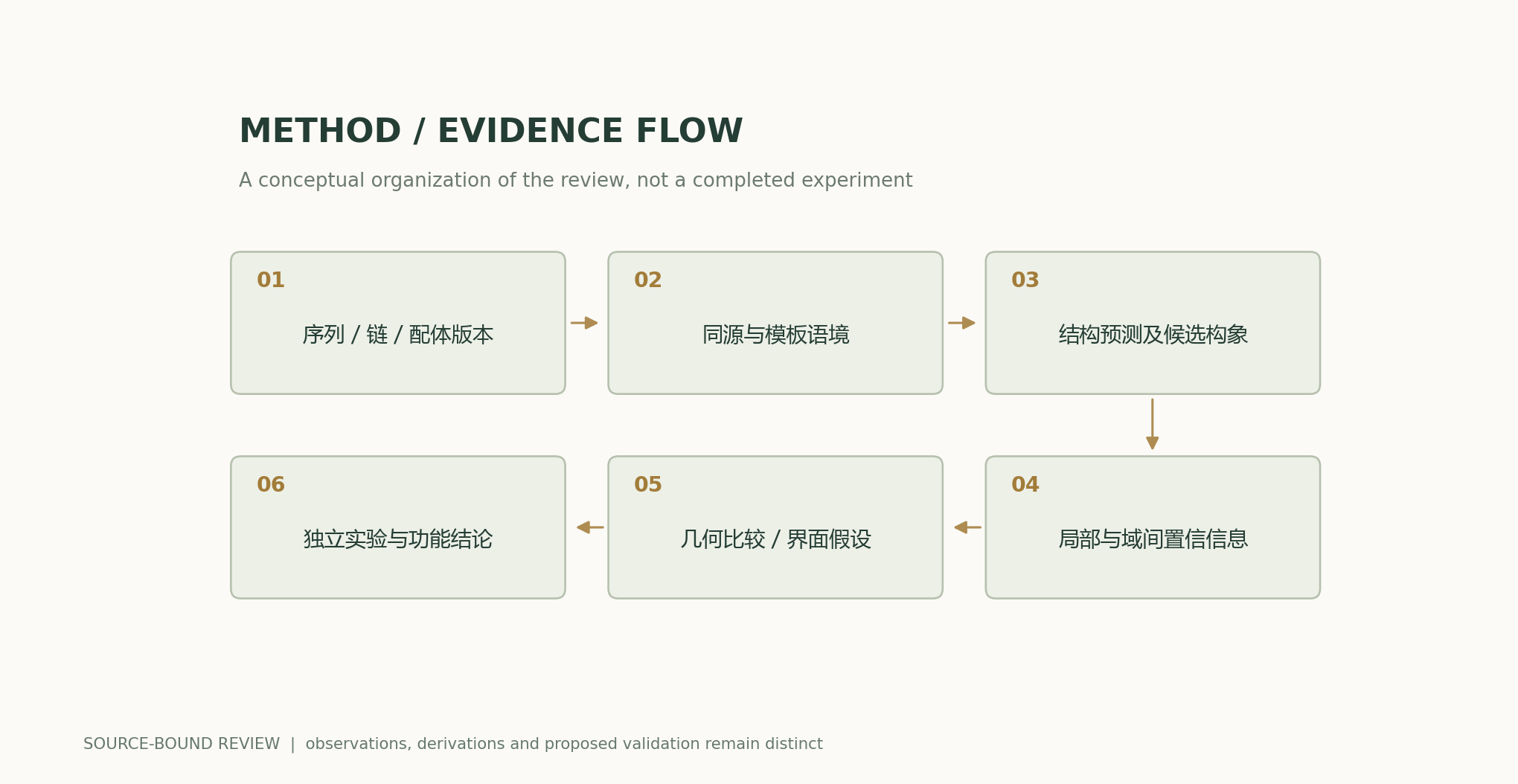
Analytical figures and numerical examples
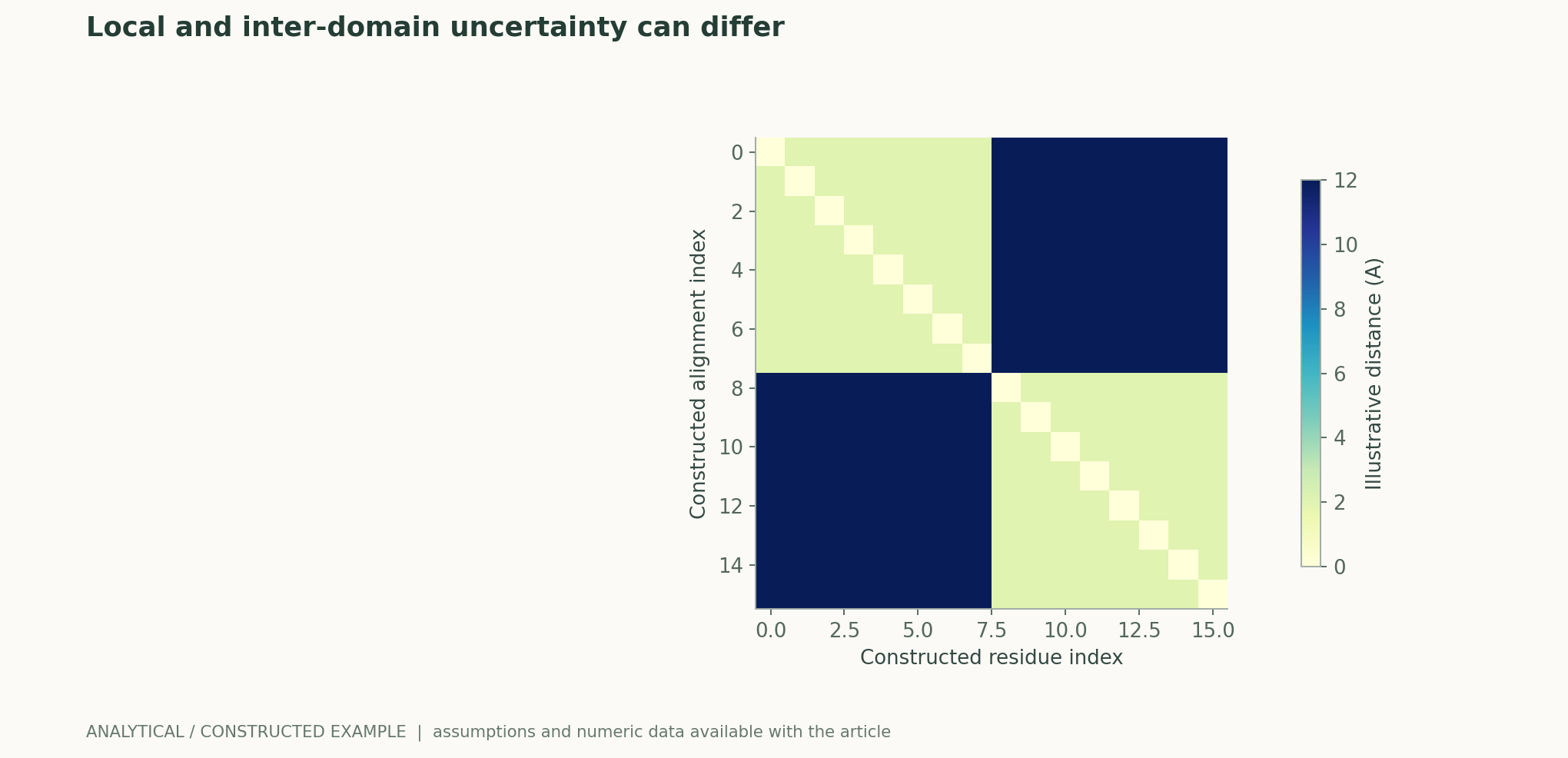
Recalculable worked example
The constructed matrix sets within-domain values to 2, between-domain values to 12, and diagonal values to 0, to distinguish local information from relative orientation. It is not a PAE output for any protein, and its colors cannot be used to infer binding, function, or drug efficacy.
Comparison of methods
| Method or judgment | Controlled variables and measurements | Failure conditions and interpretation |
|---|---|---|
| Local confidence | Retain the score definition and prediction version; examine individual regions | High local quality does not establish that the overall complex is correct |
| PAE or inter-domain relationships | Examine matrix blocks according to the specified alignment relationship | Intra-domain reliability does not guarantee a definite inter-domain orientation |
| Coordinate-based structural error | Specify the reference, atom set, and alignment method | A single RMSD may conceal local or assembly errors |
| Function and interactions | Design separate experiments for binding, activity, or cellular phenotypes | Structural visualization is not itself functional evidence |
Verification and experimental plan
- Retain the exact sequence, construct, chains and ligands, model version, parameters, and template dates; create a new record when input versions change.
- Examine local confidence and inter-domain uncertainty separately; do not replace analyses of interfaces, flexible regions, and critical sites with a single overall score.
- If an experimental reference is available, fix the atom set, symmetry handling, and alignment scheme, and report global and relevant local metrics separately.
- Propose structural hypotheses that can be experimentally falsified, and define measurements, controls, and decision rules for support or lack of support in advance.
- Retain experimental conditions separately for binding, activity, and cellular phenomena, and record negative results and alternative explanations.
- For every functional conclusion, identify individually whether it comes from prediction, existing literature, or actual experiments in the current work; this article provides only verification methods.
Scope and limitations
- The illustrative matrix is not a prediction for any real protein.
- Confidence cannot replace structural or functional experiments.
- Conformations, inputs, and experimental conditions affect comparisons.
- No new molecular experiments or judgments about drug efficacy or clinical effects are provided.
Mapping primary sources to claims
- Highly accurate protein structure prediction with AlphaFoldJumper et al. · 2021-07-15Nature 2021; network, Fig. 2 and limitations
- Accurate structure prediction of biomolecular interactions with AlphaFold 3Abramson et al. · 2024-05-08Nature 2024; diffusion module and limitations
- pLDDT: Understanding local confidenceEMBL-EBI Training · Official AlphaFold training; local confidence interpretation
Citation and article export
BibTeXRISCSL JSONTXTArticle JSON
Author, version, and sources
AI-assisted research review; Codex (AI) wrote the article and performed analytical derivations based on the listed primary literature. This site has no record of independent peer review or original model experiments for this article.
Reader performance revision: previously read pages are also reused when a recent HEAD response returns 200 and the ETag matches. The main text, equations, sources, and scientific figure data retain the content of the previous version.
The conceptual cover is separate from the scientific diagrams; scientific figures are calculated from publicly available equations and explicitly stated assumptions, and results from original papers are attributed to their sources.
Author, version, and correction history · /guides/alphafold-evidence-and-confidence/v5/
Sources for the cover and scientific figures · Data, sources, and assumptions · Publication and version history
Source revision: 6251a250b27bb8b449f59b392f81abd355383770