

Abstract
Learning models can prioritize candidates worth measuring within large chemical spaces, but predictions, in vitro activity, mechanisms of action, animal evidence, and clinical utility belong to different levels. This article compares research using interpretable graph models to discover structural classes with the work on the narrow-spectrum candidate abaucin, examining screening denominators, structural novelty, and mechanistic evidence. Calculations using assumed candidate proportions and classification errors show that high rankings do not guarantee high hit rates, much less directly establish clinical value. The figures and tables contain no real compound, drug-efficacy, or patient data, and this article offers no treatment recommendations.[1] Discovery of a structural class of antibiotics with exp[2] Deep learning-guided discovery of an antibiotic targeti
English abstract
AI-assisted antibiotic discovery ranks chemical hypotheses; measured activity, selectivity, mechanism and clinical usefulness remain separate endpoints. We compare explainable graph-model discovery with the narrow-spectrum abaucin study. A prevalence-dependent precision calculation explains why high ranking scores can yield modest screening hit rates, while a scaffold-selection analysis separates novelty from activity. All numerical illustrations use hypothetical compounds and probabilities. No molecule is proposed for treatment and no antimicrobial experiment is performed.
1. The scale of chemical-space searches is not the scale of experimental evidence
The explainable antibiotic study distinguished measurements of approximately forty thousand compounds, predictions for approximately twelve million compounds, and subsequent testing of 283 candidates. These quantities belong to training, computation, and validation, respectively, and cannot be added together as a count of experimental discoveries. This article recommends constructing a denominator table using the candidate-library version, structural deduplication, and the set actually submitted for testing. If only successfully tested compounds are published, readers cannot estimate ranking efficiency; if all high-scoring candidates are called antibiotics, the most critical measurement stage is bypassed. Here, the model is first and foremost a candidate-prioritization tool, whose value should be evaluated through the complete selection process.[1] Discovery of a structural class of antibiotics with exp
2. Structural interpretation provides testable clues, but does not yet establish a target mechanism
Wong and colleagues used graph methods to identify structural clues associated with activity and low cytotoxicity, and experimentally evaluated candidate classes. Substructure explanations can help compare chemical families and formulate subsequent hypotheses, but the associated fragments may also correlate with solubility, absorption, measurement interference, or other properties. This article argues for separating three claims: “the model relies on this fragment,” “this fragment changes experimental activity,” and “this fragment acts through a particular target.” Model responses to fragment deletion or modification support only the first claim; the latter two require corresponding independent measurements and the exclusion of alternative explanations.[1] Discovery of a structural class of antibiotics with exp
3. Narrow-spectrum candidates change the endpoint of success
The abaucin study targeted Acinetobacter baumannii, proposing a candidate through screening and model-based prioritization, then further investigating narrow-spectrum activity, mechanistic clues involving LolE, and evidence from a mouse wound model. Narrow and broad spectra do not form a simple ranking of superiority; they address different questions of selectivity. This article records target bacteria, non-target bacteria, host-related measurements, and conditions separately; a lack of inhibition of other organisms under one condition does not establish selectivity in all environments. The original study's preclinical evidence does not equate to efficacy in humans or clinical approval, neither of which can be supplied by a model name or animal results.[2] Deep learning-guided discovery of an antibiotic targeti
4. Derivation in this article: the scarcity of active candidates limits positive predictive value
Let π be the proportion of candidates in a library that truly meet the criteria, with screening sensitivity 0.8 and a false-positive rate of 0.05. At π=1%, the proportion of true positives among selected candidates is approximately 13.9%; at π=10%, it is approximately 64.0%. Even with exactly the same classification rule, changes in the chemical library and selection conditions can substantially change the hit rate. The figure juxtaposes prevalence and threshold errors, explicitly identifying all probabilities as constructed inputs. This relationship reminds researchers to reassess calibration on external candidate libraries rather than directly reuse training-set accuracy. A high AUROC alone also cannot determine the hit rate among top-ranked candidates under a fixed experimental budget.作者分析与复核建议 / Author analysis
5. Analysis in this article: scaffold novelty and out-of-distribution reliability are in tension
To find compounds distinct from known classes, researchers often deliberately favor novel scaffolds; however, moving farther from the training chemical space may also impair model calibration. This article proposes reporting ranking gains by both chemical family and distance from the training library. Novelty is not a one-dimensional objective for which more is always better: wholly unfamiliar structures may be difficult to measure, while local modifications to known scaffolds may produce valuable selectivity. Comparisons should predefine novelty calculations, deduplication, and family partitioning, rather than choosing the similarity metric that makes compounds appear most novel after observing success.作者分析与复核建议 / Author analysis
6. Activity endpoints must be tied to specific measurement conditions
Growth inhibition, killing, speed of action, and tolerance are different endpoints; candidate concentration, culture environment, and sample properties all affect interpretation. This article does not provide microbiological experimental procedures, but emphasizes that research records must retain precise endpoints and conditions. Compound aggregation, fluorescence, or other detection interference can produce artifacts and must be ruled out using measurements based on principles different from those of the original assay. If model ranking is based on one condition, transfer to another should be evaluated as a new task, rather than combining all forms of “activity” into a universal label.[1] Discovery of a structural class of antibiotics with exp[2] Deep learning-guided discovery of an antibiotic targeti
7. Docking and structural diagrams remain auxiliary support for hypotheses
Mechanistic interpretations often include molecular structures or docking diagrams, but PoseBusters points out that coordinate similarity must be accompanied by checks of chemical validity. Even if a candidate can adopt a plausible pose in a particular pocket, this cannot independently establish the true target, affinity, or ability to enter cells. This article recommends displaying docking, genetic clues, binding measurements, and cellular phenotypes in separate columns; each can support a hypothesis, but evidence cannot automatically be promoted across columns. When evidence conflicts, chemical states, measurement conditions, and alternative targets should be examined, rather than allowing the most attractive structural diagram to override negative results.[3] PoseBusters: AI-based docking methods fail to generate [2] Deep learning-guided discovery of an antibiotic targeti
8. Derivation in this article: validation-set selection changes the reportable hit rate
Suppose one ranking system tests the top 100 candidates and obtains 20 hits; another workflow first manually excludes 50 obviously difficult cases, then obtains the same 20 hits among the remaining 50. The hit rate for the top-ranked samples can be written as 40%, but the rate relative to the original budget remains 20%. This article uses a selection funnel to record the distinctions between the computational library, the available library, the library submitted for testing, and the actually measurable library. Unavailability for purchase, inadequate sample quality, and indeterminate outcomes should be recorded separately; they must neither be concealed nor all be blamed on the model. Only complete denominators permit comparisons between discovery workflows.作者分析与复核建议 / Author analysis
9. Independent confirmation is more persuasive than repeatedly optimizing the same measurement
Models can adapt to measurement characteristics by repeatedly optimizing the same endpoint, making it necessary to freeze them before testing samples from new batches or sources. This article proposes using independent chemical families and batches as comparison units, with confirmed activity and selectivity under preregistered conditions as the primary endpoints, and reporting mechanistic support and costs separately. Candidate cytotoxicity and other properties cannot be determined solely by a predictor; unmeasured properties must remain unknown. For conclusions about resistance and long-term effects, the observation window and sample scope must be explicit; a limited experiment should not support claims of unlimited durability.作者分析与复核建议 / Author analysis
Technical supplement A · Chemical splitting must prevent leakage between close neighbors
Salt forms, stereoisomers, and small modifications of the same scaffold may span training and testing, so random compound splits can exaggerate performance on new classes. This article recommends first fixing standardization and identity rules, then grouping by scaffold and similar families while retaining information on the nearest training neighbors. If certain properties are sensitive to stereochemistry, these forms must not all be merged simply to facilitate deduplication. Tests outside the training families should also check whether availability and measurement conditions are comparable; otherwise, performance changes may incorporate sample bias rather than solely reflect chemical generalization.作者分析与复核建议 / Author analysis
Technical supplement B · Multiobjective screening must preserve unmeasured properties as unknown
A candidate's activity, selectivity, host-related effects, and availability can conflict. Combining multiple prediction scores into a single weighted value obscures trade-offs, and the weights may arbitrarily determine the winner. This article recommends first displaying the candidate set that satisfies minimum constraints, then comparing the Pareto frontier and measured support; unmeasured dimensions should be marked unknown and cannot be offset by a good score on another dimension. Fixed weights may be used for a clearly defined task, but must be established before external candidate testing and accompanied by a separate sensitivity analysis.作者分析与复核建议 / Author analysis
Technical supplement C · Fragment interpretations require consideration of the accompanying effects of structural changes
Deleting a substructure changes many physicochemical properties simultaneously, so a decline in experimental activity does not necessarily mean that the fragment directly recognizes a specific target. This article proposes treating local changes, overall properties, and measurement interference as parallel explanations and distinguishing them through appropriate independent evidence. Model explanations can prioritize informative controls, but cannot replace these measurements. Deleting a fragment only within the model reveals model dependence; even if experimental results also change, samples and conditions must still be examined before further mechanistic discussion.[1] Discovery of a structural class of antibiotics with exp
Technical supplement D · Candidate selection should be frozen before external confirmation
Repeatedly screening the same validation library gradually turns it into training feedback. This article recommends freezing candidates, rankings, and thresholds after the final model adjustment, then submitting them for independent measurement and confirmation; summaries of all predictions should be saved beforehand to prevent publication of hits alone. Appropriate statistics on failed scaffolds and unmeasurable cases should also be made public to help subsequent research understand the boundaries. This distinguishes the method's own external capability from eventual success after prolonged human trial and error, without denying the legitimate role of iteration during exploration.作者分析与复核建议 / Author analysis
10. Conclusion: AI prioritization should serve more reliable chemical evidence
The value of AI antibiotic discovery lies in making limited measurement resources more likely to uncover chemical directions worth investigating, rather than directly turning computational candidates into drug conclusions. This article links structural interpretation, screening probabilities, and validation levels, emphasizing that every success requires accurate denominators and independent evidence. The measurements and preclinical achievements in the original papers belong to their original teams; this article's analytical counterexamples serve only to improve research design. Publicly verifiable failures, selection processes, and corrections will advance genuine discovery more effectively than ever-growing counts of predicted candidates.作者分析与复核建议 / Author analysis
Core equations and derivations
(1) Sensitivity s, false-positive rate f, and the proportion π of candidates meeting the criteria jointly determine the hit rate among selected candidates.
LaTeX
\operatorname{PPV}=\frac{s\pi}{s\pi+f(1-\pi)}(2) The measured proportion meeting the criteria among the top K candidates under a fixed budget; ranking and the handling of unmeasurable cases must be predefined.
LaTeX
\operatorname{Precision@K}=\frac1K\sum_{i=1}^{K}y_{(i)}(3) Tanimoto similarity for binary fingerprint sets; changes to fingerprint and scaffold definitions change how novelty is assessed.
LaTeX
T(A,B)=\frac{|A\cap B|}{|A\cup B|}(4) The conditional chain of selection, measurability, and independent confirmation; complete denominators should be retained at every stage.
LaTeX
P(\mathrm{confirmed})=P(S)P(M\mid S)P(C\mid M,S)Methods and evidence workflow
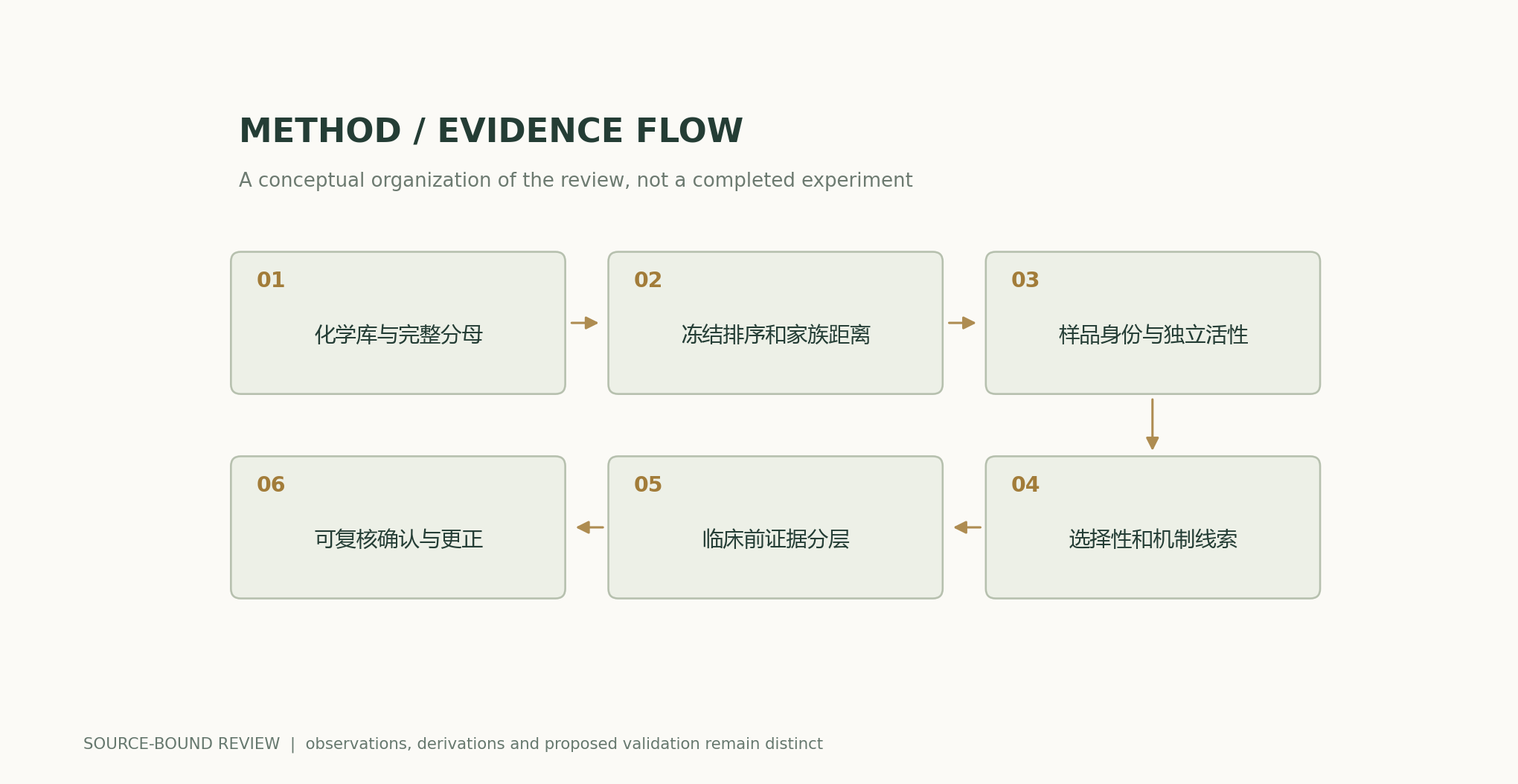
Analytical plots and numerical examples
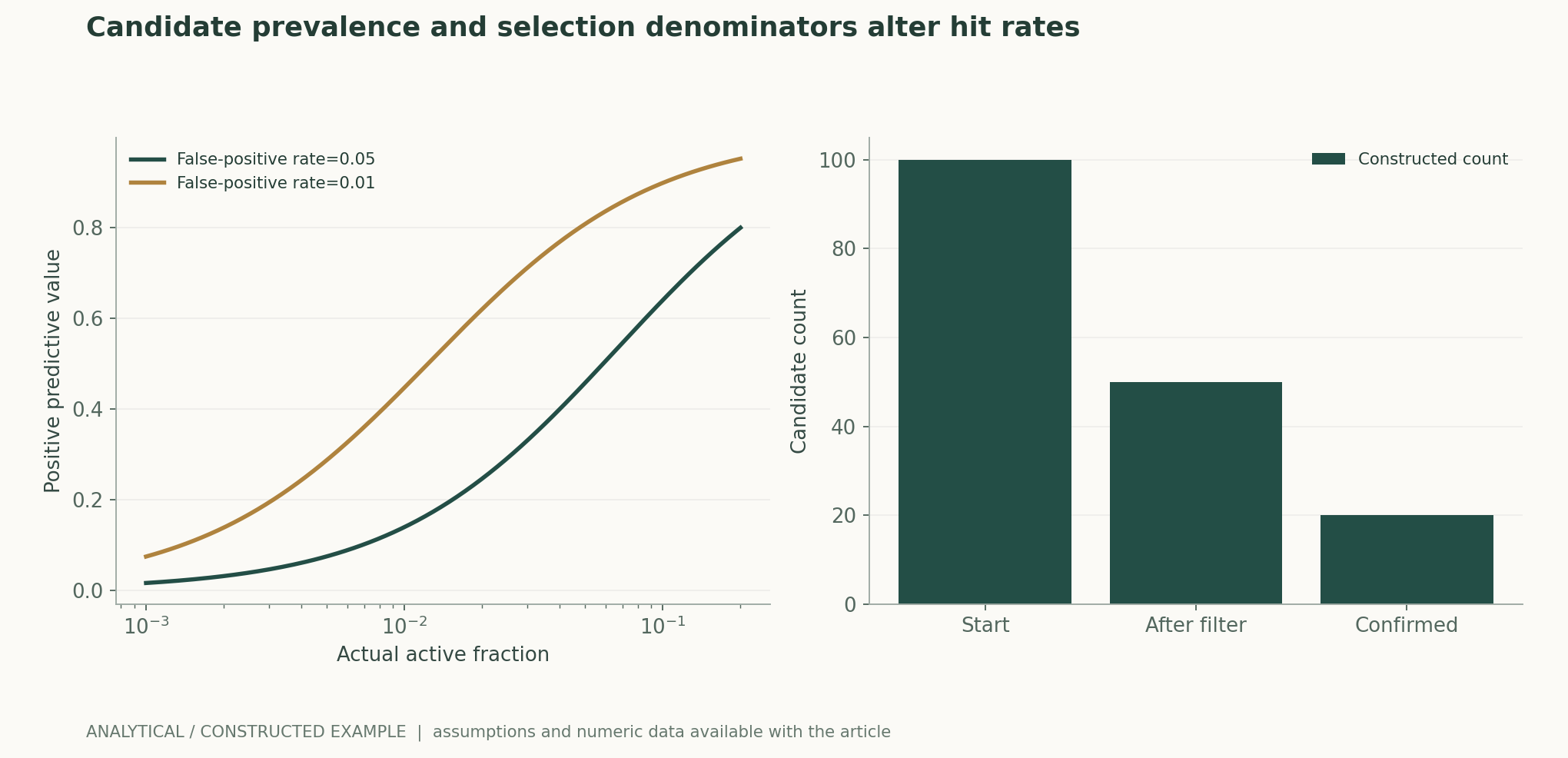
Recomputable worked example
When the active proportion is 1%, with s=0.8 and f=0.05, PPV is approximately 0.139130; when the active proportion is 10%, it is approximately 0.64. 20/50=40% and 20/100=20% use different denominators.
Method comparison
| Level | Conclusion that can be supported | Still requires independent proof |
|---|---|---|
| High computational score | Worth prioritizing for measurement | True activity |
| Measured activity | Effect under specified conditions | Performance across broad conditions and selectivity |
| Structural-fragment interpretation | Clues to model associations | Target mechanism |
| Narrow-spectrum or host measurements | Selectivity among the organisms measured | Performance across all environments and over the long term |
| Animal model | Preclinical evidence in that model | Effects in humans |
| Discovery workflow | Confirmed yield within budget | Clinical approval or treatment recommendations |
Verification and experimental plan
- Freeze the candidate library, structural standardization, deduplication, and chemical-family partitioning.
- Preregister activity and selectivity endpoints, retaining measurement conditions without merging different tasks.
- Report five denominators: computed, available, submitted for testing, measurable, and confirmed.
- Evaluate calibration and fixed-budget Precision@K on external scaffolds.
- Rule out detection interference using independent samples and measurements based on different principles.
- Separate fragment interpretation, docking, mechanistic clues, and functional evidence.
- Use families and batches as statistical units, retaining unmeasurable cases and negative results.
- Disclose accurate sources and corrections, keep unmeasured properties unknown, and make no claims of clinical use.
Scope and limitations
- The probabilities and screening funnel in this article are not real drug-performance data.
- No new antibacterial compounds are proposed, synthesized, or tested.
- The original studies' animal and mechanistic evidence cannot be directly transferred to humans.
- Novelty and calibration depend on the candidate library and structural representation.
- This article analyzes research methodology and provides no diagnostic, treatment, or microbiological procedural guidance.
Evidence from the original studies and its scope
| Original study results | Scope | Source and location |
|---|---|---|
| 39,312 measurements, 12,076,365 predictions, and 283 subsequent tests belong to different stages. | Computational counts are not treated as counts of measured discoveries. | Discovery of a structural class of antibiotics with explainable deep learningAbstract |
| Reports a narrow-spectrum candidate, mechanistic clues, and evidence from a mouse wound model. | Does not establish clinical efficacy in humans or approval. | Deep learning-guided discovery of an antibiotic targeting Acinetobacter baumanniiAbstract; characterization |
Research questions worth testing
- With family distance held fixed, can interpretable fragments improve the independent confirmation rate?
- Does calibration mismatch or sample measurability more strongly limit yield from external chemical libraries?
- With fully matched budgets, does multiobjective screening improve independently confirmed activity and selectivity?
Primary sources and corresponding claims
- Discovery of a structural class of antibiotics with explainable deep learningWong et al. · 2023-12-2039,312 measured compounds; 12,076,365 predicted; 283 tested; preclinical activity and structural rationales.
- Deep learning-guided discovery of an antibiotic targeting Acinetobacter baumanniiLiu et al. · 2023-05-25Narrow-spectrum lead, LolE-related mechanism and mouse wound-model evidence; not a clinical approval.
- PoseBusters: AI-based docking methods fail to generate physically valid poses or generalise to novel sequencesButtenschoen, Morris and Deane · 2024Physical validity tests, benchmark scope and sequence novelty; not a benchmark of every later model.
Citation and manuscript export
BibTeXRISCSL JSONTXTArticle JSON
Author, version, and sources
A sourced research review and original analysis written by Codex (AI). Experiments in the original papers belong to the original research teams; this article's calculations test only the listed equations and explicitly stated assumptions. This site currently has no independent peer review of this article or records of original models, clinical experiments, or physical experiments for it.
First published: in-depth feature on AI and scientific discovery; preserves section-level sources and the boundaries between original research evidence and the author's analysis.
The conceptual cover was generated by ImageGen. Scientific figures were plotted using the accompanying code and numerical files; captions specify assumptions and measurement definitions item by item.
Sources of the cover and scientific figures · Data, sources, and assumptions · Python · Recomputable code · Publication and version history
Source revision: b7b48f7205d705b2a3d3e8de0be5e1b458e4869c