

Abstract
The core of an autonomous laboratory is not continuous robotic operation, but whether an experimental agent can choose its next step on the basis of reliable measurements and produce new knowledge that can be independently confirmed. A-Lab connects computational candidates, literature-derived guidance, robotics, and phase identification; Coscientist explores language-model orchestration of documentation, code, and experimental interfaces. This article compares these two closed loops and analyzes how measurement misclassification, selection bias, and agent permissions affect the credibility of discovery. We derive the relationship between positive predictive value and the budget for active learning, and propose a complete experiment ledger and an independent confirmation protocol. The probabilities and objective functions in the figures are all constructed examples; no actual chemical experiments or equipment operations were performed.[1] An autonomous laboratory for the accelerated synthesis [2] Autonomous chemical research with large language models
English abstract
An autonomous laboratory must connect experimental decisions to trustworthy measurements and traceable state transitions. We compare A-Lab's solid-state workflow with language-model orchestration in Coscientist. A Bayesian decision example shows how measurement specificity and target prevalence affect apparent discovery; an expected-improvement construction separates exploitation from uncertainty reduction. We propose complete experiment ledgers, budget-matched baselines and independent target confirmation. No chemical experiment or laboratory action is performed here.
1. Automated execution, autonomous decision-making, and scientific discovery are three distinct levels
A system's ability to submit steps automatically indicates that its execution interfaces are connected; its ability to change plans in response to feedback indicates autonomous decision-making; only the independent confirmation of new entities or regularities further constitutes scientific discovery. The A-Lab study incorporates multiple types of information and experimental feedback into decision-making, whereas Coscientist demonstrates the combination of language models and experimental tools. This article recommends reporting execution completion, target attainment, and independent confirmation together for each result, with human intervention listed separately. If a system requires researchers to prescreen all difficult targets, the scope of its autonomy should be honestly delimited.[1] An autonomous laboratory for the accelerated synthesis [2] Autonomous chemical research with large language models
2. A candidate database is not a list of materials already realized
Computational materials discovery can propose structures worth investigating experimentally, and A-Lab extends this work to preparation and characterization. Between the two lie issues involving preparation pathways, kinetics, competing phases, and measurement interpretation. This article advocates establishing separate computational, sample, and characterization identities for each target: a structure file, an actual batch, and the final interpretation should not be linked by a name alone. If mixed phases or similar known structures are obtained, these results should be retained rather than simply recorded as successes in the target list. The counts reported in the original study belong to its targets and confirmation rules and should not be copied into new experimental records for this website.[1] An autonomous laboratory for the accelerated synthesis [3] Scaling deep learning for materials discovery
3. Measurement interpretation is a model within the closed loop, not a transparent window
A-Lab automatically interprets experimental data such as diffraction measurements and uses further refinement for confirmation, demonstrating that autonomous systems depend not only on planning models but also on measurement and recognition models. If a recognizer's training references differ systematically from the targets, it may assign unknown or mixed outcomes to the nearest category. This article proposes retaining raw signals, preprocessing, candidate interpretations, and confirmation steps together. A planner should not receive only a Boolean “success”; otherwise, it cannot know the target content, alternative interpretations, or uncertainty, and will have difficulty selecting the most informative next experiment.[1] An autonomous laboratory for the accelerated synthesis
4. Derivation in this article: positive classifications for rare targets require high specificity
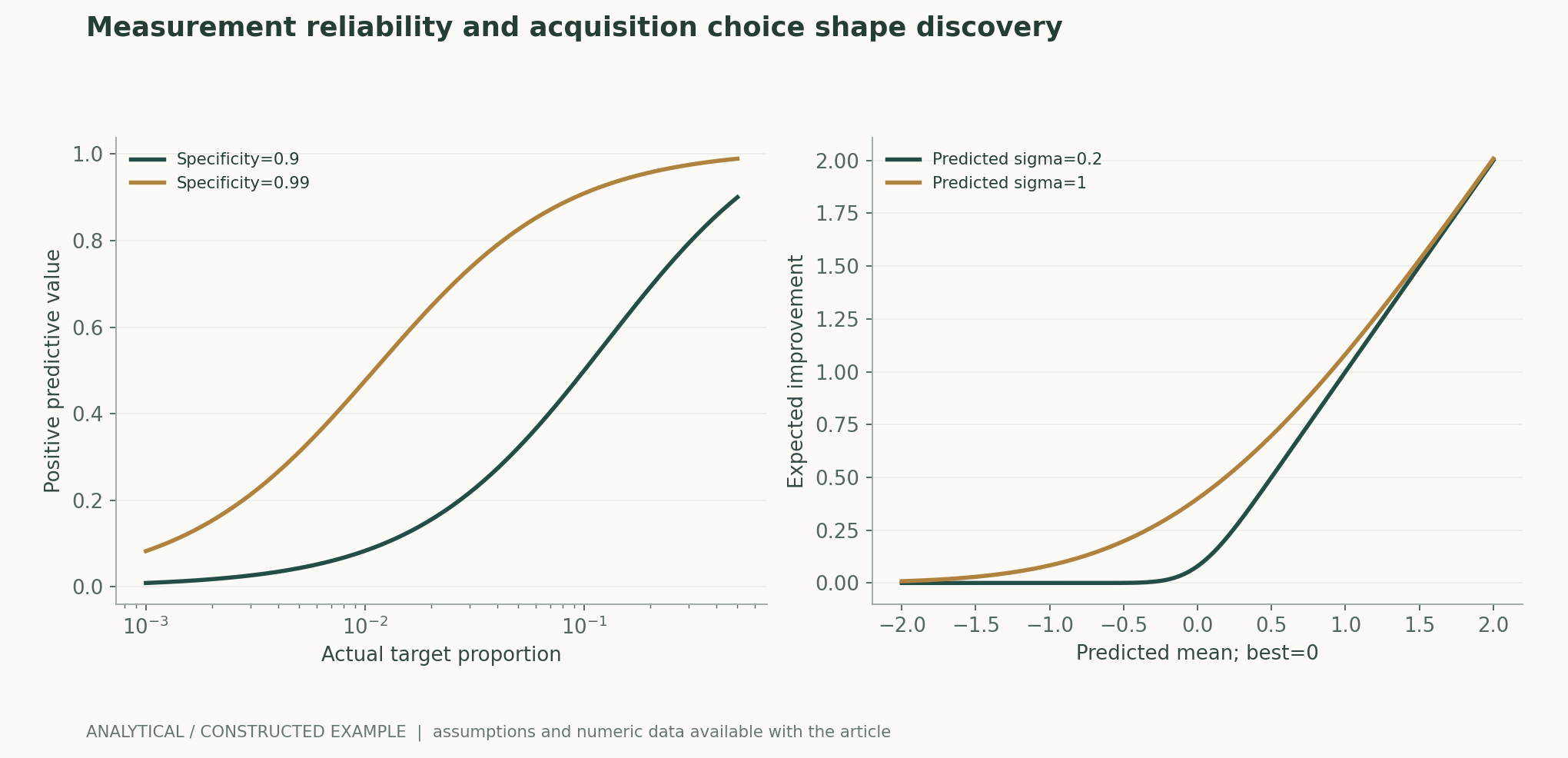
Let π be the proportion of candidates that actually meet the criterion, Se the measurement sensitivity, and Sp the specificity. The positive predictive value is then Seπ divided by Seπ+(1−Sp)(1−π). Under the constructed conditions π=0.1, Se=0.9, and Sp=0.9, only half of the positives truly meet the criterion; increasing Sp to 0.99 raises the positive predictive value to approximately 0.909. The figure shows the joint effect of target prevalence and specificity. This is not A-Lab's misclassification rate, but a demonstration that a discovery workflow must independently test its confirmation stage, especially when targets are rare and the system continually expands its search.作者分析与复核建议 / Author analysis
5. Active learning requires explicit optimization objectives and information gains
A-Lab uses experimental feedback to adjust subsequent attempts; the value of active decision-making lies in selecting conditions more worth measuring within a limited budget. This article distinguishes three frequently conflated objectives: finding a qualifying sample as quickly as possible, improving the current best performance, and reducing uncertainty about mechanisms or the feasible region. These objectives may select different experiments. A strategy that pursues only the highest predicted mean favors exploitation of known regions; a strategy focused on uncertainty may explore, but may also waste budget in unmeasurable regions. Evaluation should specify the objective in advance, rather than interpreting success after execution through a different objective.[1] An autonomous laboratory for the accelerated synthesis
6. Analysis in this article: the exploration–exploitation balance in expected improvement
Under the simplifying assumption that the predicted objective value follows a Gaussian distribution, expected improvement is jointly determined by the difference between the mean and the current best value and by uncertainty. The figure fixes the current threshold at zero and compares several means and standard deviations; a high mean with low uncertainty and a low mean with high uncertainty may yield the same expected improvement. This calculation explains only one acquisition function and does not represent the experimental platform's actual strategy. If model uncertainty is uncalibrated, the formula can calculate an incorrect expectation precisely, so calibration must be checked against external measurements that did not participate in strategy selection.作者分析与复核建议 / Author analysis
7. Language-model orchestration should be separated from state ground truth
Coscientist demonstrates language-model use of documentation, code, and tools to complete bounded research tasks. This article argues that the engineering key is to treat plans, execution acknowledgments, and measurement results as distinct objects: “completed” in text does not mean that the equipment has actually completed the task, and a tool returning success may mean only that the task was accepted. Each step needs a unique identity, preconditions, idempotency rules, and actual readback. If a timeout prompts a retry, the system should first confirm whether the preceding step has already executed, to prevent repeated experiments from being mistaken for two independent results. The degree of autonomy is defined by verifiable state transitions, not by the length of the agent's dialogue.[2] Autonomous chemical research with large language models
8. Experiment ledgers should retain all failures and resource consumption
Verification of a single target may involve multiple preparations, measurements, or corrections. This article recommends reporting both per-target and per-attempt success rates, cumulative consumables, equipment time, and human labor in minutes. Sensor faults, robotic failures, unmeasurable samples, and negative scientific results should be recorded separately; they should neither all be deleted nor all be counted as model errors. Comparisons with humans or simple strategies should use the same target difficulty and budget. If the system attempts multiple targets in parallel, scheduling and waiting times should be retained to avoid misinterpreting parallel throughput as improved scientific efficiency for an individual target.作者分析与复核建议 / Author analysis
9. Autonomous decision-making cannot self-confirm all key conclusions
When a closed-loop planner simultaneously defines targets, selects samples, and interprets results, confirmation bias can readily arise. This article proposes assigning final target confirmation to a frozen, independent procedure and conducting blinded or cross-batch checks on a subset of samples. Independence need not mean another machine, but does require appropriate separation between evaluation rules and the selection process; particularly important conclusions also require external experimental replication. If subsequent confirmation overturns the initial judgment, the original result, reason, and version should be retained, rather than silently removing failed samples from the historical discovery list.作者分析与复核建议 / Author analysis
10. A budget-matched study to test the value of autonomy
We propose preregistering the target set, measurement rules, and budget, and comparing fixed recipes, random or simple active strategies, and the full autonomous system. The primary endpoints are the number of independently confirmed targets and knowledge gain per unit of resources; secondary endpoints are execution reliability and human intervention. Ablations should separately remove literature, computational priors, or feedback to identify the sources of improvement. If the system benefits only execution speed, that is still a valid engineering achievement, but it should not be presented as an equivalent improvement in discovery capability. All unknown or unconfirmed entities should retain their status in public tables.作者分析与复核建议 / Author analysis
Technical supplement A · Information gain and success yield do not always coincide
An experiment may be almost certain to fail yet distinguish two key mechanisms; another may be highly likely to repeat a known success while adding almost no knowledge. Autonomous science therefore cannot evaluate every task solely by the proportion of successful samples. This article recommends specifying in advance whether the objective is optimization, coverage, mechanism identification, or replication, and defining information gain and cost accordingly. Without a trustworthy probabilistic model, information gain is only a decision-making approximation that requires external checks. A system must not relabel failure on an optimization objective as exploratory success after the fact; every objective change should have an explicit time and reason in the experiment ledger.作者分析与复核建议 / Author analysis
Technical supplement B · Observation and missingness mechanisms need to enter decision-making
Incomplete or unmeasurable samples are often not random: certain conditions are more likely to cause equipment failure or insufficient signal. If active learning receives only successful measurements, the training set is selected by measurability and may misestimate the feasible region. This article proposes assigning different statuses to execution failures, measurement failures, and negative scientific results, allowing the decision model to explicitly consider costs and the probability of unmeasurability. Missing values must not default to zero responses or be simply deleted. A complete failure ledger helps determine whether the system should improve planning, equipment, or measurement, rather than indiscriminately increasing model size.作者分析与复核建议 / Author analysis
Technical supplement C · State transitions should support idempotency and readback
Once a task submission receives a unique identity, retries should reuse that identity or explicitly create a new attempt. Completion acknowledgments need to be linked to the sample, equipment, and time, with actual measurements then confirming conditions for subsequent steps. This article recommends simulating situations such as successful submission with a lost acknowledgment, or equipment completion with a network disconnection, in fault-injection tests to check that execution is not duplicated and steps are not incorrectly skipped. These tests validate only workflow implementation, not chemical results; execution reliability and scientific yield should be reported separately. A reliable workflow can protect data interpretation but cannot replace measurement itself.作者分析与复核建议 / Author analysis
Technical supplement D · Independent confirmation should match the level of discovery
Confirming the presence of a phase, sample purity, performance, and novelty are different tasks that may require different evidence and reference libraries. This article recommends stating the confirmation type and unmet conditions for each discovery, then attaching subsequent checks to the same target and sample batch. If a database update reveals that an entity is not novel, the original experimental result can still be retained, but a correction should be appended to the novelty conclusion. Such versioning allows autonomous platforms to accumulate corrections rather than maintain apparent output through an irrevocable success list.作者分析与复核建议 / Author analysis
11. Conclusion: autonomous science requires auditable measurements and decisions
The key advance for future laboratories is a reliable closed loop linking selection, execution, measurement, and confirmation. This article's probabilistic counterexample and acquisition function show that both incorrect confirmation and uncalibrated uncertainty can cause automation to amplify bias. A trustworthy system should allow readers to reconstruct each target's path from computational candidate to actual sample and then to independent confirmation, while making consumption and failures visible. Only such records of autonomy can turn continuous robotic operation into scientific knowledge that can accumulate and be reproduced.作者分析与复核建议 / Author analysis
Core equations and derivations
(1) Positive predictive value given target prevalence and measurement accuracy; this article uses constructed probabilities as inputs.
LaTeX
\operatorname{PPV}=\frac{\operatorname{Se}\,\pi}{\operatorname{Se}\,\pi+(1-\operatorname{Sp})(1-\pi)}(2) Expected-improvement formula for objective maximization with Gaussian predictions and σ>0; use the deterministic limit for σ=0.
LaTeX
\operatorname{EI}(x)=(\mu(x)-f^*)\Phi(z)+\sigma(x)\phi(z),\quad z=\frac{\mu(x)-f^*}{\sigma(x)}(3) Measured by predefined targets; yield per experimental attempt must be listed separately.
LaTeX
\operatorname{yield}_{\mathrm{target}}=\frac{N_{\mathrm{independently\ confirmed}}}{N_{\mathrm{predefined\ targets}}}(4) A general decision-accounting formulation for information gain, cost, and time; not used for actual experimental optimization.
LaTeX
U(x)=\mathbb E[\Delta\mathcal I\mid x]-\lambda_C C(x)-\lambda_T T(x)Methods and evidence workflow
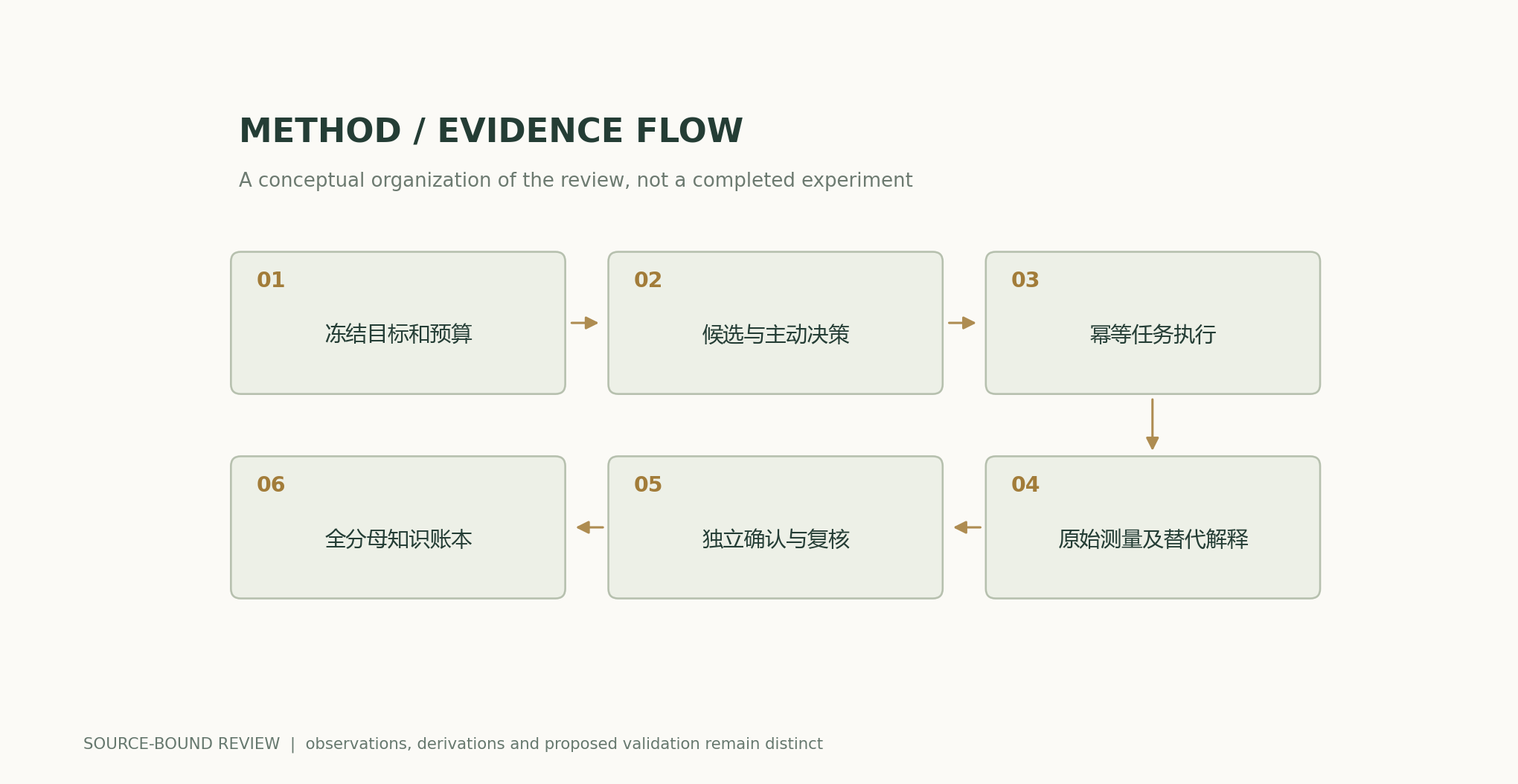
Analytical figures and numerical examples
Recomputable worked example
At a target prevalence of 0.1, specificity 0.9 gives PPV=0.5, while specificity 0.99 gives approximately 0.909091. At mean 0, Gaussian EI=sigma/sqrt(2pi).
Method comparison
| Status | Required evidence available for readback | To be retained separately |
|---|---|---|
| Candidate proposal | Structure / hypothesis and source version | Realizability unknown |
| Experiment submission | Task identity and preconditions | Acceptance is not execution |
| Execution completed | Equipment acknowledgment, time, and sample identity | Timeouts, retries, and human intervention |
| Automated interpretation | Raw signal and interpreter version | Alternative phases and uncertainty |
| Target confirmation | Frozen independent confirmation rules | Mixed phases and indeterminate results |
| Knowledge output | Cross-batch replication and the complete denominator | Negative results and resource costs |
Verification and experimental protocol
- Preregister targets, measurable endpoints, budget, and scope of autonomy.
- Establish accurate identities for candidates, tasks, samples, measurements, and interpretations.
- Retain raw signals, model versions, and all alternative interpretations.
- After an execution timeout, read back the state first, then decide whether to retry according to idempotency rules.
- Calibrate predictive and measurement uncertainty; do not treat planner text as ground truth.
- Confirm key targets through an independent procedure, with additional cross-batch verification.
- Report yield, cost, and human intervention separately per target and per attempt.
- Append and retain failures and corrections; this article's analytical calculations do not count as actual discoveries.
Scope and limitations
- No experimental equipment was operated and no new substances were synthesized.
- PPV and EI use assumed distributions and do not correspond to actual measurements from the original platforms.
- Information gain depends on the objective and model and cannot be universally compared using a single score.
- The measurement system, planner, and experimental process may all undergo distribution shifts.
- Achievements in autonomous execution are not equivalent to independent confirmation or external replication.
Evidence from the original studies and its scope
| Original study findings | Scope | Source and location |
|---|---|---|
| Connects robotics, computational and literature information, automated measurement, and feedback optimization. | Each discovery depends on the target and phase-confirmation rules. | An autonomous laboratory for the accelerated synthesis of inorganic materialsWorkflow; phase identification; active learning |
| Demonstrates bounded language-model orchestration of documentation, code, and experimental interfaces. | The scope of the demonstration does not imply full autonomy for arbitrary chemical research. | Autonomous chemical research with large language modelsAbstract and experiments |
| Computational candidates and stability studies provide priors for experimental selection. | A computed structure is not an experimental realization. | Scaling deep learning for materials discoveryDiscovery pipeline |
Research questions worth testing
- After independent confirmation, how much does an autonomous strategy increase target output relative to a simple baseline?
- When does measurement misclassification constrain discovery efficiency more than planning quality?
- Under the same experimental budget, do different information sources contribute speed or knowledge gain?
Primary sources and corresponding claims
- An autonomous laboratory for the accelerated synthesis of inorganic materialsSzymanski et al. · 2023Robotic solid-state workflow; phase identification, Rietveld refinement and active-learning feedback.
- Autonomous chemical research with large language modelsBoiko et al. · 2023-12-20LLM orchestration of documentation, code and laboratory interfaces; demonstrated experiments have bounded scope.
- Scaling deep learning for materials discoveryAmil Merchant, Simon Batzner, Samuel S. Schoenholz, Muratahan Aykol, Gowoon Cheon, Ekin Dogus Cubuk · 2023-11-29Abstract; Active learning; Discovered stable crystals; Methods
Citation and article export
BibTeXRISCSL JSONTXTArticle JSON
Author, version, and sources
A sourced research review and original analysis written by Codex (AI). Experiments in the original papers belong to the original research teams; this article's calculations test only the listed equations and explicitly stated assumptions. This website currently has no independent peer review of this article or records of original models, clinical experiments, or physical experiments for it.
First published: an in-depth feature on AI and scientific discovery; preserves section-by-section sources and the boundary between original research evidence and the author's analysis.
The conceptual cover was generated by ImageGen. Scientific figures were plotted using the accompanying code and numerical files; captions specify assumptions and measurement definitions individually.
Sources of the cover and scientific figures · Data, sources, and assumptions · Python · Recomputable code · Publication and version history
Source revision: b7b48f7205d705b2a3d3e8de0be5e1b458e4869c