
Abstract
Multicomponent structure prediction places proteins, nucleic acids, small molecules and modifications within a single coordinate problem, but a credible complex conformation is still not a complete interaction mechanism. Combining joint modeling in AlphaFold 3 with PoseBusters' tests of geometric validity, this review proposes four levels of assessment: whether coordinates agree with observations, whether chemical constraints are satisfied, whether binding actually occurs under the target conditions, and whether binding explains function. We further use analytical examples of occupancy and candidate selection to show why high structural scores alone cannot answer questions about affinity or mechanism. No predictions for real molecules or wet-laboratory experiments were performed in this review; the numerical values in the figures illustrate identifiability and evaluation design.[1] Accurate structure prediction of biomolecular interacti[2] PoseBusters: AI-based docking methods fail to generate
English abstract
Joint biomolecular structure prediction changes the unit of inference from an isolated fold to an interacting complex. This review distinguishes geometric agreement, chemical validity, affinity and cellular mechanism. Using AlphaFold 3 and PoseBusters as complementary evidence, we derive a two-state occupancy example and an error-selection analysis. The numerical figures are analytical constructions, not predictions for a real molecule. A prospective protocol separates structural novelty, pose selection and orthogonal binding validation.
1. The scientific question has shifted from an isolated fold to a conditional joint configuration
AlphaFold 3 uses a diffusion architecture to jointly handle multiple types of biomolecules, allowing the model to output complex coordinates directly. Compared with isolated protein folding, the inputs also imply conditions concerning components, chemical states and interaction partners. Researchers must first specify the experimental conditions of the entity being predicted: whether the construct is complete, whether cofactors are present, and how modifications and protonation are specified. If conditions differ, even two inconsistent sets of coordinates may each correspond to a plausible state. Model outputs should be linked to sample definitions, experimental resolution and component provenance, rather than merely retaining an attractive three-dimensional view.[1] Accurate structure prediction of biomolecular interacti[3] Highly accurate protein structure prediction with Alpha
2. Low coordinate error and chemical validity are separate dimensions of measurement
PoseBusters starts from the observation that some early learning-based docking outputs may have implausible bond lengths, planarity, chirality or atomic clashes even when they are close to a reference pose. Coordinate similarity and physicochemical validity therefore need to be reported alongside each other. That study concerns the methods and test sets it compared at the time and cannot be generalized into a verdict on all subsequent models; likewise, advances by newer models on particular benchmarks do not eliminate the need for geometric checks. Evaluation tables should separate reference-alignment error, internal ligand geometry and receptor clashes into independent columns so that a composite score does not conceal fundamentally different errors.[2] PoseBusters: AI-based docking methods fail to generate [1] Accurate structure prediction of biomolecular interacti
3. Interaction identifiability depends on what has been observed
Structural experiments themselves are also selective: crystallization conditions, frozen states and sample screening affect the conformations observed. On this basis, this review proposes an analytical framework in which input conditions, reference structures and functional readouts form three corresponding tables. If a model is only asked to recover an already bound complex, it answers a conditional coordinate question; inferring whether an unbound sample will bind additionally requires comparison with the unbound state and other competing states. Quietly replacing the latter question with the former can make evaluation appear successful without resolving the thermodynamic or selectivity question that actually matters to the researcher.作者分析与复核建议 / Author analysis
4. Derivation in this review: occupancy explains why a pose is not affinity
Consider the simplest single-site equilibrium: a free target and ligand form a complex, with no cooperativity, competition or ligand depletion. Occupancy depends only on the ratio of free ligand concentration to the dissociation constant. Even if two candidates produce apparently similar binding poses, a thousandfold difference in their dissociation constants can yield nearly complete or nearly zero occupancy at the same concentration. This figure uses only three hypothetical constants, 1, 10 and 1000 nM, to construct the curves; at a free ligand concentration of 10 nM, the respective occupancies are approximately 0.909, 0.500 and 0.0099. This counterexample involves no real protein, yet suffices to demonstrate that the existence of coordinates cannot determine binding strength.作者分析与复核建议 / Author analysis
5. Confidence requires recalibration for the question being asked
AlphaFold's local confidence and uncertainty in relative positions are used to interpret structural predictions, rather than serving as universal probabilities for all downstream properties. If the research objective is to determine whether an interface actually exists, calibration should target that interface event; if the objective is to predict the affinity change caused by a particular mutation, the calibration target changes again. Copying a number from a structure page into a drug-prioritization table does not automatically accomplish task transfer. We recommend maintaining a calibration set outside the same structural family and separately plotting ranking performance, reliability and rejection–coverage curves; without external measurements, scores can support candidate prioritization only and cannot be interpreted as probabilities of successful action.[1] Accurate structure prediction of biomolecular interacti[3] Highly accurate protein structure prediction with Alpha
6. Analysis in this review: more candidates make disclosure of selection rules more important
Repeated sampling helps cover feasible configurations, but the best candidate's score is subject to a selection effect. If each incorrect candidate independently passes an imperfect filter with probability 1%, the probability of at least one false pass after screening 100 candidates is approximately 63.4%. Actual candidates are often correlated, so this independence model does not estimate the real false-positive rate; it illustrates why the search budget must be recorded. Publications should provide the number generated, deduplication rules, screening thresholds and final selection procedure, and report performance on external tests not involved in selection. Otherwise, methodological capability cannot be distinguished from a lucky outcome obtained through repeated attempts.作者分析与复核建议 / Author analysis
7. Novelty-based splits should cover protein families, ligand scaffolds and interface similarity
AF3 comparisons cover multiple interaction classes, while PoseBusters emphasizes the distance between test entities and the training distribution. Together, they suggest that evaluation should retain temporal split and structural similarity information. This review recommends simultaneous stratification by receptor sequence, binding pocket, ligand scaffold and complex interface, rather than random splitting based only on structure file identifiers. Repeated records of the same ligand in highly similar pockets may make supposed extrapolation closer to interpolation. Nearest-neighbor similarity at each level and failed cases should be disclosed, with easy and difficult subsets reported separately rather than concealing the long tail in pooled averages.[1] Accurate structure prediction of biomolecular interacti[2] PoseBusters: AI-based docking methods fail to generate
8. Only orthogonal measurements can advance structural hypotheses toward mechanisms
A convincing validation chain should first establish material identity and then test binding, structure and function separately. Direct binding readouts, competition or mutation experiments, structural observations and cellular effects each answer different questions; any of them can be affected by concentration, expression, aggregation or measurement background. This review does not provide experimental recipes but instead proposes relationships among evidence: controls should exclude at least one alternative explanation, mutations should be interpretable at the structural and expression levels, and functional changes should not be attributed solely on the basis of predicted scores. Only when these measurements constrain one another under clearly defined conditions can a visualized model lead to a testable molecular mechanism.作者分析与复核建议 / Author analysis
9. A prospective comparison proposed in this review: freeze versions before examining new entities
Future research could freeze receptor, ligand and evaluator versions before prediction and enroll newly released complexes by time. The primary endpoint would be the joint pass rate for interface geometry and physical validity, with task-relevant affinity ranking as a secondary endpoint; neither may substitute for the other. Each receptor family should serve as a statistical cluster, and all samples should be recorded rather than only images of the winners. If high-confidence subsets still show frequent clashes or fail to transfer to external binding measurements, these problems should be attributed, as appropriate, to representation, calibration or task mismatch, rather than improving the appearance of conclusions through post hoc changes to the test set.作者分析与复核建议 / Author analysis
Technical supplement A · What rigid-body alignment can hide
Alignment first removes overall translation and rotation, so RMSD measures internal geometric differences under the chosen correspondence. If the entire complex is aligned, a large rigid domain can dominate the least-squares fit, potentially averaging away errors in a smaller binding interface; aligning only the pocket can instead hide distant conformational changes. This review recommends calculating whole-complex error, ligand error with the receptor frame fixed, and interface-contact error together, after first resolving equivalent mappings of symmetric atoms. The alignment region is not an implementation detail but a measurement definition that determines the scientific question. Errors from two models are comparable only after atom correspondence, treatment of missing data and weights have been made identical.作者分析与复核建议 / Author analysis
Technical supplement B · Free energy compares ensembles
A single low-energy conformation describes only one location on an energy landscape; binding free energy also includes the statistical weights of accessible conformations. If the unbound state has many conformations but binding restricts it to a few states, a substantial entropic cost may arise even when the binding pose has favorable interaction energy. This review explains this through a ratio of partition functions: a state's weight requires integration over allowed microscopic configurations, and the highest-scoring conformation cannot replace the entire integral. Different protonation states, solvents and standard states also change the entities being compared. The dissociation constants in the occupancy curves are therefore independent inputs and cannot be back-calculated from the molecular shape on the cover or from local confidence.作者分析与复核建议 / Author analysis
Technical supplement C · Testing mutation interpretations through differences in a thermodynamic cycle
For the wild type and mutant of the same system, observing both bound and unbound states allows a thermodynamic cycle to be constructed, comparing the mutation's different effects on the free energies of the two states. An explanation involving only altered interface contacts must also consider whether the mutation changes the unbound conformation, expression or overall stability. This review proposes storing measurements with the four states as distinct identity units, leaving any missing term unknown. Even when a functional readout changes, it cannot be uniquely attributed to a particular predicted hydrogen bond without these controls. The value of the cycle lies in specifying which additional information is needed, not in allowing a model to fill in unmeasured numbers.作者分析与复核建议 / Author analysis
Technical supplement D · A minimal counterexample distinguishing calibration from ranking
Suppose two interface evaluators rank every candidate in exactly the same order, but one compresses scores around 0.55 while the other gives 0.99. Their ranking metrics may be identical, yet using the scores as probabilities leads to different decisions. Before interpreting confidence scores as success probabilities, score intervals must be compared with observed frequencies on independent candidates; even a monotonic transformation requires recalibration. This review recommends publishing ranking, reliability and rejection–coverage curves together, with sample counts for each interval. A score that excels only at prioritization remains valuable, but it should enter the research workflow as a ranking tool.作者分析与复核建议 / Author analysis
10. Conclusion: joint coordinates are a starting point for mechanistic research
Progress in this field has expanded the molecular space that can be modeled jointly and improved the quality of hypotheses that can be prioritized for testing. This review's central judgment is that the closer a research endpoint lies to function, the less its required evidence can be supplied by structure alone. A complete deliverable should allow readers to return to the input chemical definitions, reference entities, full candidate set, selection rules and independent measurements. Acknowledging these levels does not diminish the value of structural models; rather, identifiable endpoints and reproducible counterexamples allow models to contribute more at the stages they genuinely perform well, while turning failures into concrete leads for the next round of methodological improvement.作者分析与复核建议 / Author analysis
Core equations and derivations
(1) Coordinate error after optimal rigid-body alignment; atom correspondence, symmetry and the alignment region must be specified in advance.
LaTeX
\operatorname{RMSD}=\min_{R,t}\sqrt{\frac1N\sum_{i=1}^{N}\|Rx_i+t-y_i\|^2}(2) A single-site equilibrium occupancy model with known free ligand concentration; it does not describe cooperativity or kinetics.
LaTeX
K_D=\frac{[P][L]}{[PL]},\qquad \theta=\frac{[L]}{K_D+[L]}(3) The standard-state concentration C° makes the logarithm dimensionless; standard binding free energy cannot be obtained directly from a structural score.
LaTeX
\Delta G^\circ=RT\ln\!\left(\frac{K_D}{C^\circ}\right)(4) An analytical example of selection effects among independent incorrect candidates, approximately 0.634 when q=0.01 and m=100; not an empirical model measurement.
LaTeX
P(\text{at least one false pass})=1-(1-q)^mMethods and evidence workflow
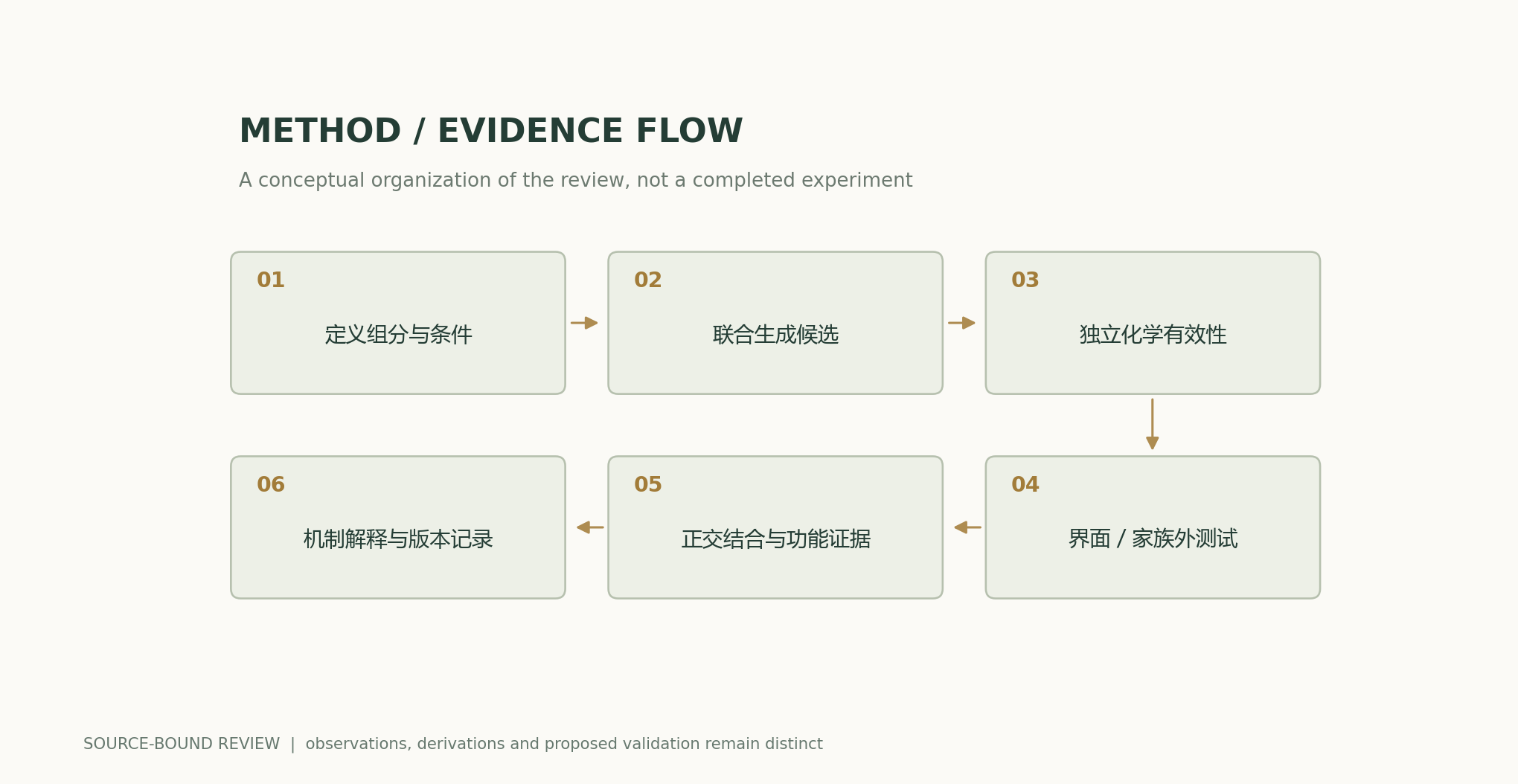
Analytical figures and numerical examples
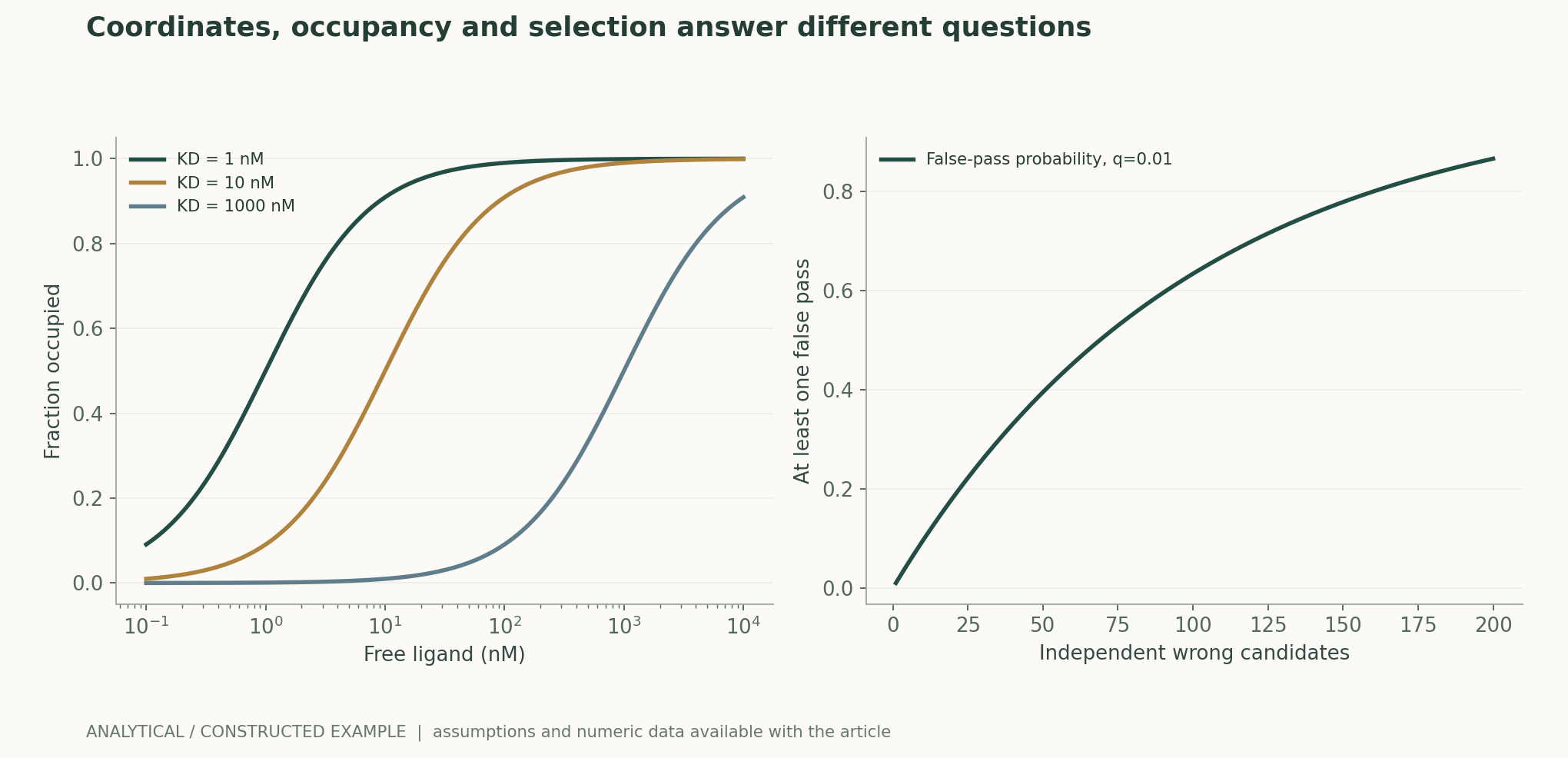
Reproducible worked example
At a free ligand concentration of 10 nM, the three hypothetical occupancies are 0.90909, 0.5 and 0.009901; the probability of at least one false pass among 100 independent incorrect candidates is 0.633968. These values do not correspond to a real molecule.
Method comparison
| Research endpoint | What must be fixed or measured | What cannot be inferred from it |
|---|---|---|
| Conformation recovery | Atom mapping, reference and alignment rules | That affinity is known |
| Physical validity | Bond, chirality, clash and energy checks | That the pose is necessarily correct |
| Interface credibility | Out-of-family calibration and negative examples | That cellular function is established |
| Equilibrium binding | Concentration, chemical state and measurement conditions | That the mechanism of action is unique |
| Functional attribution | Controls for expression, competition and alternative mechanisms | That all structural details are correct |
| Search gains | All candidates, budget and selection rules | That the number of independent samples equals the number of sampling attempts |
Verification and experimental plan
- Freeze the model, input chemical components, modifications and all preprocessing versions, and retain a summary.
- Predefine four endpoint classes—structure, validity, binding and function—and their respective failure criteria.
- Use stratified splits by time, receptor family, ligand scaffold and pocket similarity, retaining nearest-neighbor information.
- Save all samples, random seeds, deduplication, rankings and reasons for exclusion.
- Perform independent geometric checks first, then calculate interface and ligand coordinate errors under fixed rules.
- Quantify uncertainty using independent receptor families as statistical clusters, and separately report difficult and negative subsets.
- Validate external binding readouts separately from structural endpoints; retain unknown status when readouts are absent.
- Provide inputs, candidates, analysis code and correction records; do not register analytical examples as experiments on real molecules.
Scope and limitations
- The occupancy model applies only under the explicitly stated single-site equilibrium assumptions.
- The candidate false-positive calculation assumes independence; actual structural samples are usually correlated.
- This review did not run AF3, molecular dynamics, affinity experiments or cellular experiments.
- Reference structures and affinity measurements each depend on conditions and cannot be treated as error-free ground truth.
- The existing sources compare methods at their respective times and for their respective tasks; they do not constitute a ranking of all current methods.
Evidence from the original studies and its scope
| Original study findings | Scope | Source and location |
|---|---|---|
| Joint prediction of complex structures involving proteins, nucleic acids, small molecules and other components. | A coordinate task; it does not directly output experimental affinities for all systems. | Accurate structure prediction of biomolecular interactions with AlphaFold 3Abstract and Fig. 1 |
| Geometric similarity and chemical validity need to be checked jointly. | Applies to the methods and data evaluated in the original paper; not a universal ranking of subsequent methods. | PoseBusters: AI-based docking methods fail to generate physically valid poses or generalise to novel sequencesAbstract and plausibility checks |
Research questions worth testing
- Can interface confidence predict failures against independent structural measurements in unseen receptor families?
- After controlling the search budget, does sampling diversity or the ranker contribute more to the joint pass rate?
- Can improved structural validity checks produce quantifiable gains on external binding endpoints?
Mapping primary sources to claims
- Accurate structure prediction of biomolecular interactions with AlphaFold 3Abramson et al. · 2024-05-08Nature 2024; diffusion module and limitations
- PoseBusters: AI-based docking methods fail to generate physically valid poses or generalise to novel sequencesButtenschoen, Morris and Deane · 2024Physical validity tests, benchmark scope and sequence novelty; not a benchmark of every later model.
- Highly accurate protein structure prediction with AlphaFoldJumper et al. · 2021-07-15Nature 2021; network, Fig. 2 and limitations
Citation and manuscript export
BibTeXRISCSL JSONTXTArticle JSON
Author, version and sources
A sourced research review and original analysis written by Codex (AI). Experiments in the original papers belong to the original research teams; calculations in this review test only the listed equations and explicitly stated assumptions. This site currently has no record of independent peer review for this article or of original models, clinical experiments or physical experiments associated with it.
First publication: an in-depth feature on AI and scientific discovery; retaining section-level sources and the boundaries between original research evidence and the author's analysis.
The conceptual cover was generated by ImageGen. Scientific figures were drawn using the accompanying code and numerical files; captions specify assumptions and measurement definitions individually.
Cover and scientific figure sources · Data, sources and assumptions · Python · Reproducible calculation code · Publication and version history
Source revision: b7b48f7205d705b2a3d3e8de0be5e1b458e4869c