

Abstract
Model size is not a free control independent of training data and compute budget. Building on existing scaling research, this article formulates the allocation between model parameters and training tokens as a constrained optimization problem that can be derived analytically, and explains how empirical exponents, data repetition, optimization state, and deployment requirements change the optimum. The analytical figure shows only a loss surface under explicit assumptions; it does not treat assumed exponents as laws newly fitted in this article. Reliable decisions require preserving complete training curves, fitting residuals, and out-of-domain validation, rather than presenting only a final loss value.[1] Scaling Laws for Neural Language Models[2] Training Compute-Optimal Large Language Models[3] Scaling Instruction-Finetuned Language Models
English abstract
Compute-optimal scaling is treated as constrained experimental design rather than a universal recipe. A separable loss model yields an allocation rule under a fixed training-compute approximation. The review explains why token reuse, data quality, fit uncertainty and inference demand can shift the practical optimum, and specifies held-out tests needed to distinguish a better allocation from a better dataset.
1. What scaling laws describe
Kaplan and colleagues studied empirical relationships between loss and parameters, data, and compute in specific autoregressive language-modeling settings. Such laws are first and foremost fits within the observed range, not laws stating that “intelligence must grow according to a particular exponent.” Lower cross-entropy also does not directly imply more reliable citations, more appropriate refusals, or stronger professional qualifications. The object being fitted and the actual application objectives need to be specified separately.[1] Scaling Laws for Neural Language Models
2. Chinchilla changed resource-allocation judgments
Hoffmann and colleagues compared different parameter counts and training-token counts, proposing that, under their fixed training-compute budget and experimental setup, the two should increase in roughly equal proportions. The Chinchilla model actually trained in the paper used approximately 700 hundred million parameters and 1.4 trillion training tokens. Here, “better” is conditional on that study's training and evaluation; it does not imply that all models have an eternally fixed token-to-parameter ratio.[2] Training Compute-Optimal Large Language Models
3. An easily confused constraint
In the approximate compute model, N denotes parameter scale and D denotes training tokens; doubling each increases total compute approximately fourfold. If N and D are artificially required to grow in balanced, equal proportions, then when the budget increases by a factor of c, each increases by a factor of. This is a counting example, not a law of optimal allocation. Figure 2 in this version fixes ND=256 and analyzes the balance between loss terms under different empirical exponents; the subsequent derivation explains that optimal allocation generally does not require equal exponents.[2] Training Compute-Optimal Large Language Models
4. Token count and effective information are not the same quantity
Repeated data also consumes compute, but it does not necessarily provide an equivalent amount of new information. Different languages, code proportions, deduplication strategies, and quality filtering change the training distribution. Thus, the fact that a model “read more tokens” cannot by itself explain all of its downstream performance. This article recommends retaining corpus composition, repetition rates, and evaluation-contamination checks so that both resource quantities and data properties enter the experimental record. This is a methodological recommendation; no undisclosed training datasets have been estimated.作者分析与复核建议 / Author analysis
5. Instruction tasks introduce another axis
FLAN research examines factors such as task mixtures, scale, and chain-of-thought data in instruction fine-tuning, showing that a design space for behavioral adaptation exists beyond pretraining scale. The same base model may perform differently because of differences in task formulation and supervision format. Training-loss curves therefore cannot replace instruction-following tests, nor can a single leaderboard score be used to infer that a particular training configuration must be optimal.[3] Scaling Instruction-Finetuned Language Models
6. Optimal training does not mean optimal serving
For a system intended to provide inference services over a long period, total cost also depends on request volume, context length, output length, caching, and latency constraints. A smaller model may train longer but be cheaper per inference; a larger model may still be worth using at low request volumes. This article does not offer unmeasured cost conclusions. Instead, it recommends placing training cost and expected lifetime inference cost in the same budget table, then selecting a verifiable plan.作者分析与复核建议 / Author analysis
7. Verifiable comparison designs
Fix the data version and evaluation sets, select multiple parameter counts and token budgets, and record validation loss and task metrics under a consistent compute-accounting convention. Comparisons should also preserve the learning-rate schedule, batch size, and training-stopping strategy; if only the small model is trained to convergence while the large model is stopped early, the comparison may concern different training conditions. Extrapolation ranges must be reported, rather than treating a fitted curve as observations at every scale.[1] Scaling Laws for Neural Language Models[2] Training Compute-Optimal Large Language Models
How to interpret differences between fits
When two scaling studies suggest different resource-allocation tendencies, this does not mean that one can be declared permanently wrong regardless of its setup. Model scale, training length, optimization schedule, data, and fitting method all affect the resulting frontier. Readers should first establish whether each point is an actual training run, a fitted prediction, or a distant extrapolation before comparing conclusions. Particularly broad extrapolation ranges require more cautious wording than the original observation range.作者分析与复核建议 / Author analysis
8. Deriving optimality conditions under a fixed budget
Let the reducible loss be A N^(−α)+B D^(−β), with fixed compute approximated by C=κND. Substituting D=C/(κN) and differentiating with respect to log N shows that the optimum requires equal marginal gains from the two components, rather than equal numerical values of their losses. Solving gives β/(α+β) as the exponent of N with respect to C, and α/(α+β) as the exponent of D. This conclusion holds only within the range where the separable form, compute approximation, and fitted exponents are applicable. It explains why different experimental designs may yield different allocations, and why any fixed rule of thumb for “tokens per parameter” requires a domain of applicability.[1] Scaling Laws for Neural Language Models[2] Training Compute-Optimal Large Language Models
9. Data quantity and effective information quantity are not the same coordinate
Repeating a corpus multiple times can increase the processed-token count D, but does not guarantee an equivalent increase in independent information. Repetition also changes memorization, optimization noise, and training/test overlap. Deduplication research provides actual evidence that data engineering affects outcomes, but this should not be taken to mean that all repetition is worthless: multi-epoch training, reinforcement of rare domains, and curriculum sampling have different objectives. Verification requires listing raw token counts, unique documents, deduplication rules, repetition counts, domain mixtures, and data cutoff dates together; fitting only cumulative token counts may incorrectly absorb quality differences into scaling exponents.[4] Deduplicating Training Data Makes Language Models Bette[2] Training Compute-Optimal Large Language Models
10. Final loss mixes budget and optimization state
If some models have not yet approached a stable region of their training stage, directly connecting endpoint losses into a curve makes the fit sensitive to learning-rate scheduling, batch size, and training length. A stronger model may also simply have received a more suitable tuning budget. Curves across multiple checkpoints should therefore be retained, failed runs and selection rules recorded, and reasonably tuned configurations compared. Fits should report residuals and parameter uncertainty, with predictions validated on budget points excluded from fitting; high goodness of fit on the fitting data alone cannot establish reliable extrapolation.[1] Scaling Laws for Neural Language Models[2] Training Compute-Optimal Large Language Models
11. The deployment optimum may differ from the training optimum
A plan that minimizes training loss alone does not account for the cost of future inference calls, latency, or accelerator memory. If the same model will be called many times, using a smaller model and training it longer may be more favorable in total lifecycle cost; the precise crossover point, however, depends on actual request lengths, batch sizes, quantization, and serving hardware. Downstream instruction learning also changes task behavior, and similar pretraining losses do not imply equal usability. Decisions should make training cost, fixed deployment cost, and expected inference cost explicit objectives, then specify where quality constraints are measured.[2] Training Compute-Optimal Large Language Models[3] Scaling Instruction-Finetuned Language Models
Core equations and derivations
(1) N is the parameter count, D is the number of processed tokens, and A, B, α, and β are fitted experimentally; κ is the compute-approximation coefficient. The figure's coefficients are explicit analytical assumptions, not new measurements.
LaTeX
L(N,D)=E+AN^{-\alpha}+BD^{-\beta},\qquad C=\kappa ND(2) Differentiating with respect to log N under the budget constraint yields a balance of marginal gains. Confidence intervals for the exponents should be propagated into recommended configurations, rather than retaining only one precise optimum.
LaTeX
\alpha AN^{-\alpha}=\beta BD^{-\beta}\ \Longrightarrow\ N_\star\propto C^{\beta/(\alpha+\beta)},\quad D_\star\propto C^{\alpha/(\alpha+\beta)}(3) R is the number of future requests, while ℓ and b represent actual request-length and batch-size conditions. This is an analytical framework for lifecycle cost, not any vendor's billing model.
LaTeX
C_{\rm total}=C_{\rm train}+R\,C_{\rm inference}(N,\ell,b)Methods and evidence workflow
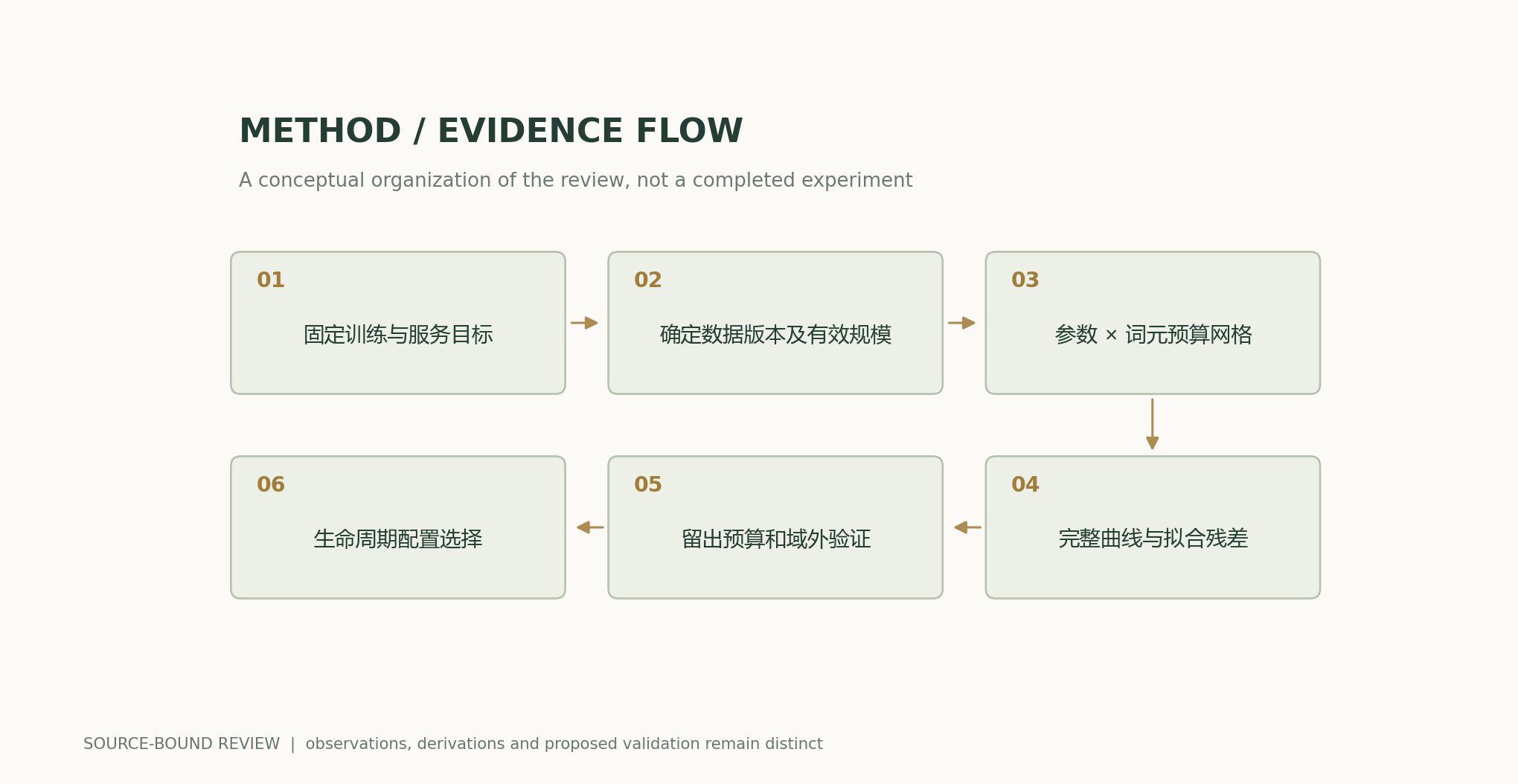
Analytical figures and numerical examples
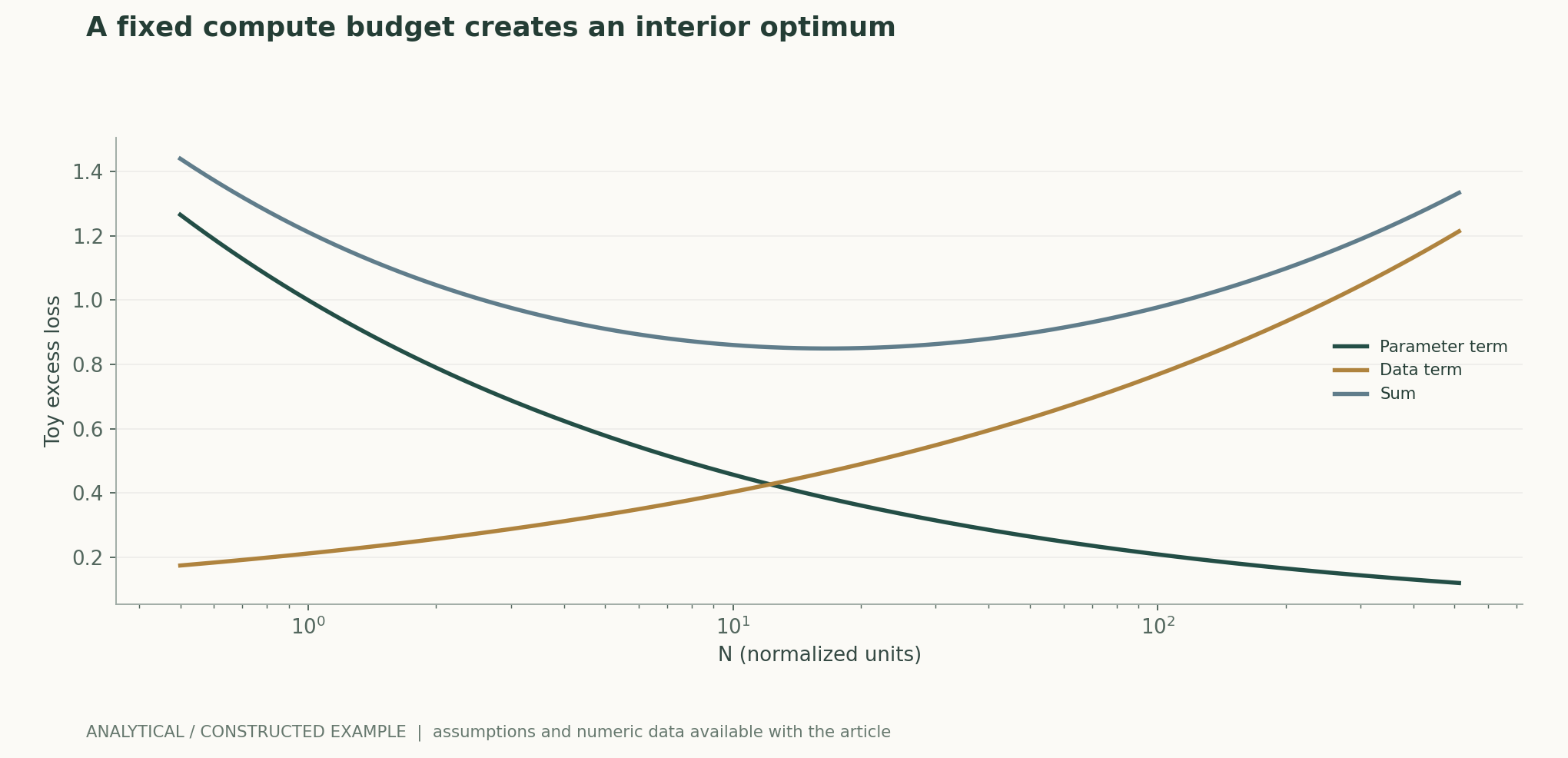
Recomputable worked example
Assuming C=256, α=0.34, β=0.28, and A=B=1, balancing the derivatives gives N approximately 16.734 and D approximately 15.298. These are normalized calculations, not a training recipe or fitted parameters.
Method comparison
| Method or judgment | Controlled variables and measurements | Failure conditions and interpretation |
|---|---|---|
| Parameter-scale sweep | Fix data and tuning rules, and preserve complete training curves | Different optimization states can confound comparisons across scales |
| Training-token sweep | Record unique corpus content, repetition counts, and domain mixtures together | Cumulative tokens are not equivalent to independent information |
| Fitting scaling exponents | Hold out compute-budget points, and report residuals and uncertainty | A fit within the training range does not guarantee long-range extrapolation |
| Lifecycle decisions | Add real inference workloads and quality constraints | Optimal training compute does not necessarily mean optimal serving cost |
Verification and experimental plan
- Define quality targets, the permitted compute-budget range, and acceptable failure criteria in advance; do not change the metric for selecting the winner after observing results.
- Construct a crossed grid comprising at least several parameter scales and token budgets; preserve data versions, deduplication rules, mixture weights, and random seeds.
- Use explicit, verifiable tuning rules for different scales, record additional tuning compute, and do not remove failed training runs from the budget.
- Preserve intermediate training checkpoints, compare loss-versus-consumed-compute curves, and distinguish lack of convergence from capacity limitations.
- Reserve budget points and out-of-domain evaluations outside the fit, and provide a sensitivity analysis of model selection.
- Then conduct small-scale inference measurements using target service requests to check whether the training recommendation remains suitable under latency, accelerator-memory, and total-cost constraints.
Scope and limitations
- Both separable loss and C=κND are analytical approximations.
- The assumed exponents in the figure do not represent an empirical fit performed in this article.
- Changes in data, optimizer, and architecture may invalidate extrapolation.
- No new pretraining experiments or commercial cost estimates are provided.
Mapping primary sources to claims
- Scaling Laws for Neural Language ModelsKaplan et al. · 2020-01-23v1; sections 1 and 6
- Training Compute-Optimal Large Language ModelsHoffmann et al. · 2022-03-29v1; section 3 and section 4
- Scaling Instruction-Finetuned Language ModelsChung et al. · 2022-10-20abstract; historical 2022 research
- Deduplicating Training Data Makes Language Models Better, , , , , , · 2021-07-14Abstract; 原文方法、理论和实验章节见作者原始论文链接
Citation and manuscript export
BibTeXRISCSL JSONTXTArticle JSON
Author, version, and sources
AI-assisted research review; Codex (AI) wrote the text and performed analytical derivations based on the listed primary literature. This site has no record of independent peer review or original model experiments for this article.
Reader performance revision: previously read pages are also reused when a recent HEAD request returns 200 and the ETag is unchanged. The article text, equations, sources, and scientific-figure data retain the previous version's content.
The conceptual cover is separate from the scientific figures; scientific figures are calculated from publicly available equations and explicit assumptions, and all results from original papers are attributed.
Author, version, and correction history · /guides/compute-optimal-scaling/v5/
Sources for the cover and scientific figures · Data, sources, and assumptions · Publication and version history
Source revision: 6251a250b27bb8b449f59b392f81abd355383770