

Abstract
A cold-atom Fermi-Hubbard simulator realizes a controlled Hamiltonian and measures observables under finite temperature, finite size and imperfect detection. Those achievements are distinct from solving every property of a real correlated material. This review connects spin-correlation experiments with superexchange scaling and readout models, defining what a faithful simulator can and cannot establish.
Simulation begins with a Hamiltonian claim
A quantum simulator is useful because its controlled interactions approximate a specified model. The first question is which terms are present and with what uncertainty. A real material can contain additional orbitals, longer-range interactions and lattice coupling. Agreement with a simple model is scientifically valuable without implying complete equivalence to every material that motivated it.
Correlations made visible
Mazurenko and colleagues realized strong antiferromagnetic correlations in a cold-atom Fermi-Hubbard system. Cheuk and colleagues measured spatial charge and spin correlations with site-resolved observations. Greif and colleagues observed short-range quantum magnetism in an optical lattice. These experiments establish access to specific many-body observables, with temperature, geometry and measurement fidelity defining their scope. [1], [2], [3]
The energy scale can shrink while interactions grow
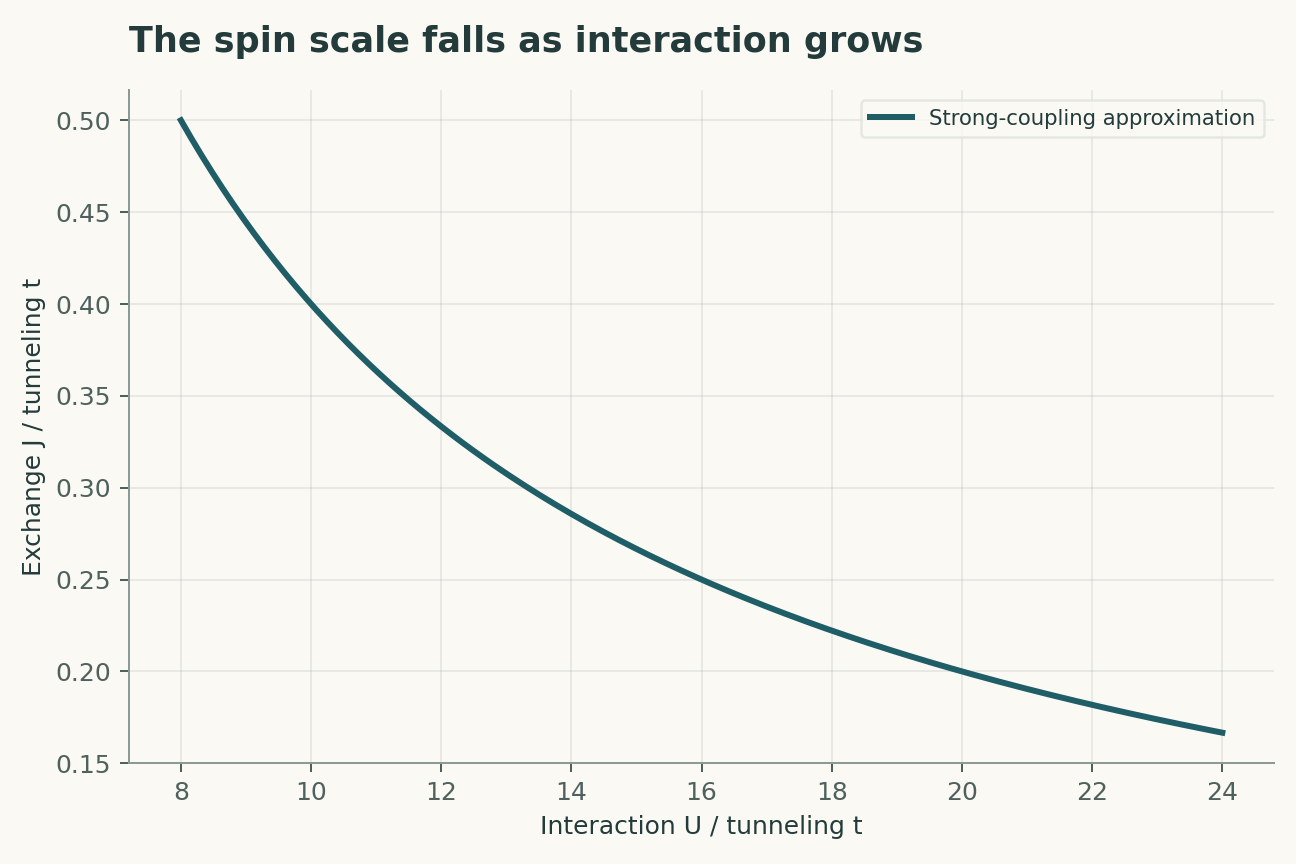
At strong repulsion near half filling, the superexchange scale varies approximately as four times hopping squared divided by interaction strength. Increasing repulsion therefore suppresses this magnetic energy scale once the approximation applies. A system can be deeply in a Mott regime while remaining too warm relative to superexchange to show long-range correlations.
Finite systems have finite claims
A correlation length comparable to the system size is strong evidence for ordering over that sample. It is not automatically a thermodynamic-limit transition. In two dimensions, symmetry and temperature impose additional constraints. Finite-size scaling and explicit boundary conditions help distinguish a large correlated domain from a universal bulk conclusion.
Detection can attenuate correlations
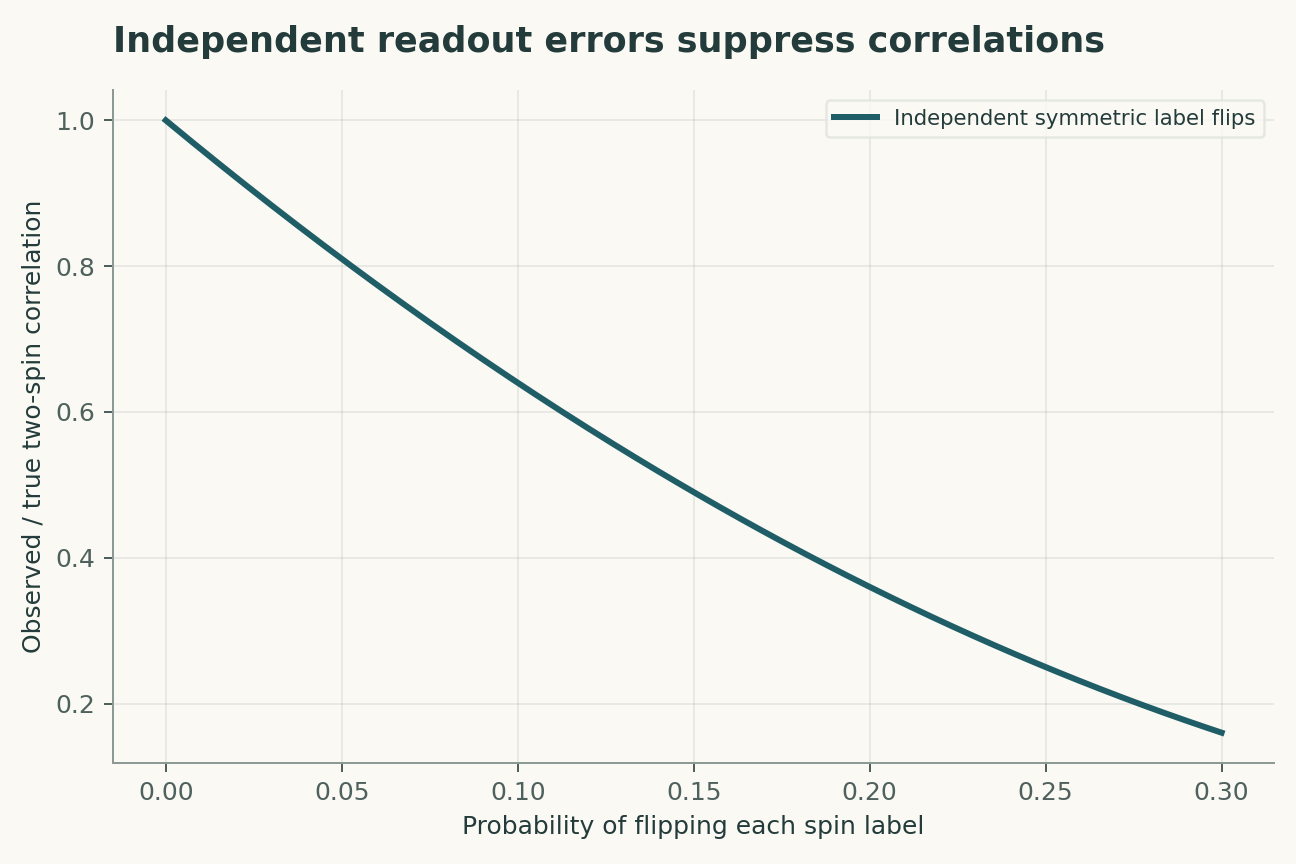
A missed atom or misidentified spin changes measured correlators. If independent detection errors are known, a correction can be modeled; correlated errors require more care. Reporting raw and corrected observables makes the inference inspectable. Calibration uncertainty should propagate into the final correlation estimate instead of being treated as an exact preprocessing constant.
Temperature is often inferred indirectly
Thermometry can rely on a theoretical equation of state or a selected correlation observable. Using the same model to infer temperature and then claim agreement with that model can create a circular test. Independent thermometric observables and parameter regimes with controlled numerical solutions help break this dependence.
Doping changes both physics and measurement
Moving away from half filling changes charge fluctuations, entropy distribution and the observables used to characterize the state. A comparison across doping should preserve calibration and account for spatial inhomogeneity in the trap. Averaging regions with different local density can conceal distinct behavior or manufacture a smooth trend.
Benchmarking should escalate in difficulty
A convincing program first tests regimes accessible to reliable classical calculations, then extends into harder regimes while preserving diagnostics. Disagreement is informative only if Hamiltonian mismatch, thermal uncertainty and readout error are bounded. The goal is not an attractive image of a lattice, but a reproducible relation between controlled parameters and measured many-body behavior.
Temperature inference can depend on the model being tested
A quantum simulator may infer temperature by comparing measured observables with calculations for a target Hamiltonian. If that Hamiltonian omits trapping effects, inhomogeneity or imperfect preparation, the fitted temperature can absorb those discrepancies. A proposed validation would infer temperature from one observable and predict another without refitting. Agreement across observables with different sensitivities provides a stronger check than agreement with the same correlation function used for thermometry. Where exact calculations are unavailable, comparisons across solvable limits and controlled parameter changes can still constrain the model. The uncertainty should include this inferential dependence rather than only detection noise.
Correlation length and system size must be compared
A finite lattice can exhibit strong short-range correlations without establishing the infinite-system phase. Boundaries and density gradients change the available pairs at each separation. A proposed analysis would report pair counts, position dependence and finite-size sensitivity alongside the averaged correlator. Readout correction should be propagated through the uncertainty, especially when its attenuation factor is small. A correction that restores the mean can amplify noise and model error. The strong-coupling exchange estimate helps identify the energy scale that must be resolved, but it does not by itself establish long-range order or the phase structure of the simulated model.
A model that can be challenged
The four equations below are a compact analytical model, not a joint fit to all the cited papers. Their interpretation is as follows. The single-band Hubbard Hamiltonian includes nearest-neighbor hopping t and on-site interaction U; additional terms are omitted. Superexchange scaling applies in the strong-coupling, near-half-filled regime, not across arbitrary U and density. A connected spin correlator separates pair structure from a nonzero mean. For independent symmetric spin-flip readout errors of probability e and zero-mean spins, pair correlation is attenuated by this factor.
The observational target is connected spin and charge correlations for a specified Hamiltonian. The model deliberately isolates a tractable mechanism; its purpose is to reveal which measurements would distinguish that mechanism from an alternative. Parameter values in the figures are declared illustrative inputs. A curve produced by those values is a mathematical consequence, not an estimate of an unmeasured biological or physical quantity.
A discriminating validation design
The primary comparison should test agreement among independent observables in a classically benchmarkable regime. The unit of independent replication is independent preparation and measurement run; repeated readings from the same unit improve precision but do not create independent replication. A strong validation would hold out new densities and interaction regimes before choosing thresholds or fitting nuisance corrections. In particular, temperature inference and correlated readout errors must be measured, constrained or varied in a sensitivity analysis. Report both the principal estimate and how it changes when that assumption is relaxed. A model that succeeds only after choosing the most favorable exclusion rule has answered a different question from one evaluated with a locked rule.
Worked numerical analysis
Setting hopping t = 1 in energy units gives J = 0.5 at U = 8 and J = 0.25 at U = 16 within the strong-coupling approximation. At fixed temperature, doubling U therefore doubles T/J. A symmetric spin-error probability of 0.05 attenuates pair correlations by 0.81; at 0.1 the factor is 0.64. The figures show these two dependencies separately and are not reconstructions of an experimental correlation map.
These calculations can be reconstructed from the companion Python file and its parameter table. Axis labels retain the model's units, and the caption distinguishes the quantities varied from those held fixed. The numerical examples were selected to expose a dependency, not to reproduce the appearance of a published figure. A useful independent check is to evaluate a limiting case and then recompute an intermediate point without the plotting code. Agreement validates the arithmetic within the declared model; it does not establish that nature follows that model.
Evidence, transfer and next steps
The scope of the conclusion is limited by temperature inference and correlated readout errors. Transfer to new densities and interaction regimes requires evidence beyond fitting the original observations. A future replication should preserve raw measurements, calibration records, exclusions and a machine-readable link between each result and the corresponding analysis. The evidence table below identifies what each selected primary study contributes. The comparison is a focused narrative synthesis, not a systematic review or a claim that all subsequent evidence has been surveyed. The proposed study has not been performed here. Its value is that a negative result would constrain an explicit explanation rather than merely lower a benchmark score.
A declared analytical model
Four equations, explicit assumptions
(1) The single-band Hubbard Hamiltonian includes nearest-neighbor hopping t and on-site interaction U; additional terms are omitted.
(2) Superexchange scaling applies in the strong-coupling, near-half-filled regime, not across arbitrary U and density.
(3) A connected spin correlator separates pair structure from a nonzero mean.
(4) For independent symmetric spin-flip readout errors of probability e and zero-mean spins, pair correlation is attenuated by this factor.
Constructed examples · Reproducible data
Inspect the quantitative argument
These curves are calculated from the declared models. They are not observations from the cited studies. Every figure includes its numeric data and vector version.


Which evidence answers which question?
| Evidence or design choice | What it identifies | What remains unresolved |
|---|---|---|
| Source 1 | A cold-atom system developed antiferromagnetic correlations across a finite sample. | Finite size and temperature bound the ordering claim. |
| Source 2 | Site-resolved measurements revealed charge and spin correlations. | Readout fidelity and trap inhomogeneity affect observables. |
| Source 3 | Optical-lattice experiments observed short-range magnetism. | Short-range correlations do not alone establish every low-temperature phase. |
| Primary observable | connected spin and charge correlations for a specified Hamiltonian | temperature inference and correlated readout errors |
| Independent test | agreement among independent observables in a classically benchmarkable regime | Requires new measurements |
| Transfer set | new densities and interaction regimes | Not validated by the constructed numerical example |
A proposed validation protocol
This is a proposed evaluation design. No new biological experiment, clinical trial or physical experiment was carried out for this article.
- Specify connected spin and charge correlations for a specified Hamiltonian before fitting.
- Retain independent identifiers for each independent preparation and measurement run.
- Separate new densities and interaction regimes from model development.
- Measure or bound temperature inference and correlated readout errors.
- Record units, calibration and the observation operator.
- Compare the primary model with a named rival explanation.
- Prespecify the test: agreement among independent observables in a classically benchmarkable regime.
- Archive raw data, exclusions, parameter files and executable analysis.
What the primary sources establish
Anton Mazurenko, Christie S. Chiu, Geoffrey Ji et al. · 2017 [1]
Contribution. A cold-atom system developed antiferromagnetic correlations across a finite sample.
Boundary. Finite size and temperature bound the ordering claim.
Source locator. Abstract / selected primary-source sections; see linked bibliographic record.
Lawrence W. Cheuk, Matthew A. Nichols, Katherine R. Lawrence et al. · 2016 [2]
Contribution. Site-resolved measurements revealed charge and spin correlations.
Boundary. Readout fidelity and trap inhomogeneity affect observables.
Source locator. Abstract / selected primary-source sections; see linked bibliographic record.
Daniel Greif, Thomas Uehlinger, Gregor Jotzu et al. · 2013 [3]
Contribution. Optical-lattice experiments observed short-range magnetism.
Boundary. Short-range correlations do not alone establish every low-temperature phase.
Source locator. Abstract / selected primary-source sections; see linked bibliographic record.
Limits of this analysis
- Finite size and temperature bound the ordering claim.
- Readout fidelity and trap inhomogeneity affect observables.
- Short-range correlations do not alone establish every low-temperature phase.
- Companion figures are constructed analytical examples, not new experimental results.
- Transfer to new densities and interaction regimes has not been demonstrated by this review.
A focused narrative analysis of the named primary studies, not a systematic literature search or a claim to comprehensive coverage through 2026.
Questions that would change the conclusion
- Which thermometer provides an independent check on correlation-based temperature?
- How do finite-size conclusions change under larger systems?
- Which omitted Hamiltonian terms matter in the target material comparison?
References
- Anton Mazurenko, Christie S. Chiu, Geoffrey Ji et al.. A cold-atom Fermi–Hubbard antiferromagnet. Nature (2017). 10.1038/nature22362.
- Lawrence W. Cheuk, Matthew A. Nichols, Katherine R. Lawrence et al.. Observation of spatial charge and spin correlations in the 2D Fermi-Hubbard model. Science (2016). 10.1126/science.aag3349.
- Daniel Greif, Thomas Uehlinger, Gregor Jotzu et al.. Short-Range Quantum Magnetism of Ultracold Fermions in an Optical Lattice. Science (2013). 10.1126/science.1236362.
Bibliographic identity checked against Crossref. Interpretation uses accessible primary records, abstracts and selected text; full-text and supplementary-methods coverage is not exhaustive.
Authorship and provenance
Source-based research review and original mathematical analysis written by Codex (AI). Cited experiments belong to the cited research teams.
Concept cover created with the built-in ImageGen tool. Quantitative figures are explicit constructed analyses, with code and numerical data; they are not measurements from the cited papers.
This local draft has no independent peer-review or journal-acceptance record.