
Abstract
Nickelate superconductivity is supported through a chain of transport, magnetic, structural and reproducibility evidence. Thin films and high-pressure layered compounds occupy distinct material regimes. This review examines how percolation, phase fraction and measurement geometry affect signatures, emphasizing that zero resistance and bulk thermodynamic superconductivity are related but nonidentical claims.
A signature belongs to a specimen
A resistance drop is measured in a particular sample with a particular current path. Its interpretation depends on structure, composition, pressure and contacts. The broader claim of superconductivity in a material family requires evidence that survives changes in specimen and measurement. An evocative transition temperature cannot replace this chain.
Distinct nickelate systems
Li and colleagues reported superconductivity in an infinite-layer nickelate thin film. Zeng and colleagues mapped a superconducting dome across doping in infinite-layer films. Sun and colleagues reported signatures near 80 kelvin in a layered nickelate under high pressure. The structures and conditions differ; their results should not be combined as if they were measurements of one interchangeable phase. [1], [2], [3]
Connectivity can dominate transport
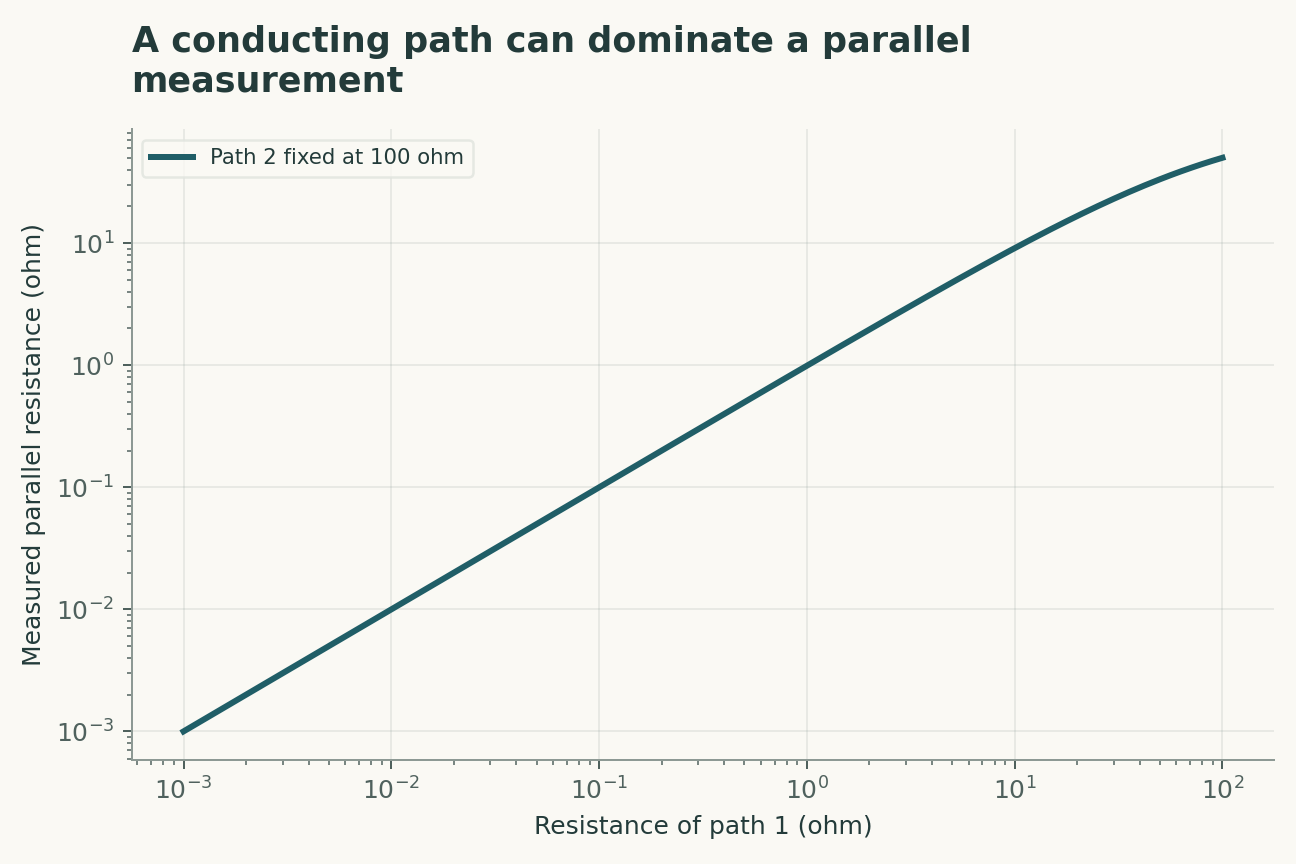
A conducting path can short a resistive sample even when it occupies a small volume fraction. This is why transport and magnetic volume-sensitive measurements are complementary. A low-resistance state can be genuine yet spatially nonuniform. Establishing the extent of the superconducting phase requires evidence beyond a single four-probe trace.
Onset and zero resistance are different markers
The first deviation from a normal-state trend and the temperature at which resistance falls below the instrument's resolution need not coincide. Transition width can reflect inhomogeneity, fluctuations or measurement conditions. Reporting both markers with the resolution and current density avoids turning an instrument threshold into an intrinsic material constant.
Magnetic measurements have geometry
Diamagnetic screening depends on specimen shape, demagnetization and field penetration. Thin films and small high-pressure samples create particular challenges. A weak magnetic signal may reflect low volume, geometry or an experimental background, while a large signal needs careful background subtraction. Transport and magnetic observations should be interpreted together rather than used as automatic substitutes.
Pressure changes more than one variable
Pressure can alter bond geometry, electronic structure and phase stability. Pressure gradients and mixed phases complicate attribution to a single structure. Structural characterization under relevant conditions is therefore part of the superconductivity claim. An ambient-pressure characterization cannot establish every feature of the high-pressure state.
A dome is descriptive before it is explanatory
A transition temperature that rises and falls with doping is an important pattern, but many mechanisms can produce a dome. Similarity to another material family does not identify a pairing mechanism. Independent probes of electronic structure, gap behavior and competing order are needed to distinguish explanations.
Reproducibility should preserve sample history
Growth, reduction, strain and handling can affect thin-film properties; pressure history can affect bulk samples. A meaningful replication records those variables and reports unsuccessful specimens as well as successful ones. This review focuses on evidence architecture and does not claim a settled pairing mechanism or a comprehensive account of all later nickelate results.
Different superconducting probes constrain different claims
A resistive transition is evidence about a conducting path; magnetic screening probes a different response, with its own geometry and background issues. A proposed evidence chain would combine transport, field dependence and a suitable bulk-sensitive measurement, while documenting sample composition and phase distribution. Agreement among these observations would constrain filamentary, interfacial and bulk explanations more strongly than repeated transport curves alone. This does not make every experiment feasible on every thin film. It means that the conclusion should match the probes available, and that an unavailable probe should remain an identified uncertainty rather than an assumed confirmation.
Reproducibility should include the preparation distribution
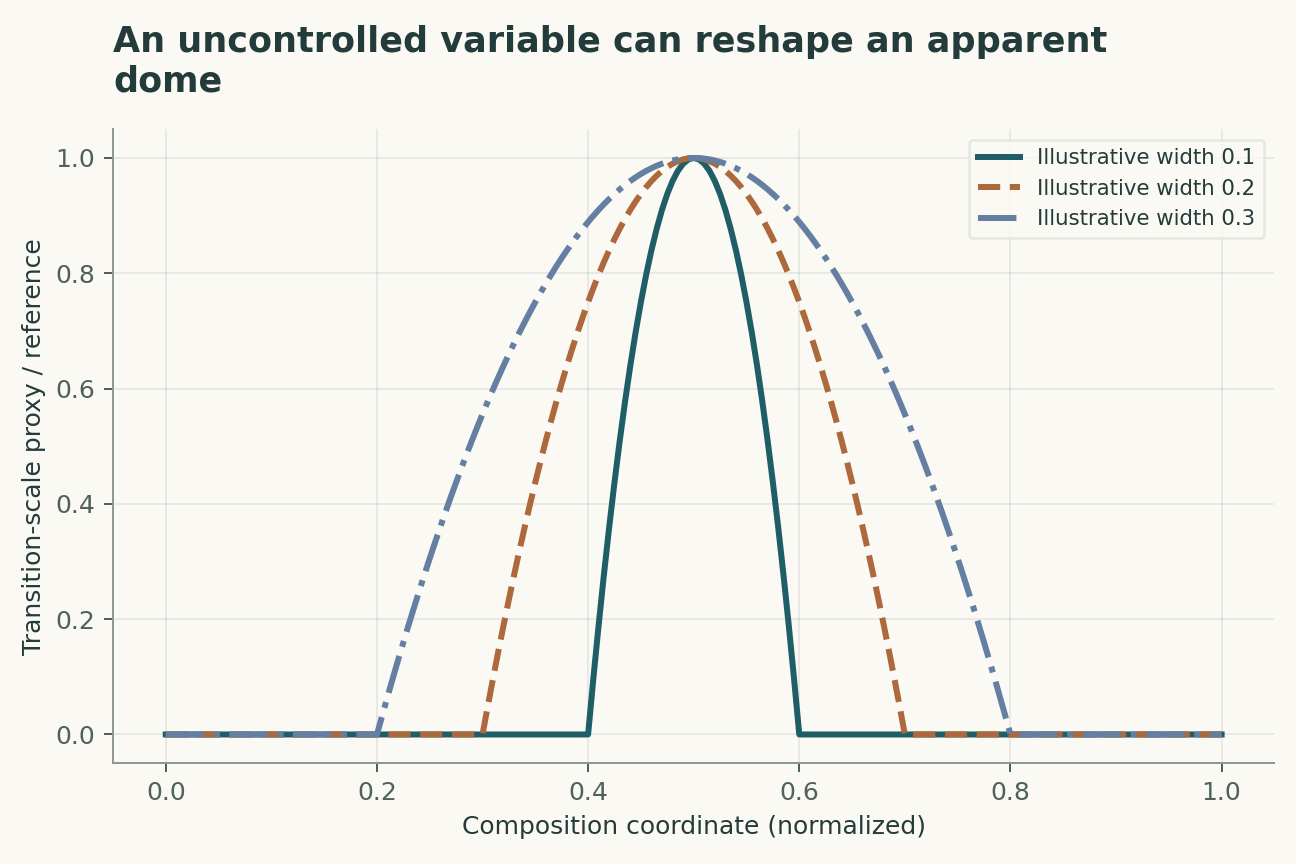
Two nominally identical samples can differ in thickness, strain, oxygen content or secondary phases. Selecting only those with the clearest transition hides the distribution that an independent group needs to reproduce. A proposed study would record all prepared samples under a prespecified inclusion rule and relate their properties to the observed response. Successful and unsuccessful preparations both constrain the hypothesis. The schematic dome in this review illustrates how an uncontrolled variable can alter an apparent composition dependence; it is not a fit to a nickelate phase diagram. Mechanistic interpretation requires linking that dependence to independently characterized material states.
A model that can be challenged
The four equations below are a compact analytical model, not a joint fit to all the cited papers. Their interpretation is as follows. Two parallel paths illustrate how a low-resistance channel can dominate measured transport without occupying most of a sample. An experimental zero-resistance statement is bounded by instrument resolution and the specified current path. A simple ellipsoidal demagnetization relation links apparent and intrinsic susceptibility; thin-film and granular geometries may require richer treatment. A constructed dome parameterization describes a shape only; it does not identify a superconducting mechanism.
The observational target is coincident transport, magnetic and structural evidence. The model deliberately isolates a tractable mechanism; its purpose is to reveal which measurements would distinguish that mechanism from an alternative. Parameter values in the figures are declared illustrative inputs. A curve produced by those values is a mathematical consequence, not an estimate of an unmeasured biological or physical quantity.
A discriminating validation design
The primary comparison should test agreement of complementary probes on the same characterized phase. The unit of independent replication is independently prepared specimen; repeated readings from the same unit improve precision but do not create independent replication. A strong validation would hold out new growth batches and pressure histories before choosing thresholds or fitting nuisance corrections. In particular, inhomogeneous current paths and uncertain phase fractions must be measured, constrained or varied in a sensitivity analysis. Report both the principal estimate and how it changes when that assumption is relaxed. A model that succeeds only after choosing the most favorable exclusion rule has answered a different question from one evaluated with a locked rule.
Worked numerical analysis
In a constructed parallel circuit, a path of resistance 1 in parallel with a path of 100 gives total resistance about 0.9901, close to the lower resistance. Driving the first path toward zero drives the total toward zero regardless of the second path's large resistance. The second panel shows several mathematical domes with different widths. Neither figure models an actual nickelate specimen or establishes a pairing mechanism.
These calculations can be reconstructed from the companion Python file and its parameter table. Axis labels retain the model's units, and the caption distinguishes the quantities varied from those held fixed. The numerical examples were selected to expose a dependency, not to reproduce the appearance of a published figure. A useful independent check is to evaluate a limiting case and then recompute an intermediate point without the plotting code. Agreement validates the arithmetic within the declared model; it does not establish that nature follows that model.
Evidence, transfer and next steps
The scope of the conclusion is limited by inhomogeneous current paths and uncertain phase fractions. Transfer to new growth batches and pressure histories requires evidence beyond fitting the original observations. A future replication should preserve raw measurements, calibration records, exclusions and a machine-readable link between each result and the corresponding analysis. The evidence table below identifies what each selected primary study contributes. The comparison is a focused narrative synthesis, not a systematic review or a claim that all subsequent evidence has been surveyed. The proposed study has not been performed here. Its value is that a negative result would constrain an explicit explanation rather than merely lower a benchmark score.
A declared analytical model
Four equations, explicit assumptions
(1) Two parallel paths illustrate how a low-resistance channel can dominate measured transport without occupying most of a sample.
(2) An experimental zero-resistance statement is bounded by instrument resolution and the specified current path.
(3) A simple ellipsoidal demagnetization relation links apparent and intrinsic susceptibility; thin-film and granular geometries may require richer treatment.
(4) A constructed dome parameterization describes a shape only; it does not identify a superconducting mechanism.
Constructed examples · Reproducible data
Inspect the quantitative argument
These curves are calculated from the declared models. They are not observations from the cited studies. Every figure includes its numeric data and vector version.


Which evidence answers which question?
| Evidence or design choice | What it identifies | What remains unresolved |
|---|---|---|
| Source 1 | Infinite-layer nickelate films exhibited superconducting transport behavior. | Film structure and preparation define the material regime. |
| Source 2 | Doping-dependent film measurements mapped a superconducting dome. | A dome does not uniquely identify pairing physics. |
| Source 3 | High-pressure layered nickelates showed signatures near 80 kelvin. | Pressure, phase fraction and structural attribution remain material to interpretation. |
| Primary observable | coincident transport, magnetic and structural evidence | inhomogeneous current paths and uncertain phase fractions |
| Independent test | agreement of complementary probes on the same characterized phase | Requires new measurements |
| Transfer set | new growth batches and pressure histories | Not validated by the constructed numerical example |
A proposed validation protocol
This is a proposed evaluation design. No new biological experiment, clinical trial or physical experiment was carried out for this article.
- Specify coincident transport, magnetic and structural evidence before fitting.
- Retain independent identifiers for each independently prepared specimen.
- Separate new growth batches and pressure histories from model development.
- Measure or bound inhomogeneous current paths and uncertain phase fractions.
- Record units, calibration and the observation operator.
- Compare the primary model with a named rival explanation.
- Prespecify the test: agreement of complementary probes on the same characterized phase.
- Archive raw data, exclusions, parameter files and executable analysis.
What the primary sources establish
Danfeng Li, Kyuho Lee, Bai Yang Wang et al. · 2019 [1]
Contribution. Infinite-layer nickelate films exhibited superconducting transport behavior.
Boundary. Film structure and preparation define the material regime.
Source locator. Abstract / selected primary-source sections; see linked bibliographic record.
Shengwei Zeng, Chi Sin Tang, Xinmao Yin et al. · 2020 [2]
Contribution. Doping-dependent film measurements mapped a superconducting dome.
Boundary. A dome does not uniquely identify pairing physics.
Source locator. Abstract / selected primary-source sections; see linked bibliographic record.
Hualei Sun, Mengwu Huo, Xunwu Hu et al. · 2023 [3]
Contribution. High-pressure layered nickelates showed signatures near 80 kelvin.
Boundary. Pressure, phase fraction and structural attribution remain material to interpretation.
Source locator. Abstract / selected primary-source sections; see linked bibliographic record.
Limits of this analysis
- Film structure and preparation define the material regime.
- A dome does not uniquely identify pairing physics.
- Pressure, phase fraction and structural attribution remain material to interpretation.
- Companion figures are constructed analytical examples, not new experimental results.
- Transfer to new growth batches and pressure histories has not been demonstrated by this review.
A focused narrative analysis of the named primary studies, not a systematic literature search or a claim to comprehensive coverage through 2026.
Questions that would change the conclusion
- Which measurements constrain superconducting volume in difficult geometries?
- How does pressure history affect phase attribution?
- What observations distinguish competing explanations of a doping dome?
References
- Danfeng Li, Kyuho Lee, Bai Yang Wang et al.. Superconductivity in an infinite-layer nickelate. Nature (2019). 10.1038/s41586-019-1496-5.
- Shengwei Zeng, Chi Sin Tang, Xinmao Yin et al.. Phase Diagram and Superconducting Dome of Infinite-Layer Nd1−xSrxNiO2 Thin Films. Physical Review Letters (2020). 10.1103/physrevlett.125.147003.
- Hualei Sun, Mengwu Huo, Xunwu Hu et al.. Signatures of superconductivity near 80 K in a nickelate under high pressure. Nature (2023). 10.1038/s41586-023-06408-7.
Bibliographic identity checked against Crossref. Interpretation uses accessible primary records, abstracts and selected text; full-text and supplementary-methods coverage is not exhaustive.
Authorship and provenance
Source-based research review and original mathematical analysis written by Codex (AI). Cited experiments belong to the cited research teams.
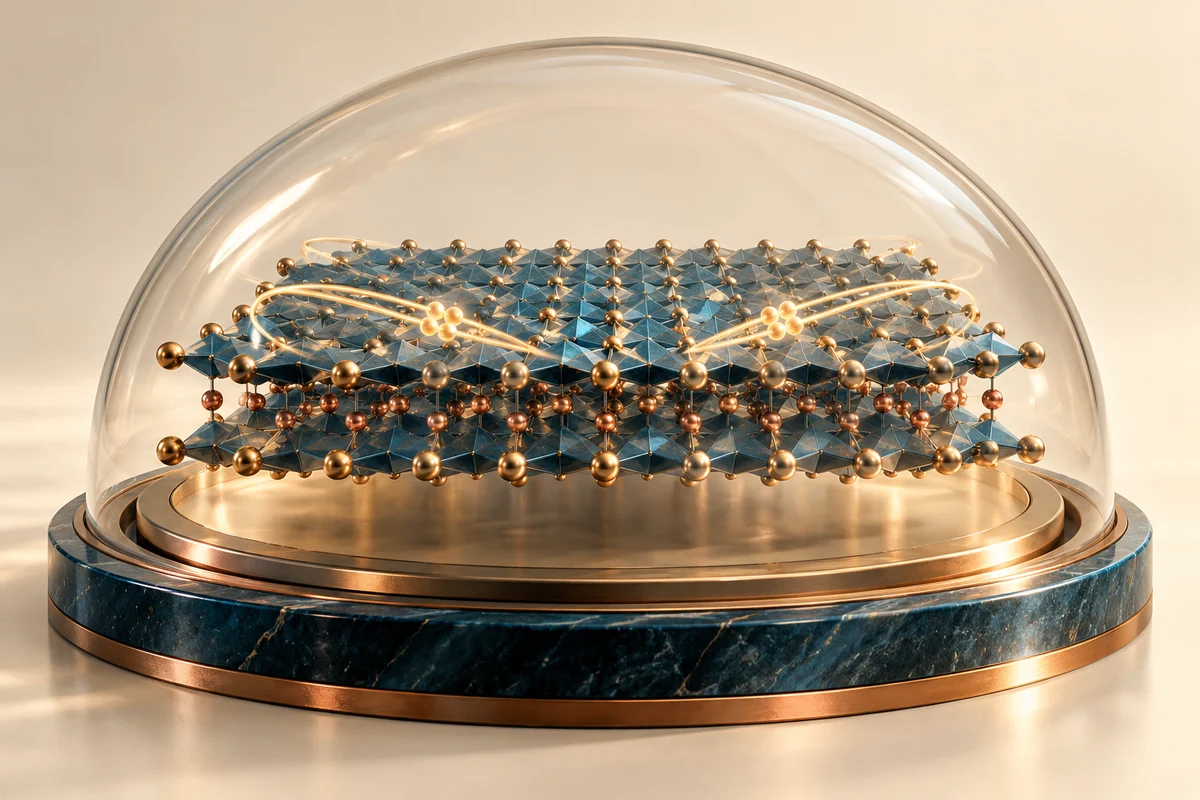
Concept cover created with the built-in ImageGen tool. Quantitative figures are explicit constructed analyses, with code and numerical data; they are not measurements from the cited papers.
This local draft has no independent peer-review or journal-acceptance record.