
Abstract
A quantum spin liquid cannot be identified solely by the absence of conventional magnetic order. Disorder, finite temperature and multiple heat carriers can mimic parts of the expected phenomenology. This review compares neutron and thermal-transport evidence, using explicit mixture and resolution models to show why convergent probes are essential.
Absence of order is an incomplete diagnosis
A magnetic material can fail to show long-range order because of frustration, disorder, dimensionality or limited experimental temperature. A quantum spin liquid is a stronger statement about the many-body state and its excitations. Establishing it requires positive evidence that distinguishes relevant alternatives, not only the failure to observe a conventional ordered pattern.
Complementary and contested signatures
Han and colleagues reported fractionalized-excitation evidence in herbertsmithite. Banerjee and colleagues examined proximate Kitaev behavior in alpha-RuCl3. Kasahara and colleagues reported a half-integer thermal Hall signature, while Lefrancois and colleagues presented evidence for a phonon Hall contribution in the same candidate material family. These studies motivate a multi-probe comparison rather than a single decisive marker. [1], [2], [3], [4]
A continuum has several origins
A broad neutron-scattering continuum can be consistent with fractionalized excitations, but broadening and overlapping conventional modes can also distribute spectral weight. The momentum and energy dependence, polarization and temperature evolution help distinguish explanations. Instrument resolution and background subtraction must be included before a broad feature is assigned to a specific excitation type.
Disorder can alter the low-energy state
Defects and site mixing can introduce local moments, random couplings or spatially varying gaps. Their contribution may dominate low-temperature measurements even when the average crystal structure appears well characterized. Sample-to-sample comparison is therefore informative, especially when independent structural or chemical measurements quantify disorder.
Heat has multiple carriers
Measured thermal conductivity can contain phonon, magnetic and other contributions. A transverse signal is not automatically carried by fractionalized magnetic excitations. Field and temperature dependence can constrain possibilities, but a successful fit to one component does not prove the others are absent. Experiments that change coupling or disorder without changing every variable provide more discriminating evidence.
Quantization needs a plateau and a scale
A value near an expected quantum is suggestive, yet calibration, geometry and subtraction errors can also shift a measurement toward or away from that value. Robust quantization should persist over an appropriate range and reproduce under independent conditions. The conversion between two-dimensional conductance and bulk conductivity must be explicit, including layer spacing and sample geometry.
Field tuning changes the candidate state
Suppressing magnetic order with a field does not guarantee that the resulting state is a spin liquid. Polarized, disordered or other intermediate states may occur. A phase assignment should integrate thermodynamic and spectroscopic observations across the same field range, rather than combine signatures collected under incompatible conditions.
A useful claim is comparative
The strongest statement specifies which candidate models remain compatible with the complete dataset and which are excluded. It can remain scientifically valuable even when no unique phase assignment is possible. This review preserves uncertainty in the interpretation of thermal Hall evidence and does not present a disputed mechanism as settled.
A continuum needs a response-specific alternative model
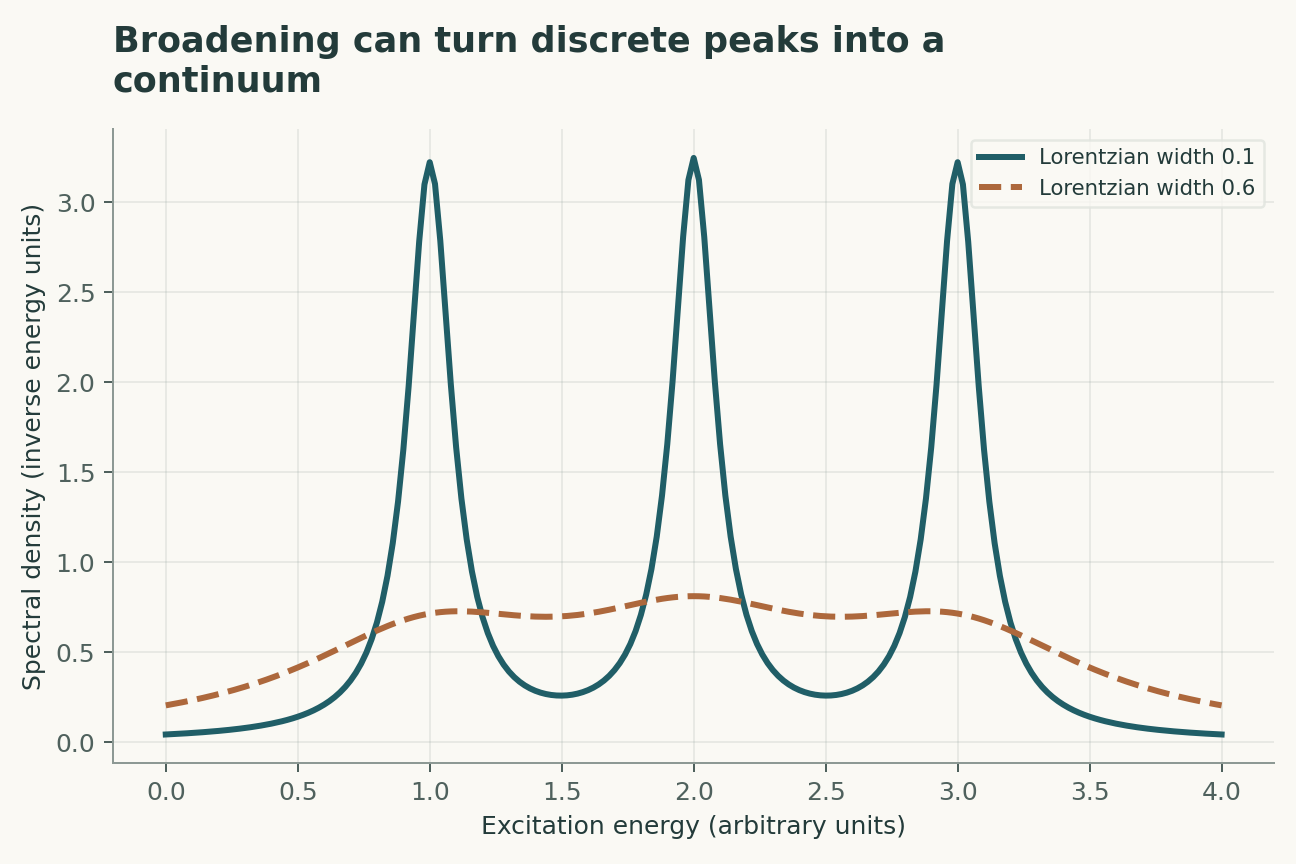
Broad spectral weight can arise from fractionalized excitations, disorder, damping or overlapping conventional modes. The relevant alternative depends on the probe's matrix elements and resolution. A proposed comparison would calculate the measured response, including instrumental convolution, for each candidate rather than compare ideal excitation cartoons. Momentum, temperature and field dependence can provide additional discrimination. A model that matches a broad energy spectrum but fails its spatial or field structure should not receive the same support as one predicting all of them. The three-Lorentzian illustration only demonstrates nonuniqueness; it is not a competing microscopic description of a specific material.
A thermal Hall signal needs channel accounting
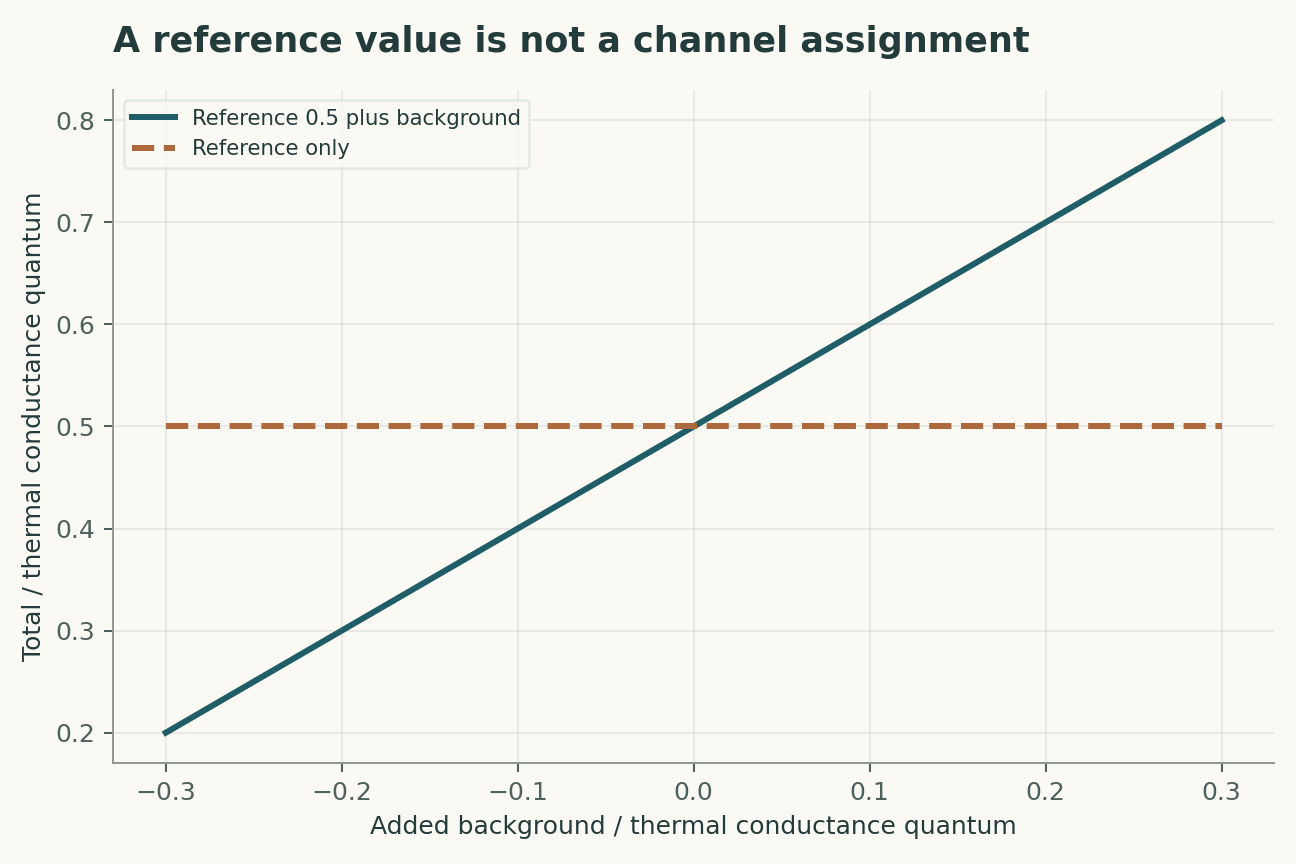
Heat can be carried by magnetic excitations, phonons and other channels, and boundaries can affect their equilibration. A proposed experiment would test field reversal, geometry, longitudinal transport and the reproducibility of the relevant temperature interval. Agreement with a reference magnitude is suggestive only when backgrounds and calibration are controlled well enough to distinguish nearby alternatives. The addition of a background in the figure is deliberately algebraic: it shows why a numerical match alone does not identify a carrier. The cited counterevidence should remain visible in the synthesis instead of being treated as an inconvenience to a preferred interpretation.
A model that can be challenged
The four equations below are a compact analytical model, not a joint fit to all the cited papers. Their interpretation is as follows. Measured scattering is a resolution convolution R of the underlying response plus background B; a broad feature can have several sources. A transverse thermal signal can contain phonon and magnetic contributions; separating them requires evidence. Ideal two-dimensional chiral-edge thermal conductance uses chiral central charge c; comparison to bulk conductivity needs geometric conversion. Each Lorentzian has integrated weight Aj and half-width gamma-j. The figure holds all three integrated weights at 1 while changing width, so broadening does not silently change total spectral weight; this is not a fit to a cited spectrum.
The observational target is joint spectroscopic, thermodynamic and thermal-transport signatures. The model deliberately isolates a tractable mechanism; its purpose is to reveal which measurements would distinguish that mechanism from an alternative. Parameter values in the figures are declared illustrative inputs. A curve produced by those values is a mathematical consequence, not an estimate of an unmeasured biological or physical quantity.
A discriminating validation design
The primary comparison should test a candidate phase explaining all probes under matched conditions. The unit of independent replication is independently characterized crystal; repeated readings from the same unit improve precision but do not create independent replication. A strong validation would hold out different samples and field orientations before choosing thresholds or fitting nuisance corrections. In particular, disorder, resolution broadening and multiple heat carriers must be measured, constrained or varied in a sensitivity analysis. Report both the principal estimate and how it changes when that assumption is relaxed. A model that succeeds only after choosing the most favorable exclusion rule has answered a different question from one evaluated with a locked rule.
Worked numerical analysis
The constructed spectrum adds three Lorentzian modes at energies 1, 2 and 3 in arbitrary units. Increasing their width from 0.1 to 0.6 makes distinct peaks overlap without introducing fractional excitations. Separately, the conductance formula assigns half of the thermal quantum when c = 0.5. The second plot compares this reference with a variable background contribution; proximity to the reference is not treated as proof of quantization.
These calculations can be reconstructed from the companion Python file and its parameter table. Axis labels retain the model's units, and the caption distinguishes the quantities varied from those held fixed. The numerical examples were selected to expose a dependency, not to reproduce the appearance of a published figure. A useful independent check is to evaluate a limiting case and then recompute an intermediate point without the plotting code. Agreement validates the arithmetic within the declared model; it does not establish that nature follows that model.
Evidence, transfer and next steps
The scope of the conclusion is limited by disorder, resolution broadening and multiple heat carriers. Transfer to different samples and field orientations requires evidence beyond fitting the original observations. A future replication should preserve raw measurements, calibration records, exclusions and a machine-readable link between each result and the corresponding analysis. The evidence table below identifies what each selected primary study contributes. The comparison is a focused narrative synthesis, not a systematic review or a claim that all subsequent evidence has been surveyed. The proposed study has not been performed here. Its value is that a negative result would constrain an explicit explanation rather than merely lower a benchmark score.
A declared analytical model
Four equations, explicit assumptions
(1) Measured scattering is a resolution convolution R of the underlying response plus background B; a broad feature can have several sources.
(2) A transverse thermal signal can contain phonon and magnetic contributions; separating them requires evidence.
(3) Ideal two-dimensional chiral-edge thermal conductance uses chiral central charge c; comparison to bulk conductivity needs geometric conversion.
(4) Each Lorentzian has integrated weight Aj and half-width gamma-j. The figure holds all three integrated weights at 1 while changing width, so broadening does not silently change total spectral weight; this is not a fit to a cited spectrum.
Constructed examples · Reproducible data
Inspect the quantitative argument
These curves are calculated from the declared models. They are not observations from the cited studies. Every figure includes its numeric data and vector version.


Which evidence answers which question?
| Evidence or design choice | What it identifies | What remains unresolved |
|---|---|---|
| Source 1 | Herbertsmithite measurements reported evidence consistent with fractionalized excitations. | Disorder and resolution remain relevant to interpretation. |
| Source 2 | Alpha-RuCl3 experiments found behavior proximate to Kitaev physics. | Proximity does not establish a pure ideal Kitaev ground state. |
| Source 3 | Thermal Hall measurements reported a half-integer signature. | Carrier attribution and reproducibility require complementary evidence. |
| Source 4 | A later study found evidence for a phonon Hall contribution. | This alternative contribution prevents a one-observable phase diagnosis. |
| Primary observable | joint spectroscopic, thermodynamic and thermal-transport signatures | disorder, resolution broadening and multiple heat carriers |
| Independent test | a candidate phase explaining all probes under matched conditions | Requires new measurements |
| Transfer set | different samples and field orientations | Not validated by the constructed numerical example |
A proposed validation protocol
This is a proposed evaluation design. No new biological experiment, clinical trial or physical experiment was carried out for this article.
- Specify joint spectroscopic, thermodynamic and thermal-transport signatures before fitting.
- Retain independent identifiers for each independently characterized crystal.
- Separate different samples and field orientations from model development.
- Measure or bound disorder, resolution broadening and multiple heat carriers.
- Record units, calibration and the observation operator.
- Compare the primary model with a named rival explanation.
- Prespecify the test: a candidate phase explaining all probes under matched conditions.
- Archive raw data, exclusions, parameter files and executable analysis.
What the primary sources establish
Tian-Heng Han, Joel S. Helton, Shaoyan Chu et al. · 2012 [1]
Contribution. Herbertsmithite measurements reported evidence consistent with fractionalized excitations.
Boundary. Disorder and resolution remain relevant to interpretation.
Source locator. Abstract / selected primary-source sections; see linked bibliographic record.
A. Banerjee, C. A. Bridges, J.-Q. Yan et al. · 2016 [2]
Contribution. Alpha-RuCl3 experiments found behavior proximate to Kitaev physics.
Boundary. Proximity does not establish a pure ideal Kitaev ground state.
Source locator. Abstract / selected primary-source sections; see linked bibliographic record.
Y. Kasahara, T. Ohnishi, Y. Mizukami et al. · 2018 [3]
Contribution. Thermal Hall measurements reported a half-integer signature.
Boundary. Carrier attribution and reproducibility require complementary evidence.
Source locator. Abstract / selected primary-source sections; see linked bibliographic record.
É. Lefrançois, G. Grissonnanche, J. Baglo et al. · 2022 [4]
Contribution. A later study found evidence for a phonon Hall contribution.
Boundary. This alternative contribution prevents a one-observable phase diagnosis.
Source locator. Abstract / selected primary-source sections; see linked bibliographic record.
Limits of this analysis
- Disorder and resolution remain relevant to interpretation.
- Proximity does not establish a pure ideal Kitaev ground state.
- Carrier attribution and reproducibility require complementary evidence.
- This alternative contribution prevents a one-observable phase diagnosis.
- Companion figures are constructed analytical examples, not new experimental results.
- Transfer to different samples and field orientations has not been demonstrated by this review.
A focused narrative analysis of the named primary studies, not a systematic literature search or a claim to comprehensive coverage through 2026.
Questions that would change the conclusion
- Which perturbation separates phonon and magnetic transverse transport?
- How strongly do defects alter the candidate low-energy state?
- Which matched probes exclude a broadened conventional explanation?
References
- Tian-Heng Han, Joel S. Helton, Shaoyan Chu et al.. Fractionalized excitations in the spin-liquid state of a kagome-lattice antiferromagnet. Nature (2012). 10.1038/nature11659.
- A. Banerjee, C. A. Bridges, J.-Q. Yan et al.. Proximate Kitaev quantum spin liquid behaviour in a honeycomb magnet. Nature Materials (2016). 10.1038/nmat4604.
- Y. Kasahara, T. Ohnishi, Y. Mizukami et al.. Majorana quantization and half-integer thermal quantum Hall effect in a Kitaev spin liquid. Nature (2018). 10.1038/s41586-018-0274-0.
- É. Lefrançois, G. Grissonnanche, J. Baglo et al.. Evidence of a Phonon Hall Effect in the Kitaev Spin Liquid Candidate α−RuCl3. Physical Review X (2022). 10.1103/physrevx.12.021025.
Bibliographic identity checked against Crossref. Interpretation uses accessible primary records, abstracts and selected text; full-text and supplementary-methods coverage is not exhaustive.
Authorship and provenance
Source-based research review and original mathematical analysis written by Codex (AI). Cited experiments belong to the cited research teams.
Concept cover created with the built-in ImageGen tool. Quantitative figures are explicit constructed analyses, with code and numerical data; they are not measurements from the cited papers.
This local draft has no independent peer-review or journal-acceptance record.