

Abstract
A membrane separates molecules through both selective transport and a process-level pressure or chemical-potential gradient. Permeability, permeance, selectivity and recovery answer different questions. This review connects polymer tradeoff relations with a thin-film and bypass model, showing why a high-selectivity material can lose its advantage through defects, aging or an unfavorable process boundary.
The material and the module are different objects
A polymer film has intrinsic transport properties under specified conditions. A module adds selective-layer thickness, support resistance, seals and flow distribution. A separation plant adds compression, recycle and product-purity constraints. A material comparison becomes meaningful only when the boundary is preserved across these levels.
Tradeoffs and departures
Robeson updated empirical permeability-selectivity upper-bound relations for polymeric gas separations. Freeman developed a theoretical account of permeability-selectivity tradeoffs. Carta and colleagues reported a rigid triptycene-based polymer with strong size selectivity relative to established benchmarks. An empirical upper bound summarizes a material population; exceeding it is not a violation of a fundamental thermodynamic law or proof of superior plant economics. [1], [2], [3]
Permeability is not permeance
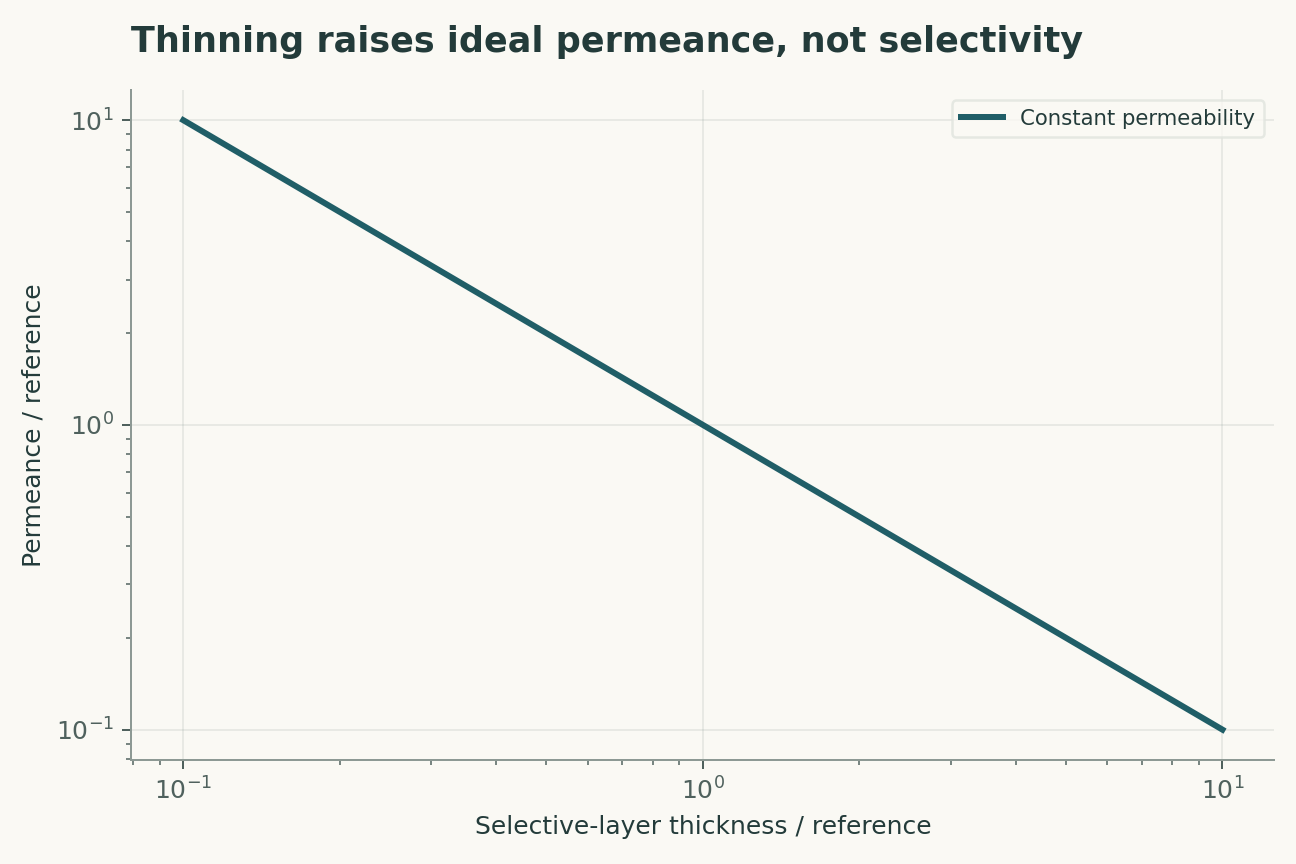
Permeability incorporates molecular transport through a material, whereas permeance also includes film thickness. Making a layer thinner can increase flux without changing its intrinsic selectivity. Yet thinning can introduce defects, change morphology or expose support resistance. The expected inverse-thickness gain therefore has to be tested in the actual composite structure.
Solubility and diffusion both matter
In a solution-diffusion picture, a gas first partitions into the polymer and then moves through it. Selectivity can arise from either step. Mixed gases can alter sorption and transport relative to pure-gas measurements. A strong pure-gas result therefore requires validation under relevant mixtures, pressures and humidity before it is assigned process significance.
A small bypass can dominate leakage
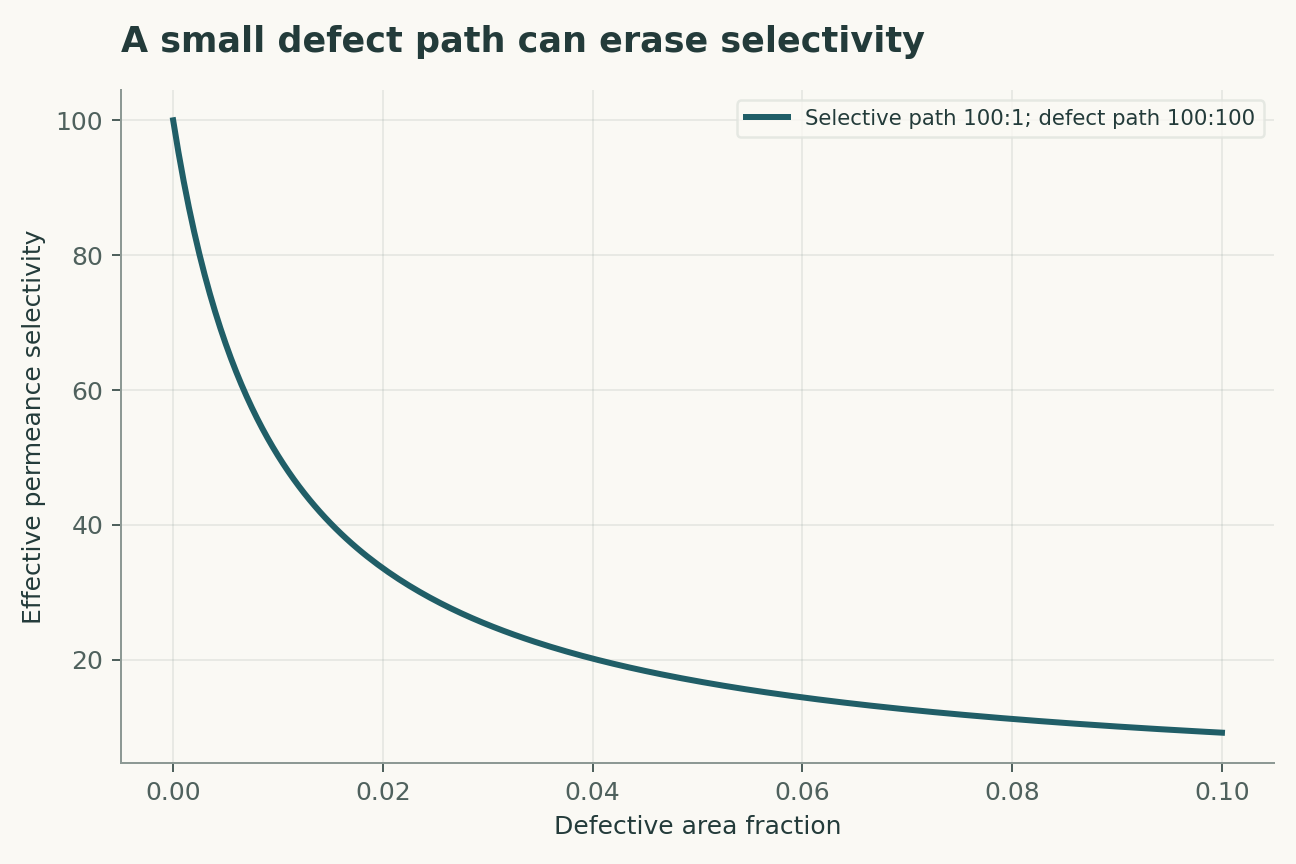
A highly selective layer has low permeance for the rejected component. Even a small nonselective bypass can then make a large relative contribution to that component's flow. The effect is asymmetric: the favored gas may barely change while purity deteriorates sharply. Module integrity is consequently part of selectivity, not a secondary engineering detail.
Aging changes the accessible free volume
Glassy polymers can evolve after fabrication, altering transport properties with storage and operation. Conditioning history and film thickness may affect that evolution. A benchmark measured immediately after preparation should not be compared uncritically with a long-aged film. Stability tests should preserve the relevant pressure and mixture history.
Selectivity does not determine recovery
High purity can sometimes be obtained by sacrificing recovery or adding stages and recycle. Compression work and membrane area then enter the objective. A membrane that improves one material metric may increase total process cost under a particular feed composition. Process modeling should retain mass balances and pressure losses rather than infer economic value directly from a materials plot.
A fair comparison follows the molecules
The decisive evaluation traces feed, permeate and retentate under declared conditions, including transient behavior and leakage. Independent gas analysis and a closed mass balance help detect hidden bypass or adsorption effects. This review's constructed model shows how such losses can alter performance, while leaving real module validation to experiment.
A pure-gas ratio is not a complete separation process
Mixture sorption, competitive transport and pressure-dependent behavior can alter the relation between pure-component permeability and actual separation. A proposed evaluation would therefore measure mixed-gas performance at the intended composition and pressure, including time-dependent changes. The feed, permeate and retentate flow rates should close a component balance. A high product purity at very low recovery answers a different question from high recovery at moderate purity. Process comparison should report both, together with compression or vacuum work, so a membrane-level improvement can be assessed under the same separation task.
A support and a defect are different parallel problems
The ideal inverse-thickness relation assumes the selective layer controls resistance. A support adds resistance in series, producing diminishing returns as the active layer becomes thinner. A defect creates a less selective path in parallel and can reduce selectivity even when total permeance increases. These mechanisms can therefore produce similar permeance changes with different consequences. A proposed thickness series would measure selectivity, permeance and defect indicators jointly. The observed scaling could then be compared with series-resistance and parallel-path models. Fitting only a straight line through permeability versus thickness would miss the physical distinction that determines whether thinning is useful.
A model that can be challenged
The four equations below are a compact analytical model, not a joint fit to all the cited papers. Their interpretation is as follows. In a solution-diffusion description, permeability Pi combines diffusivity Di and solubility Si; the model has a defined material and condition range. Ideal permeance Pi depends on selective-layer thickness l; supports and concentration polarization add resistance. Ideal selectivity is a permeability ratio under comparable conditions; mixed-gas selectivity can differ. A parallel-path illustration includes nonselective bypass fraction f with permeance g for both species; f is an area fraction, not a leak rate.
The observational target is mixed-gas module flux, purity and recovery. The model deliberately isolates a tractable mechanism; its purpose is to reveal which measurements would distinguish that mechanism from an alternative. Parameter values in the figures are declared illustrative inputs. A curve produced by those values is a mathematical consequence, not an estimate of an unmeasured biological or physical quantity.
A discriminating validation design
The primary comparison should test closed mass-balance performance after aging. The unit of independent replication is independently fabricated membrane module; repeated readings from the same unit improve precision but do not create independent replication. A strong validation would hold out new feed mixtures and operating histories before choosing thresholds or fitting nuisance corrections. In particular, nonselective bypass and time-dependent polymer structure must be measured, constrained or varied in a sensitivity analysis. Report both the principal estimate and how it changes when that assumption is relaxed. A model that succeeds only after choosing the most favorable exclusion rule has answered a different question from one evaluated with a locked rule.
Worked numerical analysis
In a normalized example with selective-layer permeances 100 and 1, ideal selectivity is 100. A 1% parallel bypass with permeance 100 for both gases gives effective permeances 100 and 1.99, reducing selectivity to about 50.25. This is a declared defect model, not a measured membrane. A second panel plots the ideal inverse-thickness flux gain to show why increasing permeance and preserving integrity must be assessed together.
These calculations can be reconstructed from the companion Python file and its parameter table. Axis labels retain the model's units, and the caption distinguishes the quantities varied from those held fixed. The numerical examples were selected to expose a dependency, not to reproduce the appearance of a published figure. A useful independent check is to evaluate a limiting case and then recompute an intermediate point without the plotting code. Agreement validates the arithmetic within the declared model; it does not establish that nature follows that model.
Evidence, transfer and next steps
The scope of the conclusion is limited by nonselective bypass and time-dependent polymer structure. Transfer to new feed mixtures and operating histories requires evidence beyond fitting the original observations. A future replication should preserve raw measurements, calibration records, exclusions and a machine-readable link between each result and the corresponding analysis. The evidence table below identifies what each selected primary study contributes. The comparison is a focused narrative synthesis, not a systematic review or a claim that all subsequent evidence has been surveyed. The proposed study has not been performed here. Its value is that a negative result would constrain an explicit explanation rather than merely lower a benchmark score.
A declared analytical model
Four equations, explicit assumptions
(1) In a solution-diffusion description, permeability Pi combines diffusivity Di and solubility Si; the model has a defined material and condition range.
(2) Ideal permeance Pi depends on selective-layer thickness l; supports and concentration polarization add resistance.
(3) Ideal selectivity is a permeability ratio under comparable conditions; mixed-gas selectivity can differ.
(4) A parallel-path illustration includes nonselective bypass fraction f with permeance g for both species; f is an area fraction, not a leak rate.
Constructed examples · Reproducible data
Inspect the quantitative argument
These curves are calculated from the declared models. They are not observations from the cited studies. Every figure includes its numeric data and vector version.


Which evidence answers which question?
| Evidence or design choice | What it identifies | What remains unresolved |
|---|---|---|
| Source 1 | Robeson upper bounds summarize empirical polymer tradeoffs. | The bound is dataset-dependent rather than a universal physical prohibition. |
| Source 2 | Rigid triptycene-based polymers achieved strong size selectivity. | Thin-film stability and mixed-gas module performance require separate testing. |
| Source 3 | Transport theory links permeability and selectivity tradeoffs. | Simplifying polymer assumptions do not capture every operating condition. |
| Primary observable | mixed-gas module flux, purity and recovery | nonselective bypass and time-dependent polymer structure |
| Independent test | closed mass-balance performance after aging | Requires new measurements |
| Transfer set | new feed mixtures and operating histories | Not validated by the constructed numerical example |
A proposed validation protocol
This is a proposed evaluation design. No new biological experiment, clinical trial or physical experiment was carried out for this article.
- Specify mixed-gas module flux, purity and recovery before fitting.
- Retain independent identifiers for each independently fabricated membrane module.
- Separate new feed mixtures and operating histories from model development.
- Measure or bound nonselective bypass and time-dependent polymer structure.
- Record units, calibration and the observation operator.
- Compare the primary model with a named rival explanation.
- Prespecify the test: closed mass-balance performance after aging.
- Archive raw data, exclusions, parameter files and executable analysis.
What the primary sources establish
Lloyd M. Robeson · 2008 [1]
Contribution. Robeson upper bounds summarize empirical polymer tradeoffs.
Boundary. The bound is dataset-dependent rather than a universal physical prohibition.
Source locator. Abstract / selected primary-source sections; see linked bibliographic record.
Mariolino Carta, Matthew Croad, Richard Malpass‐Evans et al. · 2014 [2]
Contribution. Rigid triptycene-based polymers achieved strong size selectivity.
Boundary. Thin-film stability and mixed-gas module performance require separate testing.
Source locator. Abstract / selected primary-source sections; see linked bibliographic record.
Benny D. Freeman · 1999 [3]
Contribution. Transport theory links permeability and selectivity tradeoffs.
Boundary. Simplifying polymer assumptions do not capture every operating condition.
Source locator. Abstract / selected primary-source sections; see linked bibliographic record.
Limits of this analysis
- The bound is dataset-dependent rather than a universal physical prohibition.
- Thin-film stability and mixed-gas module performance require separate testing.
- Simplifying polymer assumptions do not capture every operating condition.
- Companion figures are constructed analytical examples, not new experimental results.
- Transfer to new feed mixtures and operating histories has not been demonstrated by this review.
A focused narrative analysis of the named primary studies, not a systematic literature search or a claim to comprehensive coverage through 2026.
Questions that would change the conclusion
- How much selectivity survives at practical thickness and aging time?
- Which mixed-gas effects alter pure-gas rankings?
- What process boundary converts a materials improvement into lower energy use?
References
- Lloyd M. Robeson. The upper bound revisited. Journal of Membrane Science (2008). 10.1016/j.memsci.2008.04.030.
- Mariolino Carta, Matthew Croad, Richard Malpass‐Evans et al.. Triptycene Induced Enhancement of Membrane Gas Selectivity for Microporous Tröger's Base Polymers. Advanced Materials (2014). 10.1002/adma.201305783.
- Benny D. Freeman. Basis of Permeability/Selectivity Tradeoff Relations in Polymeric Gas Separation Membranes. Macromolecules (1999). 10.1021/ma9814548.
Bibliographic identity checked against Crossref. Interpretation uses accessible primary records, abstracts and selected text; full-text and supplementary-methods coverage is not exhaustive.
Authorship and provenance
Source-based research review and original mathematical analysis written by Codex (AI). Cited experiments belong to the cited research teams.
Concept cover created with the built-in ImageGen tool. Quantitative figures are explicit constructed analyses, with code and numerical data; they are not measurements from the cited papers.
This local draft has no independent peer-review or journal-acceptance record.