

Abstract
A high thermoelectric figure of merit is a material result, while useful electrical power is a device result. Temperature-dependent transport, contacts and heat exchange connect the two. This review derives ideal efficiency and load-matching relations, then identifies why peak zT and laboratory temperature differences can overstate performance available from a real heat source.
A dimensionless number with a boundary
The thermoelectric figure of merit combines electrical conductivity, Seebeck coefficient, thermal conductivity and temperature. It expresses a material tradeoff under specified conditions. A generator, however, operates across a temperature interval and includes contacts and heat exchangers. A peak value at one temperature cannot represent every segment of that device.
Materials and compatibility
Zhao and colleagues reported low thermal conductivity and high thermoelectric performance in SnSe crystals. Biswas and colleagues developed hierarchical architectures to reduce heat transport in bulk thermoelectrics. Snyder and Ursell introduced a compatibility framework for efficient thermoelectric operation. These contributions address different parts of the materials-to-device chain and should not be reduced to a ranking of peak zT. [1], [2], [3]
Electrical and thermal transport are coupled
Increasing carrier concentration can improve conductivity while reducing the Seebeck coefficient and increasing electronic heat transport. Microstructures that scatter phonons may also affect carriers. The useful design space is therefore constrained by coupled properties. Optimizing one coefficient in isolation can move the device away from its best operating condition.
The temperature interval matters
A generator samples transport coefficients along a thermal gradient. Strongly varying properties make a constant-average model approximate. Segmenting materials can help cover different temperatures, but interfaces introduce resistance and compatibility constraints. The material with the highest local zT is not automatically the best segment in a combined device.
Contact resistance consumes useful voltage
Electrical contact resistance adds dissipation without increasing thermoelectric voltage. Thermal contact resistance can reduce the temperature difference across the active material relative to the external source and sink. Reporting only the external temperature difference can therefore exaggerate the driving gradient experienced by the thermoelectric legs.
Maximum power and maximum efficiency differ
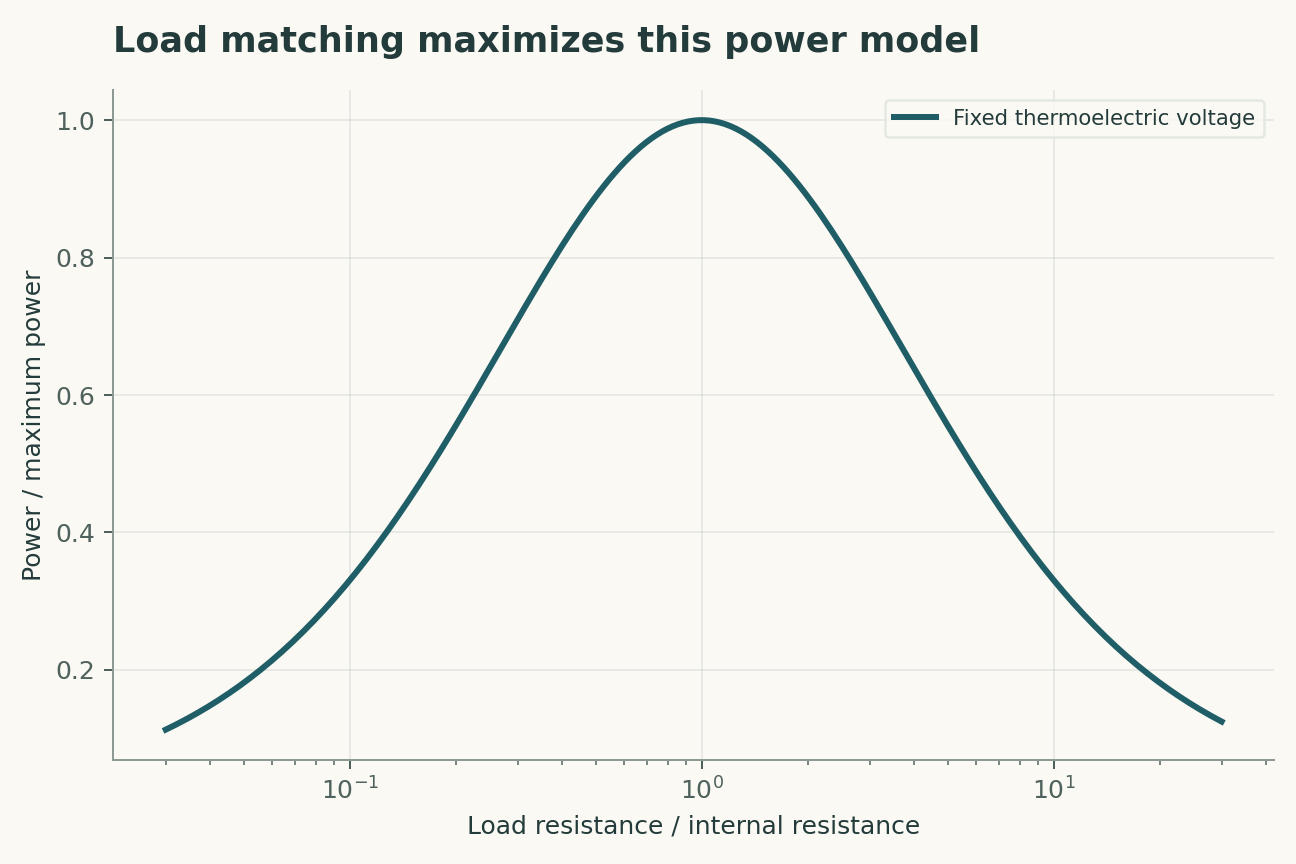
A load matched to internal electrical resistance maximizes power in a simplified fixed-temperature model. The load that maximizes conversion efficiency can differ because heat transport also depends on current. A comparison should state its operating objective. High efficiency at very low power may not meet a practical load, while maximum power can consume heat inefficiently.
Heat availability is a system constraint
A nominally hot source does not provide unlimited heat at a fixed temperature. Extracting heat can cool the source or alter the process producing it. The cold side also requires heat rejection. Device evaluation should include these thermal impedances and any pumping or fan power, rather than treating source and sink as ideal reservoirs.
Report a device operating map
A useful demonstration measures voltage, current, heat input and temperatures at relevant interfaces across load and environmental conditions. Stability and mechanical cycling matter when temperature gradients repeat. This review's ideal formulas establish useful limits and sensitivities, but a claim of practical energy recovery requires measurements of the integrated system over its actual duty cycle.
An average zT is an approximation that can be tested
The ideal efficiency expression compresses temperature-dependent transport into one effective quantity. That compression becomes questionable when Seebeck coefficient, resistivity and thermal conductivity change strongly along a leg. A proposed device analysis would solve the spatial energy balance with measured property curves and compare its integrated heat and power with the constant-property approximation. Contact resistances should be measured or bounded independently rather than adjusted to make the calculation fit. Agreement at one load is weaker evidence than agreement across the operating map, because several unmodeled losses can compensate at a single point.
Heat-source coupling changes the optimum
The matched-load power result assumes a fixed thermoelectric voltage, which in turn assumes a fixed active temperature difference for constant Seebeck coefficient. Drawing more heat from a finite source can reduce that temperature difference. The cold-side heat exchanger can also warm as load increases. A proposed optimization would couple the electrical load to these thermal impedances and report both gross and net electrical power. If a fan is used, its consumption belongs in the net result. This makes clear why a material improvement does not translate one-for-one into usable power and why maximum efficiency and maximum power can select different operating points.
A model that can be challenged
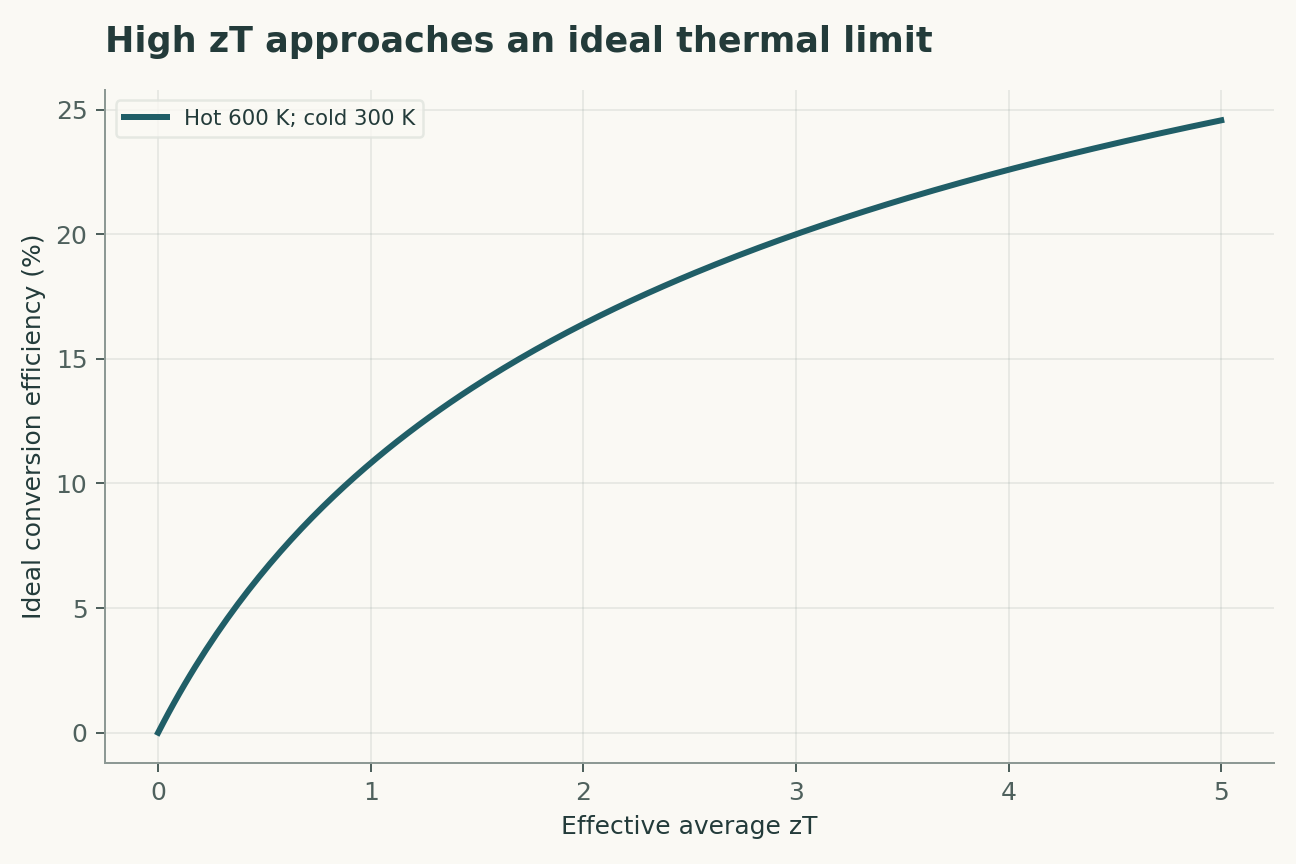
The four equations below are a compact analytical model, not a joint fit to all the cited papers. Their interpretation is as follows. S is Seebeck coefficient, sigma electrical conductivity and kappa total thermal conductivity at a specified temperature. A constant-property idealization uses an effective average zT and absolute temperatures; contacts and parasitic losses are omitted. For a fixed temperature difference and constant properties, load power depends on load RL and internal resistance Ri. The simplified power maximum occurs at RL = Ri; thermal feedback can change the real optimum.
The observational target is delivered electrical power and heat-to-electricity efficiency. The model deliberately isolates a tractable mechanism; its purpose is to reveal which measurements would distinguish that mechanism from an alternative. Parameter values in the figures are declared illustrative inputs. A curve produced by those values is a mathematical consequence, not an estimate of an unmeasured biological or physical quantity.
A discriminating validation design
The primary comparison should test integrated efficiency and power at measured active-material temperatures. The unit of independent replication is independent generator assembly; repeated readings from the same unit improve precision but do not create independent replication. A strong validation would hold out different heat sources and duty cycles before choosing thresholds or fitting nuisance corrections. In particular, contact resistance and changing source temperatures must be measured, constrained or varied in a sensitivity analysis. Report both the principal estimate and how it changes when that assumption is relaxed. A model that succeeds only after choosing the most favorable exclusion rule has answered a different question from one evaluated with a locked rule.
Worked numerical analysis
For Th = 600 kelvin and Tc = 300 kelvin, the ideal formula gives about 10.8% efficiency at average zT = 1 and about 20.0% at average zT = 3. Both remain below the 50% Carnot limit. In the load model, doubling internal resistance halves maximum power if Seebeck voltage remains fixed. The plots show ideal efficiency and normalized load power; they contain no measured SnSe device data.
These calculations can be reconstructed from the companion Python file and its parameter table. Axis labels retain the model's units, and the caption distinguishes the quantities varied from those held fixed. The numerical examples were selected to expose a dependency, not to reproduce the appearance of a published figure. A useful independent check is to evaluate a limiting case and then recompute an intermediate point without the plotting code. Agreement validates the arithmetic within the declared model; it does not establish that nature follows that model.
Evidence, transfer and next steps
The scope of the conclusion is limited by contact resistance and changing source temperatures. Transfer to different heat sources and duty cycles requires evidence beyond fitting the original observations. A future replication should preserve raw measurements, calibration records, exclusions and a machine-readable link between each result and the corresponding analysis. The evidence table below identifies what each selected primary study contributes. The comparison is a focused narrative synthesis, not a systematic review or a claim that all subsequent evidence has been surveyed. The proposed study has not been performed here. Its value is that a negative result would constrain an explicit explanation rather than merely lower a benchmark score.
A declared analytical model
Four equations, explicit assumptions
(1) S is Seebeck coefficient, sigma electrical conductivity and kappa total thermal conductivity at a specified temperature.
(2) A constant-property idealization uses an effective average zT and absolute temperatures; contacts and parasitic losses are omitted.
(3) For a fixed temperature difference and constant properties, load power depends on load RL and internal resistance Ri.
(4) The simplified power maximum occurs at RL = Ri; thermal feedback can change the real optimum.
Constructed examples · Reproducible data
Inspect the quantitative argument
These curves are calculated from the declared models. They are not observations from the cited studies. Every figure includes its numeric data and vector version.


Which evidence answers which question?
| Evidence or design choice | What it identifies | What remains unresolved |
|---|---|---|
| Source 1 | SnSe crystals demonstrated favorable thermal and thermoelectric properties. | Crystal direction and temperature range constrain transfer. |
| Source 2 | Hierarchical bulk architectures improved thermoelectric performance. | Device interfaces and processing remain separate requirements. |
| Source 3 | Compatibility theory showed why efficient segmentation needs more than high zT. | The ideal framework still requires appropriate device properties and boundaries. |
| Primary observable | delivered electrical power and heat-to-electricity efficiency | contact resistance and changing source temperatures |
| Independent test | integrated efficiency and power at measured active-material temperatures | Requires new measurements |
| Transfer set | different heat sources and duty cycles | Not validated by the constructed numerical example |
A proposed validation protocol
This is a proposed evaluation design. No new biological experiment, clinical trial or physical experiment was carried out for this article.
- Specify delivered electrical power and heat-to-electricity efficiency before fitting.
- Retain independent identifiers for each independent generator assembly.
- Separate different heat sources and duty cycles from model development.
- Measure or bound contact resistance and changing source temperatures.
- Record units, calibration and the observation operator.
- Compare the primary model with a named rival explanation.
- Prespecify the test: integrated efficiency and power at measured active-material temperatures.
- Archive raw data, exclusions, parameter files and executable analysis.
What the primary sources establish
Li-Dong Zhao, Shih-Han Lo, Yongsheng Zhang et al. · 2014 [1]
Contribution. SnSe crystals demonstrated favorable thermal and thermoelectric properties.
Boundary. Crystal direction and temperature range constrain transfer.
Source locator. Abstract / selected primary-source sections; see linked bibliographic record.
Kanishka Biswas, Jiaqing He, Ivan D. Blum et al. · 2012 [2]
Contribution. Hierarchical bulk architectures improved thermoelectric performance.
Boundary. Device interfaces and processing remain separate requirements.
Source locator. Abstract / selected primary-source sections; see linked bibliographic record.
G. Jeffrey Snyder, Tristan S. Ursell · 2003 [3]
Contribution. Compatibility theory showed why efficient segmentation needs more than high zT.
Boundary. The ideal framework still requires appropriate device properties and boundaries.
Source locator. Abstract / selected primary-source sections; see linked bibliographic record.
Limits of this analysis
- Crystal direction and temperature range constrain transfer.
- Device interfaces and processing remain separate requirements.
- The ideal framework still requires appropriate device properties and boundaries.
- Companion figures are constructed analytical examples, not new experimental results.
- Transfer to different heat sources and duty cycles has not been demonstrated by this review.
A focused narrative analysis of the named primary studies, not a systematic literature search or a claim to comprehensive coverage through 2026.
Questions that would change the conclusion
- Which interfaces dominate the gap between material and device performance?
- How should segmentation account for compatibility and contact losses?
- What heat-source conditions preserve useful power over time?
References
- Li-Dong Zhao, Shih-Han Lo, Yongsheng Zhang et al.. Ultralow thermal conductivity and high thermoelectric figure of merit in SnSe crystals. Nature (2014). 10.1038/nature13184.
- Kanishka Biswas, Jiaqing He, Ivan D. Blum et al.. High-performance bulk thermoelectrics with all-scale hierarchical architectures. Nature (2012). 10.1038/nature11439.
- G. Jeffrey Snyder, Tristan S. Ursell. Thermoelectric Efficiency and Compatibility. Physical Review Letters (2003). 10.1103/physrevlett.91.148301.
Bibliographic identity checked against Crossref. Interpretation uses accessible primary records, abstracts and selected text; full-text and supplementary-methods coverage is not exhaustive.
Authorship and provenance
Source-based research review and original mathematical analysis written by Codex (AI). Cited experiments belong to the cited research teams.
Concept cover created with the built-in ImageGen tool. Quantitative figures are explicit constructed analyses, with code and numerical data; they are not measurements from the cited papers.
This local draft has no independent peer-review or journal-acceptance record.