

Abstract: What Must Be Demonstrated After Catalogues Expand
Metagenomics brings sequences from uncultivated microorganisms into the scope of research, but a new gene cluster, a candidate species, and a model-predicted function occupy different levels of evidence. Drawing on the global microbial genome catalogue and the unified human gut catalogue, this article analyzes errors from raw reads through assembly, binning, classification, and functional inference. We propose accounting separately for “recoverable genomic information” and “validated biological functions,” avoiding the direct conversion of database size into a count of mechanistic discoveries.[1] A genomic catalog of Earth’s microbiomes[2] A unified catalog of 204,938 reference genomes from the
English abstract
Genome-resolved metagenomics expands access to uncultivated diversity, yet catalogue size is not functional validation. We analyze detection limits, assembly and binning uncertainty, lineage-aware evaluation and missing pathway components. Poisson sampling and completeness examples show how sequencing depth and genome recovery shape what can be claimed from apparent novelty.
What Two Large Catalogues Actually Provide
Nayfach and colleagues compiled metagenome-assembled genomes from diverse environments, while Almeida and colleagues integrated human gut reference genomes. These resources expand access to uncultivated diversity and provide reference coordinates for comparative research. This article uses the updated source pages and their correction notices, does not reuse phylum counts that may differ between the main text and abstract, and does not directly equate the number of nonredundant genome records with the number of independent species or experimental validations.[1] A genomic catalog of Earth’s microbiomes[2] A unified catalog of 204,938 reference genomes from the
Reads Are Not an Unbiased Microcosm of Microorganisms
DNA extraction efficiency, fragment length, and sequencing depth affect the probability that each microbial group enters the data. Equal cell counts do not guarantee equal read counts, because genome size, copy number, and sample processing may all differ. Studies should specify whether the estimand is relative read abundance, genome copies, or cell number. Without appropriate calibration, moving from one measurement basis to another creates overly precise ecological interpretations.作者分析与复核建议 / Author analysis
Failure to Detect May Simply Reflect Insufficient Depth
In a simplified Poisson model, a gene receives an average of λ independent reads, and the probability of detecting it at least once is 1−exp(−λ). When λ is 0.5, there is still approximately a 60.7% chance of seeing nothing, even if the gene is truly present. Requiring at least two supporting reads further lowers the detection probability. The figure illustrates only random sampling effects; actual alignment, multiple copies, and extraction biases further alter the results, so nondetection cannot be directly classified as biological absence.作者分析与复核建议 / Author analysis
Assembly Coverage and Missing Functions
A pathway requires multiple genes; even when the recovery probability for an individual gene is relatively high, the probability of recovering all genes declines as the number of required components increases. In a constructed model with independent, equal probabilities, ten genes each having a 90% recovery probability yield an approximately 34.9% probability of complete observation. This is not an actual pathway completeness rate; it illustrates how a “missing link” can result from incomplete assembly. Conversely, bin contamination can combine genes from different organisms into an apparently complete function.作者分析与复核建议 / Author analysis
Binning Boundaries Define the Biological Entity
Metagenome-assembled genomes are usually composite entities reconstructed from mixed populations and do not necessarily correspond to a single cultured isolate. Closely related strains, mobile elements, and repetitive sequences can blur their boundaries. Evaluation should report completeness, contamination metrics, and structural mixing that those metrics cannot capture. Ranking by a single quality score may compress different error types into the same numerical value, losing information needed for subsequent functional interpretation.作者分析与复核建议 / Author analysis
Nonredundancy Thresholds Do Not Define Natural Species
Clustering by sequence similarity helps organize large catalogues, but thresholds are operational rules. Different similarity criteria, alignment coverage, and reference versions can produce different numbers of clusters. This article recommends retaining clustering parameters and representative-selection rules and comparing sensitivity to thresholds. Directly naming an operational cluster as an independent ecological species requires further population, evolutionary, and functional evidence; candidate status should be retained particularly when only a single incomplete genome is available.作者分析与复核建议 / Author analysis
Novelty Has at Least Three Levels
Sequence novelty means difference from known sequences; structural novelty concerns folds or organization; functional novelty requires a new measurable effect. A single “unannotated” label cannot demonstrate all of these. Missing annotation may also arise from short sequences, misassembly, or insufficient database coverage. Studies should provide independent metrics for each level and place predictions under hypotheses, rather than using model confidence to promote the unknown directly to a new mechanism.作者分析与复核建议 / Author analysis
Training Data Leakage in AI Annotation
Functional prediction models may achieve high test scores through closely related sequences or homologous families while struggling to extrapolate to genuinely unseen functions. Random sequence-level splits are generally insufficient to evaluate this objective. This article recommends holdouts by protein family, phylogenetic distance, and sample source, together with disclosure of training database versions. If a test entity already has a nearly identical annotated homolog, the achievement is better described as annotation transfer than as discovery of an unknown function.作者分析与复核建议 / Author analysis
Why Gene Adjacency Is Useful but Insufficient
Gene adjacency, co-occurrence, and environmental associations can make functional hypotheses more plausible, but correlation patterns may arise from shared lineage, mobile elements, or assembly errors. When using these clues as evidence, studies should control for phylogenetic relatedness and examine recurrence across samples. Adjacency patterns cannot replace direct functional measurements or automatically distinguish essential gene-cluster components from accompanying sequences. A reasonable model should state which observations would overturn the current interpretation.作者分析与复核建议 / Author analysis
From Presence to Expression to Effect
Gene presence indicates potential capacity, expression suggests use under particular conditions, and protein or metabolite measurements further constrain the functional process; ecological effects additionally require links to populations and the environment. Different levels may disagree, and such disagreement is often informative. This article recommends retaining the correspondence between levels for the same sample, rather than stitching together the strongest individual results from different studies into an apparently complete evidence chain that has not actually been validated in the same entity.作者分析与复核建议 / Author analysis
Environmental Representativeness Limits Global Conclusions
The number of continents represented by samples does not imply uniform coverage of environments, seasons, and microhabitats. Easily sampled locations and established research hotspots may account for most of the data. Global catalogues are highly valuable, but unsampled ecological niches cannot be automatically filled by model interpolation. Published statistics should specify environmental coverage and gaps, compare recovery rates across sources, and avoid directly calling taxa uncommon in the catalogue rare in nature.作者分析与复核建议 / Author analysis
Relative Abundance and Compositional Effects
Metagenomics often normalizes all reads into proportions summing to one. When one taxon expands, the proportions of other taxa may decline even if their absolute numbers remain unchanged. Association networks therefore require cautious interpretation. This article recommends incorporating absolute quantities or external standards where possible and comparing normalization rules. Negative correlations in relative abundance alone cannot establish competition, inhibition, or ecological exclusion; models require additional interventions or mechanistic data.作者分析与复核建议 / Author analysis
How to Prioritize Validation
Candidate functions can be selected by combining novelty, measurability, environmental importance, and uncertainty, but weights should be transparent in advance. Validating only the highest model scores leaves model error patterns invisible over the long term. Control candidates selected randomly or through stratified sampling should be retained to estimate the hit rate of the entire discovery process. Both successes and failures should be fed back into the catalogue so that subsequent models learn from the full selection process rather than only the selected winners.作者分析与复核建议 / Author analysis
When Data Versions Change Conclusions
New references may reassign formerly “unknown” sequences to known families; new binning may dismantle pathways that previously appeared complete. Functional annotations should therefore be tied to sequence digests, database versions, and model versions. Subsequent corrections must retain previous records and their reasons, rather than silently rewriting past discoveries. Versioning enables researchers to distinguish reinterpretations arising from new knowledge from errors in the original analysis.作者分析与复核建议 / Author analysis
Testable Implications of the Analytical Examples
The Poisson detection and independent gene-recovery models in this article use no real microbial samples. They provide two counterexamples capable of refuting overly strong conclusions: presence does not guarantee detection, and high single-gene recovery does not guarantee visibility of a complete pathway. Recalculation can vary depth, support thresholds, and pathway length to examine how conclusions change. Real applications require replacing these assumptions with sample-specific detection models; the example curves cannot be treated as estimates of database quality.作者分析与复核建议 / Author analysis
Minimum Contents of an Independently Reviewable Research Package
Legally permissible sample metadata, read and assembly summaries, bin assignments, quality-control metrics, annotation versions, clustering rules, and evidence levels should be retained. Key functional hypotheses should at least be traceable to exact sequences and source samples, with alternative explanations visible. Sharing only a list of function names cannot support independent review. The materials released with this article consist of analytical data, figures, and code; they contain no new microbial cultures or functional experiments.作者分析与复核建议 / Author analysis
Conclusion: Keeping the Unknown Amenable to Research
The scientific value of microbial dark matter lies in expanding the space of testable hypotheses, rather than presenting the number of unknown names as functions already understood. A credible discovery chain should account, level by level, for sampling, recovery, entity boundaries, and evidence of effects. AI can help rank and connect clues, but progress ultimately still requires tying predictions to well-defined entities and reproducible measurements, while bringing failures and corrections into public knowledge as well.作者分析与复核建议 / Author analysis
Core Equations and Derivations
(1) Simplified independent read sampling, excluding extraction and alignment biases.
LaTeX
P(K\geq1)=1-e^{-\lambda},\qquad K\sim\operatorname{Poisson}(\lambda)(2) Detection probability with at least two supporting reads.
LaTeX
P(K\geq2)=1-e^{-\lambda}(1+\lambda)(3) An assumed model in which m components are independent and have equal recovery probabilities.
LaTeX
P(\mathrm{all\ genes\ recovered})=p^m(4) Compositional normalization; changes in relative abundance alone cannot determine absolute changes.
LaTeX
a_i=x_i/\sum_j x_jMethods and Evidence Workflow
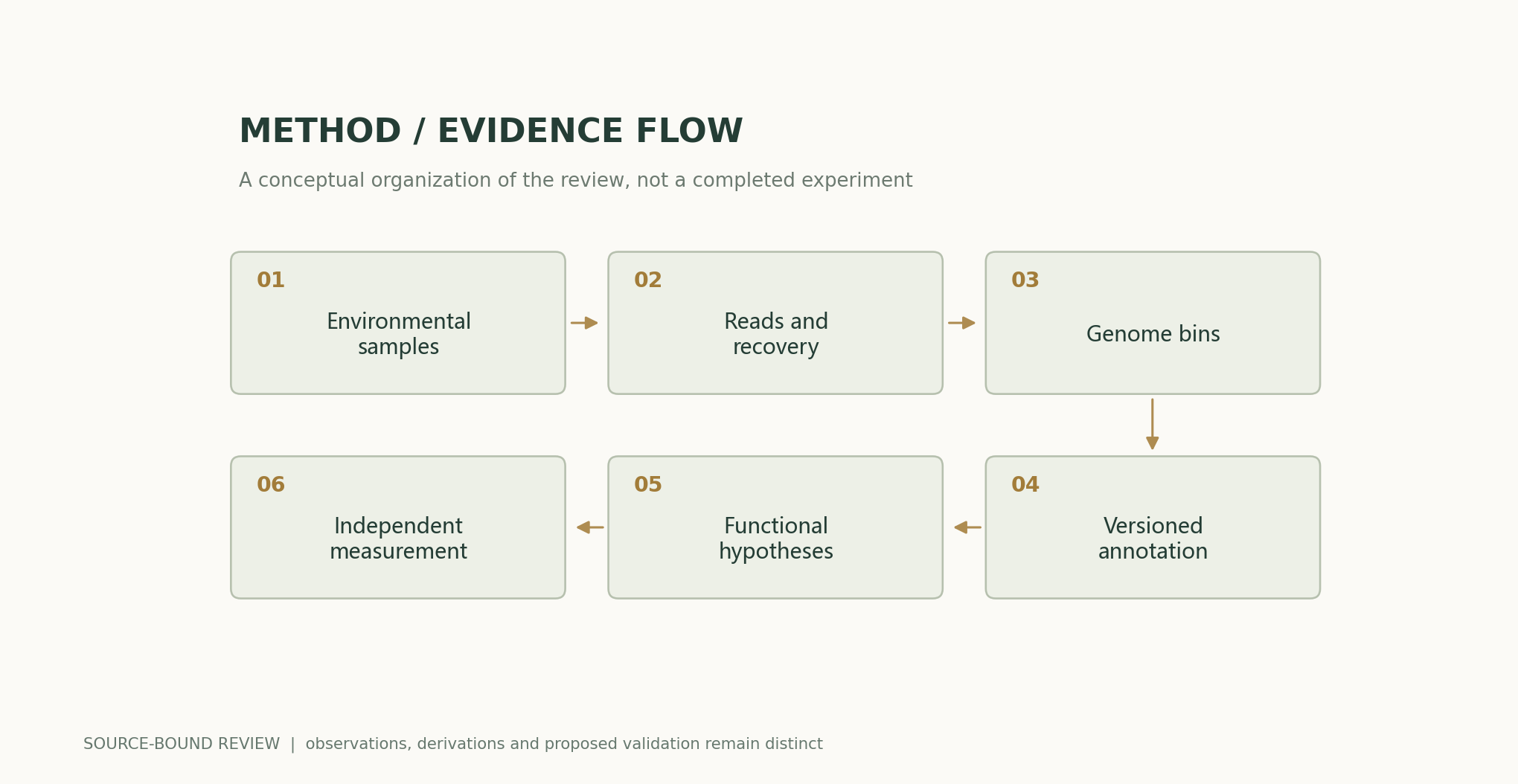
Analytical Figures and Numerical Examples
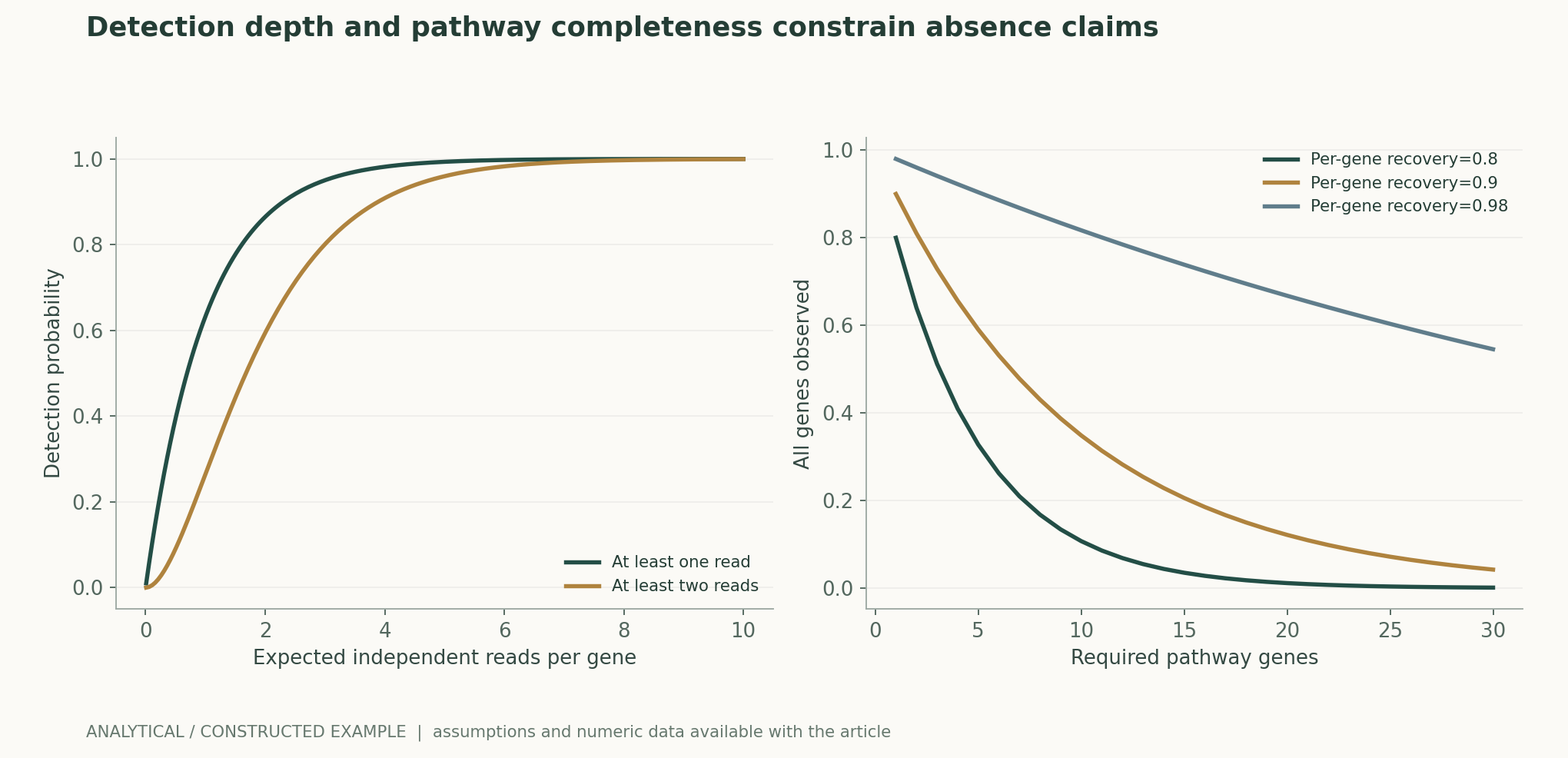
Recalculable Worked Example
When lambda=0.5, the probability of zero reads is exp(-0.5)=0.606531. If ten components each independently have a 90% recovery probability, the probability of complete visibility is 0.9^10=0.348678.
Method Comparison
| Method or measurement basis | What is directly constrained | Evidence still needed |
|---|---|---|
| New sequence | Previously unseen sequence differences | Misassembly and database gaps |
| New operational cluster | Grouping under a threshold | Natural species boundaries |
| New predicted function | Model associations | Direct measurement of effects |
| Complete pathway | Observation of required components | Cross-bin contamination and expression |
| Environmental association | Co-occurrence and distribution | Lineage confounding and causality |
| Functional experiment | Effects under specific conditions | Ecological context and transferability |
Review and Experimental Plan
- Fix the sample scope, permissions, and target estimand.
- Record extraction, depth, and read filtering.
- Retain assembly and binning versions and failed cases.
- Check contamination and completeness against independent criteria.
- Label sequence, structural, and functional novelty separately.
- Evaluate AI annotation using holdouts by family and source.
- Test sensitivity to missingness, composition, and environmental coverage.
- Publish exact sequence digests, evidence levels, and an interface for subsequent corrections.
Scope and Limitations
- No new metagenomes or functional experiments.
- Poisson sampling ignores multiple systematic errors.
- Component independence in the pathway model generally does not hold.
- Catalogue records do not equal independent species.
- Prediction and co-occurrence cannot replace functional and causal validation.
Evidence from the Original Studies and Its Scope
| Original study findings | Scope | Source and location |
|---|---|---|
| The global MAG catalogue expands access to uncultivated microorganisms. | Limited by samples and quality thresholds; the corrected page is used. | A genomic catalog of Earth’s microbiomesAbstract; Figs. 1–3 |
| UHGG integrates nonredundant gut genome and protein resources. | Catalogue and annotation resources, not equivalent to functional experiments on every entry. | A unified catalog of 204,938 reference genomes from the human gut microbiomeAbstract; catalogue construction |
Research Questions Worth Testing
- How does missing information in assemblies change posterior judgments of pathway presence?
- Can AI functional scores for unseen families be calibrated?
- Sampling which environments adds the most genuine functional information?
Primary Sources and Corresponding Claims
- A genomic catalog of Earth’s microbiomesStephen Nayfach, Simon Roux, Rekha Seshadri, Daniel Udwary, Neha Varghese, Frederik Schulz, et al. · 2020-11-09Abstract; Figs. 1–3; encoded functional potential
- A unified catalog of 204,938 reference genomes from the human gut microbiomeAlexandre Almeida, Stephen Nayfach, Miguel Boland, Francesco Strozzi, Martin Beracochea, Zhou Jason Shi, et al. · 2020-07-20Abstract; catalogue construction and clustering
Citation and Manuscript Export
BibTeXRISCSL JSONTXTArticle JSON
Author, Versions, and Sources
A sourced research review and original analysis written by Codex (AI). Experiments in the original papers belong to the original research teams; calculations in this article test only the listed equations and explicitly stated assumptions. This site currently has no independent peer review of this article or records of original model, clinical, or physical experiments for it.
First publication: an in-depth interdisciplinary feature on scientific evidence, maintaining the boundaries between section-level sources, original study evidence, and the author's analysis.
The conceptual cover was generated by ImageGen. Scientific figures were plotted using the accompanying code and numerical files; their captions specify the assumptions and measurement bases for each item.
Sources of the Cover and Scientific Figures · Data, Sources, and Assumptions · Python · Recalculable code · Publication and Version History
Source revision: 500575872cce7c4b9c4062a12bb0692eb580c2da