

Abstract: Precision is a set of joint conditions
Prime editing encodes “where to edit” and “what to change it to” within the same molecular recognition and template system, but achieving the intended state at one base does not automatically establish that the genomic outcome of the entire cell is correct. Taking studies of the original mechanism and repair environment as its evidentiary starting point, this review develops a hierarchical ledger from input cells and complete reads to intended products. The central question is how to report rewriting probability, unintended products, missing measurements, and subsequent selection together, so that the metrics improved by design optimization correspond to the biological entities of actual interest.[1] Search-and-replace genome editing without double-strand[2] Enhanced prime editing systems by manipulating cellular
English abstract
Prime editing couples targeted nicking to template-directed reverse transcription. This review separates intended editing, product purity, delivery and cellular selection. We develop a multinomial outcome ledger, show why conditional purity can conceal low starting-cell yield, and propose molecule-linked and longitudinal validation without presenting new editing experiments.
Mechanism and scope of the initial study
Anzalone and colleagues proposed coupling a nickase, a reverse-transcription module, and a guide RNA containing editing information, and demonstrated multiple types of site-specific changes. The study provides experimental evidence for the range of capabilities, but the system, sites, and cell types are part of its conclusions. “Without requiring double-strand breaks” describes the design pathway; it does not mean that double-strand damage, large-segment changes, or cellular stress are absent under all conditions. This review does not recast the theoretical coverage of editable variants as a success rate for treating diseases.[1] Search-and-replace genome editing without double-strand
Repair environments produce different outcomes from the same design
Through analysis of cellular determinants and optimization of editor architecture, Chen and colleagues showed that host repair processes alter the distribution of editing products. Editor performance should therefore be viewed as a joint function of design, cellular environment, and measurement procedures. A fold improvement in one cellular background cannot be transferred directly as a fixed gain in another tissue. Short-term effects in the original study must also be distinguished from the long-term validation objectives proposed here, which require additional evidence.[2] Enhanced prime editing systems by manipulating cellular
Defining an outcome space with nonoverlapping categories
This review recommends first defining mutually exclusive categories at the molecular level: fully intended, carrying additional changes, unedited, structurally abnormal, and indeterminate. A fully intended outcome must specify the observation window; molecules read as correct only locally cannot automatically be assigned to “genome-wide correctness.” If multiple sites lie on the same molecule, counting them independently reuses evidence. Where it is uncertain whether long and short reads share an origin, linkage uncertainty should be retained rather than assembling results from the largest success counts.作者分析与复核建议 / Author analysis
Why denominators change conclusions
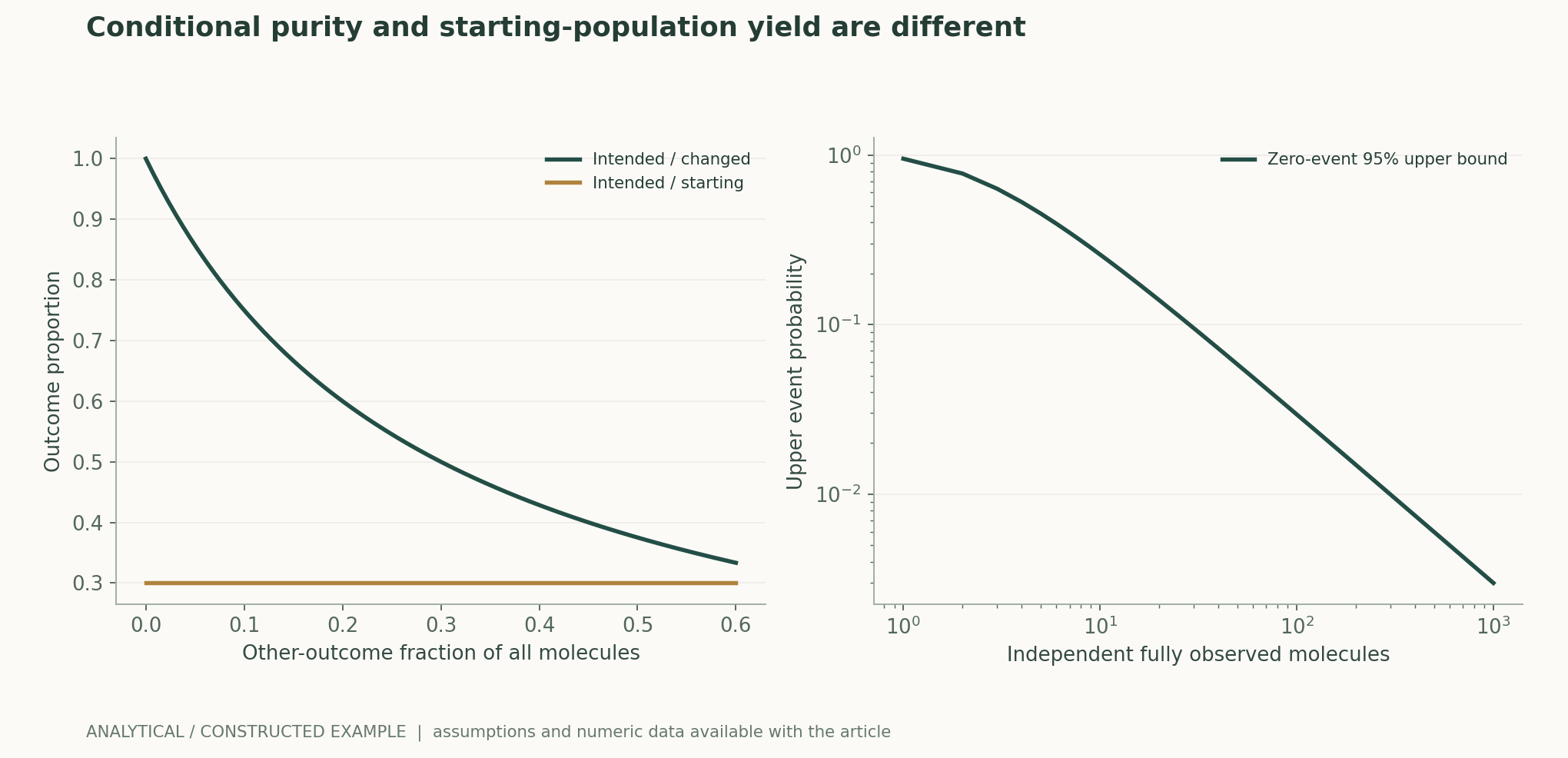
Consider a purely arithmetic example: among 1000 eligible original molecules, 300 are fully intended, 100 carry other changes, and 600 are unedited. The intended editing rate is 30%, while purity among all altered products is 75%. Both figures are correct, but they answer different questions. Removing unedited molecules first and then claiming 75% efficiency turns a conditional probability into an overall probability. If there are another 100 indeterminate molecules, the overall denominator must also be stated separately; they cannot be silently discarded.作者分析与复核建议 / Author analysis
Delivery and survival form another layer of selection
Suppose that only half of the starting cells enter observation and that the fraction with intended rewriting among them is 30%; the yield relative to starting cells is then only 15%. These are not actual parameters of a delivery platform, but an illustration of how conditional selection compounds multiplicatively. A more complex situation arises when correct rewriting and survival are associated: two independently measured proportions cannot then simply be multiplied, and joint data from the same cell or lineage are required. Otherwise, preferential selection of survivors may conceal the damaged population.作者分析与复核建议 / Author analysis
Sequence windows and structural events
Short reads can distinguish local bases finely, but may not span more distant rearrangement breakpoints. Expanding the window can reduce missed detection of certain events, but may also alter alignment failure and amplification bias. A reasonable strategy is to deploy complementary measurements for different event categories and specify the regions visible to each measurement. Events that are “not observed” require a detection-based upper bound, rather than assigning zero risk outside the observation window. Prime-editing precision should be reported together with resolution.作者分析与复核建议 / Author analysis
Sequencing errors and low-frequency unintended products
When the target error rate approaches the sequencing or amplification background, adding reads may merely measure platform bias more precisely. This review expresses observed frequency as a mixture of true events and a misclassification process, requiring independent negative samples and calibration materials with known mixture proportions. If errors depend on sequence context, subtracting a single constant background uniformly is insufficient. Frequencies are preferably estimated after molecular deduplication, while preserving the distinction between raw read counts and independent molecule counts.作者分析与复核建议 / Author analysis
Zero observations cannot prove zero events
If each independent molecule has probability q of a particular event, the probability of detecting none in n molecules is (1−q) raised to the power n. A one-sided upper confidence bound can be derived from this; smaller samples give wider upper bounds. The formula depends on independence and perfect detection, and the constraint is weaker when events are missed in practice. The upper bound in the figure is only a binomial model, not a safety estimate made by this review for any editor, and it cannot replace conclusions about cellular behavior that require long-term observation.作者分析与复核建议 / Author analysis
Extrapolation errors caused by site selection
Sites that are easy to measure, easy to deliver to, or successful first are often more likely to enter the showcased set. If a designer is also tuned on those sites, the test set will favor the same kinds of local sequences. This review recommends fixing site families that did not participate in design selection in advance and grouping them by sequence similarity and cellular background. Failed sites and reasons for missingness should be reported; averages across sites must specify whether weighting is used, so that many technical replicates do not overwhelm a few difficult sites.作者分析与复核建议 / Author analysis
The time dimension and clonal expansion
The early proportion of intended products and the long-term share of a lineage are not the same quantity. A rare cell with a growth advantage can account for a large proportion of later samples; conversely, correctly edited cells may gradually disappear. Longitudinal comparisons therefore require records of culture or follow-up conditions, lineage relationships, and sampling fractions. Attributing every later increase in proportion to continued editing reactions confounds generation mechanisms with selection mechanisms, especially when division rates differ.作者分析与复核建议 / Author analysis
Multiobjective optimization requires more than a single highest score
Design evaluation should include at least intended yield, the rate of other changes, the indeterminate fraction, and cost. A Pareto frontier of these metrics can show that no candidate dominates in every dimension simultaneously. If a single composite score is required, the weights and acceptable lower bounds should be disclosed in advance, and sensitivity to the weights should be analyzed. Otherwise, changing weights can manufacture a new “best solution.” The figures in this review use assumed parameters to explain denominators and do not rank specific experimental designs.作者分析与复核建议 / Author analysis
Statistical units that can be verified
Reads, original molecules, cells, clones, and independent batches form a nested structure. Technical replication can only reduce measurement noise; it cannot replace replication in independent backgrounds. The resampling level for confidence intervals should be chosen according to the research objective, for example using batches or lineages as units. If methods share the same batch of samples, the comparison has a paired structure, which should be used to estimate differences rather than assuming all reads from both methods are independent observations.作者分析与复核建议 / Author analysis
AI designers should output falsifiable claims
A useful design model should specify whether it predicts local editing rate, complete-product purity, or joint success after delivery. Output uncertainty needs calibration in unseen backgrounds; the model should also be able to reject requests beyond its training coverage. This review recommends retaining the training version, candidate-filtering order, and every failure record so that “model recommendations” can be traced to their exact inputs. Model scores establish only testing priorities and cannot replace molecular measurement results.作者分析与复核建议 / Author analysis
From existing research to propositions requiring validation
A testable extension is whether optimization targeting the repair environment still improves joint correct yield under a complete denominator, identical event windows, and independent batches, and whether that improvement comes at the cost of a higher indeterminate rate or selection of particular lineages. Answering these questions requires a prespecified primary endpoint and complete retention of unsuccessful samples. This review provides an evaluation framework and analytical models; it adds no newly edited cells, clinical observations, or long-term safety experiments.作者分析与复核建议 / Author analysis
Sample-size design at the same error rate
If the goal is to reduce the 95% upper bound for a completely undetected event to no more than 1%, approximately 299 molecules are needed under independence and perfect detection; reducing it to one in a thousand requires approximately 2995. These numbers come from a logarithmic inequality and are not recommendations for a regulatory-compliant size of any particular experiment. If actual sampling is dominated by the same clone, thousands of reads may represent far fewer than thousands of independent pieces of evidence. Advance design must therefore constrain molecular coverage, cellular origins, and batch counts together.作者分析与复核建议 / Author analysis
Interpretable comparisons of differences in ratios
Between two editing approaches, increased purity may result from more intended products or simply from fewer products with other changes. These mechanisms affect overall yield differently. This review recommends displaying absolute frequency differences, relative frequencies, and uncertainty intervals for mutually exclusive categories together, and making paired comparisons on shared samples. Comparing conditional ratios alone can readily overlook denominator changes, particularly when one approach renders a large number of samples unmeasurable.作者分析与复核建议 / Author analysis
Batch effects and blinded classification
If experimenters know which approach a candidate belongs to, manual classification of ambiguous products may develop a directional bias. Reanalysis can first fix quality rules and event classifiers, then produce results through a process that conceals candidate labels. When classification rules need revision, results under the old rules should be retained and all candidates rerun together, rather than patching only the design receiving the most attention. The classifier version is therefore also part of the research results.作者分析与复核建议 / Author analysis
The publication value of negative results
Designs that have low yields, show no improvement, or work only in a few backgrounds constrain the scope of a mechanism; they are not waste products of research. Complete data should allow identification of the step limiting joint success: failure to enter cells, failure to form the intended product, or failure to retain it after formation. Such localizable failures can help subsequent models avoid repeated unproductive searches and test whether improvement comes from biological changes or changes in reporting conventions.作者分析与复核建议 / Author analysis
Conclusion: Tie “correctness” to the entity being assessed
The scientific value of prime editing lies in its programmable rewriting mechanism, while credible applications also depend on joint constraints imposed by the outcome space, measurement coverage, and selection processes. The most informative reports should allow readers to recalculate results under different denominators, windows, and time points, and clearly see which conclusions remain valid when assumptions change. This comes closer to cumulative research evidence than displaying a single highest local efficiency and provides a basis for fair comparisons between laboratories.作者分析与复核建议 / Author analysis
Core equations and derivations
(1) Mutually exclusive categories constitute the complete denominator; indeterminate outcomes are also a category.
LaTeX
\widehat p_k=n_k/N,\qquad \sum_k n_k=N(2) Conditional purity is not the editing yield among all original molecules.
LaTeX
P(\mathrm{intended}\mid\mathrm{changed})=n_{\rm intended}/(n_{\rm intended}+n_{\rm other})(3) Joint yield in the starting sample; D denotes entering the target delivery/observation conditions, and I denotes a fully intended product.
LaTeX
Y=P(D)P(I\mid D)(4) One-sided binomial upper bound for zero events, dependent on independence and perfect detection.
LaTeX
q_{\rm upper}=1-\alpha^{1/n}Methods and evidence workflow
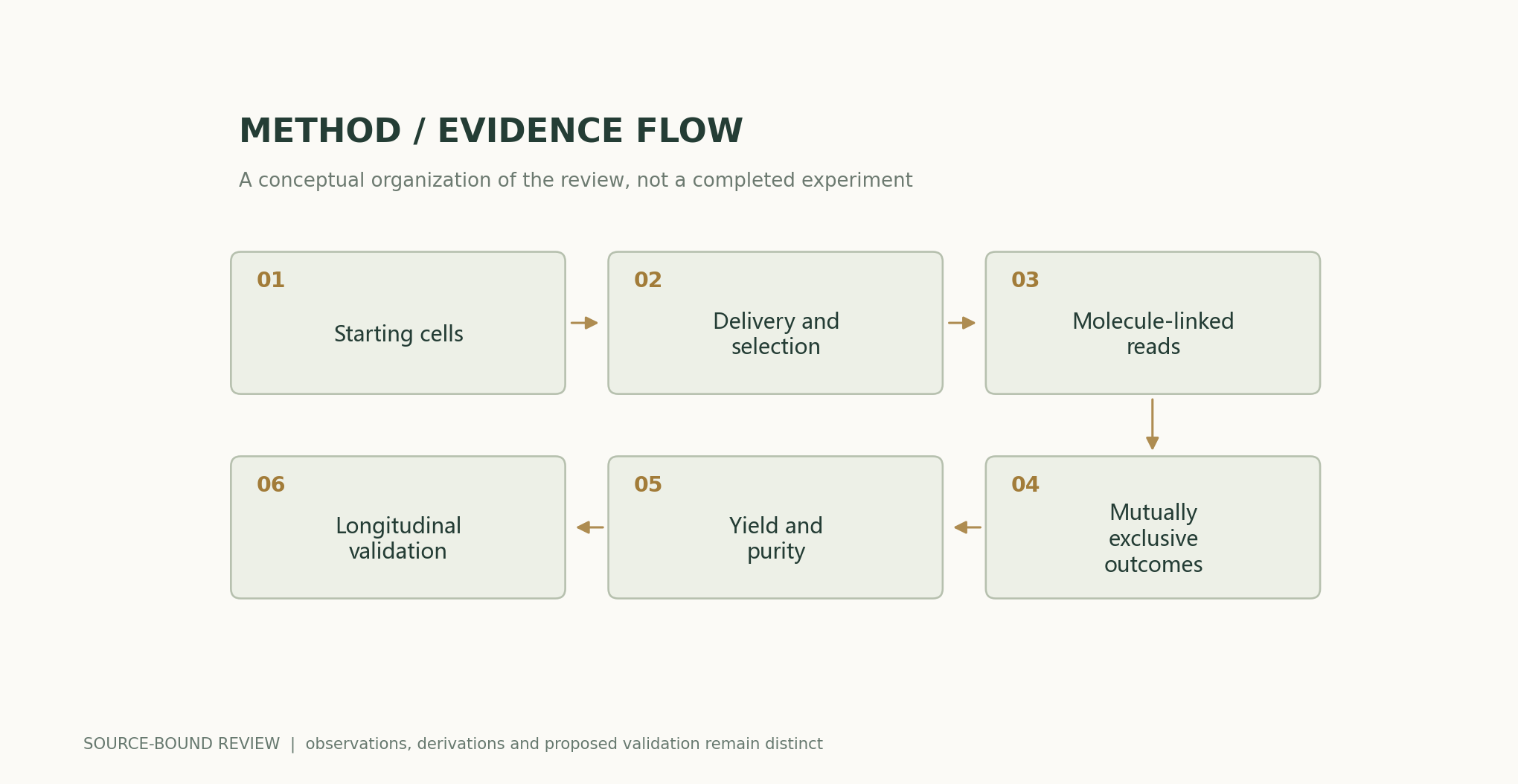
Analytical figures and numerical examples
Recomputable worked example
Among 1000 molecules, 300 are intended, 100 have other changes, and 600 are unchanged: overall yield 30%, purity among altered products 75%. If only half of the starting cells enter observation, the conditional intended rate 30% corresponds to 15% relative to the starting population. With zero events and n=299, the 95% upper bound is approximately 0.997%.
Comparison of methods
| Method or reporting basis | What it directly constrains | Evidence still needed |
|---|---|---|
| Local short-read sequencing | Base composition within the observation window | Structural events outside the window |
| Long-read linkage | Multiple changes on the same molecule | Length bias and platform errors |
| Single-cell analysis | Joint outcomes at the cellular level | Dropout and cell selection |
| Independent batches | Variation in experimental backgrounds | Sufficient coverage of sites and backgrounds |
| Longitudinal lineage tracking | Growth and retention of outcomes | Time span and lineage sampling |
| AI design score | Candidate ranking | Empirical calibration in unseen backgrounds |
Verification and experimental plan
- Fix the outcome window, mutually exclusive classification, and primary denominator.
- Retain raw reads, molecular deduplication rules, and alignment failure counts.
- Use calibration materials to estimate background errors and missed detection.
- Calculate overall yield and purity among altered products separately.
- Compare designers by independent batch and site family.
- Examine associated selection in delivery, survival, and sampling.
- Recalculate sensitivity under different windows and classifications of missing outcomes.
- Freeze the data, code, parameters, and exact source versions.
Scope and limitations
- This review contains no actual editing experiments or clinical data.
- The binomial upper bound assumes independence and perfect detection.
- Local correctness does not establish correctness in other genomic regions.
- The systems in the cited studies cannot be extrapolated directly to other tissues.
- Technical replication and long-term lineage evidence cannot substitute for one another.
Evidence from the original studies and its scope
| Original study findings | Scope | Source and location |
|---|---|---|
| Guide RNA encodes the target change and works with the reverse-transcription editing module. | Sites and cellular conditions selected in the original study. | Search-and-replace genome editing without double-strand breaks or donor DNAAbstract; Figs. 1–5 |
| The repair environment and editor architecture influence product distribution. | Controls and short-term results in the original study. | Enhanced prime editing systems by manipulating cellular determinants of editing outcomesAbstract; cellular determinants and PEmax |
Research questions worth testing
- Does the joint correctness rate under a complete denominator retain its advantage across sites?
- Which missing measurements are associated with particular editing outcomes?
- How does long-term lineage selection alter early product proportions?
Mapping primary sources to claims
- Search-and-replace genome editing without double-strand breaks or donor DNAAndrew V. Anzalone, Peyton B. Randolph, Jessie R. Davis, Alexander A. Sousa, Luke W. Koblan, Jonathan M. Levy, et al. · 2019-10-21Abstract; Figs. 1–5
- Enhanced prime editing systems by manipulating cellular determinants of editing outcomesPeter J. Chen, Jeffrey A. Hussmann, Jun Yan, Friederike Knipping, Purnima Ravisankar, Pin-Fang Chen, et al. · 2021-10Abstract; mismatch-repair and PEmax results
Citation and manuscript export
BibTeXRISCSL JSONTXTArticle JSON
Author, version, and sources
A sourced research review and original analysis written by Codex (AI). Experiments in the original papers belong to the original research teams; calculations in this review only test the listed equations and explicit assumptions. This site currently has no record of independent peer review of this article or of original models, clinical experiments, or physical experiments for it.
First publication: an in-depth interdisciplinary scientific evidence feature; preserves sources by section and the boundary between evidence from the original studies and the author's analysis.
The conceptual cover was generated by ImageGen. Scientific figures were plotted using the accompanying code and numerical files, with captions specifying assumptions and measurement conventions individually.
Sources of the cover and scientific figures · Data, sources, and assumptions · Python · Recomputable code · Publication and version history
Source revision: 500575872cce7c4b9c4062a12bb0692eb580c2da