
Deep Learning: Sequence Models / DEEP LEARNING III
Retrieval Is Part of the Model: Exposure, Evidence, and Training-Time Coupling
Retrieval-augmented generation is a coupled inference procedure, not a generator with a neutral appendix.
English original. Translations of this new review are not yet available.

Abstract
Retrieval-augmented generation is a coupled inference procedure, not a generator with a neutral appendix. This review separates retrieval recall, evidence usefulness, context utilization and answer support. An exact probability tree shows why improving recall can fail to improve answers when distractors alter behavior. A finite two-document mixture shows how joint likelihood training can favor useful documents without certifying truth. The analysis leads to versioned, counterfactual evaluation protocols rather than unsupported factuality claims.
In this paper
- 1. A retrieved document changes the predictor
- 2. What the selected papers contribute
- 3. Availability, usefulness and utilization
- 4. An exact answer-probability decomposition
- 5. More context can change the conditional problem
- 6. A latent-document mixture
- 7. Predictive utility can reward shortcuts
- 8. Training exposure determines what the generator expects
- 9. Index updates require versioned evaluation
- 10. Citation is not entailment
- 11. Abstention changes the utility calculation
- 12. Security and scientific evidence share a boundary
- 13. A controlled evaluation matrix
- 14. What the finite program verifies
- 15. Interpreting a successful retrieval intervention
- 16. Open questions and scope
1. A retrieved document changes the predictor
A retrieval-augmented system maps a query into selected material and then into an answer. The retriever, corpus, ranking policy, prompt assembly and generator jointly define the predictor. Changing the index can therefore change the model's behavior even when its neural weights remain fixed. Treating retrieval as a neutral input attachment obscures this dependence.
The central question is not merely whether a relevant document appears in the top results. It is whether the complete procedure produces a supported answer under the intended corpus and query distribution. A document can contain the answer but be ignored; a correct answer can be generated from memory without using the document; a plausible document can encourage an unsupported claim. This review develops two finite controls that separate these possibilities. The first is a probability tree for evidence availability and utilization. The second is a two-document latent mixture whose likelihood gradients reveal a distinction between predictive usefulness and source truth. These are declared analytical examples, not measured performance of a retrieval-augmented language model.
2. What the selected papers contribute
REALM incorporates retrieval into language-model pretraining. RAG combines parametric generation with non-parametric memory. Dense Passage Retrieval studies learned dense representations for selecting passages. These records address different components of the pipeline and motivate distinguishing document selection from answer generation.
RETRO studies language modeling with a large retrieval corpus and retrieval-conditioned computation. REPLUG treats the generator as a black box while adapting retrieval. Atlas studies few-shot learning with a pretrained retrieval-augmented model and examines index content. Together, these sources show that retrieval can be integrated at different training and inference stages. Our review uses the inspected original abstracts and metadata for these broad methodological distinctions. It does not reproduce their experiments, verify all implementation details or claim that their historical comparative results hold universally today. The authored constructions below isolate basic probability relationships that apply to a declared pipeline. They help specify what additional evidence is needed when a system is said to become more factual, more updateable or more data-efficient through retrieval.
3. Availability, usefulness and utilization
Let R denote the event that the selected context contains evidence sufficient for the question. Let U denote successful use of that evidence, and let C denote answer correctness, regardless of whether the answer is grounded in the selected context. Grounding is a separate outcome. These events are related but not identical. A relevant document may be incomplete, outdated or ambiguous, so a conventional relevance label need not imply R. Even when R occurs, the generator may misunderstand it or prefer memorized information.
A retrieval metric should therefore state what its labels mean. Top-k passage recall can measure inclusion of a known answer-bearing passage, but it does not directly measure whether the final context preserves the necessary qualification or whether the generated answer cites it correctly. The pipeline can also answer correctly without retrieved evidence, which makes answer accuracy alone an incomplete measure of grounding. Counterfactual tests are useful: remove the evidence, replace it with a controlled contradiction, or change a versioned fact while keeping the question fixed. The resulting behavior helps distinguish actual context dependence from incidental retrieval. Such tests need explicit task semantics so that a model is not penalized for refusing an intentionally inconsistent document.
4. An exact answer-probability decomposition
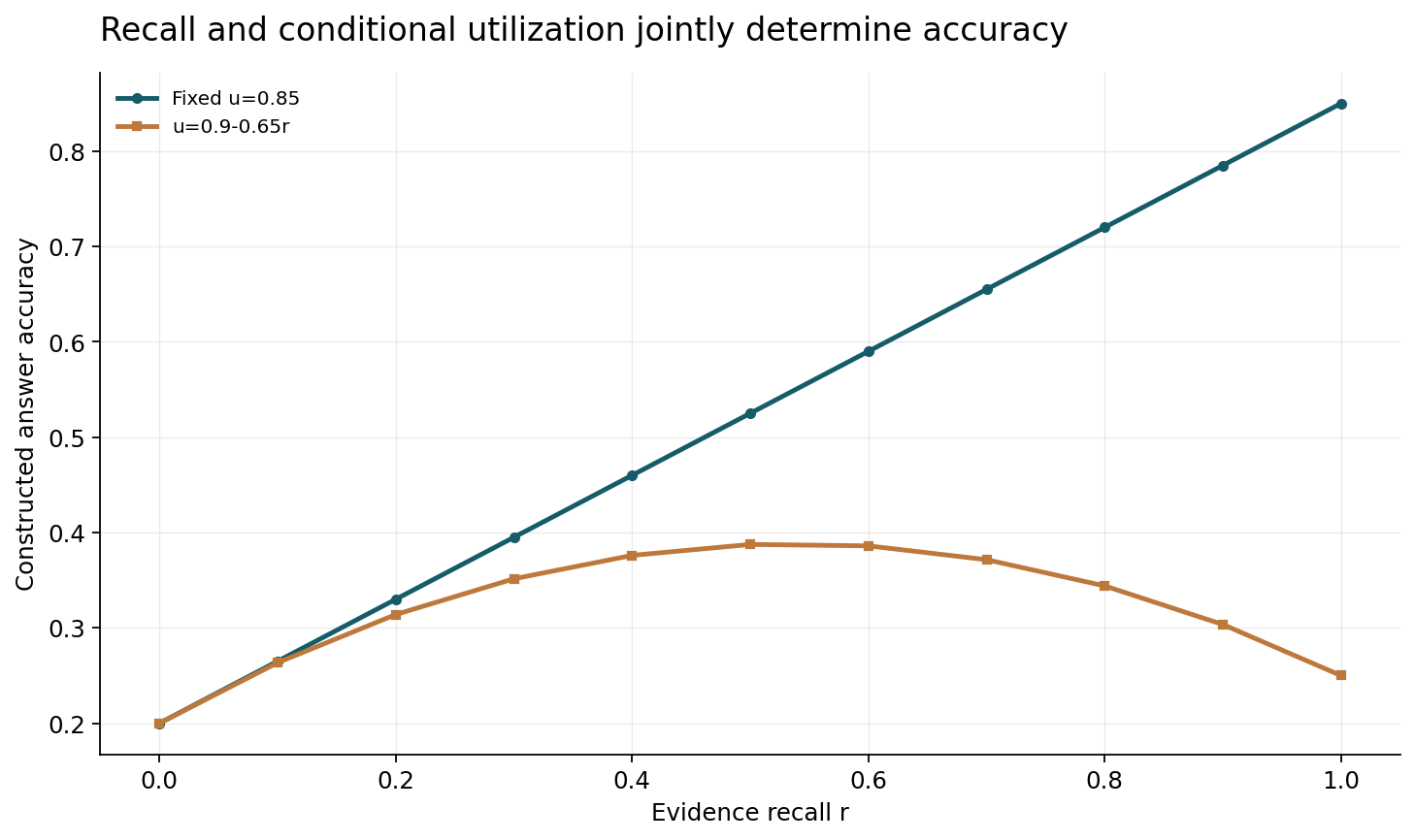
In a two-branch construction, let r be the probability that sufficient evidence is retrieved. Let u=P(C given R) be the probability of a correct answer when sufficient evidence is present, and let b=P(C given not R) be the probability of a correct answer when it is absent. Both branches use the same correctness event. Then total answer accuracy is ru+(1-r)b. The expression is elementary, but it identifies why retrieval recall and end-to-end accuracy cannot be substituted for one another.
If u is fixed and exceeds b, improving r increases accuracy. If u changes with the retrieval policy, the conclusion no longer follows. Adding more documents may raise recall while reducing the generator's ability to locate or interpret evidence. Figure one compares a fixed-utilization scenario with a constructed decreasing-utilization scenario as r increases. The curves are not empirical estimates. Their parameters are stated and their purpose is to provide a counterexample to the claim that higher recall must imply better answers. This binary accuracy model counts abstention as not correct and does not distinguish supported answers from correct guesses; those outcomes require separate measurements in an actual evaluation. A complete report should preserve those distinctions rather than compressing them into one success rate.
5. More context can change the conditional problem
Increasing k changes both the chance of finding evidence and the distribution of material shown to the generator. It can introduce conflicting versions, repeated claims, irrelevant instructions or near-duplicate passages. Consequently, the conditional success probability u is a property of the assembled context, not a constant attached to the generator.
A useful experiment varies k while measuring evidence sufficiency and answer quality independently. It should retain the exact retrieved set and its order, because ordering and truncation can determine which passages are actually visible. If a context budget clips the final document, the retriever may receive credit for selecting evidence that the generator never sees. De-duplication can change both token count and apparent consensus. Repeating the same claim in many passages is not independent corroboration, and a model may over-weight it. These effects are specific to the pipeline. They cannot be diagnosed from a retrieval leaderboard alone. The analytical decomposition is useful because it directs attention to the conditional branch that changed, rather than assuming every gain or loss originates in recall.
6. A latent-document mixture
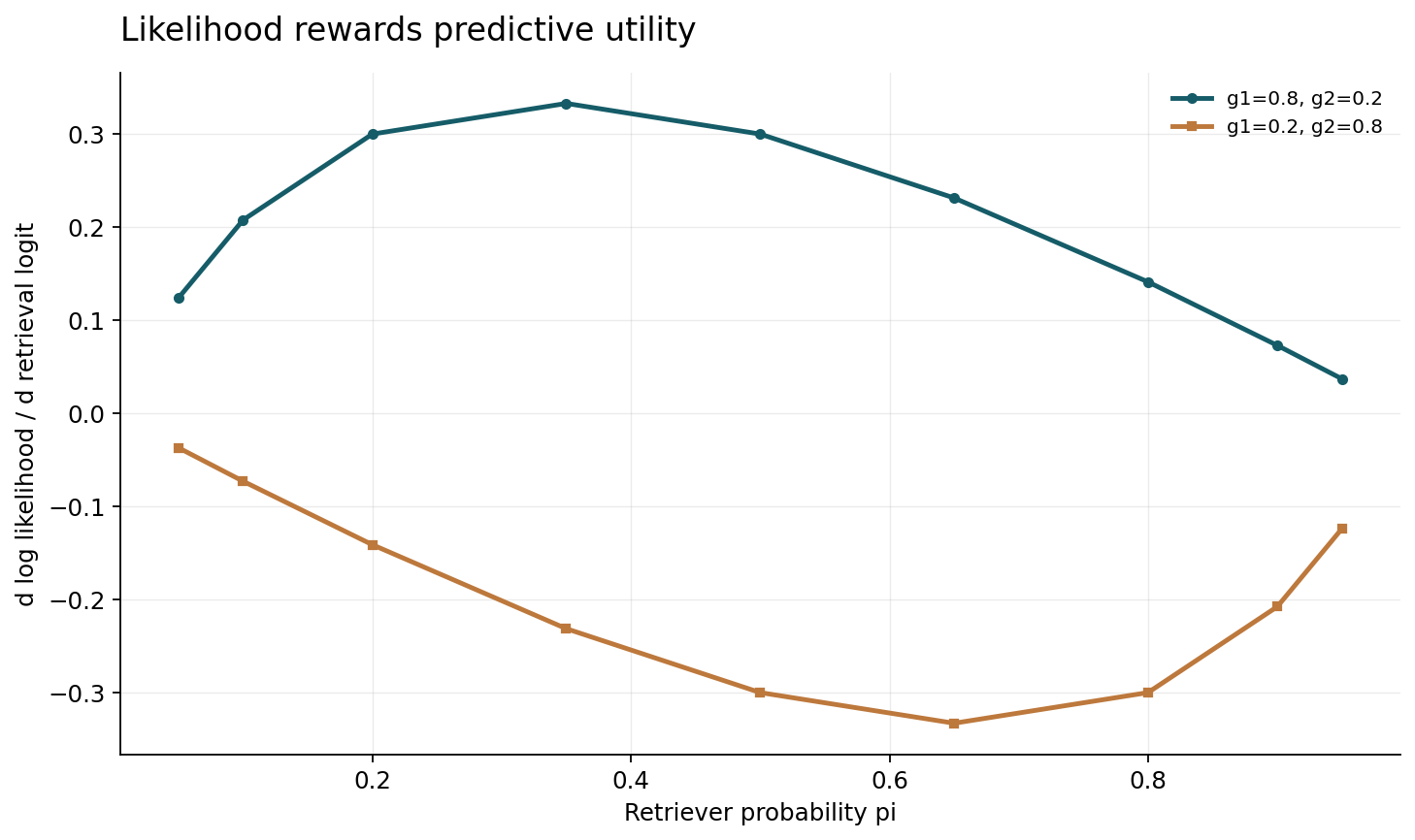
Consider two candidate documents z1 and z2. A retriever assigns probability pi to z1 and one minus pi to z2. For a particular target answer y, the generator assigns likelihood g1 when conditioned on z1 and g2 when conditioned on z2. The mixture likelihood is pi g1+(1-pi)g2.
Parameterize pi as a logistic function of a retrieval logit a. Differentiating the log mixture likelihood gives pi(1-pi)(g1-g2) divided by the mixture likelihood. Thus the update favors the document under which the target answer is easier for the generator to predict. That is a statement about predictive utility under the current model and training target. It is not a certificate that the favored document is true, authoritative or causally necessary. Figure two plots the gradient over pi for two declared likelihood pairs. The sign follows the difference between g1 and g2. The executable program checks the derivative against finite differences, making the distinction concrete without claiming to reproduce any particular joint-training algorithm.
7. Predictive utility can reward shortcuts
A document can increase the likelihood of the training answer because it contains a lexical cue, duplicated answer text or an artifact correlated with the label. A likelihood-based learning signal may reward that document even if it provides weak evidence for the intended reasoning. This possibility does not invalidate joint training; it identifies a gap between the optimization target and the desired epistemic property.
The training dataset therefore matters as much as the retriever architecture. If every answer is copied from one source format, the model may learn that format as a shortcut. If the evaluation corpus contains near-duplicates of training answers, apparent retrieval skill may partly reflect leakage. A stronger design includes questions requiring qualifications, source comparison and refusal when evidence is insufficient. It also tests alternative passages that support the same conclusion using different wording. The objective is to separate semantic usefulness from answer exposure. The two-document mixture is intentionally agnostic about truth because likelihood alone is agnostic. A factuality claim requires additional labels and interventions that connect predictive behavior to valid evidence.
8. Training exposure determines what the generator expects
A generator trained with clean, short, answer-centered passages may behave differently when inference retrieves noisy, long or conflicting documents. This is a distribution shift in the conditioning context. It can occur even if the question distribution and model weights remain unchanged.
An evaluation should compare the training-time and inference-time retrieval pipelines: corpus snapshots, chunk sizes, negative sampling, ordering, filtering and context budgets. If the retriever is updated independently, the generator may encounter new score distributions or document styles. Conversely, a generator adapted to one retriever's errors may compensate for those errors and behave unexpectedly when retrieval improves in a different way. This coupling complicates modular claims. A retriever can be better under a standalone relevance metric yet worse for a particular generator. The appropriate response is not to abandon component metrics, but to pair them with controlled end-to-end tests. Report both the component improvement and the observed interaction so that the source of a system-level change remains interpretable.
9. Index updates require versioned evaluation
An index refresh can add facts, remove obsolete material or change duplicate structure. Because retrieval is part of the predictor, the corpus snapshot should be versioned alongside model and prompt configuration. Otherwise a repeated benchmark may silently evaluate a different information environment.
A useful update test contains facts with known temporal versions and queries that specify the relevant date. It distinguishes current facts from historical questions and checks that removed material is no longer supplied when policy requires removal. A model may still remember old facts parametrically, so changing the index does not guarantee erasure from the generator. That limitation must be stated. Provenance records should include the selected document version, not merely a mutable URL. If an answer cites a page that later changes, the evidence supporting the original answer should remain reconstructable. These requirements concern scientific traceability as well as deployment operations. They allow an observed answer change to be attributed to a specific index revision rather than to an unexplained combination of corpus drift, ranking drift and stochastic decoding.
10. Citation is not entailment
A generated citation can point to a real document without supporting the sentence to which it is attached. Source existence, retrieval inclusion, passage relevance and claim entailment are separate checks. A system that verifies only that the URL appeared in the retrieved set has not established that its answer is grounded.
Evaluation should bind individual claims to specific passages and allow partial support, contradiction and insufficient evidence. A paragraph containing several claims may require more than one source. Quoting the correct document title does not repair an unsupported numerical assertion. Conversely, a paraphrase can be well supported without lexical overlap if the reasoning is valid. Human or carefully designed structured assessment may be needed for these distinctions, with uncertainty retained rather than forced into a binary label. The present review does not claim to solve automatic entailment evaluation. It argues that retrieval accuracy should not be reported as a substitute. A technically successful retrieval step creates an opportunity for grounding; it does not complete the grounding task on its own.
11. Abstention changes the utility calculation
When evidence is absent or contradictory, abstention can be preferable to an unsupported answer. A system's quality therefore depends on the cost assigned to false assertions, missed answers and refusals. Overall accuracy alone can reward a model that guesses frequently in a setting where unsupported certainty is harmful.
A decision analysis can assign explicit utilities to supported correct answers, unsupported answers and abstentions. The optimal threshold then depends on both uncertainty calibration and the application's costs. A retrieval confidence score is not automatically a calibrated probability that the final answer is supported. It may reflect similarity rather than evidence sufficiency. Calibration should be evaluated on the complete decision pipeline and under index shifts. The two-branch accuracy formula can be extended to multiple outcomes, but no choice of weights is universally correct. A research report should show the outcome distribution before aggregating it under a chosen utility. This makes the tradeoff inspectable and prevents a single favorable metric from concealing a high rate of unsupported output.
12. Security and scientific evidence share a boundary
Retrieved text is data from outside the model's trusted instruction channel. A passage can contain statements that resemble commands, fabricated citations or misleading formatting. The model should use it as evidence to be evaluated, not as authority to redefine the task or the system's rules. This distinction is operationally important even in a scholarly retrieval system.
A test corpus should include irrelevant imperative text, conflicting metadata and documents that quote other documents. These cases reveal whether the pipeline separates source content from instruction and whether provenance survives nested quotation. The goal is not to make retrieval distrustful of every source, but to preserve the difference between evidence and control. Scientific evaluation benefits from the same separation: an authorial claim inside a paper is not automatically an independently verified fact. The system can report what a source says while indicating its status and limitations. Such behavior cannot be inferred from answer accuracy on clean benchmarks. It requires targeted tests of how the generator handles ambiguous or adversarially structured evidence.
13. A controlled evaluation matrix
Cross retriever quality with generator context training, corpus version and context budget. Include an oracle-evidence condition to estimate utilization when retrieval is ideal, a no-evidence condition to measure parametric guessing, and a shuffled or contradictory-evidence condition to test dependence on context. Record both passage inclusion and claim-level support.
Use fixed query sets with independently maintained answers and temporal scope. Keep document duplicates and leaked answers identifiable rather than silently filtering difficult cases after evaluation. Report retrieval latency, generator latency and token use separately, including failed requests and empty retrieval results. For stochastic decoding, repeat runs or fix a declared deterministic policy. Confidence intervals should reflect independent questions or document families, not multiple correlated passages from one query. No such full system campaign is run here. The protocol describes the evidence needed to turn a component improvement into an end-to-end reliability claim. The exact constructions serve as sanity checks for the interpretation of that campaign.
14. What the finite program verifies
The first construction enumerates the evidence-present and evidence-absent branches and checks that their probabilities sum to one. It computes total accuracy from the branch outcomes and demonstrates a declared setting where increasing recall is offset by declining utilization. It also verifies the monotone case when utilization is fixed above the no-evidence baseline.
The second construction evaluates the two-document mixture, computes its analytic retrieval-logit gradient and compares it with centered finite differences at several interior probabilities. Boundary cases with equal generator likelihoods produce zero gradient, as expected. The program emits the exact data used in both figures. These checks validate the arithmetic and the counterexample, not the empirical frequency of the phenomenon in deployed systems. The likelihood values are chosen parameters, not estimated model outputs. A reader can alter them to inspect how the conclusion depends on the assumptions. This makes the illustration a transparent diagnostic rather than a fabricated benchmark disguised as an experiment.
15. Interpreting a successful retrieval intervention
A strong result says which component changed, what information became available and how the answer distribution responded. For example, a retriever update may improve sufficient-evidence inclusion while answer support remains unchanged because the generator ignores additional passages. That is useful evidence about a utilization bottleneck, even if the headline answer score does not rise.
Another update may improve answer accuracy while reducing citation support, suggesting greater reliance on memorized or shortcut information. The distinction matters for a scholarly system whose purpose includes inspectable evidence. The relevant success criterion may require both correct answers and valid claim-source links. Reporting these outcomes separately enables targeted improvement: retrieval, context assembly, training exposure and answer verification can be adjusted based on the observed failure mode. Without this decomposition, every change is attributed vaguely to retrieval augmentation. The mathematical controls show why that label is too broad. Retrieval is a family of coupled predictors, and its benefits must be demonstrated at the level of the complete procedure.
16. Open questions and scope
The unresolved research problem is how to train retrieval and generation jointly while preserving evidence quality under changing corpora. Likelihood offers a useful learning signal but does not by itself distinguish authoritative support from convenient answer exposure. Better objectives may need explicit evidence labels, counterfactual contexts and uncertainty-aware refusal, each with its own annotation and evaluation costs.
This review does not propose a proven solution. It provides two exact controls and a framework for separating quantities that are often conflated. The source inspection is focused rather than exhaustive, and no neural retrieval system is trained or benchmarked. The conclusions concern interpretation: higher recall is not necessarily higher answer quality, index updates change the predictor, and citations require claim-level support. These are practical constraints on any credible evaluation. A future study that publishes versioned corpora, controlled context interventions and outcome distributions would provide stronger evidence than one that reports a single aggregate score after changing several pipeline components at once.
Core equations and definitions
(1) Law of total probability for answer correctness C: r=P(R), u=P(C|R), b=P(C|not R). Grounding and evidential support are separate outcomes.
(2) Two-document latent mixture for a fixed target answer.
(3) Retriever probability parameterized by logit a.
(4) Likelihood training favors predictive usefulness in this declared mixture.
Constructed analytical figures
Comparison and reporting contract
| Object | What it establishes | What it does not establish |
|---|---|---|
| Retrieval recall | Selected evidence is included under its labels | The generator uses it correctly |
| Answer accuracy | Output matches a target | Its cited claims are supported |
| Mixture likelihood | A document helps predict training targets | That document is true or authoritative |
Evaluation protocol
- Version corpus, retriever, assembly policy and generator together.
- Use oracle, absent and contradictory evidence controls.
- Measure claim support separately from answer accuracy.
- Retain latency, failures and refusal outcomes.
Limitations
- No retrieval-augmented neural system is trained.
- The branch probabilities and document likelihoods are constructed.
- Source experimental results are not independently reproduced.
Open research questions
- How can joint objectives distinguish useful evidence from answer leakage?
- How should grounding calibration survive corpus updates?
- Which context interventions best reveal actual evidence use?
Evidence and its boundaries
- Incorporates retrieval into language-model pretraining.
- [1] — Original arXiv bibliographic record and abstract inspected on 2026-10-28; full proof and source experiments not independently audited. Inspected: Primary arXiv abstract and bibliographic record.
- Combines generation with non-parametric memory.
- [2] — Original arXiv bibliographic record and abstract inspected on 2026-10-28; full proof and source experiments not independently audited. Inspected: Primary arXiv abstract and bibliographic record.
- Studies dense passage retrieval with learned representations.
- [3] — Original arXiv bibliographic record and abstract inspected on 2026-10-28; full proof and source experiments not independently audited. Inspected: Primary arXiv abstract and bibliographic record.
- Studies language modeling conditioned on a large retrieval corpus.
- [4] — Original arXiv bibliographic record and abstract inspected on 2026-10-28; full proof and source experiments not independently audited. Inspected: Primary arXiv abstract and bibliographic record.
- Adapts retrieval around a black-box language model.
- [5] — Original arXiv bibliographic record and abstract inspected on 2026-10-28; full proof and source experiments not independently audited. Inspected: Primary arXiv abstract and bibliographic record.
- Studies few-shot retrieval-augmented learning and index content.
- [6] — Original arXiv bibliographic record and abstract inspected on 2026-10-28; full proof and source experiments not independently audited. Inspected: Primary arXiv abstract and bibliographic record.
References
- REALM: Retrieval-Augmented Language Model Pre-Training
Kelvin Guu, Kenton Lee, Zora Tung, Panupong Pasupat, Ming-Wei Chang. arXiv primary author manuscript (2020). https://arxiv.org/abs/2002.08909Source scope
Original arXiv bibliographic record and abstract inspected on 2026-10-28; full proof and source experiments not independently audited.
- Retrieval-Augmented Generation for Knowledge-Intensive NLP Tasks
Patrick Lewis, Ethan Perez, Aleksandra Piktus, Fabio Petroni, Vladimir Karpukhin, Naman Goyal, Heinrich Küttler, Mike Lewis, Wen-tau Yih, Tim Rocktäschel, Sebastian Riedel, Douwe Kiela. arXiv primary author manuscript (2020). https://arxiv.org/abs/2005.11401Source scope
Original arXiv bibliographic record and abstract inspected on 2026-10-28; full proof and source experiments not independently audited.
- Dense Passage Retrieval for Open-Domain Question Answering
Vladimir Karpukhin, Barlas Oğuz, Sewon Min, Patrick Lewis, Ledell Wu, Sergey Edunov, Danqi Chen, Wen-tau Yih. arXiv primary author manuscript (2020). https://arxiv.org/abs/2004.04906Source scope
Original arXiv bibliographic record and abstract inspected on 2026-10-28; full proof and source experiments not independently audited.
- Improving language models by retrieving from trillions of tokens
Sebastian Borgeaud, Arthur Mensch, Jordan Hoffmann, Trevor Cai, Eliza Rutherford, Katie Millican, George van den Driessche, Jean-Baptiste Lespiau, Bogdan Damoc, Aidan Clark, Diego de Las Casas, Aurelia Guy, Jacob Menick, Roman Ring, Tom Hennigan, Saffron Huang, Loren Maggiore, Chris Jones, Albin Cassirer, Andy Brock, Michela Paganini, Geoffrey Irving, Oriol Vinyals, Simon Osindero, Karen Simonyan, Jack W. Rae, Erich Elsen, Laurent Sifre. arXiv primary author manuscript (2021). https://arxiv.org/abs/2112.04426Source scope
Original arXiv bibliographic record and abstract inspected on 2026-10-28; full proof and source experiments not independently audited.
- REPLUG: Retrieval-Augmented Black-Box Language Models
Weijia Shi, Sewon Min, Michihiro Yasunaga, Minjoon Seo, Rich James, Mike Lewis, Luke Zettlemoyer, Wen-tau Yih. arXiv primary author manuscript (2023). https://arxiv.org/abs/2301.12652Source scope
Original arXiv bibliographic record and abstract inspected on 2026-10-28; full proof and source experiments not independently audited.
- Atlas: Few-shot Learning with Retrieval Augmented Language Models
Gautier Izacard, Patrick Lewis, Maria Lomeli, Lucas Hosseini, Fabio Petroni, Timo Schick, Jane Dwivedi-Yu, Armand Joulin, Sebastian Riedel, Edouard Grave. arXiv primary author manuscript (2022). https://arxiv.org/abs/2208.03299Source scope
Original arXiv bibliographic record and abstract inspected on 2026-10-28; full proof and source experiments not independently audited.