

Abstract: What Remains Unknown After Targeting
RNA-guided transposition connects sequence recognition with cargo integration, providing a route to programmable insertion distinct from conventional cleavage and repair. However, one correct junction does not guarantee that the junction at the other end is correct, that the cargo is intact, that its orientation matches the design, or that no additional copies are present. This article organizes targeting, structural integrity, and cellular consequences into a joint outcome space, focusing on why commonly used integration rates may overestimate truly complete products and how linked evidence can test this discrepancy.[1] RNA-guided DNA insertion with CRISPR-associated transpo[2] Transposon-encoded CRISPR–Cas systems direct RNA-guided
English abstract
CRISPR-associated transposases decouple RNA-guided targeting from conventional nuclease-driven repair. We compare targeting and insertion as separate measurable stages, derive a joint integrity ledger and an insertion-site entropy diagnostic, and outline how molecule-linked evidence can distinguish intended integration from attractive local junctions.
What Evidence the Two Original Studies Provide
Strecker and colleagues investigated CRISPR systems associated with transposable elements, while Klompe and colleagues demonstrated another class of RNA-guided integration mechanism. Together, these studies support the feasibility of using RNA recognition to guide DNA insertion, while differing in their components, insertion offsets, and product characteristics. This article does not directly recast findings from bacterial systems as general capabilities in mammals, nor does it provide cargo sequences, delivery formulations, or experimental operating conditions.[1] RNA-guided DNA insertion with CRISPR-associated transpo[2] Transposon-encoded CRISPR–Cas systems direct RNA-guided
Treating Recognition and Insertion as Separate Modules
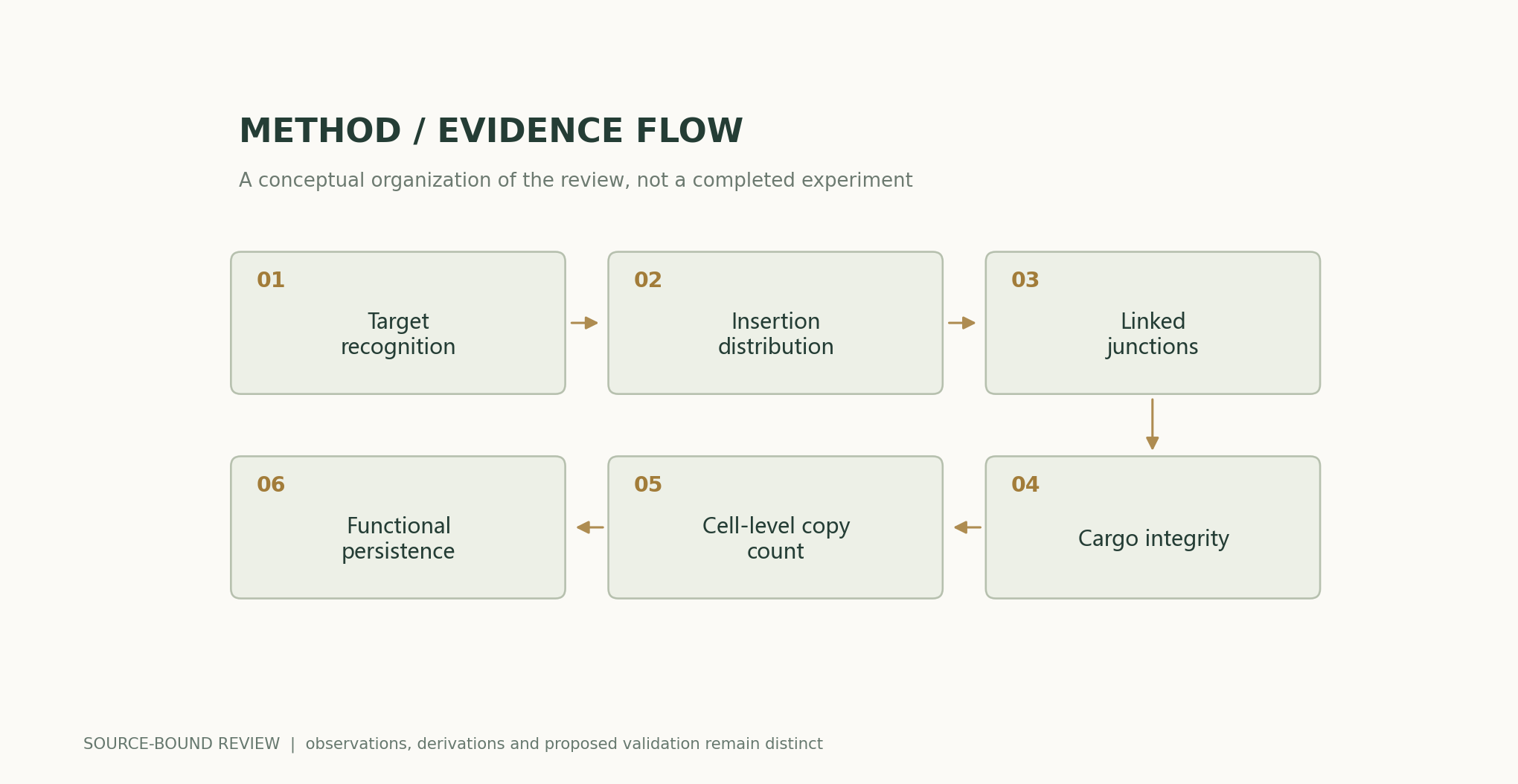
In an abstract mechanistic model, the recognition module first constrains the candidate region near the target, and the transposition module then determines the actual junction position, orientation, and product structure. Evaluating off-target activity solely through guide-sequence similarity is therefore insufficient; even after successful binding, physical insertion may still follow a distribution. A modular investigation should separately measure recognition arrival, insertion occurrence, and product completion to identify the level at which the bottleneck arises, rather than attributing every failure to a “poor guide RNA.”作者分析与复核建议 / Author analysis
The Product for Joint Correctness Must Use Conditional Probabilities
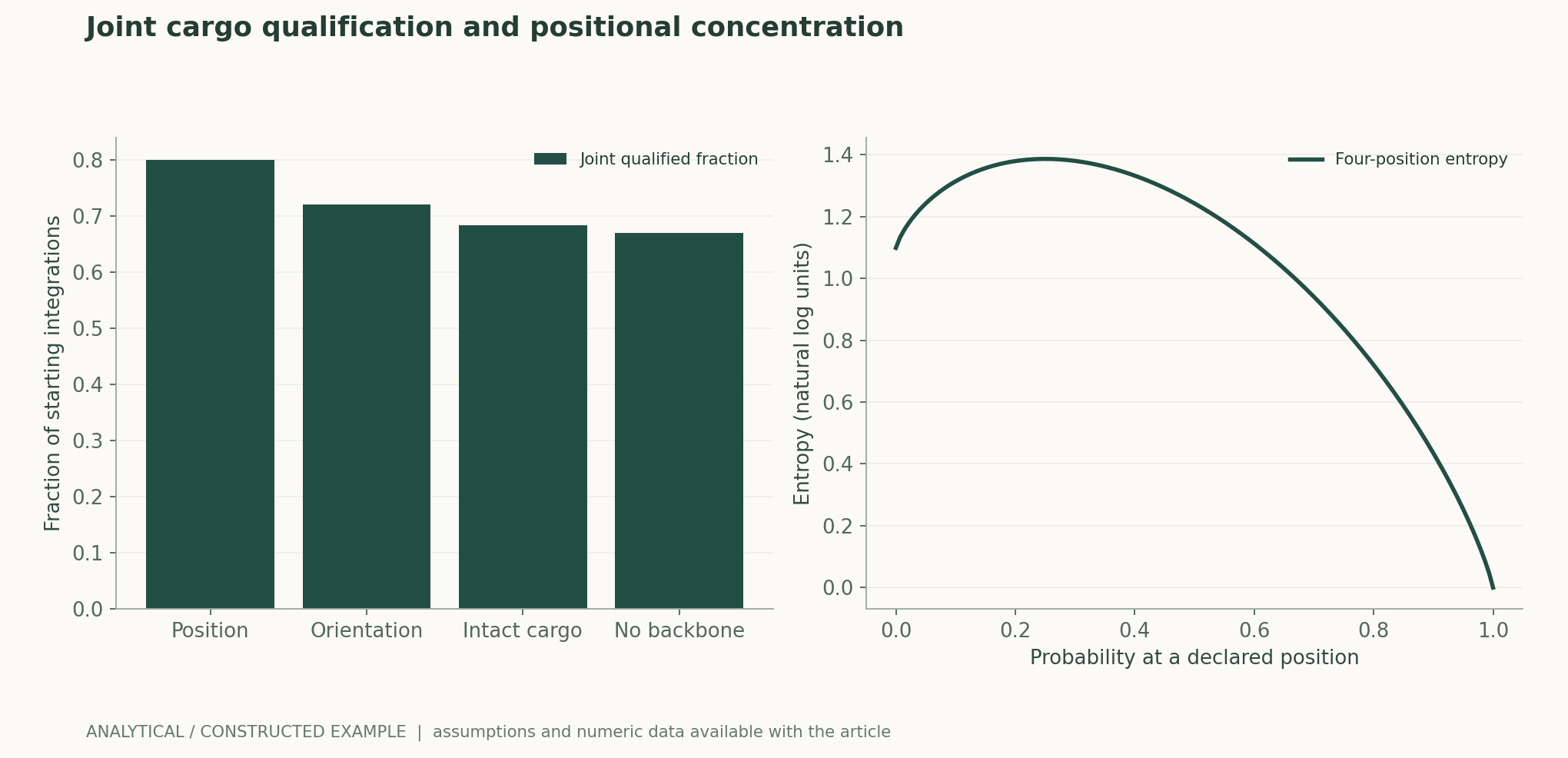
This article defines a fully qualified product as one that simultaneously satisfies four conditions: position, orientation, integrity, and absence of unwanted backbone. If the successive conditional probabilities are assumed to be 0.8, 0.9, 0.95, and 0.98, the joint proportion is 0.67032. Although each individual measure is high, the overall proportion is still only about 67%. The figure is merely a constructed example of this probability chain; directly multiplying four marginal proportions from different samples is generally unjustified.作者分析与复核建议 / Author analysis
Why PCR Results from the Two Ends Cannot Simply Be Combined
Suppose some molecules are correct only at the left end and others only at the right end. Both assays would yield positive results, yet there might be no fully correct cargo. Evaluation must link the left and right ends, cargo interior, and genomic adjacency relationships to the same molecule, or explicitly state the gap in linkage. Even when both ends are correct, internal deletions, tandem cargo, or replicated backbone still require additional discrimination. Different measurements jointly covering information is not the same as jointly establishing properties of the same entity.作者分析与复核建议 / Author analysis
Insertion Offset Is a Distribution, Not a Mean
The original studies show a structured relationship between insertion positions and recognition sites. Reporting a mean offset hides multiple modes, long tails, or rare distant events. This article recommends presenting the complete histogram of target-relative coordinates, the proportion within a prespecified permitted window, and molecules whose positions cannot be determined together. If only the most common position is shown, readers cannot estimate the burden outside the window or compare two systems with the same mean but different tail shapes.[1] RNA-guided DNA insertion with CRISPR-associated transpo[2] Transposon-encoded CRISPR–Cas systems direct RNA-guided
Uses and Misuses of Positional Entropy
The Shannon entropy of an insertion-site distribution can summarize positional dispersion, but low entropy does not imply correct targeting. A system that concentrates insertions at the wrong position may also have entropy close to zero. The “probability of falling within the permitted window” and the “entropy of the conditional distribution within the window” should therefore be reported separately. The figure compares uniform and concentrated distributions only to illustrate dispersion; it does not simulate any transposition protein or infer genomic risk or functional change.作者分析与复核建议 / Author analysis
Cargo Length and Selection Bias in Complete Recovery
Long fragments are harder to cover completely than short fragments, and sequencing and amplification may preferentially retain shorter abnormal products. Treating only successfully recovered molecules as the population prevents fair comparison of cargos of different lengths. A feasible reanalysis should stratify by starting molecules, resolvable fragment length, and failure reason, and use calibration objects of known structure to estimate detection probabilities. Without length-dependent calibration, conclusions about integrity must be restricted to the observable portion.作者分析与复核建议 / Author analysis
Multiple Copies and the Single-Cell Level
A cell containing one targeted integration and one additional integration may be classified as successful when counting by target site, but outcomes at the cellular level differ from those at the individual-reaction level. The copy-number distribution for each cell or clone and its association with position should be reported. A mean copy number of one does not imply that every cell has one copy; a mixture of zero and two can produce the same mean. Data obtained after clonal selection also cannot directly represent the starting population.作者分析与复核建议 / Author analysis
Background Integration and Detectable Scope
Controls without a guide, with a nonmatching guide, or lacking a key module can help distinguish background junction formation from guide-dependent outcomes, but they do not cover all potential events. Some genomic regions are difficult to align, and repetitive regions may not be uniquely mapped. This article recommends listing junctions that cannot be uniquely assigned separately and assessing their proportions across conditions; excluding all ambiguous alignments may systematically underestimate complex events.作者分析与复核建议 / Author analysis
Candidate Optimization and Independent Testing
If multiple component combinations are all screened at the same readily integrable site, the final optimal combination is likely to be adapted to that local context. Evaluating generalization requires holding out site families, cargo configurations, and independent batches in advance. If a model is trained using junction reads from the same source, data should be split by original molecule and experimental group; two reads from the same event must not be randomly assigned to training and testing. Otherwise, accuracy may mainly reflect repeated recognition.作者分析与复核建议 / Author analysis
From Junction Signals to Expression Function
Structurally correct cargo may still exhibit altered expression, transcriptional interference, or silencing at a new position. Expression strength likewise cannot establish integration-structure correctness in reverse, because partial cargo or nonintegrated templates may generate signals. Studies should measure structural and functional endpoints separately, then connect them through the same molecule or lineage. For research tools, functional output validates utility; for long-term applications, persistence over time and cellular selection also require independent assessment.作者分析与复核建议 / Author analysis
When an Independence Assumption Cannot Simplify the Analysis
Orientation, integrity, and backbone retention may share mechanisms and be correlated. This article uses a conditional probability chain to avoid assuming that these events are independent; each step requires the actual denominator among cases in which the preceding step has been satisfied. If existing data contain only marginal proportions, probability bounds can provide an admissible interval for the joint proportion, rather than manufacturing an excessively precise product. Insufficient joint data should itself be a result, rather than a gap filled by a model.作者分析与复核建议 / Author analysis
The Value of Reporting Missing Data and Failures
Unmeasurable outcomes, nonintegration, structurally unqualified products, and functionally inadequate products should remain in separate categories. Only then can one determine whether subsequent improvements increase truly qualified products or merely make successful entities easier to read out. Comparisons across methods should also disclose the proportion excluded by each method and the reasons for exclusion. If one combination appears to have a higher success rate but also has more indeterminate molecules, the missingness mechanism must be explained before discussing superior performance.作者分析与复核建议 / Author analysis
The Scope of Recomputable Figures
The numerical model in this article consists of four conditional probabilities and artificial positional distributions; it contains no real genome, transposase kinetics, or cellular measurements. Its value is to make the proposition that “multiple high individual metrics cannot replace a joint endpoint” inspectable. Anyone can change the conditional probabilities, recalculate yield, and test whether entropy remains low when events concentrate at the wrong position. Such a counterexample constrains evaluation metrics, but it is not an empirical verdict on any particular system.作者分析与复核建议 / Author analysis
Research Propositions and Falsification Conditions
A proposition worth testing is whether, under complete coverage of the same molecule and consistent classification of missing data, optimizing a component can consistently increase the joint proportion of qualified insertions, and whether that improvement depends on a particular cargo or target window. Counterevidence could include increased signal within the window without an increase in complete products, or an advantage appearing only in clones after selection. Defining such failure conditions in advance helps prevent every observation from being interpreted as support for the model.作者分析与复核建议 / Author analysis
A Minimal Exchangeable Research Package
A comparable study should include original molecule identifiers, precise target coordinates, the permitted window, a cargo structure diagram, classifier version, a denominator ledger, and independent batches. Shared materials may contain only legally public, nonsensitive summary data, but must suffice to recalculate key proportions and trace exclusions. This article supplies analytically constructed data and code; it does not present design recommendations as integration experiments already completed.作者分析与复核建议 / Author analysis
Conclusion: From a Single Positive Site to a Complete Entity
The breakthrough of RNA-guided transposition lies in forming a programmable interface between recognition and integration; credible engineering evaluation requires bringing position, orientation, integrity, and cellular consequences back together on the same entity. Retaining the full outcome distribution offers more explanatory power than the most impressive junction-positive rate. The next important advances should be reflected in joint product quality that can be verified across contexts, not merely in improved metrics after narrowing to the most favorable denominator.作者分析与复核建议 / Author analysis
Core Equations and Derivations
(1) Joint conditional chain; T denotes position, O orientation, C integrity, and B absence of unwanted backbone.
LaTeX
P(T,O,C,B)=P(T)P(O\mid T)P(C\mid T,O)P(B\mid T,O,C)(2) Positional entropy quantifies dispersion only; it cannot establish positional correctness.
LaTeX
H(p)=-\sum_j p_j\log p_j(3) Lower bound on the joint probability when only marginal data are available; marginal probabilities cannot be multiplied.
LaTeX
P(\cap_{i=1}^{m} A_i)\geq\max(0,\sum_i P(A_i)-(m-1))(4) Qualification rate in the starting population, kept separate from the proportion among clones after selection.
LaTeX
Y_{\rm start}=N_{\rm qualified}/N_{\rm starting}Methods and Evidence Workflow
Analytical Figures and Numerical Examples
Recomputable Worked Example
The joint qualification rate for four conditions is 0.8×0.9×0.95×0.98=0.67032. With a uniform distribution across four positions, entropy is ln4; with complete concentration at one position, it is 0, even if that position is wrong.
Method Comparison
| Method or measurement basis | Direct constraint | Evidence still needed |
|---|---|---|
| Single-junction detection | Adjacency at one end | The other end and internal structure |
| Independent detection of both ends | Marginal signals at both ends | Linkage to the same molecule |
| Long-molecule coverage | Adjacency of the complete cargo | Length and alignment biases |
| Site distribution | Window and long tail | Cellular copy number and function |
| Single cell/clone | Combinations within a cell | Selection and growth biases |
| Functional output | Use-related phenotype | Integration structure and long-term persistence |
Verification and Experimental Plan
- Fix the target window and criteria for complete structure.
- Define three denominators: starting, recovered, and qualified.
- Preserve molecular linkage among the left end, right end, and internal structure.
- List outcomes that cannot be localized or completely covered separately.
- Calculate the joint proportion and conditional probability chain.
- Perform controlled comparisons stratified by site, cargo, and batch.
- Check whether structure, copy number, and function are linked to the same entity.
- Publish versioned classification rules, summary data, and all failure reasons.
Scope and Limitations
- This article generated no new integration experiments.
- The conditional probabilities are analytical examples, not system performance.
- Positional entropy cannot represent safety.
- The cited initial bacterial results do not directly equate to capabilities in human cells.
- Limited coverage cannot establish the absence of additional events genome-wide.
Evidence from the Original Studies and Its Scope
| Original study finding | Scope | Source and location |
|---|---|---|
| RNA recognition can be coupled to transpositional insertion. | The original bacterial systems, specific components, and sites. | RNA-guided DNA insertion with CRISPR-associated transposasesAbstract; Fig. 5 |
| Another class of CRISPR-associated system achieves targeted integration. | Insertion offset, orientation, and configuration depend on the system. | Transposon-encoded CRISPR–Cas systems direct RNA-guided DNA integrationAbstract; insertion-site distributions |
Research Questions Worth Testing
- Does component optimization increase the joint yield of complete products?
- How does cargo length alter missingness in measurement?
- How are targeted integration and additional copies associated at the cellular level?
Primary Sources and Their Corresponding Claims
- RNA-guided DNA insertion with CRISPR-associated transposasesJonathan Strecker, Alim Ladha, Zachary Gardner, Jonathan L. Schmid-Burgk, Kira S. Makarova, Eugene V. Koonin, et al. · 2019-07-05Abstract; Fig. 5
- Transposon-encoded CRISPR–Cas systems direct RNA-guided DNA integrationSanne E. Klompe, Phuc L. H. Vo, Tyler S. Halpin-Healy, Samuel H. Sternberg · 2019-06-12Abstract; integration-site distribution
Citation and Article Export
BibTeXRISCSL JSONTXTArticle JSON
Author, Version, and Sources
A sourced research review and original analysis written by Codex (AI). Experiments in the original papers belong to the original research teams; the calculations in this article test only the listed equations and explicitly stated assumptions. This site currently has no independent peer review of this article or records of original models, clinical experiments, or physical experiments for it.
First publication: an in-depth interdisciplinary feature on scientific evidence; preserves the boundaries among section-specific sources, evidence from the original studies, and the author's analysis.
The conceptual cover was generated by ImageGen. Scientific figures were plotted using the accompanying code and numerical files; captions specify assumptions and measurement bases item by item.
Sources of the Cover and Scientific Figures · Data, Sources, and Assumptions · Python · Recomputable code · Publication and Version History
Source revision: 500575872cce7c4b9c4062a12bb0692eb580c2da