

Abstract
Cellular condensates make a striking promise: chemistry might be organized by collective molecular interactions rather than by a surrounding membrane. Yet the appearance of a round, dynamic compartment does not by itself identify the mechanism that formed it or the function it performs. This review examines three experimental approaches to condensate biology and develops a quantitative framework for separating coexistence, transport, reaction and causal intervention. A mass-balance construction shows how concentration buffering can coexist with large changes in compartment volume, while a recovery model demonstrates why a single fluorescence timescale cannot uniquely determine material state. The resulting research agenda focuses on measurements that distinguish competing explanations, including absolute concentration, reversible perturbation and function-preserving controls.
A physical explanation must make risky predictions
A cell contains many bright structures, but brightness is an observation rather than a mechanism. To explain a compartment by phase separation is to claim that a mixture can lower its free energy by occupying distinct compositional states. This claim should predict how the surrounding concentration, condensed volume and exchange respond when total material changes. It should also specify where the equilibrium approximation breaks down. An active cell continuously synthesizes, modifies, transports and degrades its components. The central task is therefore to identify a useful physical model at a declared timescale, then test consequences that would not follow from a competing model of binding to a fixed scaffold. A photograph of a sphere cannot perform that discrimination.
Three experimental footholds
Brangwynne and colleagues observed liquid-like behavior and spatially regulated dissolution and condensation of germline P granules. Molliex and colleagues connected low-complexity-domain interactions, droplet formation and enhanced fibrillization in an RNA-binding-protein system. Shin and colleagues introduced light-controlled optoDroplets, allowing assembly to be perturbed in space and time. These studies probe different links in an explanatory chain: biological organization, molecular interaction and controllable assembly. None licenses the inference that every punctum is a liquid, that every liquid compartment is functional, or that an engineered optogenetic response reproduces an unmodified endogenous system. Their value here is methodological: they suggest distinct observables that can be combined in a stronger causal test. [1], [2], [3]
The concentration ledger
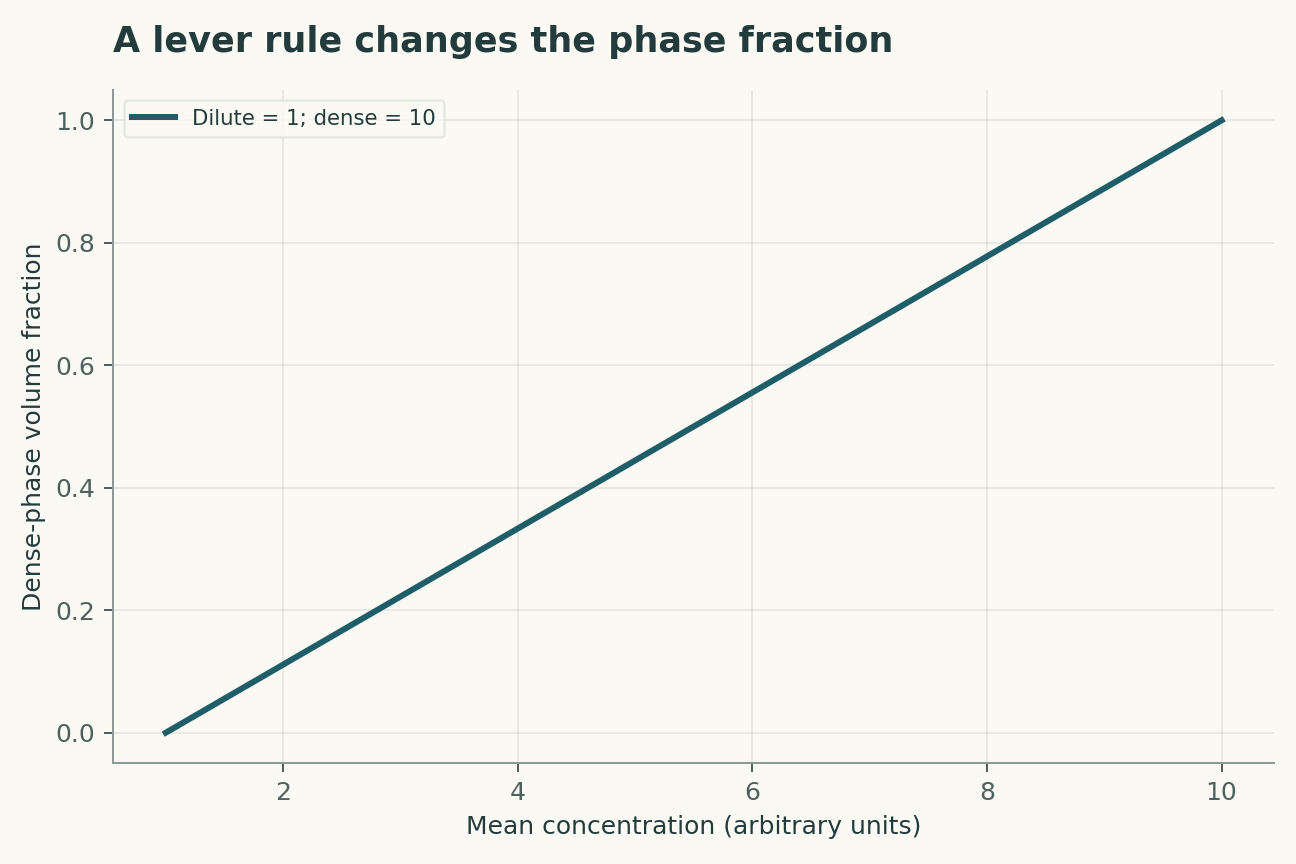
Consider an ideal two-phase mixture with a dilute concentration of one arbitrary unit and a dense concentration of ten. If the total concentration is three, conservation requires a dense-phase volume fraction of two ninths. Raising the total to five increases that fraction to four ninths while leaving both phase concentrations unchanged in this idealization. A detector focused only on the dilute phase could therefore report almost no change even though the compartment volume doubles. Conversely, a detector reporting integrated droplet fluorescence would show a large change without a change in dense-phase concentration. Neither measurement is wrong. The apparent contradiction comes from comparing concentration, amount and volume as though they were the same variable. Absolute calibration makes the distinction experimentally accessible.
Why the lever rule is only a starting point
The two-phase calculation assumes a well-mixed, closed system at coexistence, negligible interfaces and a single effective concentration coordinate. A real condensate contains many molecular species, so moving one concentration can move the coexistence compositions of others. A protein that partitions into droplets may be a passive client, a scaffold that shifts the phase boundary, or a regulator of another component's interactions. The observed dilute concentration need not remain flat across all perturbations. This does not automatically falsify phase separation; it challenges the chosen reduction. A useful extension measures at least two independent concentration coordinates and records whether the inferred tie line changes. Increasing model complexity should follow an observable failure of the simpler model, rather than serve as an escape from every failed prediction.
Exchange is not the same as internal fluidity
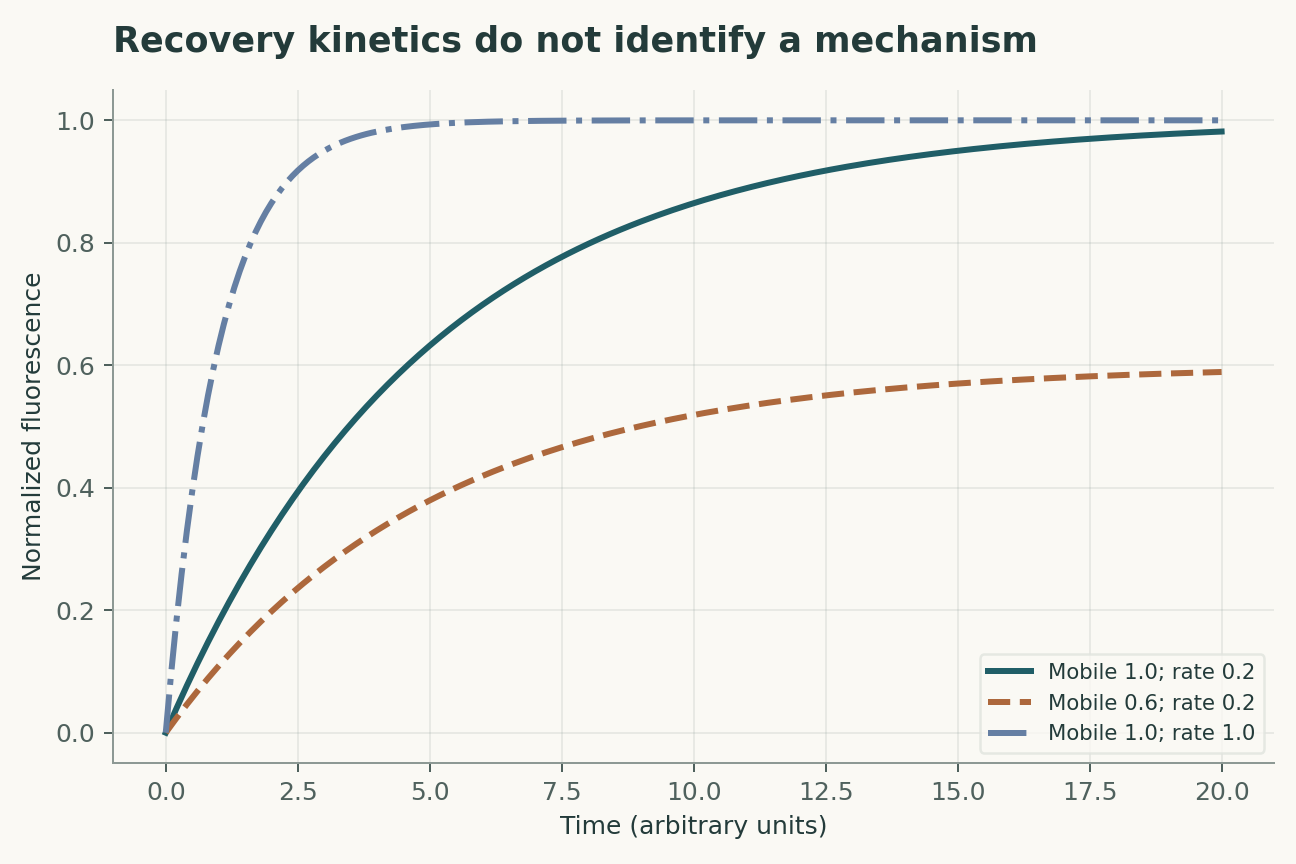
Fluorescence recovery after photobleaching is often treated as a material fingerprint. In a minimal exchange model, the recovered fraction approaches a plateau exponentially, with an amplitude describing the exchanging population and a rate describing effective replenishment. Identical recovery curves can arise from different combinations of diffusion, reversible binding and transport across an interface. Bleaching an entire droplet primarily tests exchange with its surroundings; bleaching a small internal region also tests redistribution within it. The geometry of the bleach therefore belongs in the measurement definition. A fast recovery establishes molecular mobility under that geometry, but it does not uniquely identify a thermodynamic phase or exclude a dynamically renewing scaffold. A second geometry is often more informative than a much more precise estimate of the first recovery constant.
A quantitative ambiguity in a familiar curve
Suppose one experiment gives a recovery fraction of one minus an exponential with a ten-second characteristic time. A reaction-limited binding model and an exchange-limited compartment model can both produce that trace. Even noiseless measurement of the trace cannot choose between them because both predict the same observable. This is structural non-identifiability, not a shortage of statistical power. Now halve the bleach radius while keeping composition fixed. A diffusion-controlled contribution should change with the square of a characteristic length, whereas an ideal first-order unbinding rate should not. The intervention creates a distinction in predictions. The analysis figure illustrates recovery curves with different mobile fractions and rates, but the proposed discrimination depends on how those parameters respond to a controlled geometric change.
Interfaces carry information that interiors conceal
For a spherical droplet of radius r, the surface-to-volume ratio is three divided by r. Small droplets consequently devote a larger fraction of their material to interfacial environments. If a reaction is localized at the interface, total reaction rate need not track condensed volume. Doubling the radius multiplies volume by eight but area by four. A comparison based only on integrated intensity would therefore misstate the relevant scaling. This simple dimensional argument motivates measuring size distributions, not merely average size. It also reveals a limitation: a population of irregular, interacting or surface-wetted compartments cannot be reduced to isolated spheres without checking geometry. The purpose of a scaling law is to expose a testable dependence, not to disguise an inconvenient morphology.
Distinguishing enrichment from acceleration
A substrate can be highly enriched inside a compartment while its reaction is slower there. The enzyme may be excluded, inhibited, saturated or trapped in a less productive orientation. Partition coefficients are equilibrium ratios of concentration; catalytic flux is a nonequilibrium rate. To connect them, one needs the concentrations of every limiting reactant and a kinetic law valid in each phase. In a deliberately simple unsaturated bimolecular reaction, enrichment of both reactants multiplies local reaction propensity, but the total contribution must still be weighted by the small volume occupied by the dense phase. Once saturation or diffusion limitation appears, that multiplication fails. Reporting local enrichment and whole-cell flux side by side would prevent an attractive spatial image from being mistaken for a kinetic mechanism.
A causal intervention needs a matched alternative
Removing a low-complexity region may abolish droplets and a biological function simultaneously. That result is compatible with a functional role for condensation, but the deletion may also remove binding sites, localization signals or regulatory modifications. A stronger design seeks variants that alter collective assembly while preserving the interaction needed for the proposed function. Conversely, a rescue that restores function without restoring the original morphology would challenge a morphology-centered explanation. Such separation is difficult and should not be promised by a generic mutation strategy. It must be demonstrated with direct interaction measurements and comparable expression. The key question is whether the intervention changes the hypothesized causal variable selectively enough that the functional response can be attributed to it.
Time creates a second phase diagram
An assembly that initially exchanges rapidly can later become arrested. An experiment that measures only the first minute and one that measures the next day may therefore describe different material states without disagreeing. A useful study records the age of each assembly and distinguishes repeated observations of the same object from independent objects of different ages. Hysteresis during assembly and dissolution may reflect nucleation barriers, slow rearrangement or irreversible chemistry. An equilibrium interpretation needs a timescale-separation argument: relaxation must be fast compared with the protocol. When this condition fails, the experiment should report a kinetic trajectory rather than label every threshold a coexistence boundary. This shift in terminology is scientifically productive because it identifies which rates need to be measured next.
What computational models should be asked to predict
A sequence model trained to label proteins as condensate-associated can learn localization, abundance or annotation practice instead of a thermodynamic property. A mechanistic prediction should specify the target: saturation concentration in a defined solution, partitioning in a mixture, a kinetic arrest time, or a cellular response. These targets require different training labels. Splitting similar sequences across training and testing can also exaggerate generalization. A useful evaluation withholds sequence families and entire experimental conditions, then asks whether predicted changes preserve their sign and uncertainty. Out-of-domain failures should be recorded alongside successful rankings. Agreement among several models trained on the same annotations is not independent physical evidence, although it may help select a tractable set of hypotheses for experiment.
A measurement program that can fail constructively
The most informative next experiment would jointly track total concentration, dilute concentration, dense concentration, compartment geometry and functional flux through a reversible perturbation. If mass balance closes but dilute concentration drifts, the two-component reduction is inadequate. If morphology changes while flux remains constant, morphology is not the limiting mediator under those conditions. If recovery changes with bleach geometry but not with a binding perturbation, transport deserves greater emphasis. Each outcome narrows the space of explanations. This approach trades a universal label for a model whose failure is interpretable. Condensate biology becomes stronger when a negative result tells us which link in the causal chain broke, rather than merely moving a structure from one descriptive category to another.
A perturbation must separate assembly from function
A useful causal test would compare perturbations that change condensed volume while preserving protein abundance, binding sites and compartment access. That requirement is difficult: the same sequence features can control phase behavior and molecular recognition. A loss of activity after deleting a disordered region therefore has at least two interpretations. An orthogonal perturbation, a rescue that restores assembly without restoring the original sequence, and an assay of binding outside droplets would help discriminate them. The endpoint should be measured as a time course because delayed transport can produce the same final product with different kinetics. The proposed comparison concerns mechanism, rather than whether an object looks liquid.
Identifiability of an apparent partition coefficient
A fluorescence ratio becomes a concentration ratio only after accounting for background, optical sectioning and fluorophore response. A saturating detector can compress the dense-phase signal; an excluded background marker can change the apparent dilute signal. In a mass-balance test, independently measured total abundance should agree with the volume-weighted concentrations. Failure of that closure would first challenge the measurement model. Even a consistent partition coefficient does not prove equilibrium: driven binding and transport can maintain enrichment. Measuring the response to controlled concentration changes and the return path after reversal would expose hysteresis that a single image cannot resolve.
A declared analytical model
Four equations, explicit assumptions
(1) Lever rule for a closed ideal two-phase mixture; valid only between the coexistence concentrations.
(2) Constructed single-rate recovery model; the fitted rate does not identify a unique microscopic mechanism.
(3) Spherical geometry distinguishes interfacial and volumetric contributions.
(4) Volume-weighted reaction flux when each phase has a well-defined local rate.
Constructed examples · Reproducible data
Inspect the quantitative argument
These curves are calculated from the declared models. They are not observations from the cited studies. Every figure includes its numeric data and vector version.


Which evidence answers which question?
| Evidence or design choice | What it identifies | What remains unresolved |
|---|---|---|
| Absolute phase concentrations | Mass balance and buffering | Multicomponent shifts of coexistence |
| Whole-droplet recovery | Exchange with surroundings | Internal rearrangement |
| Local bleach at several radii | Length dependence of recovery | Coupled reaction and diffusion |
| Matched assembly perturbation | A candidate causal mediator | Other altered interactions |
| Time-resolved functional flux | Kinetic consequences | Which molecular step limits flux |
A proposed validation protocol
This is a proposed evaluation design. No new biological experiment, clinical trial or physical experiment was carried out for this article.
- Calibrate total and phase-specific concentration on the same scale.
- Record bleach geometry, object age and acquisition timing.
- Predefine competing binding, transport and coexistence models.
- Measure reversible concentration sweeps and their hysteresis.
- Compare size-dependent functional rates with area and volume predictions.
- Use matched perturbations that preserve relevant interactions where demonstrated.
- Release segmentation choices, uncertainty propagation and negative outcomes.
What the primary sources establish
Clifford P. Brangwynne, Christian R. Eckmann, David S. Courson et al. · 2009 [1]
Contribution. P granules exhibited liquid-like behavior and regulated dissolution and condensation.
Boundary. The studied germline system and imaging conditions.
Source locator. Abstract; principal observations
Amandine Molliex, Jamshid Temirov, Jihun Lee et al. · 2015 [2]
Contribution. Low-complexity interactions supported droplets and promoted fibrillization in the studied protein system.
Boundary. Specific proteins and experimental conditions.
Source locator. Summary; phase separation and fibrillization
Yongdae Shin, Joel Berry, Nicole Pannucci et al. · 2017 [3]
Contribution. Light activation provided spatial and temporal control over engineered droplet formation.
Boundary. Engineered optogenetic constructs.
Source locator. Abstract; optoDroplet platform
Limits of this analysis
- The figures are mathematical constructions, not new condensate measurements.
- The lever rule assumes an ideal closed two-phase reduction.
- Single-exponential recovery is not a unique model of material state.
- Selected studies do not establish that all cellular puncta share one mechanism.
A focused narrative analysis of the named primary studies, not a systematic literature search or a claim to comprehensive coverage through 2026.
Questions that would change the conclusion
- Which functional changes survive perturbations that preserve binding but alter collective assembly?
- Can joint concentration and geometry measurements distinguish a moving tie line from kinetic arrest?
- When does interfacial scaling predict flux better than condensed volume?
References
- Clifford P. Brangwynne, Christian R. Eckmann, David S. Courson et al.. Germline P Granules Are Liquid Droplets That Localize by Controlled Dissolution/Condensation. Science (2009). 10.1126/science.1172046.
- Amandine Molliex, Jamshid Temirov, Jihun Lee et al.. Phase Separation by Low Complexity Domains Promotes Stress Granule Assembly and Drives Pathological Fibrillization. Cell (2015). 10.1016/j.cell.2015.09.015.
- Yongdae Shin, Joel Berry, Nicole Pannucci et al.. Spatiotemporal Control of Intracellular Phase Transitions Using Light-Activated optoDroplets. Cell (2017). 10.1016/j.cell.2016.11.054.
Bibliographic identity checked against Crossref. Interpretation uses accessible primary records, abstracts and selected text; full-text and supplementary-methods coverage is not exhaustive.
Authorship and provenance
Source-based research review and original mathematical analysis written by Codex (AI). Cited experiments belong to the cited research teams.
Concept cover created with the built-in ImageGen tool. Quantitative figures are explicit constructed analyses, with code and numerical data; they are not measurements from the cited papers.
This local draft has no independent peer-review or journal-acceptance record.