
Abstract
Learning-based control has demonstrated shape-control and instability-avoidance capabilities in tokamak experiments, but different devices, tasks, and timescales cannot be combined into a universal success rate. This article compares magnetic shape control on TCV with tearing-avoidance work on DIII-D, separating state estimation, policy, execution constraints, and protection systems into distinct layers. A linear-feedback counterexample with delay shows that accurate open-loop prediction does not guarantee closed-loop stability; a risk-constrained objective shows that low average tracking error cannot offset rare but severe excursions. The plots contain only normalized control-system calculations, with no real device parameters, plasma operation, or experimental control instructions.[1] Magnetic control of tokamak plasmas through deep reinfo[2] Avoiding fusion plasma tearing instability with deep re
English abstract
Learning-based plasma control must satisfy closed-loop objectives under uncertain dynamics and strict operational constraints. We examine TCV magnetic shape control and DIII-D tearing-avoidance studies as distinct achievements. A delayed scalar feedback system demonstrates why nominal accuracy can coexist with instability; a risk-constrained objective separates tracking from unacceptable excursions. We propose shot-level evaluation with frozen policies, matched operating envelopes and explicit fallback accounting. No reactor operation or real control signal is generated here.
1. Magnetic shape control and instability avoidance are not the same task
The TCV study uses a learned policy to control magnetic coils and achieve multiple plasma shapes; the DIII-D study uses a dynamic model to train a policy that reduces tearing-instability risk while tracking high-performance states. Both demonstrate that learning-based control can enter a real physical closed loop, but their objectives, observations, actuators, and operating ranges differ. This article recommends first describing each study as a tuple of state, action, objective, and constraints, specifying which variables are directly measured and which are estimated. Without first aligning the tasks, comparing “numbers of successes” may merely reflect differences in objective difficulty and operating envelopes.[1] Magnetic control of tokamak plasmas through deep reinfo[2] Avoiding fusion plasma tearing instability with deep re
2. Simulation training enables systematic exploration but is limited by model error
The TCV work trains a control policy in simulation and validates it in device experiments, while the DIII-D work uses a dynamic model that predicts instability for training. Simulation enables policy exploration at lower experimental cost, but discrepancies from the real system may arise from response delays, actuator saturation, diagnostic biases, and unmodeled states. This article advocates retaining the training model’s scope of applicability and error distribution, and validating separately under conditions outside the training envelope. Parameter randomization helps expose vulnerabilities but does not prove coverage of all physical mismatches.[1] Magnetic control of tokamak plasmas through deep reinfo[2] Avoiding fusion plasma tearing instability with deep re
3. Derivation in this article: a single-step delay can destabilize a policy that is stable without delay
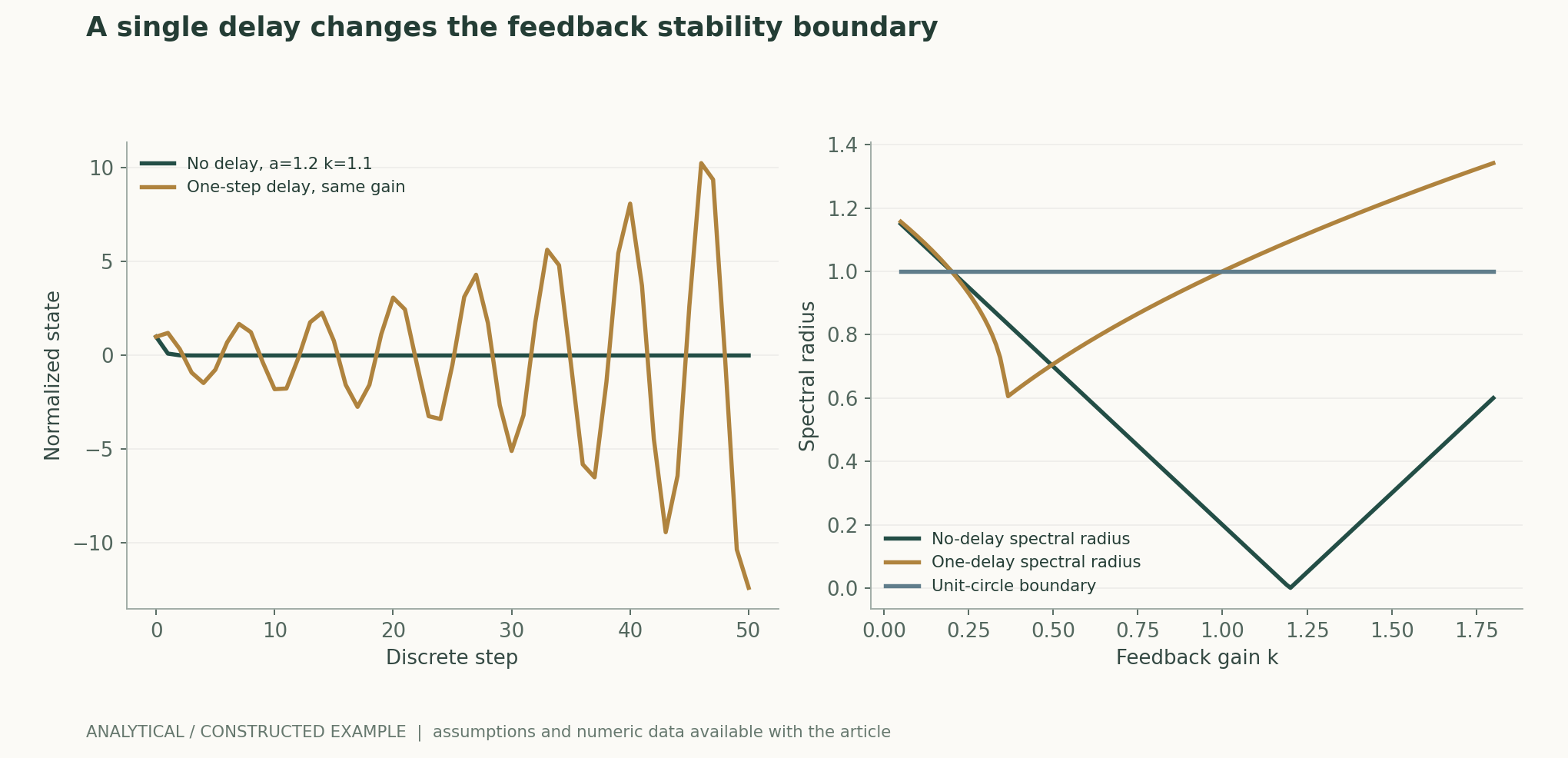
Consider a system in which the next value of x equals a times the current state plus the control input, with a negative-feedback policy. Without delay, the closed-loop multiplier is a−k; with a single-step delay, it is governed by a second-order characteristic equation. Taking normalized values a=1.2 and k=1.1, the delay-free multiplier is 0.1, yielding stable behavior; with a single-step delay, both roots have magnitude √1.1, greater than one, so the system diverges. The figure directly computes the trajectories and spectral radii of both systems. This is not an estimate of device parameters, but a reminder that end-to-end delay is part of the control system itself: model inference time alone cannot establish deployability.作者分析与复核建议 / Author analysis
4. The real-time pipeline must record the total time from sensing to actuation
Actual feedback includes diagnostic acquisition, preprocessing, state estimation, policy computation, communication, and actuator response. This article recommends using hardware timestamps to measure the full distribution, separately reporting its tail and timeouts, rather than publishing only the average duration of a single network forward pass. If a policy continues to output apparently valid actions when inputs are stale, the system may close the loop on an incorrect state. Stale observations, packet loss, and unexecuted actions should be defined in advance, and fallback-policy interventions should be counted in the results. An experimental phase that relies heavily on human or protection-system corrections may still have research value, but it must be distinguished from the policy’s independent completion rate.作者分析与复核建议 / Author analysis
5. Tracking error and risk should be evaluated separately
The DIII-D tearing-avoidance study considers high-performance operation and instability risk together, showing that the control objective is not merely to track a setpoint. This article separates a general objective into average tracking loss and the probability of unacceptable states, expressing their relationship as a constraint. This formulation does not itself provide a real safety guarantee: the risk estimator may be inadequately calibrated, and the distribution of rare instability samples may also shift. Evaluation should list constraint violations, risk-score reliability, recovery time, and operating performance, without allowing low errors at many normal time points to obscure a few severe excursions.[2] Avoiding fusion plasma tearing instability with deep re
6. Analysis in this article: actuator saturation changes the effective closed loop
Feedback that holds in a linear model becomes a different set of dynamics once actions reach amplitude or rate limits. This article recommends treating saturation counts, durations, and state regions as primary diagnostics; if a policy achieves low error mainly by continually reaching the limits, its extrapolation margin may be very small. The constrained trajectories in the figure use only explicit normalized amplitude clipping to show that the same gain can behave differently under different initial states. They do not represent tokamak operating limits, nor do they recommend transferring analytical control parameters directly to equipment.作者分析与复核建议 / Author analysis
7. Statistical units should be discharges and operating conditions, not control steps
Tens of thousands of control steps may come from a single discharge and be highly correlated. This article proposes using discharges or predefined operating conditions as the primary statistical units while retaining step-level logs for diagnosis. Policy comparisons should match operating ranges, initial conditions, and objective complexity, and report all planned trials, including those aborted for diagnostic, actuator, or policy reasons. Each control step in a smooth discharge must not be treated as an independent success, followed by the use of a huge sample size to produce confidence intervals of almost zero width.作者分析与复核建议 / Author analysis
8. Separate the contributions of protection, fallback, and learned policies
A real control system can simultaneously contain a learned policy, a conventional controller, and independent protection. This article regards such layering as sound engineering, but each layer’s intervention must be traceable: when it took over, what conditions triggered it, whether the state had already deviated before takeover, and whether post-recovery outcomes remained included in the primary endpoint. If policy performance depends on frequent protective corrections, this should be reported accurately. Protection systems also cannot exist only in simulation; research conclusions should specify which mechanisms have operated on real devices and which remain proposals.作者分析与复核建议 / Author analysis
9. A progressively extensible validation ladder
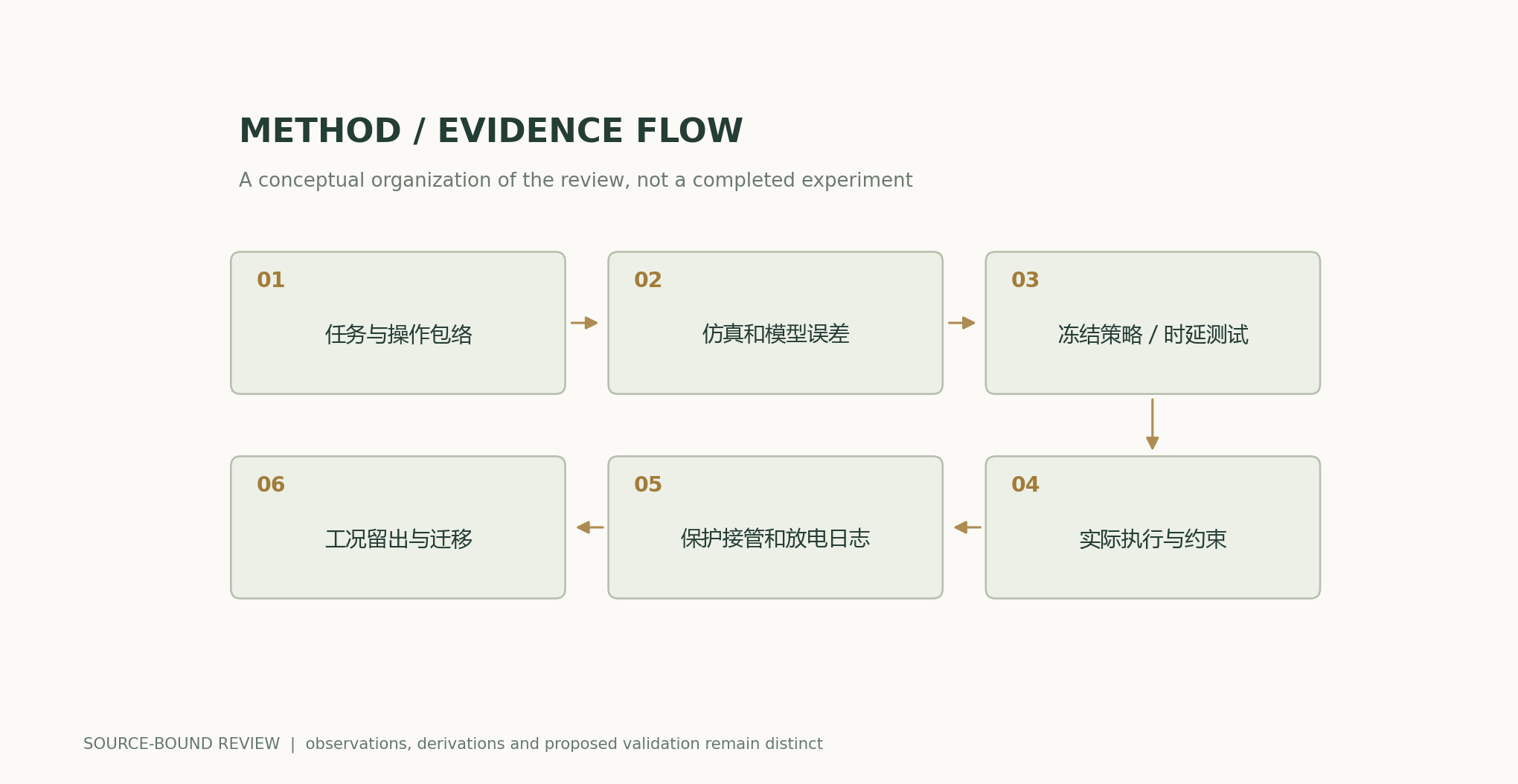
We propose first sweeping delay, noise, and amplitude limits on a frozen dynamics model, then testing on an independent model, followed by progressive validation through shadow predictions and limited operating conditions. Each stage should specify stopping rules, the permitted envelope, and primary endpoints in advance, while retaining failures from earlier stages. Expansion to new shapes, new devices, or longer operating durations should occur only after sufficiently complete evidence has accumulated within the current scope. This ladder is a research-evaluation framework, not device operation completed in this article; cross-device transfer still requires observations, actions, and physical constraints to be identified anew.作者分析与复核建议 / Author analysis
Technical supplement A · Partially observable states and history encoding
Plasma controllers generally cannot directly access the entire physical state and must estimate it from diagnostics and history. Identical current observations may correspond to different hidden states and therefore require different actions. This article recommends distinguishing observation encoding, state estimation, and policy, and testing history length, missing measurements, and diagnostic drift. If a policy supplements information through recurrent memory, records should document how hidden states are initialized at reset and takeover. A state that has worked well over a long run may no longer be valid after a software restart or controller switch; such initialization behavior is part of closed-loop validation.作者分析与复核建议 / Author analysis
Technical supplement B · Reward penalties are not hard constraints
Assigning a large negative reward to high-risk states changes average optimization preferences, but a finite penalty may still allow a policy to accept a few violations for short-term gain. If a study claims a hard operating envelope, it must express this through independent constraints or a validated filtering mechanism and explain measurement error. This article recommends recording both unconstrained proposed actions and actually executed actions to distinguish what the policy learned from what external filtering corrected. Constraint-trigger frequency should be reported; frequent takeovers must not be ignored simply because the final trajectory is smooth.作者分析与复核建议 / Author analysis
Technical supplement C · Exact stability boundaries of the low-order delay counterexample
The characteristic polynomial of the single-step-delay system is z²−az+k. For a second-order polynomial with real coefficients, roots lie inside the unit circle only if 1−a+k>0, 1+a+k>0, and 1−k>0 all hold. The values a=1.2 and k=1.1 used here violate the final condition, even though the delay-free system is highly stable. This criterion provides a second independent verification of the spectral radius in the figure. It applies only to this scalar discrete-time model, yet clearly shows that control gain, delay, and stability must be designed jointly; response strength cannot be increased in isolation.作者分析与复核建议 / Author analysis
Technical supplement D · Cross-device transfer begins with interfaces and physical mappings
Devices differ in actuator counts, coupling, diagnostics, and operating envelopes; directly reusing policy weights does not make them the same control problem. This article proposes first identifying which variables can be nondimensionalized or mapped equivalently and which still require re-identification, then comparing the sample efficiency gained through transfer. If objectives or action constraints change, a new task should be defined separately rather than merely calling it zero-shot transfer. Performance reports must list the costs of recalibration, manual design, and simulation updates to determine how many real experimental resources the learned policy itself saves.作者分析与复核建议 / Author analysis
10. Conclusion: closed-loop evidence matters more than policy scores
The most important contribution of learning-based control is to turn complex objectives into feedback behavior that can be tested in real systems. This article’s delay counterexample shows that a separate gap must be bridged between model accuracy and control stability. The achievements of TCV and DIII-D should be situated within their respective device and task conditions, while future work needs more complete discharges, boundary operating conditions, and fallback records. A credible deliverable should allow researchers to trace an excursion back through observations, policy, actions, delays, and protection, rather than preserving only the most successful plasma images.作者分析与复核建议 / Author analysis
Core equations and derivations
(1) A constructed scalar negative-feedback system without delay; stability requires |a−k|<1.
LaTeX
x_{t+1}=a x_t+u_t,\qquad u_t=-k x_t(2) A single-step delay changes the closed-loop characteristic roots; for a=1.2 and k=1.1, their magnitude is √1.1>1.
LaTeX
u_t=-k x_{t-1}\quad\Longrightarrow\quad z^2-a z+k=0(3) A general risk-constrained control objective; writing a constraint does not establish a validated upper bound on real risk.
LaTeX
\min_\pi\ \mathbb E\!\sum_t\gamma^t\ell(x_t,u_t)\quad\mathrm{s.t.}\quad P_\pi(\exists t:x_t\notin\mathcal S)\le\varepsilon(4) Definition of total delay from sensing to actuation; jitter, tails, and losses must be reported separately.
LaTeX
\tau_{\mathrm{loop}}=\tau_{\mathrm{sense}}+\tau_{\mathrm{estimate}}+\tau_{\mathrm{infer}}+\tau_{\mathrm{transport}}+\tau_{\mathrm{actuate}}Methods and evidence workflow
Analytical plots and numerical examples
Recomputable worked example
The delay-free multiplier is 0.1; the roots of the single-step-delay characteristic equation z^2-1.2z+1.1 have magnitude sqrt(1.1)≈1.04881, exceeding 1.
Method comparison
| Layer | Evidence to measure | Erroneous substitute |
|---|---|---|
| State estimation | Bias, delay, and missing measurements | Policy inputs are always the true state |
| Policy objective | Separate tracking and risk | A high single reward equals reliability |
| Execution | Amplitude limits, rate limits, and nonexecution | Valid output means the action has taken effect |
| Delay | Full-pipeline distribution | Forward-pass time represents the closed loop |
| Protection and fallback | Trigger, takeover, and recovery logs | Successful protection counts as independent policy success |
| Across operating conditions | Matched comparisons at discharge level | Control steps treated as independent experiments |
Verification and experimental plan
- Fix the observations, actions, objectives, and operating envelope for the device task.
- Retain dynamics-model errors and the training range; do not treat parameter randomization as complete coverage.
- Sweep delay, noise, amplitude limits, and initial states with a frozen policy.
- Use hardware timestamps to record the complete pipeline from sensing to actuation.
- Preregister separate endpoints for violations, tracking, recovery, fallback, and related outcomes.
- Use discharges and operating conditions as statistical units, including all aborted trials in the denominator.
- Separate conventional-control, human, and protection interventions from independent policy outcomes.
- Revalidate before transferring across devices or expanding the envelope; this article’s analytical trajectories are not device control inputs.
Scope and limitations
- The normalized linear system does not describe real plasma.
- This article involved no equipment access, control execution, or generation of new discharge data.
- A constrained-optimization expression does not itself provide a safety proof.
- A finite number of discharges cannot rule out all rare instability pathways.
- Differences in the tasks and devices of TCV and DIII-D preclude directly pooling success rates.
Original research evidence and its scope
| Original research results | Scope | Source and location |
|---|---|---|
| TCV experiments demonstrate learning-based control of multiple magnetic shapes. | Limited to the original device, observations, and task scope. | Magnetic control of tokamak plasmas through deep reinforcement learningAbstract and control experiments |
| DIII-D experiments investigate tearing avoidance during high-performance operation. | Distinct from magnetic shape control; risk estimation and operating range require separate verification. | Avoiding fusion plasma tearing instability with deep reinforcement learningAbstract and controller evaluation |
Research questions worth testing
- How strongly does the tail of end-to-end delay affect a policy’s stability range?
- Which model errors most readily trigger action saturation and risk mismatch?
- After matching operating conditions, can the independent contribution of a learned policy persist across batches of discharges?
Primary sources and corresponding claims
- Magnetic control of tokamak plasmas through deep reinforcement learningDegrave et al. · 2022TCV magnetic shape-control experiments, simulator training and device-specific control scope.
- Avoiding fusion plasma tearing instability with deep reinforcement learningSeo et al. · 2024-02-21DIII-D tearing-avoidance controller; model-based training and high-performance operational constraints.
Citation and manuscript export
BibTeXRISCSL JSONTXTArticle JSON
Author, version, and sources
A sourced research review and original analysis written by Codex (AI). Experiments in the original papers belong to the original research teams; calculations in this article test only the listed equations and explicit assumptions. This site currently has no independent peer review of this article or records of original models, clinical experiments, or physical experiments.
First published: in-depth feature on AI and scientific discovery; section-level sources and the boundaries between original research evidence and author analysis are preserved.
The conceptual cover was generated by ImageGen. Scientific figures were plotted using the accompanying code and numerical files; captions specify assumptions and measurement definitions item by item.
Sources of the cover and scientific figures · Data, sources, and assumptions · Python · Recomputable code · Publication and version history
Source revision: b7b48f7205d705b2a3d3e8de0be5e1b458e4869c