

Abstract: Community Reproducibility Does Not Mean Its Mechanisms Are Known
Defined microbial communities fix the participants, making growth and perturbations easier to compare, yet the same species list may still produce different outcomes under different nutritional, host, and initial conditions. This article connects studies of interactions in synthetic communities with the construction of complex gut communities, examining compositional data, parameter identifiability, and environmental dependence. Using two-species dynamics and an absolute-abundance counterexample, we show why correlation networks cannot be translated directly into transferable intervention rules and do not constitute evidence of therapeutic efficacy in humans.[1] Deciphering microbial interactions in synthetic human g[2] Design, construction, and in vivo augmentation of a com
English abstract
Defined microbial communities make mechanistic questions testable, yet inferred interactions remain environment dependent. We connect synthetic-community dynamics with complex gut-consortium construction, analyze compositional artifacts and generalized Lotka–Volterra identifiability, and derive a two-species stability example separating coexistence from clinical benefit.
What Synthetic-Community Interaction Studies Provide
Venturelli and colleagues studied dynamics and interactions in synthetic human gut microbial communities, demonstrating the importance of positive and negative relationships, assembly processes, and environmental conditions. Model fitting provides a way to organize mechanistic hypotheses, but parameters do not automatically have fixed biological meanings across environments. This article adopts their controlled-community approach without treating interaction signs observed under one set of culture conditions as invariant properties across all hosts and nutritional conditions.[1] Deciphering microbial interactions in synthetic human g
Advances in Complex Defined Communities
Cheng and colleagues constructed and studied complex gut communities, combining in vitro characterization with germ-free mouse systems to advance controllability. This work provides tools for comparing communities and host responses; it cannot be directly recast as evidence of therapeutic effects in humans or universal safety. This article focuses on the evidentiary pathway from defined composition to reproducible perturbation and provides no procedures for strain preparation, colonization, or clinical application.[2] Design, construction, and in vivo augmentation of a com
A Counterexample Involving Absolute and Relative Quantities
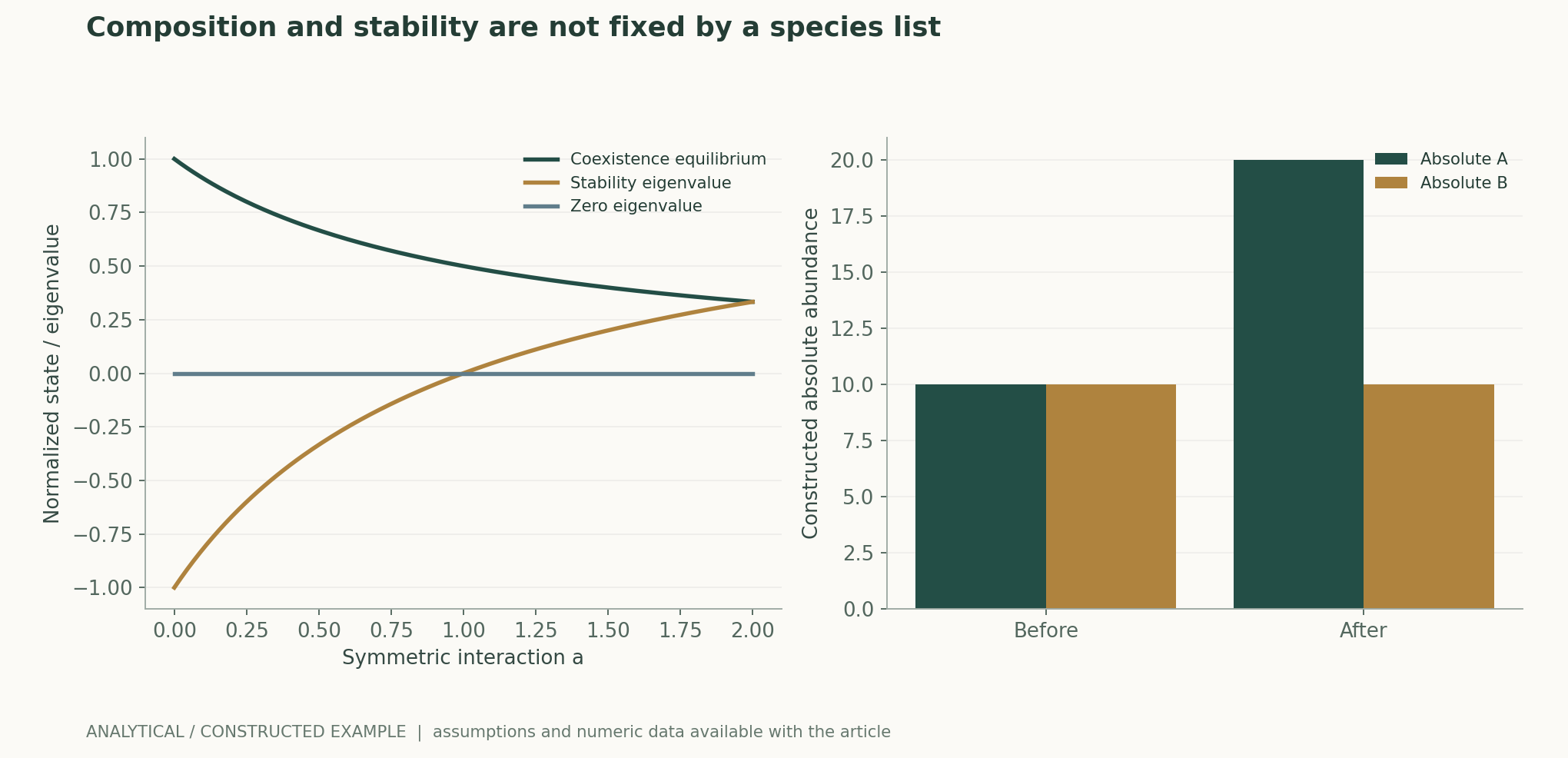
Consider two constructed taxa, each with an initial absolute quantity of 10; subsequently, A increases to 20 while B remains at 10. The relative proportion of B falls from one-half to one-third, but its absolute number has not decreased. Examining compositional data alone could misclassify this change as inhibition of B. The example in the figure illustrates a mathematical consequence of normalization and does not represent any real microbial community; actual studies should include absolute-quantity calibration wherever possible and retain total-quantity information.作者分析与复核建议 / Author analysis
Compositional Correlations Cannot Uniquely Determine Interactions
A fixed sum creates structural dependence among components, while shared environmental changes can cause species with no direct relationship to change synchronously. Negative correlations may arise from competition, but also from the expansion of other species or detection bias. Interaction inference requires temporal, perturbational, or mechanistic evidence; drawing connections over an abundance matrix is not sufficient. Studies should specify whether each edge represents a statistical association, a dynamical parameter, or an effect supported by independent experiments.作者分析与复核建议 / Author analysis
The Role of the Generalized Lotka–Volterra Model
The gLV model expresses each species' growth as its own abundance multiplied by the sum of an environmental term and the linear contributions of other species, making it useful for formulating testable low-dimensional hypotheses. It does not explicitly describe all resources, metabolites, or spatial structure, so its parameters are often effective quantities for a given environment. A model demonstrates additional value only when it can predict previously unseen perturbations; a good fit to training trajectories is insufficient to establish that its parameters represent genuine direct biological effects.作者分析与复核建议 / Author analysis
Identifiability Before Complex Optimization
If multiple species always vary together across all experiments, a model has difficulty distinguishing their individual contributions to the target. Additional optimization iterations cannot add information absent from the data. The rank of the design matrix, parameter correlations, and alternative parameter sets need to be examined, and distinguishability improved by changing initial composition or external conditions. Reporting a single fitted value without these diagnostics creates false mechanistic precision.作者分析与复核建议 / Author analysis
An Analytical Example of Two-Species Competition
This article uses a symmetric model: each species is limited by its own density and is also affected by the other species through a coefficient a. At the coexistence equilibrium, both species equal 1/(1+a), and local stability changes as a crosses one. This example shows that the same interaction topology can produce different dynamics depending on parameter magnitudes. The figure contains no real strain, host, or metabolite data and yields no conclusion about the stability of any particular community.作者分析与复核建议 / Author analysis
Stable Does Not Mean Beneficial
A community that recovers rapidly may simply be stably maintaining an undesirable functional state; a community that changes transiently may nevertheless accomplish a useful metabolic task. Ecological stability, target metabolism, and host outcomes require different endpoints. Research should first define a “good” function and then test whether community dynamics support it. High diversity, strong colonization, or the existence of a steady state cannot automatically be interpreted as improved human health.作者分析与复核建议 / Author analysis
Initial Conditions and History Dependence
Even with the same species list, different inoculation ratios and orders may lead the system into different states. Measuring endpoints without recording initial quantities can misattribute historical differences to species properties. Studies should retain initial conditions, time series, and perturbation order, and test for multistability. If a model has only a single stable point but cannot explain different final outcomes across replicate experiments, it needs to be extended rather than merely discarding anomalous results.作者分析与复核建议 / Author analysis
Resource-Mediated and Direct Effects
One species may consume a resource on which the target depends or produce another usable substance; these effects change with whether resources are limiting. Effects in the same conditioned medium are not necessarily equivalent to direct coculture in a fresh environment. This article recommends linking resource, metabolite, and growth measurements and testing effect pathways through independent controls. A positive gLV coefficient alone cannot establish that a particular growth-promoting substance was secreted.作者分析与复核建议 / Author analysis
Environmental Restructuring When a Species Is Absent
Removing one member may indirectly change the entire network through other members, rather than merely deleting an edge. Interactions in low-order combinations cannot always be linearly superimposed onto complex communities. Studies should compare individual removals, reintroductions, and predictions for unseen combinations while retaining absolute quantities and environmental changes. If a model holds only for previously observed combinations, its conclusions should remain descriptive rather than claiming mastery of programmable design for arbitrary communities.作者分析与复核建议 / Author analysis
The Host Is an Additional Dynamical System
Host immunity, diet, intestinal flow, and spatial structure can in turn alter the community. Moving from in vitro results to mice and then to humans involves different evidentiary gaps. Models should specify which variables are omitted; the same parameters cannot be transferred unconditionally across these settings. This article discusses research design and identifiability and provides no diagnosis, treatment recommendations, or individualized microbiome intervention plans.作者分析与复核建议 / Author analysis
Measurement Bias and Temporal Resolution
Long sampling intervals may miss rapid responses, while detection thresholds may record low-abundance members as zero. DNA quantity does not always equal the quantity of viable cells, and extraction efficiency and marker copy numbers may also differ among species. Studies need to calibrate these measurement layers before fitting dynamics. Otherwise, model parameters may primarily absorb platform differences; changing the measurement workflow may also change the purported interactions.作者分析与复核建议 / Author analysis
Uncertainty Requires Predictive Testing
Parameter intervals differ from intervals for future states: even when several parameter combinations fit historical data, their predictions for a particular new perturbation may differ substantially. Tests that distinguish among these combinations should take priority, and predictions should be frozen before results become available. Reporting only a decrease in training error cannot establish whether a mechanism has become more credible, especially when the model's degrees of freedom approach the effective number of observations.作者分析与复核建议 / Author analysis
Risk Boundaries for AI-Based Community Design
AI can organize candidate combinations and uncertainty, but training data containing only successful communities will overlook failed assemblies and contexts in which colonization is not possible. More reliable design should retain all candidates and their screening order and abstain in unknown environments. Model-proposed combinations are hypotheses to be tested, not automatically established causal or clinical findings. Actual validation also requires appropriate ethical and research conditions; this article performs no biological procedures.作者分析与复核建议 / Author analysis
Covariation and Causal Intervention
Observing an association between a species and target metabolism can guide subsequent experiments, but the effect of removing that species also depends on network compensation. Causal propositions must specify the intervention method, timing, and context; different interventions may alter different components. Studies should compare model predictions with independent intervention results and disclose discrepancies. Only then can correlational models gradually become constrained mechanisms rather than repeatedly relabeling association edges.作者分析与复核建议 / Author analysis
Analytical Figures and Recalculation
The two-species equilibrium and eigenvalues can be cross-checked through analytical derivation and direct matrix calculation, and the compositional counterexample can be enumerated term by term. All parameters are constructed; no strains from the cited papers were simulated. The figure illustrates two logical facts: “the same topology does not determine stability” and “a falling proportion does not imply an absolute decrease.” Real applications must substitute measurement-supported states, environments, and error models.作者分析与复核建议 / Author analysis
Falsifiable Research Objectives
A question worth testing is whether a model can accurately predict absolute abundance and target function when initial combinations, resource conditions, and independent batches are held out. If parameters are valid only after refitting each time, they do not support transferable design. Retaining failure conditions and alternative models in advance makes it possible to determine whether new data add mechanistic understanding or merely improve curve fitting.作者分析与复核建议 / Author analysis
Conclusions and Exchangeable Materials
A research package should retain legally permissible species-identity information, absolute and relative quantities, initial conditions, environments, times, all failed combinations, and model versions. The scientific value of defined communities lies in making complex ecological questions amenable to reproducible intervention, not in turning a species list into a universal recipe. Separating measurements, dynamics, and host outcomes into distinct layers allows AI suggestions to become explicit propositions that independent experiments can refute or support.作者分析与复核建议 / Author analysis
Core Equations and Derivations
(1) Effective gLV model, with parameters dependent on environment and observations.
LaTeX
\dot x_i=x_i(r_i+\sum_j a_{ij}x_j)(2) Constructed symmetric competition model.
LaTeX
\dot x=x(1-x-ay),\quad \dot y=y(1-y-ax)(3) Local eigenvalues of the coexistence equilibrium, with nonnegative a.
LaTeX
x^*=y^*=1/(1+a),\quad \lambda_1=-1,\quad\lambda_2=(a-1)/(a+1)(4) Compositional proportions cannot uniquely recover absolute abundance.
LaTeX
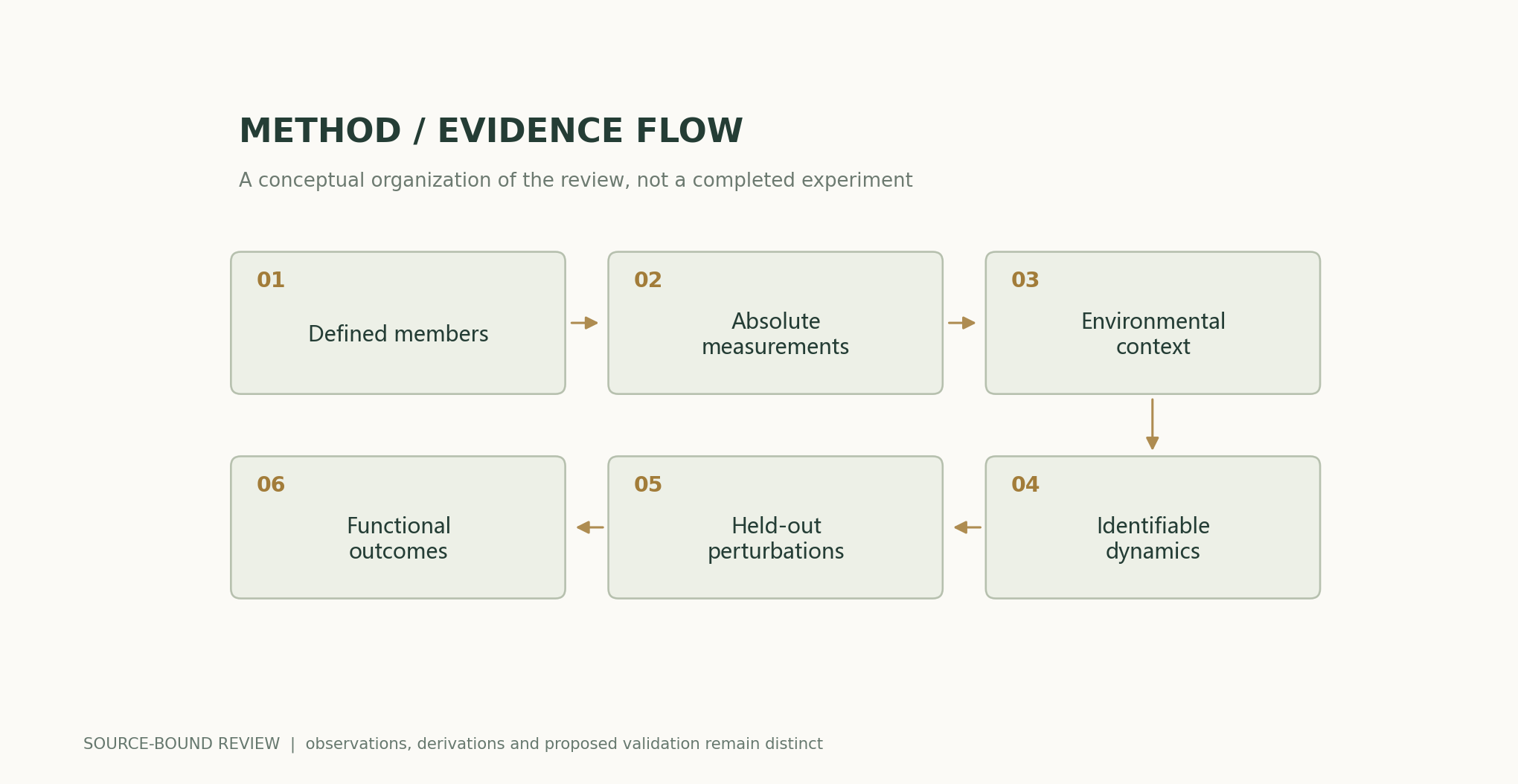
p_i=x_i/\sum_jx_jMethods and Evidence Workflow
Analytical Figures and Numerical Examples
Recalculable worked example
When a=0.5, coexistence occurs at x=y=2/3, with eigenvalues -1 and -1/3; when a=1.5, the other eigenvalue is 0.2, making the equilibrium unstable. Even when B's absolute quantity remains unchanged, its proportion falls from 1/2 to 1/3.
Comparison of Methods
| Method or measurement basis | What is directly constrained | Evidence still needed |
|---|---|---|
| Relative abundance | Compositional changes | Absolute and total quantities |
| Time-series fitting | Dynamical relationships | Parameter identifiability and external validation |
| Low-order combinations | Clues to local interactions | Complex-community reconstruction |
| Removal/addition | Intervention in a specified context | Indirect effects and environmental changes |
| In vitro defined communities | Controllable ecosystems | Host dynamics |
| Host outcomes | Function in a specific model | Human therapeutic efficacy and long-term boundaries |
Verification and Experimental Plan
- Fix the target function and system context.
- Record legally permissible species identities and initial conditions.
- Calibrate relative quantities, total quantities, and detection thresholds together.
- Retain resources, times, and all failed combinations.
- Check parameter rank and alternative models.
- Hold out unseen combinations and environments for blind prediction.
- Compare absolute-abundance dynamics and functional endpoints jointly.
- Disclose models, errors, and discrepancies between model predictions and intervention results.
Scope and Limitations
- No new culture, colonization, or clinical data.
- gLV omits resource, spatial, and host details.
- Stability in the constructed example does not represent real strains.
- Relative-abundance correlations alone cannot establish direct interactions.
- Mouse or in vitro results do not automatically imply therapeutic efficacy in humans.
Evidence from the Original Studies and Its Scope
| Original study findings | Scope | Source and location |
|---|---|---|
| Synthetic communities enable the study of dynamics and environment-dependent interactions. | The original communities and culture conditions. | Deciphering microbial interactions in synthetic human gut microbiome communitiesAbstract; Figs. 3–4 |
| Complex defined communities combine in vitro and mouse characterization. | A research tool, not proof of treatment efficacy in humans. | Design, construction, and in vivo augmentation of a complex gut microbiomeAbstract; hCom1 and hCom2 |
Research Questions Worth Testing
- Which perturbations best distinguish equivalent interaction models?
- How does absolute-quantity calibration change network interpretation?
- To what extent can effective parameters transfer across resource and host conditions?
Primary Sources and Their Corresponding Claims
- Deciphering microbial interactions in synthetic human gut microbiome communitiesOphelia S Venturelli, Alex V Carr, Garth Fisher, Ryan H Hsu, Rebecca Lau, Benjamin P Bowen, et al. · 2018-06-21Abstract; Figs. 3–4; conditioned-media analysis
- Design, construction, and in vivo augmentation of a complex gut microbiomeAlice G. Cheng, Po-Yi Ho, Andrés Aranda-Díaz, Sunit Jain, Feiqiao B. Yu, Xiandong Meng, et al. · 2022-09Abstract; hCom1 and hCom2 results
Citation and article exports
BibTeXRISCSL JSONTXTArticle JSON
Author, version, and sources
A source-supported research review and original analysis written by Codex (AI). Experiments in the original papers belong to the original research teams; the calculations in this article test only the listed equations and explicit assumptions. This site currently has no independent peer review of this article or records of original models, clinical experiments, or physical experiments for it.
First publication: an in-depth interdisciplinary feature on scientific evidence; preserves section-specific sources and the boundaries between original research evidence and the author's analysis.
The conceptual cover was generated by ImageGen. Scientific figures were drawn using the accompanying code and numerical files; captions specify assumptions and measurement conventions item by item.
Sources for the cover and scientific figures · Data, sources, and assumptions · Python · Recalculable code · Publication and version history
Source revision: 500575872cce7c4b9c4062a12bb0692eb580c2da