

Abstract
Quantum error correction uses redundant measurements to infer whether encoded information has suffered a logical error, and decoders must operate under correlated, time-varying, and partially observable noise. AlphaQubit demonstrates the accuracy potential of learning-based decoding, while quantum-memory experiments below the surface-code threshold show that hardware, code distance, and real-time processing requirements must be met together. Starting from logical equivalence classes, this article analyzes error degeneracy, finite samples, code-distance scaling, throughput, and latency. We strictly distinguish code-distance results on real chips, simulations of larger code distances, and end-to-end real-time systems; the figures are solely classical analytical calculations, not quantum-processor experiments conducted by this site.[1] Learning high-accuracy error decoding for quantum proce[2] Quantum error correction below the surface code thresho
English abstract
Surface-code decoding is inference over logical equivalence classes, not simply localization of the most likely physical error. We examine AlphaQubit and below-threshold quantum-memory experiments while keeping experimental and simulated code distances separate. A degeneracy example explains why summing over error classes matters; logical-parity and service-rate calculations connect finite data to operational requirements. The numerical plots are analytical constructions and do not simulate a quantum processor or establish a fault-tolerance threshold.
1. Stabilizer readouts reveal only part of the error
The surface code generates syndrome information through repeated stabilizer measurements. Multiple distinct physical errors can produce the same observations; some are equivalent to one another, while others differ by a logical operation. Decoding therefore does not uniquely reconstruct what happened to each qubit, but selects an equivalence class that preserves logical information. AlphaQubit uses a recurrent architecture to process measurement histories, converting spatiotemporal information into logical-error predictions. On this basis, this article emphasizes that evaluation must target logical failure, rather than merely per-measurement-bit classification accuracy; large numbers of uneventful readouts can make the latter look impressive without guaranteeing the preservation of quantum information.[1] Learning high-accuracy error decoding for quantum proce
2. Derivation in this article: the most likely path need not belong to the most likely equivalence class
Consider three mutually exclusive candidates for a given syndrome: class A contains only one path, with conditional probability 0.35; class B contains two paths, with probabilities 0.33 and 0.32. Maximizing probability over individual paths selects A, but B has total probability 0.65, so summing by logical class selects B. This small example illustrates the meaning of error degeneracy and does not represent a probability assignment for a real code. When comparing matching, tensor-network, and learning-based decoders, what matters is how they handle correlations and the probability mass of equivalence classes; learning methods should not be interpreted merely as larger classifiers of error locations.作者分析与复核建议 / Author analysis
3. Real chips and simulated code distances represent different levels of evidence
The original AlphaQubit paper studies code distances 3 and 5 using real Sycamore data, and compares correlated-noise settings in simulations of larger code distances up to 11. Pretraining and adaptation using limited real samples enable the model to exploit more complex noise information, but simulated code distance 11 must not be described as an equivalent demonstration already achieved on a real chip. Training, validation, and testing also require separation with respect to experimental samples and noise-model fitting. Fitting a noise model first using all experimental data and then generating test samples from that model changes the difficulty of the external generalization problem.[1] Learning high-accuracy error decoding for quantum proce
4. Correlated noise and leakage make temporal history important
An independent and identically distributed Pauli-error model is computationally convenient, but real devices may exhibit crosstalk, leakage, changes in analog readouts, and correlations across cycles. The AlphaQubit study uses historical state and soft information to address these phenomena. This article interprets this as a hidden-state inference problem: the same current syndrome can correspond to different posteriors under different histories. Evaluation should vary noise strength, correlation length, and calibration drift separately to observe when the model becomes mismatched, rather than merely increasing the number of samples from the same noise generator. The closer the training distribution is to the test noise, the greater the need to reserve genuinely independent time periods.[1] Learning high-accuracy error decoding for quantum proce[2] Quantum error correction below the surface code thresho
5. Derivation in this article: the relationship between multiround parity failure and the per-round error rate
If the logical bit flips independently with probability ε in each round, the probability of an odd number of flips after R rounds is [1−(1−2ε)^R]/2. It is approximately Rε at short times and approaches 1/2 at long times; it cannot grow linearly without bound. This article plots curves for different assumed values of ε and independently checks them by binomial summation. Actual logical errors may be correlated, so this formula cannot be used directly to fit every device; however, it helps researchers distinguish the per-round failure rate, the final error rate after a fixed number of rounds, and memory lifetime, avoiding a single ranking that mixes different metrics.作者分析与复核建议 / Author analysis
6. Improvement with increasing code distance requires ruling out an error floor
Below the surface-code threshold, logical error can decrease as code distance increases; research associated with Willow demonstrates specific memory and real-time decoding results while also discussing limitations such as rare correlated events. This article advocates examining trends across multiple code distances, temporal stability, and rare events together, rather than fitting an exponential curve to a few distances and extrapolating to arbitrarily low error rates. Hardware quality, the decoder, and noise calibration may all change with distance. Without controlling these changes, observed improvements cannot be uniquely attributed to a particular algorithmic component.[2] Quantum error correction below the surface code thresho
7. Analysis in this article: throughput, latency, and backlog are three distinct quantities
The arrival of each round of syndrome data creates a stream that the decoding system must process continuously without allowing backlog to grow without bound. Throughput describes how many rounds are completed per unit time, whereas latency describes the time from a round's input to its answer; batching can improve the former while increasing the latter. Using a fluid approximation with arrival rate λ and service rate μ, this article illustrates that backlog cannot stabilize when λ≥μ over the long term, while λ<μ still does not guarantee that tail-latency requirements are met. The plot compares only normalized service rates and backlog slopes and does not purport to measure hardware. The full time for acquisition, transmission, inference, and feedback should be recorded, rather than only the execution time of a single accelerator kernel.作者分析与复核建议 / Author analysis
8. Accuracy papers and real-time systems papers cannot automatically substitute for one another
The original AlphaQubit paper explicitly states that its throughput remains slower than the microsecond-per-round target for superconducting qubits and discusses improvements such as distillation, low precision, and hardware implementation; a separate below-threshold experiment uses its own real-time decoding system. Both advance fault-tolerant computing, but they do not constitute a single product chain whose loop has already been closed. This article recommends presenting separate evidence for algorithmic accuracy, code distance on actual chips, streaming throughput, final feedback latency, and logical-gate operations. If subsequent acceleration sacrifices error suppression, it must also be reevaluated under the same noise and code distance; results from the uncompressed teacher cannot be cited in its place.[1] Learning high-accuracy error decoding for quantum proce[2] Quantum error correction below the surface code thresho[3] Distilling the Knowledge in a Neural Network
9. Rare errors require sufficiently long independent observation
If no logical errors are observed in testing, the upper bound depends on the number of independent trials, the number of rounds, and the correlation structure of events. Repeated readouts within a long sequence are not equivalent to fully independent new experiments, and device drift may invalidate the identically distributed assumption. This article proposes stratifying statistics by experimental batch, time period, and calibration cycle, while separately retaining leakage, reset, and anomalous events. For low-error-rate tasks, zero observations should be reported with an upper confidence bound, not described as zero risk; comparisons across code distances should match noise conditions and observation duration so that shorter tests do not appear more perfect.作者分析与复核建议 / Author analysis
10. Research agenda: from memory decoding to composable logical processes
A decoder that works for logical memory does not thereby handle all logical gates, boundary changes, and cross-block information. Future research should freeze component interfaces and test the transfer of historical state, noise changes, and latency budgets during composition. Separate holdouts can be established for noise mismatch, code-distance transfer, and logical operations to compare the joint limits of accuracy and processing capacity. If a model performs well only at the same distance and on the same operation, conclusions should be limited accordingly, rather than equating success in surface-code memory with universal fault-tolerant quantum computing.作者分析与复核建议 / Author analysis
Technical supplement A · Process the syndrome first, then determine the logical class
Changes between successive measurement rounds can form detection events, but measurement errors themselves also produce changes, so the temporal dimension is not an optional embellishment. Repeated rounds allow a decoder to distinguish persistent physical changes from an isolated readout anomaly. Recurrent networks retain a summary of the history, while architectures such as attention propagate spatial information; the ultimate target remains the logical observable, rather than the recovery of a unique physical path. This article recommends separately ablating current readouts, soft readouts, and historical state, and evaluating their gains at the same logical-error endpoint. If removing history leaves performance unchanged, one should examine whether the task or noise setting actually requires inference over temporal correlations.[1] Learning high-accuracy error decoding for quantum proce
Technical supplement B · Measurement requirements for trials with zero observed errors
For independent and identically distributed Bernoulli trials, the one-sided 95% upper bound with zero failures is approximately 3/n. To support an error rate below 10 to the power of minus six solely through zero observed errors requires approximately three million independent trials; lower targets require longer measurements. Real error-correction rounds may share drift and correlated events, so each round cannot simply be treated as an independent trial. This article recommends reporting total rounds, independent experimental segments, calibration cycles, and correlated anomalies together, with intervals estimated at the appropriate level. When measurements are insufficient, the upper bound and the unknowns should be retained rather than replacing experiments with model extrapolation.作者分析与复核建议 / Author analysis
Technical supplement C · Effects of calibration changes on soft readouts
Soft readouts carry more information than hard thresholds, but they may also be more sensitive to instrument gain, bias, and drift. This article proposes independently changing readout calibration after freezing the decoder, and distinguishing actual noise changes from changes in representation alone. If a method depends primarily on a particular numerical range of soft information, recalibration or a new batch may degrade its performance. Evaluation should retain the original readout-processing rules and calibration times; optimizing the mapping first using test-batch labels and then calling the result generalization without adaptation is not valid. Although a hard-readout baseline contains less information, it can still help identify which additional input produces the gains.作者分析与复核建议 / Author analysis
Technical supplement D · States in streaming windows cannot be joined arbitrarily
Splitting long time series into windows can reduce real-time computation, but boundaries require correct transfer of historical information or overlapping processing. If each window is decoded independently, error chains crossing windows may be truncated; if historical state is cached, restarts and switches between logical operations may invalidate that state. This article recommends testing different window lengths, overlaps, and reset strategies, evaluating logical failure over the complete long sequence as well as end-to-end latency. Average accuracy within windows is insufficient to establish correct composition: boundary events must be checked, and buffering and waiting for the final answer must be included in the timing budget.作者分析与复核建议 / Author analysis
11. Conclusion: logical reliability is the scientific object of decoding
The advantage of learning-based decoding is its ability to exploit information in complex data that handcrafted approximations may miss; its credibility depends on whether equivalence classes, noise, samples, and real-time conditions are all clearly specified. The analytical degeneracy and parity examples in this article provide intuition that can be independently checked, while the real experiments in the sources retain their respective boundaries. Published research should provide noise-generation and fitting rules, precise data splits, complete logical endpoints, and timing data so that subsequent methods can be compared on the same problem. Only then can lower offline error rates gradually be translated into operational logical reliability.作者分析与复核建议 / Author analysis
Core equations and derivations
(1) Sum posterior probabilities by logical equivalence class for a given syndrome; the most likely individual path is not necessarily optimal.
LaTeX
\widehat L(s)=\arg\max_L\sum_{E:\,\operatorname{syn}(E)=s,\,[E]=L}P(E\mid s)(2) The probability of an odd number of independent per-round logical flips; it does not represent all real noise.
LaTeX
P_{\mathrm{odd}}(R)=\frac{1-(1-2\varepsilon)^R}{2}(3) An approximate scaling form in the threshold regime, requiring fixed noise and independent validation; it cannot be extrapolated to arbitrary error rates.
LaTeX
\varepsilon_d\approx A\left(\frac p{p_{\mathrm{th}}}\right)^{(d+1)/2}(4) A deterministic fluid-backlog example; λ<μ is a basic capacity condition, not a tail-latency guarantee.
LaTeX
Q(t)\approx\max\{0,Q(0)+(\lambda-\mu)t\},\qquad\lambda<\muMethods and evidence workflow
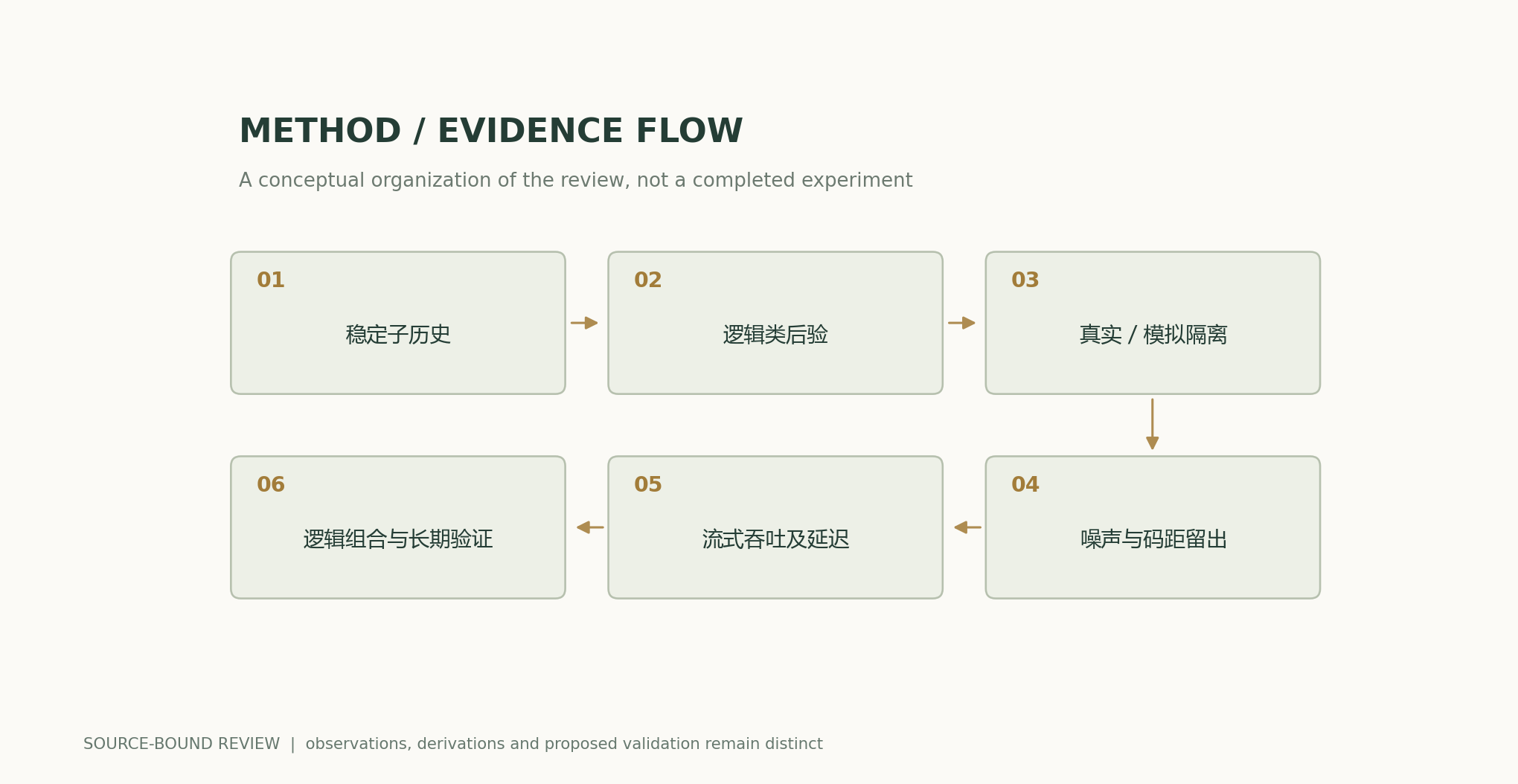
Analytical plots and numerical examples
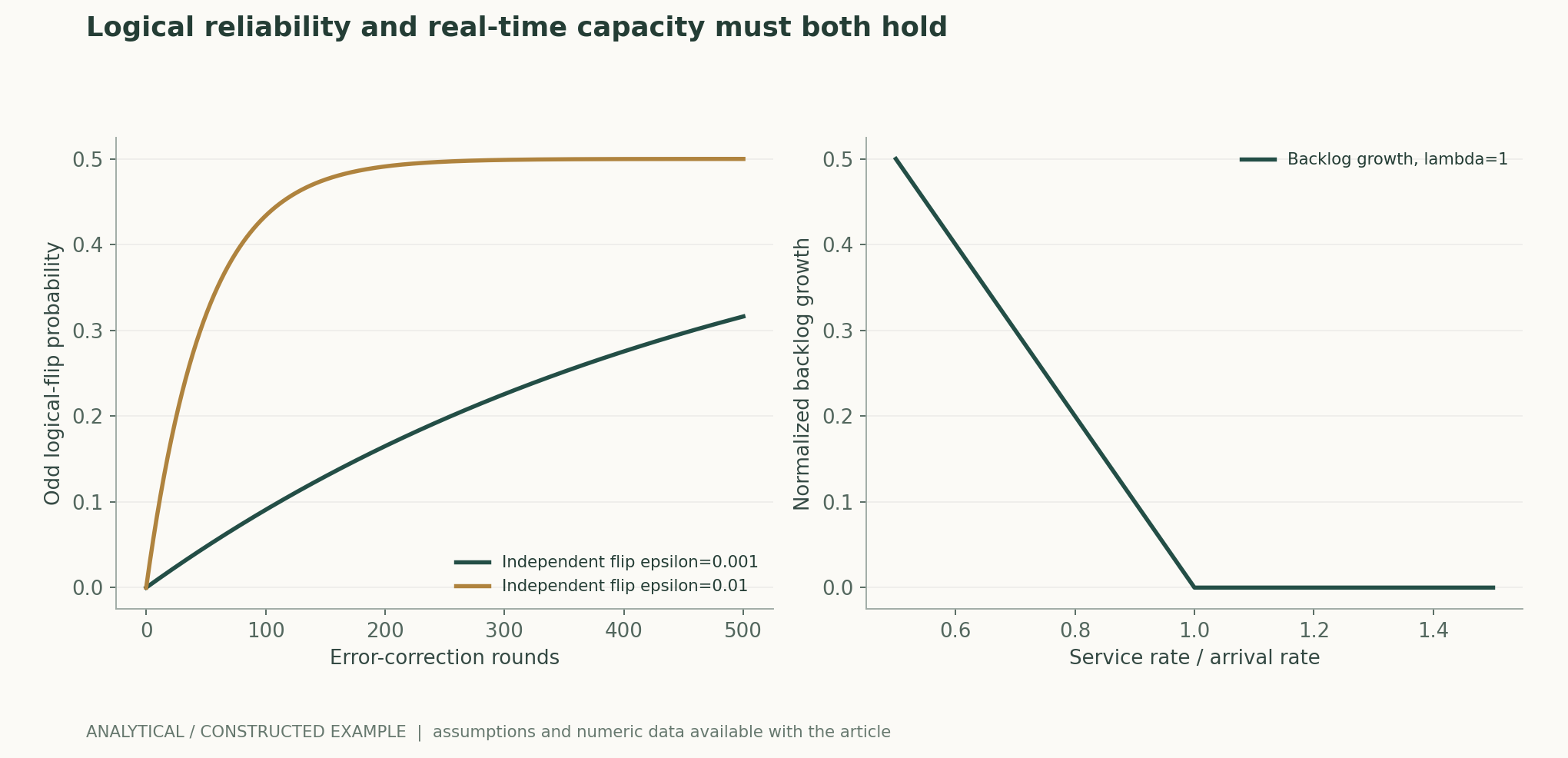
Reproducible worked example
For the same syndrome, the most probable individual path, 0.35, belongs to A, but class B has the larger total probability, 0.65. The logical-flip formula gives approximately 0.090717 after 100 rounds with epsilon=0.001; backlog grows when the service rate is insufficient.
Method comparison
| Evidence | What must be reported | Measures or claims that must not be conflated |
|---|---|---|
| Logical decoding | Complete syndrome and logical failure | Per-measurement classification accuracy |
| Real chip | Device, code distance, and time period | Simulation of larger distances |
| Correlated noise | Leakage, soft readouts, and fitting sources | Performance under independent, identically distributed noise |
| Distance scaling | Trends across multiple distances under matched noise | Guarantees of arbitrarily low error rates |
| Real-time execution | Sustained throughput, latency, and backlog | Single-kernel speed |
| Fault-tolerant composition | Logical operations and state transfer | Equating static memory with universal computing |
Verification and experimental plan
- Fix the code, logical observable, noise model, and decoder version.
- Separate real samples between noise fitting, training, early stopping, and testing.
- Record chip and simulated code distances separately rather than merging them into one type of validation.
- Compare the same logical endpoint and retain the definition of physical-error equivalence classes.
- Report errors and intervals by time, calibration batch, and correlated events.
- Measure arrival rate, service rate, tail latency, and backlog under sustained load.
- Revalidate logical errors after acceleration or compression; do not substitute results from the original teacher.
- Establish separate holdouts for logical gates, boundaries, and cross-block composition, retaining all anomalous events.
Scope and limitations
- The degeneracy example, parity probabilities, and queue model are all analytical constructions.
- No quantum chip was simulated, no decoder was trained, and no new quantum experiments were performed.
- The threshold approximation depends on specific noise, and a correlated-error floor may exist.
- The accuracy results and real-time systems in the original studies do not use the same implementation.
- Finite observations and drift limit inference about extremely low error rates.
Evidence from the original studies and its scope
| Original study results | Scope | Source and location |
|---|---|---|
| Real Sycamore code distances 3/5, with simulation comparisons up to code distance 11. | The speed section of the original paper still reports a gap relative to the microsecond-scale throughput target. | Learning high-accuracy error decoding for quantum processorsAbstract; Decoding speed |
| Willow memory and real-time decoding demonstrate specific below-threshold experiments. | Uses its own decoding system; these are not AlphaQubit real-time results. | Quantum error correction below the surface code thresholdAbstract; surface-code memory; real-time decoding |
Research questions worth testing
- Under the same logical-failure target, how much do soft readouts and historical information each contribute?
- Are the accuracy and throughput limits both maintained after noise drift?
- Can a compressed decoder support the composition of logical operations without accumulating hidden-state bias?
Primary sources and corresponding claims
- Learning high-accuracy error decoding for quantum processorsBausch et al. · 2024-11-20Experimental distance 3/5; simulated distances through 11; Methods decoding speed distinguishes throughput and latency.
- Quantum error correction below the surface code thresholdGoogle Quantum AI and Collaborators · 2024-12-09Willow surface-code memories, real-time distance-5 decoder and rare correlated errors; updated article noted.
- Distilling the Knowledge in a Neural Network, , · 2015-03-09Abstract; 原文方法、理论和实验章节见作者原始论文链接
Citation and manuscript export
BibTeXRISCSL JSONTXTArticle JSON
Author, version, and sources
A sourced research review and original analysis written by Codex (AI). Experiments in the original papers belong to the original research teams; the calculations in this article test only the listed equations and explicitly stated assumptions. This site currently has no record of independent peer review or original models, clinical experiments, or physical experiments for this article.
First published: an in-depth feature on AI and scientific discovery; preserving section-by-section sources and the boundaries between original research evidence and the author's analysis.
The conceptual cover was generated by ImageGen. Scientific figures were plotted using the accompanying code and numerical files, with captions specifying assumptions and measurement definitions item by item.
Sources of the cover and scientific figures · Data, sources, and assumptions · Python · Reproducible calculation code · Publication and version history
Source revision: b7b48f7205d705b2a3d3e8de0be5e1b458e4869c