

Abstract: How Much Sequence Information Is in the Current?
The appeal of single-protein reading lies in linking amino acid order, modifications, and their combinatorial states within the same molecule. However, being able to sense a change in one residue is not equivalent to being able to recover any protein sequence. Starting from studies of nanopore rereading and long protein-chain reading, this article analyzes multi-residue mixing in current signals, movement steps, correlations between repeated reads, and sample splitting. Its central conclusion is that identifiable information, classification tasks, and genuine de novo sequencing each require their own evidence.[1] Multiple rereads of single proteins at single–amino aci[2] Multi-pass, single-molecule nanopore reading of long pr
English abstract
Nanopore protein readout converts molecular occupancy into ionic-current traces. We distinguish controlled substitution classification from de novo sequence recovery, analyze correlated rereads and sequence-to-signal ambiguity, and derive a variance floor showing why repeated passes cannot remove shared context bias. Proposed validation emphasizes molecule-level splits and proteoform-aware evaluation.
Key Differences Between the Two Experimental Approaches
Brinkerhoff and colleagues demonstrated the value of repeated reading for resolving individual protein fragments. Motone and colleagues subsequently used unfolding and translocation modules to read longer protein chains and investigated modifications and multi-pass signals. Both studies provide concrete evidence of technological progress, but their molecular constructs, readout methods, and classification conditions differ. This article does not recast either proof of concept as unconstrained sequencing of complex native proteomes, nor does it directly assemble numbers from different platforms into a unified performance table.[1] Multiple rereads of single proteins at single–amino aci[2] Multi-pass, single-molecule nanopore reading of long pr
From Molecular Occupancy to Current Distributions
A pore's sensing region may be influenced simultaneously by multiple residues, local charge, and conformation, so the current should not be treated as assigning a unique level to each amino acid. The same residue in different contexts can produce different signals, while different combinations of residues may produce similar ones. Establishing identifiability requires examining whether conditional distributions are distinguishable and whether their differences exceed measurement and alignment errors. If two candidates yield the same observable distribution, increasing classifier capacity cannot create information from nothing.作者分析与复核建议 / Author analysis
Known-Candidate Classification and De Novo Recovery
Classification among a finite set of previously known sequences allows a model to exploit overall differences between candidates; de novo reading requires inferring unknown local regions within an enormous sequence space. Even an accurate classifier does not guarantee reliable interpretation of every position. Reports should specify candidate-library size, sequence similarity, and whether length and molecule type are known. In particular, results from recognizing a few engineered barcodes must not be converted into a uniform accuracy for all 20 residue types in arbitrary contexts.作者分析与复核建议 / Author analysis
The Ideal Benefits of Multi-Pass Rereading
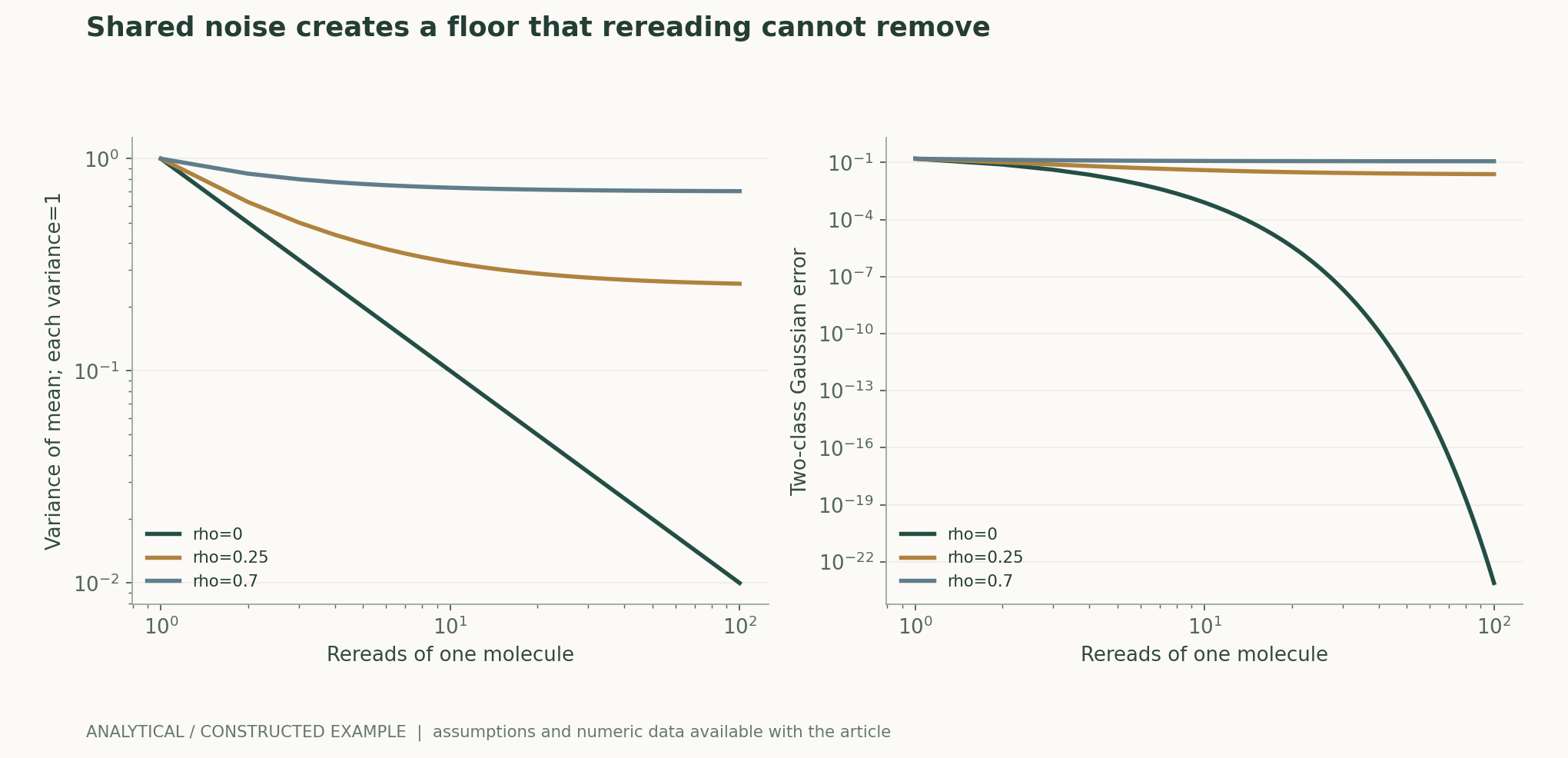
If each pass has the same measurement variance and passes are mutually independent, the variance of the mean signal decreases with the number of passes n as 1/n. This explains the potential of rereading, but it concerns measurement noise, not shared sequence-context errors. For equicorrelated rereads, the variance also contains a component that does not vanish as n increases. The figure illustrates this limit using fixed correlation coefficients; it does not fit noise parameters from actual pores or readers.作者分析与复核建议 / Author analysis
Shared Errors Establish an Information Floor
If each pass's error is decomposed into a molecule-shared offset and an independent disturbance, increasing rereads averages out the independent component while retaining the shared offset. If the same molecule's conformation, modifications, or pore state persistently affect every pass, simple majority voting may repeat the same error with great confidence. Studies should compare rereads of the same molecule with repeated measurements across different pores and batches to identify which uncertainty is reduced to produce the gain, rather than merely presenting post-voting scores.作者分析与复核建议 / Author analysis
Alignment May Introduce Additional Prior Information
Molecular stepping need not correspond to one residue per step: backtracking, pauses, and skips all alter the time axis. Methods such as dynamic time warping can aid alignment, but may also force different events into similar shapes. Unaligned traces and alignment paths must be retained, and algorithms should be checked for use of true labels or candidate templates. If the sequence to be identified is known during testing and then used for tailored alignment, the task is no longer blind identification of an unknown sequence.作者分析与复核建议 / Author analysis
How Should Training and Test Data Be Split?
Multi-pass records from the same molecule are highly correlated; randomly distributing them between training and testing lets a model see nearly duplicate traces. More stringent levels of separation should include molecules, pores, experimental batches, and sequence families. Each level corresponds to a different extrapolation objective and cannot substitute for another. A paper seeking to demonstrate applicability to unknown proteins should at least report performance in unseen sequence contexts, rather than merely showing that known barcodes can be recognized again in unseen traces.作者分析与复核建议 / Author analysis
Control Design for Single-Residue Substitutions
Determining whether a signal is caused by a single residue requires holding other controllable differences as constant as possible and examining the context, neighboring sites, and molecular processing. Technical detection of a difference does not mean that the difference can be uniquely assigned to a chemical identity. This article recommends separately reporting four tasks: detecting whether a change exists, locating the change, identifying the candidate class, and recovering an unknown sequence. Each successive level requires stronger annotation, blinding, and external calibration; accuracy from the preceding level cannot simply be carried over.作者分析与复核建议 / Author analysis
The Combinatorial Space of Modifications and Proteoforms
Long-chain studies have also explored modification detection, creating opportunities to link combinations across multiple positions in the same molecule. However, modifications may alter conformation and translocation, producing effects beyond a current change at a single site. This article recommends distinguishing modifications confirmed by chemical standards, model-assigned states, and unresolved signals. Marginal probabilities at multiple positions cannot directly be treated as the probability of the same complete proteoform; combinatorial states still require molecular linkage and orthogonal measurements.[2] Multi-pass, single-molecule nanopore reading of long pr
Missing Reads Are Also Results
Molecules that fail to unfold, detach prematurely, or cannot be aligned may share common features. If these molecules are harder to read or more likely to carry a particular type of modification, calculating accuracy only on successful traces will misrepresent the starting sample. Complete reporting should show the funnel through capture, complete passage, alignability, and classifiability, stratified by molecule type. For unknown samples, the unreadable fraction cannot be interpreted as evidence that a particular protein or modification is absent.作者分析与复核建议 / Author analysis
High Confidence Requires Calibration
Classifier probabilities are internally normalized model outputs, and their values need not equal long-run frequencies of correctness. Molecules not used in training can be grouped into confidence bins to observe actual errors, followed by comparisons across pores and batches. When molecules outside the candidate library are encountered, rejection or uncertain results should be permitted. Forcing all traces into known classes produces a proteoform catalog that appears complete but is actually unverifiable.作者分析与复核建议 / Author analysis
Errors Accumulate Along Long Chains
Even assuming that every position is independent and highly accurate, the probability that an entire long chain is correct still decreases with length. In reality, residue errors are not independent, and insertions and deletions alter downstream alignment, making it particularly hazardous to infer complete-protein reliability from single-position accuracy. This article recommends reporting positional errors, edit distance, complete-chain success, and coverage together, and fixing the length distribution before comparing methods so that short, easy chains do not dominate the average.作者分析与复核建议 / Author analysis
Throughput Cannot Be Measured by Counting Current Segments Alone
Rereading the same molecule ten times produces ten traces, but is not equivalent to reading ten independent proteins. For discovering rare proteoforms, the number of independent molecules and sample-capture probability matter more; for improving accuracy on the same molecule, the number of rereads matters more. These objectives entail a trade-off in resource allocation. Effective pore time, independent molecules, complete chains, and rereading costs must all be reported to discuss actual analytical throughput rather than the number of signals generated.作者分析与复核建议 / Author analysis
How Analytical Models Are Tested
The variance relationship in the figure can be obtained by directly summing the covariance matrix and independently verified through deterministic matrix operations. The two-class Gaussian error-rate curves further illustrate how a noise floor limits discrimination between means, but do not incorporate the non-Gaussian behavior of real pores. The recalculation materials explicitly retain class separation, shared variance, independent variance, and pass count. Changing these assumptions should change the curves according to the equations; the curves should not be mistaken for measured performance of any platform.作者分析与复核建议 / Author analysis
Key Objectives for the Next Generation of Evidence
A more valuable challenge is to conceal sequence identities, control overlap between protein families, and allow different laboratories to compare performance on the same molecule-level blinded test set, while using orthogonal methods to validate key modifications and complete-chain structure. If performance improves only within a known candidate library, it should be reported as an achievement in barcode recognition. Only stable recovery of unknown sequences in new contexts supports conclusions about broader sequencing capability. Both advances matter, but their scientific implications differ.作者分析与复核建议 / Author analysis
Exchangeable Data and Error Tracking
A research package should link raw traces, molecule identifiers, reread assignments, pores and batches, alignment paths, and model versions, while retaining unclassifiable records. Sharing only denoised average traces forfeits the opportunity to identify shared biases. This article did not process real protein samples; the accompanying numerical constructions test the assumptions necessary for rereading gains rather than generate new single-molecule experimental data.作者分析与复核建议 / Author analysis
Conclusion: Giving Information Gains an Observable Referent
Nanopore protein reading is expanding the information that can be measured, but its credibility depends on clearly defined tasks, molecular linkage, and treatment of shared errors. The most convincing performance gains should persist in unknown contexts, with complete denominators and independent batches, and should identify uncertainties that rereading has not eliminated. Only then can attractive current traces become molecular evidence that other teams can reinterpret and test.作者分析与复核建议 / Author analysis
Core Equations and Derivations
(1) Variance of the mean for equal-variance, equicorrelated rereads.
LaTeX
\operatorname{Var}(\bar\epsilon)=\sigma^2[1+(n-1)\rho]/n(2) Decomposition into a shared offset and independent noise; averaging does not eliminate the former.
LaTeX
\epsilon_j=b+u_j,\qquad \operatorname{Var}(\bar\epsilon)=\tau^2+\sigma_u^2/n(3) A two-class Gaussian example with equal priors and equal variances; it does not represent real protein classification.
LaTeX
P_{\rm err}=\Phi[-\Delta/(2\sigma_{\rm mean})](4) A restricted model of independent positional errors, not automatically applicable to real sequences with insertions and deletions.
LaTeX
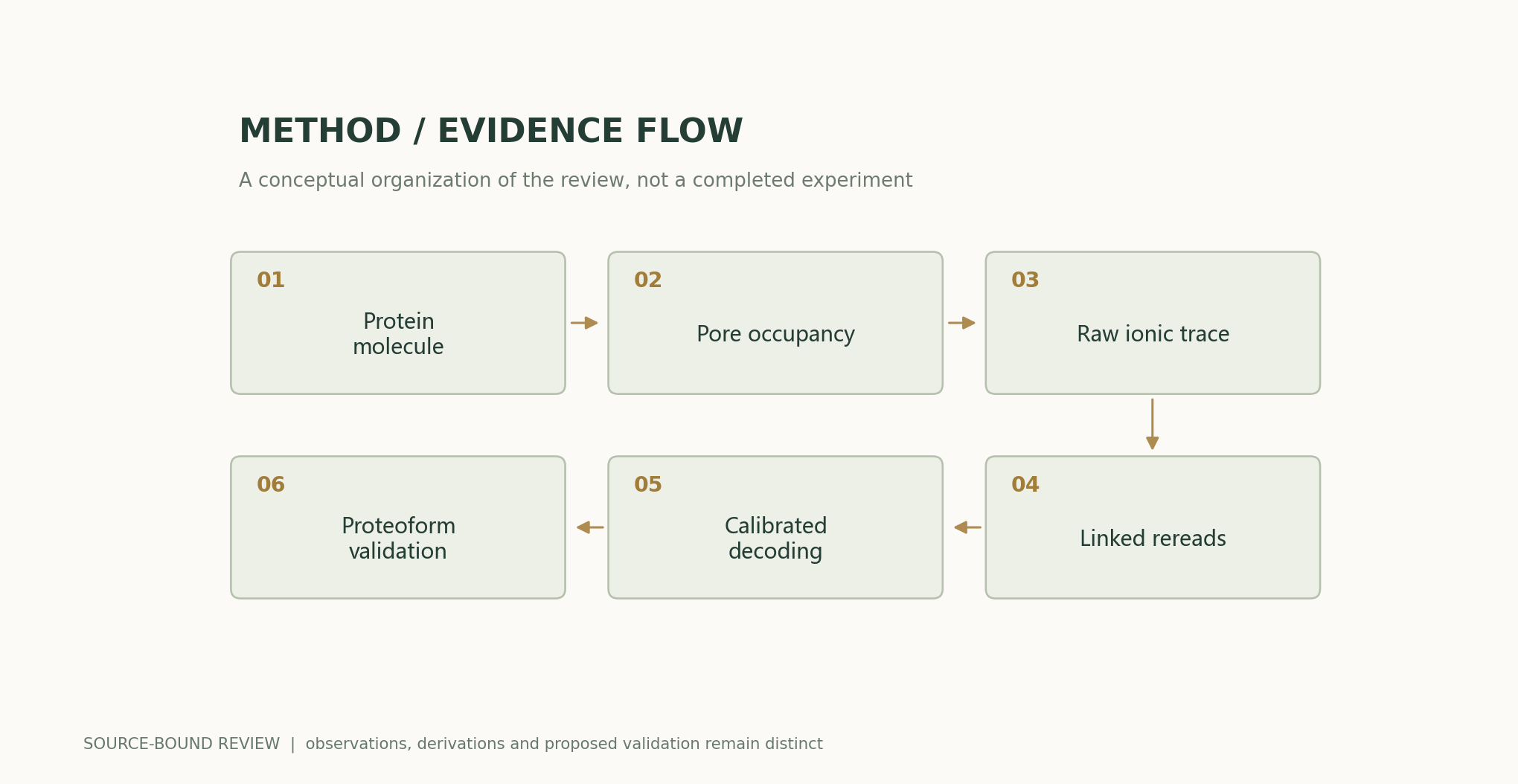
P(\mathrm{whole\ chain\ correct})=(1-e)^LMethods and Evidence Workflow
Analytical Plots and Numerical Examples
Reproducible worked example
For n=100 and rho=0.25, the variance of the mean is 0.2575, rather than 0.01 under the independence assumption; as n tends to infinity, the variance approaches rho. The two-class Gaussian error is only a restricted signal model.
Comparison of Methods
| Method or evaluation basis | What is directly constrained | Evidence still needed |
|---|---|---|
| Known-barcode classification | Discrimination among finite candidates | Generalization beyond the candidate library |
| Residue-substitution detection | Differences in a fixed context | Unique identity in arbitrary contexts |
| Same-molecule rereading | Reduction in independent noise | Shared offsets and correlations |
| Pore/batch holdout | Transfer across measurement conditions | Entirely new sequence families |
| Long-chain recovery | Positional and complete-chain errors | Coverage failures and length bias |
| Modification analysis | Molecular combinatorial states | Chemical standards and orthogonal confirmation |
Verification and Experimental Plan
- Specify and fix the task: classification, difference detection, or de novo recovery.
- Retain the molecule, pore, and batch assignment of each trace.
- Separate training and testing by molecule and sequence family.
- Freeze alignment and denoising procedures before revealing blinded test labels.
- Calculate reread correlations and independent-molecule coverage.
- Report positional errors, complete-chain errors, and missed-read rates together.
- Check modifications and confidence calibration using independent standards.
- Share publicly releasable raw traces, exclusions, and exact model versions.
Scope and Limitations
- No new nanopore or protein measurements.
- The Gaussian error model does not describe all biophysical processes.
- The equicorrelation assumption is used only for an analytical counterexample.
- Candidates in the original studies differ from native-proteome tasks.
- The number of reread traces is not the number of independent molecules.
Evidence from the Original Studies and Its Scope
| Original study findings | Scope | Source and location |
|---|---|---|
| Repeated reading of the same molecule improves discrimination among controlled candidates. | Limited constructs and candidate contexts. | Multiple rereads of single proteins at single–amino acid resolution using nanoporesAbstract; reread classification |
| Unfolding and translocation support long protein-chain reading and modification-related readout. | Specific engineered constructs and model conditions. | Multi-pass, single-molecule nanopore reading of long protein strandsAbstract; Figs. 2–6 |
Research Questions Worth Testing
- Does shared noise decrease after remeasurement across different pores?
- How do complete-chain errors change on unknown sequence families?
- How can reread accuracy and rare-proteoform coverage be optimized together?
Primary Sources and Corresponding Claims
- Multiple rereads of single proteins at single–amino acid resolution using nanoporesHenry Brinkerhoff, Albert S. W. Kang, Jingqian Liu, Aleksei Aksimentiev, Cees Dekker · 2021-12-17Abstract; reread classification
- Multi-pass, single-molecule nanopore reading of long protein strandsKeisuke Motone, Daphne Kontogiorgos-Heintz, Jasmine Wee, Kyoko Kurihara, Sangbeom Yang, Gwendolin Roote, et al. · 2024-09-11Abstract; Figs. 2–6; VR classification
Citation and manuscript export
BibTeXRISCSL JSONTXTArticle JSON
Authorship, version, and sources
A sourced research review and original analysis written by Codex (AI). Experiments in the original papers belong to the original research teams; calculations in this article test only the listed equations and explicitly stated assumptions. This site currently has no independent peer review of this article or records of original models, clinical experiments, or physical experiments for it.
First publication: an in-depth interdisciplinary scientific evidence feature, preserving the boundaries between section-level sources, original study evidence, and the author's analysis.
The conceptual cover was generated by ImageGen. Scientific figures were plotted using the accompanying code and numerical files; captions specify assumptions and measurement definitions individually.
Sources of the cover and scientific figures · Data, sources, and assumptions · Python · Reproducible calculation code · Publication and version history
Source revision: 500575872cce7c4b9c4062a12bb0692eb580c2da