

Abstract
Sparse expert models expand parameter capacity by selecting a subset of experts for each token, but selection itself introduces issues of load, capacity, and communication across devices. This article analyzes the relationships among routing weights, capacity factors, auxiliary balancing objectives, and expert placement, and proposes a verification plan that jointly records effective computation, dropping or rerouting, waiting time, and quality. The accompanying figure performs deterministic capacity accounting with 8 experts and 1000 tokens. All loads are explicitly constructed; they are neither routing distributions nor performance measurements from any trained model.[1] Switch Transformers: Scaling to Trillion Parameter Mode[2] GShard: Scaling Giant Models with Conditional Computati[3] Attention Is All You Need
English abstract
Sparse mixture-of-experts models allocate token computation through learned routing. This review separates total capacity, activated computation, expert overflow and communication. A deterministic load calculation compares uniform and skewed routing under a declared capacity factor; it is not a trained-router experiment. Evaluation must jointly report model quality, dropped or rerouted tokens, communication and device utilization.
1. Total capacity and computation activated per step are separate budgets
Replacing a dense feedforward layer with multiple experts allows each token to enter only a few experts, increasing total parameters without a proportional increase in activated computation. However, the remaining attention, routing, normalization, and shared layers must still run. Total parameters affect storage, checkpoints, and optimizer states, while activated parameters more closely reflect part of the arithmetic cost; neither alone represents training throughput. Comparisons should specify the number of layers, expert size, top-k, shared experts, and the dense baseline to avoid attributing gains from additional training resources entirely to the sparse mechanism.[1] Switch Transformers: Scaling to Trillion Parameter Mode[2] GShard: Scaling Giant Models with Conditional Computati
2. Routing turns local selection into a global queuing problem
The router produces expert scores for an input, then selects one or more experts and combines their results. A high score for a particular token does not mean that the corresponding expert still has capacity in that batch. Capacity is usually determined by the total number of tokens within a routing group, top-k, and the number of experts; group boundaries, device partitioning, and padding all change actual utilization. If many tokens select the same expert, overflow or waiting can occur while other experts remain idle. Reporting only average load therefore conceals hotspots; at a minimum, maximum load, tail percentiles, and capacity overflow counts should also be reported.[1] Switch Transformers: Scaling to Trillion Parameter Mode
3. A balancing objective improves utilization but changes the optimization problem
An auxiliary balancing loss encourages more uniform expert utilization and routing probabilities, which can alleviate persistent congestion at a few experts; it also constrains how freely the router can develop a division of labor based on the data. The balancing coefficient, noise, selection rules, and training stage affect this trade-off. Uniform load does not prove that experts have learned useful differences or that quality is highest. The balancing coefficient should be swept under the same data and compute budget while measuring task quality, overflow, and expert usage together, to determine whether gains come from reduced dropping rather than changes in routing statistics alone.[1] Switch Transformers: Scaling to Trillion Parameter Mode[2] GShard: Scaling Giant Models with Conditional Computati
4. All-to-all communication can consume the arithmetic savings
When experts are distributed across multiple devices, token representations must be reordered according to routing, sent, processed, and returned. Communication volume depends on hidden dimension, precision, top-k, and expert placement, while small messages, batches of varying lengths, and inter-device bandwidth affect latency. Two deployments with the same arithmetic operation count may have entirely different communication waiting times. Dispatch, expert computation, combination, and synchronization times should be recorded separately, and the actual topology and parallelism strategy reported; sparse multiplication results on a single accelerator cannot directly represent multi-machine training or online serving performance.[2] GShard: Scaling Giant Models with Conditional Computati[1] Switch Transformers: Scaling to Trillion Parameter Mode
5. Capacity overflow must become part of quality reporting
When an expert reaches capacity, an implementation may drop that path, retain only the residual, or reroute to a next-choice expert. Different strategies change the actual model computation and may have uneven effects on minority languages, rare tasks, or long sequences. A low overall drop rate may still conceal high dropping in particular groups. Evaluation should be stratified by task, length, and language, and differences between candidate routes and routes actually executed should be retained. If training and inference use different capacities or selection algorithms, they should be treated as different operating conditions; comparison cannot rely only on identical weight files.[1] Switch Transformers: Scaling to Trillion Parameter Mode
6. Cost conclusions should incorporate joint system and quality constraints
The appropriate comparison asks how much training computation, device memory, communication, and latency a sparse approach requires to achieve the same quality and service targets. Expanding parameters does not automatically demonstrate improved sample efficiency, nor does sparse activation automatically demonstrate lower total cost. The constructed load chart in this article serves only to illustrate how capacity overflow arises. For real routers, group statistics should be retained for each layer without recording private token text, and bottlenecks should then be confirmed through repeated runs and device-level measurements. Separating verifiable counts from actual system measurements is necessary to explain performance differences.[1] Switch Transformers: Scaling to Trillion Parameter Mode[2] GShard: Scaling Giant Models with Conditional Computati[3] Attention Is All You Need
Core equations and derivations
(1) Expert outputs are combined using the weights after selection; normalization, capacity overflow, and shared paths are specified separately by the implementation.
LaTeX
y(x)=\sum_{e\in\operatorname{TopK}(g(x))}p_e(x)E_e(x)(2) T is the number of tokens in the same routing group, k is the number of dispatches per token, E is the number of experts, and c is the capacity factor; O counts dispatches exceeding capacity and does not automatically equal the final number of dropped tokens.
LaTeX
C_e=\left\lceil c\frac{Tk}{E}\right\rceil,\qquad O=\sum_e\max(0,L_e-C_e)(3) Hotspots are measured as the ratio of the busiest expert's load to the ideal average load. Two batches with exactly the same average load can still have different hotspots.
LaTeX
\rho_{\max}=\frac{\max_e L_e}{Tk/E}Method and evidence workflow
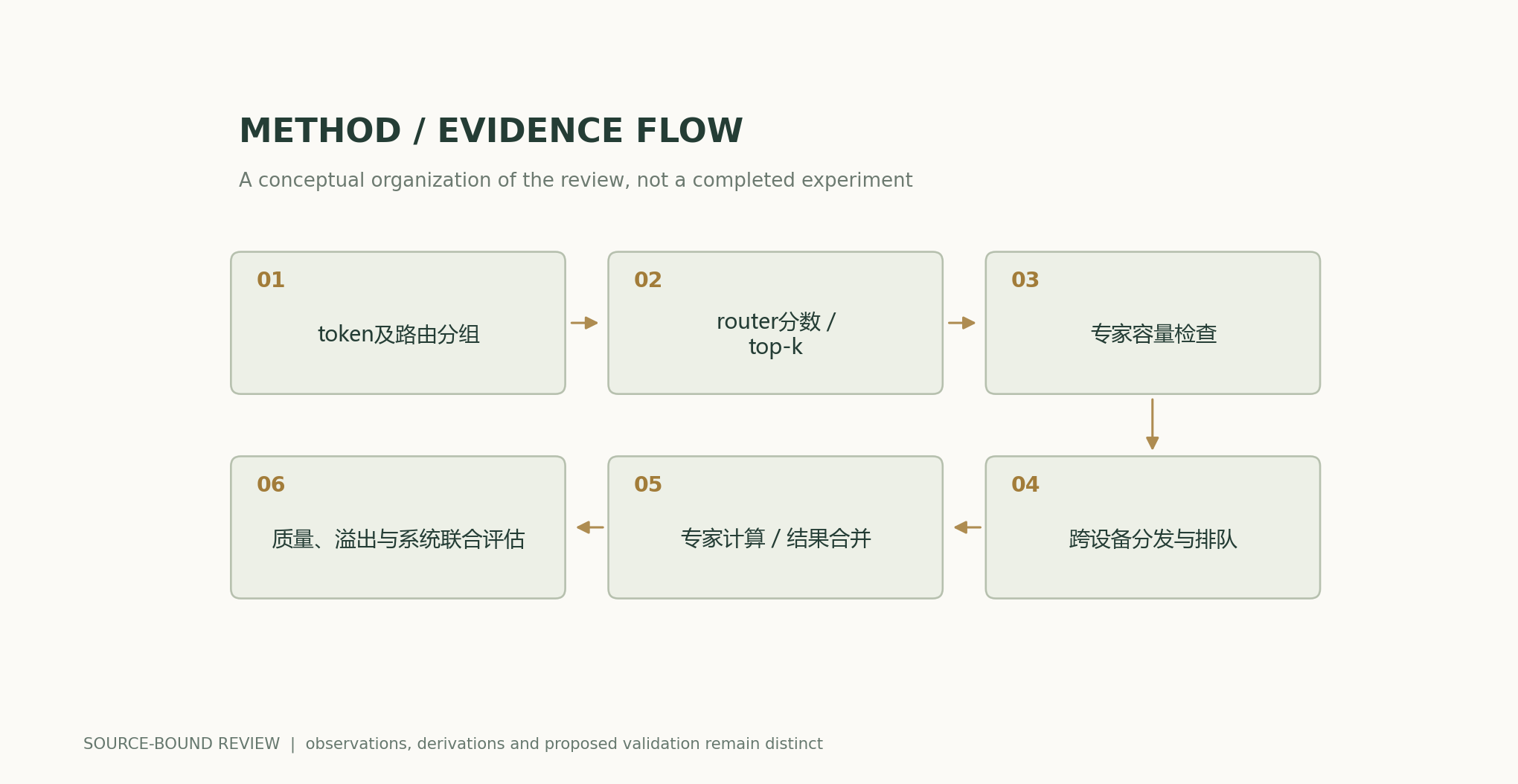
Analytical figures and numerical examples
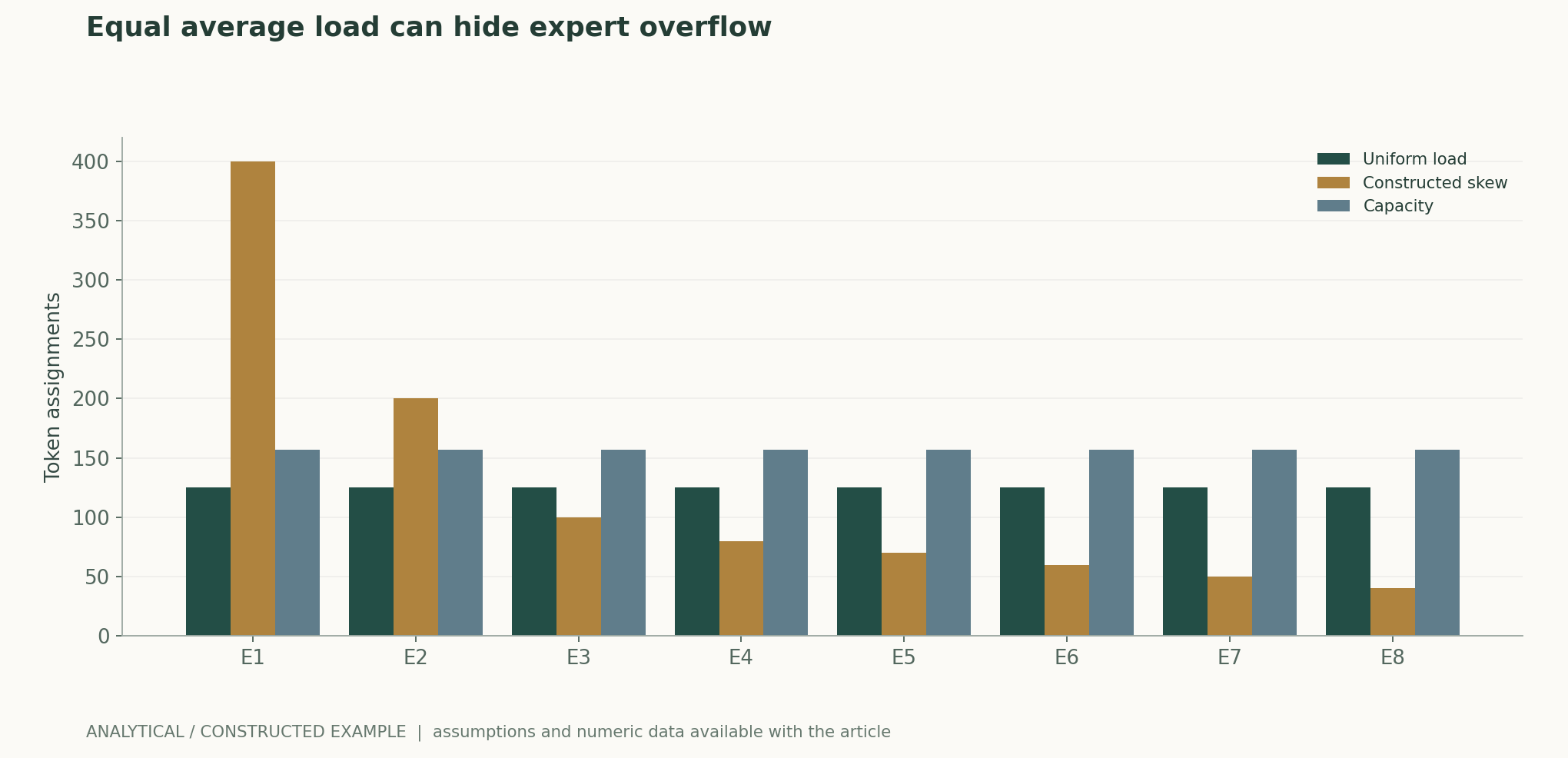
Reproducible worked example
Both groups have 1000 dispatches and a capacity of 157. The uniform group has no overflow; the skewed group has a total of 286 dispatches exceeding capacity. Final dropping, rerouting, and quality depend on the implementation and are not automatically determined by the counts.
Comparison of methods
| Method or judgment | Controlled variables and measurements | Failure conditions and interpretation |
|---|---|---|
| Total parameters | Itemize all experts, shared layers, and optimizer states separately | Not equivalent to activated computation per token |
| Routing balance | Record per-expert loads and stratified overflow | Uniformity does not guarantee an effective division of labor among experts |
| Capacity factor | Fix routing groups and overflow handling rules | Increasing capacity also increases memory or padding |
| Distributed throughput | Measure dispatch, computation, combination, and tail latency | FLOPs cannot characterize communication and waiting |
Verification and experimental plan
- Fix the dense baseline, layer structure, expert size, top-k, and training data, and disclose the budget-matching rules.
- Specify token routing groups, capacity factor, weight normalization, and handling at full capacity.
- Retain per-expert loads, maximum-to-average ratios, and overflow for each layer, stratified by language and length.
- Sweep the balancing coefficient and capacity, jointly comparing quality and the token paths actually executed.
- Record device topology, communication bytes, padding fraction, peak memory, and time spent in each stage.
- Repeat measurements with real serving batch sizes and length distributions, distinguishing this article's illustrative counts from production throughput.
Scope and limitations
- The illustrative loads do not come from a trained model.
- The capacity equation depends on how routing groups are defined.
- Total parameters and activated computation do not represent total expenditure.
- Balance, specialization, and task quality require joint empirical measurement.
Primary sources and corresponding claims
- Switch Transformers: Scaling to Trillion Parameter Models with Simple and Efficient Sparsity, , · 2021-01-11Abstract; 原文方法、理论和实验章节见作者原始论文链接
- GShard: Scaling Giant Models with Conditional Computation and Automatic Sharding, , , , , , , , · 2020-06-30Abstract; 原文方法、理论和实验章节见作者原始论文链接
- Attention Is All You NeedVaswani et al. · 2017-06-12v7; sections 3-4; Table 2 (EN-DE only)
Citation and article export
BibTeXRISCSL JSONTXTArticle JSON
Author, version, and sources
An AI-assisted research review; Codex (AI) wrote the article and performed analytical derivations based on the listed primary literature. This site has no record of independent peer review or original model experiments for this article.
Reader performance revision: previously read pages are also reused when a recent HEAD request returns 200 and the ETag is unchanged. The main text, equations, sources, and scientific figure data retain the content of the previous version.
The conceptual cover is separate from the scientific figures; scientific figures are calculated from public equations and explicit assumptions, and results from original papers are attributed to their sources.
Author, version, and correction history · /guides/sparse-mixture-experts/v1/
Cover and scientific figure sources · Data, sources, and assumptions · Publication and version history
Source revision: 6251a250b27bb8b449f59b392f81abd355383770